


Can Treasury support market liquidity without artificially suppressing borrowing costs? Manish Singh looks at the implications for yields, fiscal policy and risk assets.
Summary
Bond buybacks are a curve-flattening tool, supporting long-dated bond prices and reducing the term premium at the long end of the curve. More importantly, they reinforce the view that the US Treasury has several levers available to influence long-term yields without requiring the Federal Reserve to resort to quantitative easing or formal yield curve control. Politically, the move is somewhat awkward for Treasury Secretary Scott Bessent, who previously criticised Janet Yellen for altering Treasury issuance to ease financial conditions, arguing that it blurred the line between fiscal and monetary policy. Circumstances, however, have a habit of testing previously held convictions.
Whether Bessent’s strategy succeeds remains to be seen. But for perhaps the first time in decades, the world’s largest bond market is being managed by someone who has spent a career trading it. That is a significant shift, and one that markets may not yet fully appreciate.
A 4% to 4.5% 10-year Treasury yield is not necessarily a problem. It can be a feature of a healthy economy, while imposing useful discipline by making excessive government borrowing more expensive. Treasury buybacks should improve market liquidity and help prevent disorderly moves in yields. They should not be used to engineer artificially low borrowing costs. If buybacks become a mechanism for suppressing yields, they risk encouraging even greater fiscal profligacy.
More broadly, the message from the past four weeks of economic data is reassuring. The US economy is proving more resilient than the pessimists expected, while inflation is becoming less threatening than the hawks feared. Equity markets have historically struggled when inflation accelerates alongside weakening growth, the classic stagflation scenario, or when recession causes corporate earnings to collapse. Today’s data suggest neither is the most likely outcome.
Instead, earnings growth is increasingly being supported by investment, productivity gains and artificial intelligence rather than an overstretched consumer. For risk assets, and equities in particular, that remains a constructive backdrop.
Bessent Buys the Long End. Is the Market Listening?
Every US Treasury Secretary inherits the Treasury bond market.
Few try to trade it.
Scott Bessent is different.
For perhaps the first time in modern Treasury history, the United States has a Treasury Secretary who spent four decades as a global macro investor, trading bonds, currencies, and interest rates at the highest level. Before entering government, Bessent was a partner and Chief Investment Officer at Soros Fund Management and later founded Key Square Capital. His career was built on understanding liquidity, market psychology, and the interaction between fiscal and monetary policy – not writing academic papers about them.
That distinction matters.
The obvious historical comparison is Alexander Hamilton.
Hamilton was America’s first Treasury Secretary, but more importantly he was America’s first debt manager.
The United States emerged from the Revolutionary War effectively bankrupt. States had accumulated separate debts, federal obligations traded at distressed prices, and confidence in American credit barely existed. Hamilton’s genius was recognising that public credit was itself a national asset.
His famous maxim still resonates today: “A national debt, if it is not excessive, will be to us a national blessing.”
Hamilton did not mean debt was inherently good. He meant that a well-managed government bond market creates credibility, lowers borrowing costs and provides the financial foundation upon which capital markets develop. The US Treasury market exists today, largely because Hamilton deliberately created one.
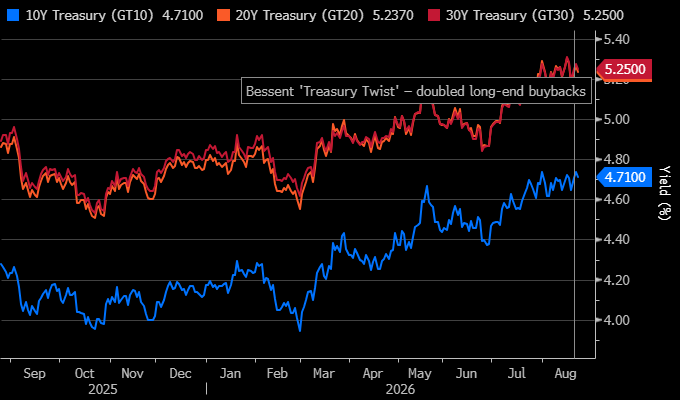
One of the most interesting developments in global markets this month has not been a Federal Reserve decision or an inflation print. It has been the US Treasury market, where Bessent has suggested using buybacks of long-dated bonds as part of a broader debt management strategy.
The policy itself is relatively straightforward. The reaction to it has been anything but.
US Treasury Yield: 10-Year, 20-Year & 30-Year (Aug 2025- Aug 2026)
Source: Bloomberg
Within hours of Bessent announcing an expansion of Treasury buybacks in the 10–30-year sector, headlines declared the policy a failure because long-end yields had barely moved. The Financial Times suggested the intervention had “failed to soothe investors.”
That conclusion struck me as extraordinary.
The 10-year Treasury yield had moved by only a handful of basis points. Anyone who has traded bonds understands that Treasury yields fluctuate throughout the trading day as liquidity ebbs and flows. Four or five basis points tells you remarkably little about whether a policy has succeeded or failed. Yet in today’s media environment, every market tick is expected to fit a ready-made narrative.
This is not occurring in a vacuum.
Relations between Bessent and sections of the financial press have become increasingly strained. Bessent has openly criticised what he calls “steno journalism,” reporting that simply repeats prevailing narratives without analysing the underlying policy.
Whether one agrees with his criticism or not, it has clearly become personal. Every Treasury announcement is now met with a degree of scepticism that sometimes borders on hostility.
Markets benefit from scepticism, but they suffer when scepticism becomes confirmation bias.
One comment from Bessent has largely been ignored. He remarked that Treasury possesses “asymmetric information.”
That is an important observation.
Debt management decisions are informed by information about issuance calendars, dealer balance sheets, funding conditions, foreign official demand, and market functioning that is simply unavailable to outside observers. Investors often assume policymakers are reacting to markets. Policymakers are frequently acting on information markets have not yet incorporated.
Bessent has previously hinted that coordinated action between the United States and Japan in stabilising USD/JPY precisely demonstrated this point. Public markets only discover such coordination after the fact.
Perhaps the most revealing episode came from social media. Bessent explained that Treasury intended to purchase up to $4 billion per operation. Within hours this became distorted into a claim that Treasury would purchase only $4 billion of Treasuries in total.
The distinction is enormous. Yet that nuance disappeared almost immediately. Memes circulated showing a tiny truck attempting to fill a gigantic hole labelled “$40 trillion US debt.” It was clever, gained enormous traction across social media, but it was also wrong.
This illustrates one of the defining characteristics of modern financial markets. Information no longer competes on accuracy. It competes on shareability.
The bond buyback strategy itself deserves more attention than the headlines. Treasury is effectively issuing shorter-dated securities while repurchasing discounted long-dated bonds.
Consider one simple example:
- The Treasury 4% bond maturing in November 2052 has recently traded around 82 cents on the dollar, with approximately $64 billion outstanding.
- If Treasury repurchases the entire issue at market prices, it will require roughly $52 billion of newly issued short-dated debt to retire $64 billion of face value.
- Back-of-the-envelope arithmetic suggests that around $12 billion of outstanding principal disappears through the transaction before accounting for coupons, accrued interest and issuance mechanics.
Equally important, the operation improves liquidity in older, less actively traded securities while concentrating issuance into benchmark maturities that trade more efficiently. This is debt management, not a monetary policy or Quantitative Easing (QE) on the sly as some have called it.
Much of the commentary has focused on whether long-end yields fell immediately after the announcement. That misses the point entirely.
Treasury is attempting to improve the structure of government financing, enhance liquidity and reduce refinancing costs over time, not engineer a dramatic overnight collapse in yields.
Markets rarely reward thoughtful policy instantly. Nor should they.
Perhaps the most important lesson has little to do with bonds.
It concerns information. Today’s markets are increasingly shaped by headlines, social media, and memes. Nuance disappears and the context is often lost as interpretation overtakes facts.
As investors, we therefore have a responsibility to go back to primary sources. Listen to speeches. Read transcripts. Examine Treasury announcements. Separate what policymakers said from what social media claims they meant. The gap between those two things has never been wider. And in markets, that gap increasingly creates opportunity.
In my opinion, as I have been saying for a few months now – inflation is not a problem, bond yields are not a problem and the debt management that Bessent is undertaking is a smart move. Bond buybacks are a curve-flattening tool, supporting long-dated bond prices and reducing the long-end term premium. It reinforces the view that the US Treasury has several levers to influence long-term yields without the Fed resorting to quantitative easing or formal yield curve control. Politically, the move is awkward for Bessent, who previously criticised Janet Yellen for altering Treasury issuance to ease financial conditions, arguing that it blurred the line between fiscal and monetary policy. But you do what you have got to do.
Whether Bessent’s strategy succeeds remains to be seen. But for perhaps the first time in decades, the world’s largest bond market is being managed by someone who has spent a lifetime trading it. That is a significant shift, and one that markets may not yet fully appreciate.
Markets and the Economy
Inflation concerns this summer have largely centred on one question: Would the Iran conflict send oil prices soaring by disrupting the Strait of Hormuz?
So why hasn’t oil spiked as much as many feared?
One important reason is that the US military has quietly kept oil flowing through the Strait of Hormuz. As reported by Axios, according to US officials, 15–20 tankers have been transiting the southern shipping lane each night, allowing around 10 million barrels of oil per day (mbpd), roughly half of pre-war volumes, to reach global markets. Add to that 4-5 mbpd transported through Saudi pipelines and you begin to understand why the oil price spike has been contained. As I regularly remind readers of this newsletter, always look for the reaction function. A knee jerk reaction to risk is almost always the wrong instinct and it clouds judgement.
The operation has helped cushion the biggest inflation risk from the conflict: A sharp supply shock in crude oil.
It’s a reminder that markets don’t just react to wars. They react to whether supply is disrupted. So far, despite the conflict, a significant share of Gulf oil exports has continued to flow, helping to keep a lid on energy prices and, by extension, inflation expectations.
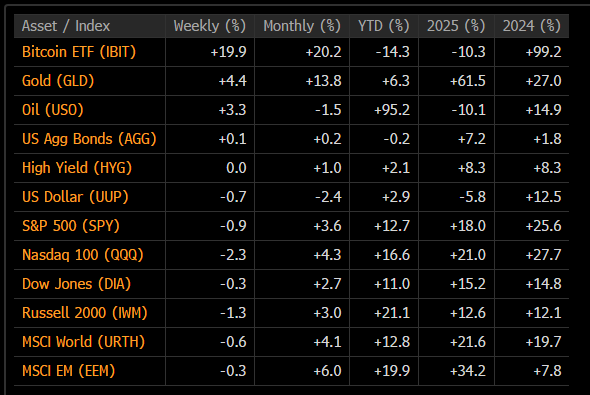
Asset class and Index performance – as of Aug 24, 2026
Source: Bloomberg
Before I talk about equities, for the first time in quite a while, Bitcoin ETF ($IBIT) topped the weekly asset class performance table, surging +22.6% while the Nasdaq 100 ($QQQ) fell -2.4%.
That’s worth paying attention to.
For much of the past two years, Bitcoin has largely traded as a high-beta technology asset. Last week, it began to behave differently.
The timing is very interesting.
The GENIUS Act provides the first comprehensive federal framework for dollar-backed stablecoins. On its own, it isn’t a Bitcoin or crypto bill. But it legitimises a broader digital asset ecosystem by giving banks, payment companies, and institutions greater regulatory clarity.
History suggests that when the infrastructure becomes investable, capital follows.
The market may be starting to look beyond Bitcoin as a speculative asset and towards Bitcoin as part of an emerging digital financial system.
If that’s right, last week’s divergence from tech wasn’t just a strong week for Bitcoin. It may have been an early signal that the next phase of institutional adoption has begun.
On to the US economy and equities
Over the past month, investors have been bombarded with economic releases—CPI, retail sales, GDP revisions, inflation expectations, and labour market data. Taken individually, the numbers appear mixed. Viewed together, however, they paint a remarkably consistent picture (summary table below).
In my opinion, the US economy is slowing, but it is not stalling and it’s cooling gracefully.
The big picture on US macro data: The US economy is cooling gracefully
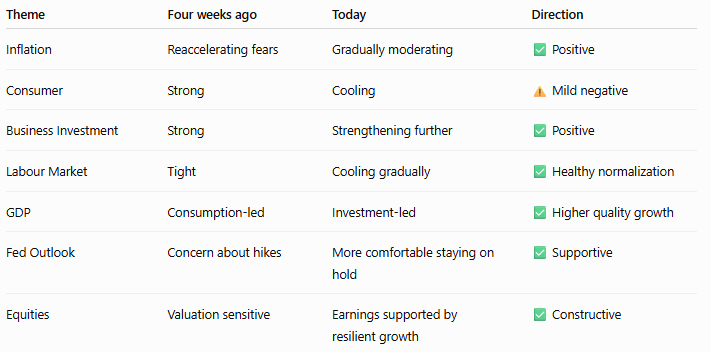
That distinction is critical because equity markets do not require booming growth. They require an economy that continues to expand without reigniting inflation.
The inflation story has become increasingly encouraging. Headline CPI eased to +3.4% year-on-year (YoY), while core inflation remained contained at +2.5%, suggesting underlying price pressures continue to moderate despite higher oil prices resulting from geopolitical tensions. Earlier PCE readings also showed inflation easing from spring highs, with July’s report out later this week expected to reinforce that trend. While inflation remains above the Federal Reserve’s +2% target, the direction of travel is becoming more favourable.
Consumer spending has softened but remains far from recessionary. July retail sales declined, although much of the weakness reflected calendar effects following Amazon Prime Day shifting into June. Strip out those distortions and underlying spending remains resilient, particularly in restaurants, clothing, and services. Household demand may be cooling but it isn’t collapsing.
The composition of economic growth is also changing.
Consumer spending is no longer carrying the economy alone. Instead, investment -particularly in AI infrastructure, technology and government-supported capital expenditure, is becoming a larger contributor to GDP. That transition is healthier than many appreciate because investment expands productive capacity rather than simply fuelling consumption. Over time, that can support further consumer spending as jobs are created and wages are earned and spent.
Meanwhile, inflation expectations remain reasonably anchored. This leaves investors facing an unusual backdrop.
- Growth is moderating
- Inflation is gradually easing
- Corporate investment remains strong
- The labour market is cooling without showing signs of distress
That combination is far more consistent with a mid-cycle slowdown than the beginning of a recession.
For equities, this matters enormously. Equity markets have historically struggled when inflation accelerates alongside weakening growth, classic stagflation, or, when recession causes earnings to collapse. Today’s data suggest neither scenario is the most likely outcome.
Instead, earnings growth is increasingly being supported by investment, productivity improvements, and artificial intelligence rather than an overstretched consumer.
The principal risk remains the bond market. Long-term Treasury yields continue to reflect concerns over fiscal deficits, Treasury issuance, and the supply of government debt. Higher real yields can compress equity valuations even if earnings remain healthy. That explains why equity markets have become increasingly sensitive to movements in the long end of the Treasury curve.
In the 24 midterm election years since 1928, the S&P 500 has, on average, been essentially flat through August, posting a modest 0.5% decline year-to-date. By contrast, in the 74 non-midterm years, the index has delivered a much stronger average gain of 8.2% over the same period.
However, the pattern reverses in the final four months of the year. From September through December, the S&P 500 has averaged a 4.2% gain in midterm years, compared with just 1.15% in non-midterm years (chart below).
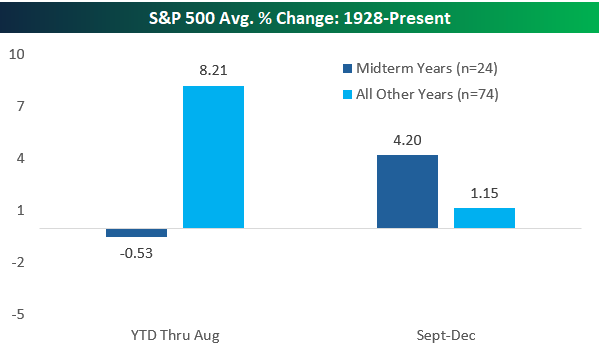
Source: Bespoke Investment Group
In other words, midterm years tend to underperform early in the year but significantly outperform into year-end, making the September–December period one of the strongest seasonal windows in the four-year presidential cycle.
Overall, the message from the last four weeks of economic data is reassuring. The US economy is proving more resilient than the pessimists expected, while inflation is becoming less threatening than the hawks feared.
For risk assets, and equities in particular, that remains a constructive backdrop.
The market is no longer pricing perfection; it is pricing resilience.
The path to the S&P 500 at 8,000 and NASDAQ 100 at 30,000 remains intact, but it will not be linear. Periods of volatility, consolidation, and drawdowns are inevitable as we saw in June-July.
This is precisely the type of environment where structured strategies become relevant. Properly deployed, they allow investors to navigate volatility, define entry levels, and generate returns even in sideways markets. For tailored strategies, stock-specific ideas, or structured solutions, please reach out to your relationship manager.
Best wishes,
Manish Singh, CFA