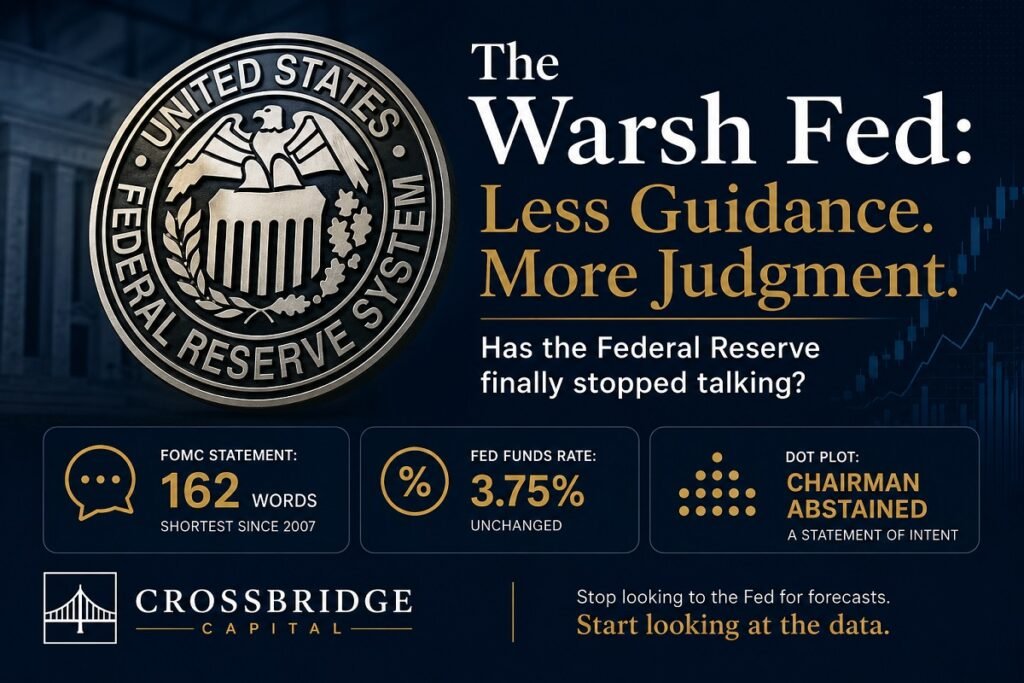
The Next Economy Runs on Compute - and Big Tech Knows It

AI capex arms race continues to accelerate. The companies that build and supply compute will dictate access, pricing, and deployment speed.

Summary

Are Big Tech’s vast AI capital expenditure programmes laying the foundations for a genuine productivity surge, or sowing the seeds of the next bubble? Each new spending announcement still triggers reflexive comparisons to the dot-com era, yet those analogies increasingly miss the point. AI has transformed compute from a utility into a strategic asset. Strategic assets are never about shared access. They are about control.

The companies that build and supply compute infrastructure will dictate access, pricing, and deployment speed. Control the bottleneck and you control the economics of the entire ecosystem layered on top. That reality explains why the AI capex arms race continues to accelerate, and why simplistic bubble comparisons fail to capture the scale of what is unfolding. This is no longer about individual winners or losers. OpenAI’s eventual fate matters far less than the structural shift now underway.

The investment framework around capex is changing. Markets currently focus on hyperscaler margins and near-term free cash flow. That focus will move toward a more consequential divide: companies with secured compute access versus those forced to rent capacity, absorb hyperscaler margins, and operate with structurally higher costs. In an AI-driven economy, control of compute is not optional. It is decisive.

Against this backdrop, changes at the Federal Reserve and a renewed policy push toward deregulation and growth signal a potential inflection point for the US economy. A break from the long-standing 2–3% growth regime toward a more durable, productivity-led expansion now looks plausible. A 5% GDP quarter within the next year no longer feels far-fetched.

The Dow approaching 50,000 reflects this transition. It speaks less to narrow tech exuberance and more to a broadening rotation into banks, industrials, and consumers. Tech leadership may pause, but the baton is moving through the real economy before cycling back. That rotation does not signal risk aversion. It marks a bull market functioning as it should.

The Next Economy Runs on Compute – and Big Tech Knows It

Over the past three months, markets and geopolitics have been driven by a volatile mix of AI euphoria – and AI fear – alongside fiscal uncertainty and rising geopolitical risk.

Global equities have been repeatedly jolted by one central question: Are Big Tech’s massive AI capital spending plans, laying the foundations for the next productivity boom, or inflating the next capex bubble?

Each new spending announcement has been met with suspicion, with comparisons to the dot-com era drawn reflexively-even when those parallels feel increasingly forced.

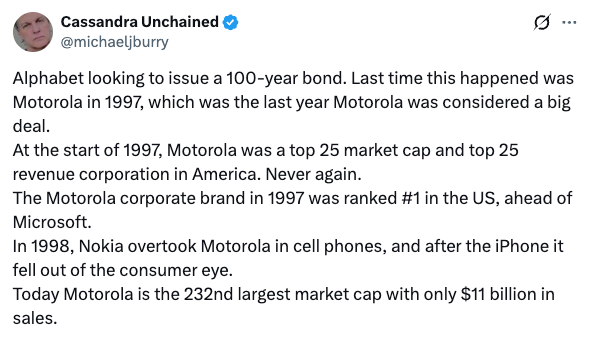
This week’s catalyst came from comments by US investor Michael Burry, responding to Alphabet issuance of a 100-year bond.

Burry warned: “Last time this happened was Motorola in 1997.”

It’s a clever line – -but it rests on an outdated framework. The Motorola comparison says less about Alphabet’s fragility, and more about the limits of applying legacy tech analogies to a compute-driven world.

Source: Michael Burry on X

Motorola in 1997, was a one-product company riding a fading cycle, with no ecosystem, eroding pricing power, and distribution about to be commoditized.

Alphabet today is the inverse. It sits on over $120bn in cash, generates approximately $75bn in annual free cash flow, and saw more than $100bn of demand for a bond deal initially sized at $15bn. Even after expanding long-term debt to approximately $46.5bn, Alphabet’s debt-to-cash ratio remains comfortably below 0.5x.

This isn’t survival financing. It’s infrastructure financing.

The market is missing the bigger point. AI has turned compute into a strategic asset, not a utility. And strategic assets are never about shared access –they’re about control.

Alphabet isn’t issuing century debt because it’s desperate; it’s laying the rails of the next economic system. It could retire a meaningful portion of its debt tomorrow without breaking stride.

This is now a race for compute. Full stop.

The companies that matter most – Microsoft, Amazon, NVIDIA, and Google – won’t just supply compute. They’ll control access, pricing, and deployment speed. When you own the choke point, you own the economics of the ecosystem built on top of it.

This is why the AI capex arms race is accelerating — and why comparisons to past bubbles miss the scale.

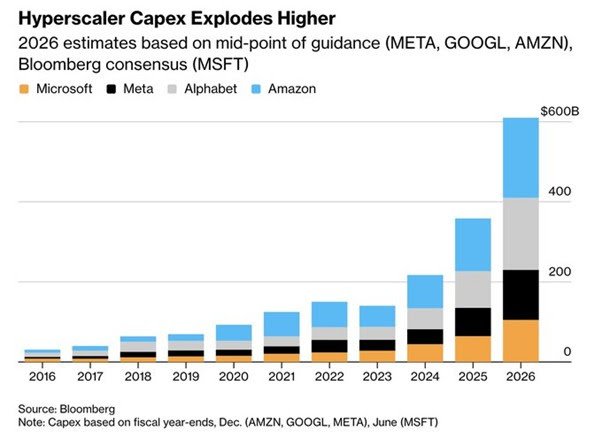
Capex estimates for the Big Four hyperscalers – Microsoft, Meta, Alphabet, and Amazon – have surged to approximately $610bn for 2026, up from $359bn in 2025 (see chart below). That’s not incremental spending. That’s a structural reallocation of capital toward compute, power, and infrastructure.

For context, Bloomberg estimates that 21 of America’s largest industrial companies combined-including automakers, railroads, defence contractors, telecoms, logistics firms, Exxon Mobil, Intel, Walmart, and the companies formerly known as GE-will spend just $180bn on capex in 2026. Big Tech alone is outspending the rest of industrial America by more than 3x.

And before panic sets in, some perspective matters. Hyperscalers are currently reinvesting about 60% of operating cash flow into data centres and capex. Two years ago, that figure was 33%. From 2017–2022, it averaged 27%. Crucially, today’s spending intensity remains well below the 140% of cash flow telecom companies burned through at the peak of the 2001 fibre bubble.

As Brad Gerstner of Altimeter Capital put it: “Think of it as digging a gold mine. You have to spend a lot of money before you get the gold out. These guys are digging the biggest gold mine in the history of software. The real question is whether you believe Andy Jassy, Mark Zuckerberg, Sundar, and Jensen-or think there’s no gold at the bottom.”

That’s the trade. Either this is reckless overbuild-or the upfront cost of controlling the most valuable infrastructure layer of the next economy.

Today, markets obsess over hyperscaler margins and free cash flow. Tomorrow, the focus will be on companies without secured compute access-those renting capacity, inheriting hyperscaler margins, and operating at structurally higher cost.

The cloud worked when compute was cheap. AI has ended that era.

A tech re-rating is underway, but it won’t be uniform. Firms with genuine AI and infrastructure control will benefit disproportionately. Software remains in price discovery. European and emerging-market tech firms without compute ownership face structural de-rating risk. If you sit downstream of someone else’s infrastructure, your margins sit downstream too.

This isn’t about one bond deal-or even one company. It’s about who controls the machines the next economy runs on.

AI turns compute into a strategic weapon. And weapons, historically, are never about shared access.

They’re about control.

Most people are still operating on scarcity logic, in a world that has already moved on.

As those closest to the transformation keep reminding us, including Garry Tan, President & CEO of Y Combinator – what’s unfolding across AI, energy, materials, and biology is a shift from allocation to creation. Yet our political, economic, and cultural systems were built for a different era: Managing scarcity, negotiating slices, deciding who gets what and at whose expense.

They were never designed for exponential technologies that expand the pie faster than institutions can process. When those systems collide with abundance, they don’t recalibrate – they panic.

The failure is as much psychological as it is structural.

If you believe the world is zero-sum, abundance looks like instability. If you believe intelligence, coordination, and technology can scale together, abundance looks like the next stage of civilization.

Markets and the Economy

Before turning to the economy and equities, it’s worth outlining the market structure we are operating in—and likely to remain in for some time.

Markets feel far more volatile than they are- if you listen to headlines instead of price action. Or, to put it more precisely: Markets today are segmented, not contagious.

As Philosopher Heraclitus warned: “Much learning does not teach understanding.” We’re drowning in narratives but missing the signal.

Recent price action makes the point brutally clear. Silver has traded like a meme stock-surging from approximately $40 in September to over $120 in late January, then collapsing back below $65, including two -20% drawdowns in a single week. And yet, during that same stretch, the largest daily move in S&P 500 futures was just –1.2%, while a 9.3basis points (a basis point is 1/100th of a percent) drop in 10-year Treasury yields barely registered against far larger swings seen repeatedly over the past year.

Chaos in selected corners, calm everywhere else.

This disconnect reflects a defining feature of modern markets: Liquidity is everywhere for small positions, but balance-sheet risk is nowhere for big ones.

Years of asset inflation, from equities to housing to crypto, has created a powerful wealth effect, and empowered retail but regulation has stripped institutions of the ability (and incentive) to warehouse risk. The giants that once tied markets together- Dot-com era equity desks, pre-Global Financial Crisis Mortgage-Backed Securities machines- are gone. Price discovery now happens fast, violent, and local.

There are casualties, but they arrive early. As Philosopher Friedrich Nietzsche put it, “What does not kill me makes me stronger.” Rapid price discovery prevents bubbles from metastasizing into systemic threats. Losses are real, but they’re contained-and instructive.

Crypto markets show this most clearly. Heavily leveraged traders are auto-liquidated en masse, clearing positioning in hours, not months. The market goes vertical on the way down-and often rips higher once excess leverage is flushed. Painful? Absolutely. Systemic? No. These losses act as circuit breakers, not accelerants.

Contrast this with the globalization era, when shocks cascaded across borders and balance sheets-from subprime mortgages to sovereign debt crises. Today’s structure does the opposite: it absorbs shocks rather than transmits them.

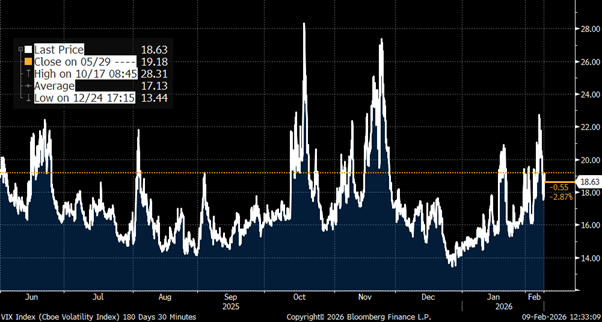
Even volatility itself is telling the story. The VIX has averaged around 17 over the past six months (see chart below), and repeated spikes into the low 20s have failed to spark broader stress-much to the frustration of those still waiting for the long-anticipated equity reckoning.

Conclusion: Volatility is no longer a warning siren- it’s a sanitation mechanism. Big moves don’t signal growing macro danger; they signal risk being cleared. The calm in the S&P 500 amid violent swings elsewhere isn’t complacency-it’s evidence that today’s market system contains risk rather than denying it.

The VIX index – 6-month price chart

Source: Bloomberg

Over a month ago, I wrote a post – “Let’s talk about Kevin” and made a case for why former member of the US Federal Reserve (Fed) Board Kevin Warsh will be the next Fed chair.

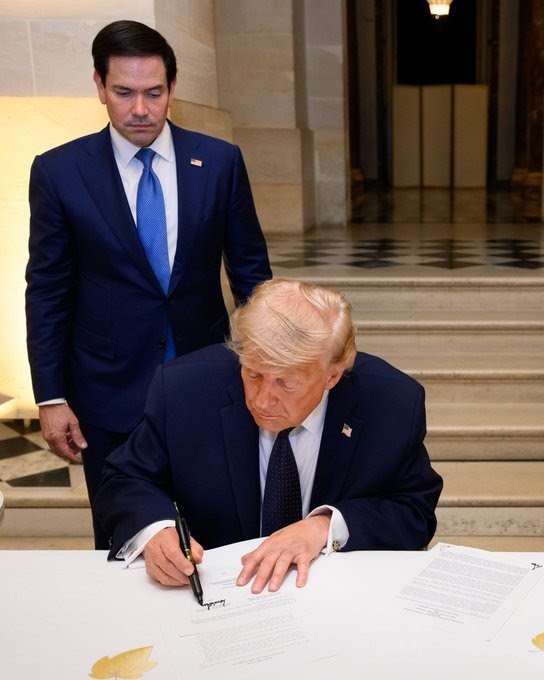
Just over a week ago, President Donald Trump formally appointed Kevin Warsh to be the next Chair of the US Fed subject to confirmation hearing by the Senate.

The nomination of Kevin Warsh as Fed Chair has refocused attention on how deeply the Fed is embedded in markets. Warsh has long argued that the Fed’s footprint-still approximately $7.5 trillion-is too large, not just in asset holdings but in blurred lines between monetary and fiscal policy and an overbearing communications regime that shapes investor behaviour.

A Warsh-led Fed is unlikely to change the near-term rate path, but it could gradually shift balance sheet strategy.

Any meaningful shrinkage, however, is constrained by structurally high bank demand for reserves (still above $3 trillion). Move too fast, and funding markets break-something the Fed learned the hard way in 2019.

To understand the direction of travel, it’s worth reading-and re-reading The Wall Street Journal op-ed Warsh co-authored with Stanley Druckenmiller last June: “ The Asset-Rich, Income-Poor Economy ”  It offers a clear preview of what may be coming next.

Warsh and Druckenmiller argued – higher asset prices are not translating into meaningful increases in capital expenditures, and the weak growth in business investment is proving to be an opportunity-killer for workers.

Balance-sheet wealth is only durable when it stems from earned economic success rather than government stimulus or financial engineering. True wealth creation requires productive growth – where labour, capital, and innovation raise productivity, converting income into savings, savings into investment, and investment into lasting assets.

Today, the US shows a widening gap between asset-driven balance-sheet gains and income growth that benefits the broader population: many households lack stock ownership or housing wealth, retirees face weak bond returns, and employment recovery has lagged population growth, driving high non-participation.

Meanwhile, corporate incentives favour debt-funded buybacks over long-term investment, rewarding short-term asset inflation instead of productive risk-taking.

The result is rising asset prices alongside subdued ~2% real growth, weak business investment, slower wage gains, and below-trend productivity. Without stronger investment in productive capacity and people, prosperity will remain fragile and uneven – though sweeping deregulation and economy-wide growth initiatives could mark an inflection point toward more durable, productivity-led expansion.

“The Powell Fed has failed to get interest rates about right for most of Chair Powell’s tenure.”
– Kevin Warsh, Oct 12, 2025

“What we need to do is examine the entire Federal Reserve institution and whether it has been successful. All of these PhDs over there-I don’t know what they do. This is like a universal basic income for academic economists.”
– US Treasury Secretary, Scott Bessent, July 21, 2025

Both Bessent and Warsh are aligned on the need for urgent Fed reform. That process is likely to begin as Powell’s term ends on May 15, 2026- or sooner, should he step aside.

A broader agenda of major deregulation, reduced red tape, and growth driven by the full breadth of the US economy-not just Wall Street and tech-could mark a defining inflexion point. If executed well, it may finally lift the US out of its long-running 2–3% GDP growth rut and toward a more durable, productivity-led expansion.

This is something to be really excited about. I will not be surprised if we see +5% GDP growth quarter at some point over the next 12 months.

Bottom line: Fed Chair Warsh wouldn’t pull the Fed out of markets overnight-but he’d push toward a smaller, quieter central bank, slowly and within tight plumbing constraints to engender better GDP growth.

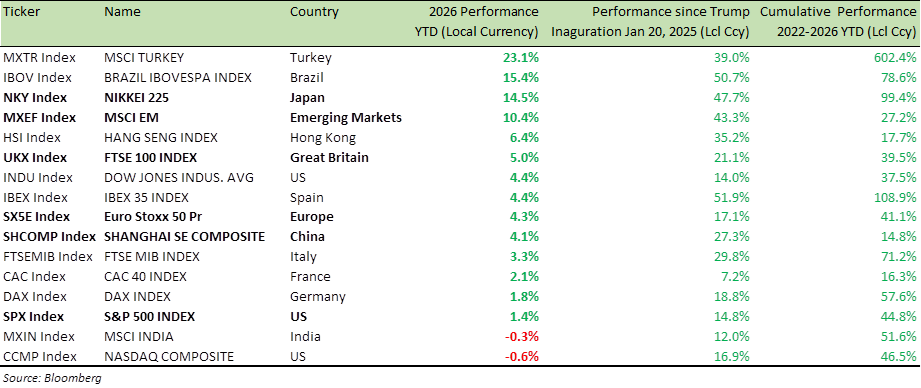
The Dow Jones Industrial Average hit 50,000 for the first time on Friday.

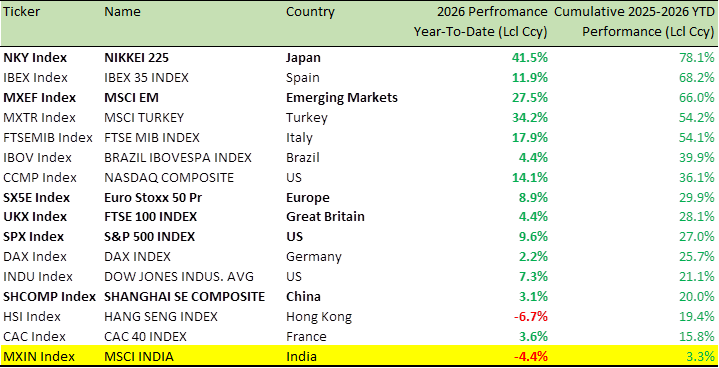
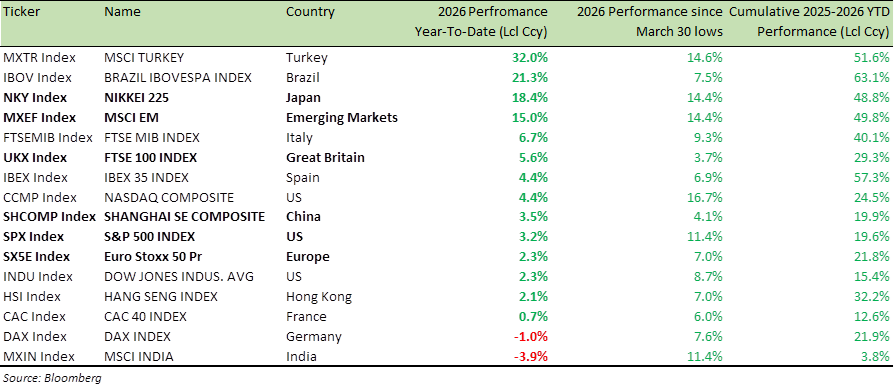
The Dow hitting 50,000 is less about tech euphoria and more about a quiet rotation into the real economy. Over the past six months, the Dow has outperformed both the S&P 500 and the Nasdaq, as investors trimmed crowded AI trades and rotated into banks, industrials, consumer staples, and transport stocks.

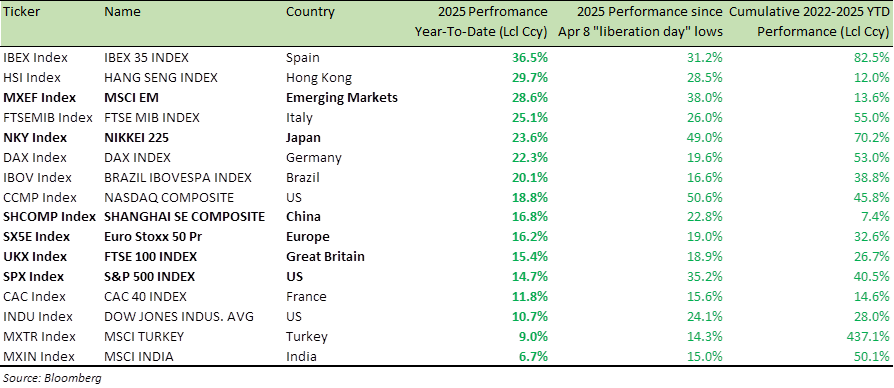
Global Equity Index Performance (2026 YTD, since Jan 20 to YTD and 2022-26 YTD)

While the Nasdaq has been choppy and flat-to-down amid software and AI volatility, and the S&P 500 has delivered modest gains, the Dow has surged-helped by standout performances from names like Walmart, Johnson & Johnson, and Coca-Cola.

At the same time, emerging markets have kept pace or beaten US tech-heavy indices, benefiting from cheaper valuations and a weaker dollar narrative.

The market’s message is clear: this rally isn’t just tech beta-it’s a vote of confidence in reaccelerating US growth, which is good news for both the broader economy and US equities.

Tech may pause and consolidate, but the baton is being passed to the real economy-banks, industrials, transports, and consumer staples-before ultimately rotating back to tech. That handoff, from innovation to picks-and-shovels and back again, isn’t a risk-off signal. It’s a sign of a healthy, durable bull market doing exactly what it’s supposed to do.

A few thoughts on US GDP growth-and yes, try not to laugh.

“If our new head of the Fed [Kevin Warsh] does the job he’s capable of, we can grow at 15%-maybe more.” That was Donald Trump speaking to Fox News on February 9, 2026.

Fifteen percent is…ambitious. I’m not sure the economy-or anyone’s spreadsheets-are ready for that.

Personally, I’d be more than satisfied with +5% real GDP growth, a level the US hasn’t sustained in over two decades, excluding the post-COVID rebound distortions. Even getting close would be meaningful.

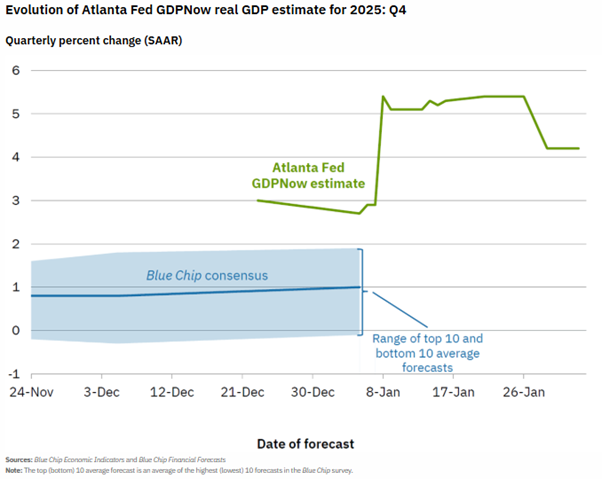
That said, the data are moving in the right direction. The Atlanta Fed’s GDPNow model is tracking +4.2% growth for Q4 2025, putting full-year GDP north of +3%-not fantasy numbers, but strong momentum by modern, post-GFC standards.

US inflation is also behaving better than feared. December CPI rose +0.3% m/m, with headline inflation at +2.7% y/y and core inflation at +2.6%. Importantly, inflation psychology is cooling too: the New York Fed’s consumer survey shows 1-year inflation expectations easing to +3.1%, down from +3.4%.

The US consumer is slowing but not cracking. US Retail sales were flat m/m in December, and core sales dipped -0.1%, pointing to moderation after a strong run rather than outright retrenchment.

Meanwhile, the labour market is cooling in a healthy way. US Payrolls rose 64,000, US unemployment rate sits at 4.6%, and US wage growth remains around 3.5% y/y. Slower hiring alongside steady wages fits a late-cycle but intact expansion-not an economy rolling over.

Bottom line: Growth is solid, inflation is cooling, and the labour market is bending, not breaking.

The journey to S&P 500 at 8,000 and Nasdaq 100 at 30,000 will not be linear. Periodic selloffs and extended sideways phases are inevitable along the way.

That’s precisely where equity structured products come into their own. Used thoughtfully, they are an effective way to navigate-and potentially monetize-higher volatility. These strategies can offer partial capital protection, help define disciplined entry levels, and generate returns even when markets move sideways or pull back.

For tailored ideas, stock-specific structures, or deeper insights, please reach out to me or your dedicated relationship manager.

 
Best wishes,
Manish Singh, CFA

Crossbridge Capital: Market Viewpoints - November/December 2025: Tinsel, Trust, Tail Risk, & AI: The Markets Hidden in Christmas Classics

The US’s new tariffs have shaken up the global economy – but the AI boom is helping to hold things together

Summary

If two words were to define 2025, they’re tariffs and artificial intelligence. President Trump’s “Liberation Day” tariffs initially sent shockwaves through global markets. Economists warned of a sharp hit to trade, corporate margins, and global growth. Yet the anticipated recession never arrived. Instead, the S&P 500 is up over +16% year-to-date, and the Nasdaq has gained more than +20%, extending a powerful run driven by structural forces beneath the surface.

The reason? While tariffs tightened parts of the system, the AI boom expanded others. Corporate earnings have held up, risk appetite has returned, and productivity optimism is rising. Many of the most aggressive tariffs were ultimately scaled back or delayed – but AI’s momentum hasn’t paused. Markets are adjusting not to a collapse in global trade, but to a recalibration of where and how future growth will emerge.

AI is now being recognised as a true general-purpose technology — with potential long-term productivity gains of +1.5% to +3% annually. As compute costs decline and adoption accelerates, the path to profitability becomes clearer. Challenges remain: Tariff-linked inflation, fiscal drag, slower AI capex, or geopolitical shocks could all weigh on sentiment.

But the clear lesson from this cycle is that structural tailwinds have consistently outpaced short-term noise. Staying invested – especially through periods of technological transformation – remains the most effective strategy for compounding long-term wealth.

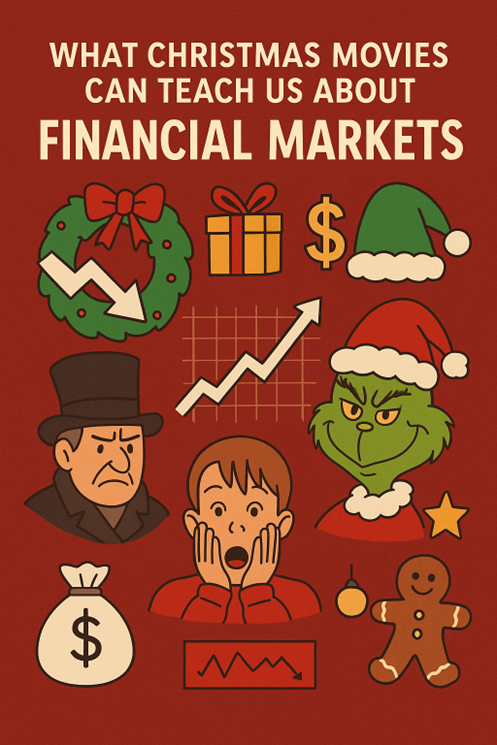
Tinsel, Trust, Tail Risk, & AI: The Markets Hidden in Christmas Classics

It’s almost that time of year again – market activity is slowing down, Radio Times in hand, and the annual ritual of deciding which Christmas movies to watch over the holidays. We all have our favourites: It’s a Wonderful Life, A Christmas Carol, Home Alone, Love Actually, and in my daughter’s case, The Grinch (the 2018 Pharell Williams version).

Christmas movies often feel like warm, nostalgic escapes from reality – but look closely and many of them are built on themes straight out of financial markets: Risk, fear, liquidity crunches, moral hazard, irrational behaviour, asset bubbles, and the psychology that drives economic cycles.

It’s a Wonderful Life — Liquidity Crunches & Bank Runs

George Bailey’s Building & Loan is a textbook lesson in liquidity risk: Long-term assets, short-term liabilities, and a sudden loss of confidence that sparks a classic bank run. A reminder that markets run on trust — until they don’t.

A Christmas Carol — Behavioural Finance in Victorian Clothing

Scrooge is the original case study in loss aversion, hoarding, and over-saving at the expense of utility. The ghosts force him to confront future regret — essentially a crash course in long-term forecasting and behavioural incentives.

Home Alone — Risk Management & Tail Events

Kevin McCallister is an 8-year-old master of scenario analysis. He anticipates threats, allocates resources smartly, and creates asymmetric defences with limited capital. It’s tail-risk hedging… through marbles, nails, and paint cans.

The Santa Clause
 — Succession Risk & Governance Failures

Santa quite literally falls off the roof, and leadership transfers via a poorly drafted contractual clause. It’s corporate governance gone wrong — unclear terms, no oversight, and no succession planning.

The Grinch — Overconsumption & Sentiment Cycles

Whoville thrives on relentless consumption, leaving it vulnerable to a collapse in demand. The Grinch’s theft is a sentiment shock, showing that an economy built purely on cheer is only as strong as its confidence levels.

Well, we are not going to just talk about movies, so let’s look at the state of the market.

If 2025 can be summed up in two words, they are: Tariffs and Artificial Intelligence (AI).

The US’s new tariffs have shaken up the global economy – but the AI boom is helping to hold things together.

When US President Donald J. Trump rolled out his “Liberation Day” tariffs in April, many economists warned of a global shock. The consensus predicted US import slowdowns would choke global supply chains, hurt exports, stunt growth, and cost jobs around the world.

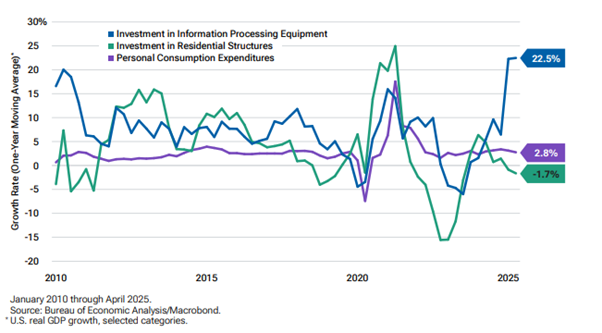
The AI infrastructure buildout is pulling the US economy up

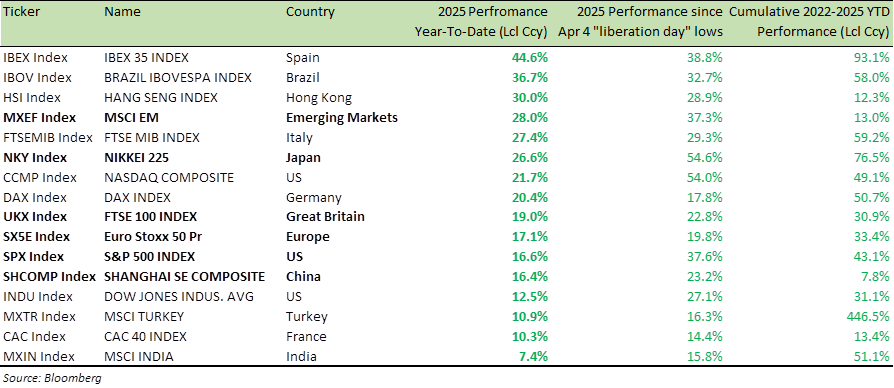
Yet, months later, some of those same economists are revising their growth forecasts upward. Despite the tariff barrage, there’s been no recession, and markets are holding firm. The S&P 500 is up almost +16% year-to-date, while the Nasdaq Composite has surged more than +20%, building on two straight years of nearly +20% annual returns.

That resilience isn’t just luck – it reflects confidence in the AI-driven growth story, the resilience of corporate earnings, and a broader recalibration of risk across global capital markets.

In light of this, it’s often wiser to stay invested than to try to “time the market.” Trying to guess when markets will correct — pull out some money — and then jump back in is a high-stakes game. Instead, riding the upward trends, especially when structural themes like AI are driving value, tends to reward long-term discipline.

As Trump himself put it when defending the tariff strategy back in Spring: “We’re putting American workers and American innovation first.” Whether one agrees or not, the market seems to be voting with its capital — at least for now.

In short: Tariffs tightened one valve, but AI blew another wide open.

Global Equity Index Performance (2025 YTD, since April 4 YTD and 2022-25 YTD)

Last December in looking forward at 2025, I wrote:

“U.S. Equities Set for Uptick: Predicting specific figures is challenging, but U.S. stocks are well-positioned to see a rise of approximately 10-15% over the next year.”

I’d predict another double-digit year for 2026 for the S&P 500, as rates normalise and the job market improves. With a new Fed Chair in place probably by end of Q1, the year will be driven by robust growth, as inflation fear recede.

As for the next Fed chair, Polymarket gives Kevin Hassett a 74% chance of becoming the next U.S. Federal Reserve Chair. Hassett, Director of the National Economic Council since 2025, previously chaired the Council of Economic Advisers (2017–2019) and was a scholar at the conservative American Enterprise Institute. He has published widely on tax policy, growth, productivity, and macroeconomics.

In short, he is not a career central banker or regulator. His background is primarily that of an economic adviser, academic policy expert, and advocate for tax and growth-focused policies—experiences that strongly influence his economic philosophy and worldview.

If Hassett were appointed Fed Chair, his background and philosophy suggest several probable tendencies:

  • Focus on growth and productivity, not just cyclical stabilization. He might push the Fed to consider structural growth and long-term output potential as part of its mandate.
  • Balanced monetary policy. Rather than swing widely between aggressive rate hikes and rate cuts, he might favour a more measured, long-horizon approach — especially if underlying growth and productivity remain resilient.
  • Coordination (or at least compatibility) with pro-growth fiscal policy. Given his history of advocating for tax reform and deregulation, he may prefer monetary policy that stabilizes inflation while giving the private sector room to invest and grow.
  • More predictable, less politically reactive style. Coming from a policy-adviser and academic background, Hassett may favour rules-based or transparent frameworks over short-term discretion.

All this bodes well for risk assets.

On another note, Japan is coming up for discussion given its large pile of debt and rising inflation. It is also coming up in news for another reason – Trump called Prime Minister Sanae Takaichi last month, and advised her not to provoke Beijing on the question of Taiwan’s sovereignty.

Let me address the two issues – debt and inflation, and Taiwan, one at a time.

On debt, inflation and rising Japanese Govt bond (JGB) yield the central claim of a viral post “Japan printed money for 30 years and exported it to keep mortgages cheap, stocks inflated, and governments solvent,” is false and misleading.

Japan’s global financial strength comes from decades of persistent current account surpluses, not money printing. Its Net International Investment Position—around $3.4 trillion and ~80% of GDP—makes it one of the world’s largest creditor nations, alongside Germany.

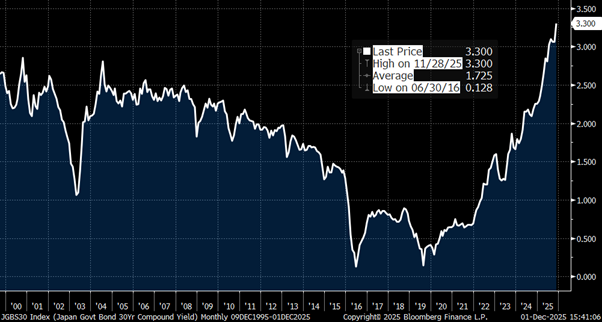
Recent JGB movements reflect normal market dynamics, like reduced BoJ purchases and changing domestic investment needs, not economic collapse.

Myths about Japan or China dumping U.S. Treasuries are illogical, as it would destroy their own portfolios.

Doom narratives persist because fear sells, but Japan remains a rich, stable, globally integrated economy. Rising interest costs are manageable relative to nominal growth, and warnings of collapse are often biased and superficial.

30-Year Japan government bond (JGB) yield: 30-year price chart

Source: Bloomberg

On the topic of Japan’s growing support for Taiwan, it behoves the new PM to be more careful as it cannot count on US unconditional support under President Trump or the next resident of the white House.

There’s an old strategic truth worth revisiting: The decline of your patron is far more lethal than the rise of your rival.

Japan is more at risk from losing its patron – the US than from the rise of its rival China.

For decades, the US has been the world’s ultimate stabiliser – the patron state underpinning global security, trade, and financial architecture. Its consumer market absorbed global exports; its dollar anchored the monetary system; its military and diplomatic presence kept regional tensions from spiralling.

A rival’s rise – whether China, India, or any emerging power – is disruptive but manageable. The system can adjust to new competitors. Markets can reprice. Supply chains can evolve.

But the weakening of the anchor power?
That’s a different order of risk and needs to be responded with urgency.
Arguably, Prime Minister Takaichi has the toughest job of all the world leaders.

A rival adds pressure. A patron’s decline shakes the foundation and forces you to get off your back and become more proactive, creative, thoughtful and think anew.

As the world edges toward a more multipolar, more uncertain equilibrium, this asymmetry is becoming harder to ignore – in markets, in geopolitics, and in boardrooms.

The question for 2026 and beyond isn’t simply who is rising. It’s what happens if the system’s cornerstone begins to slip.

Former British Prime Minister Winston Churchill once said – “Peace is made secure not by the balance of forces, but by the strength of the strongest.”

With the US slipping, its priorities changing, the part of the globe that relied on US support, needs to rethink its strategy.

Looking Ahead: 2026–2027

The combination of tariffs and AI-driven investment is shaping not just 2025, but potentially the next several years of the economic cycle.

AI once grew more expensive, as models scaled, but efficiency gains have flipped that logic. Intelligence that cost $37 per million words in 2023 now costs only a few cents, thanks to faster chips, smarter code, leaner models, and open-weight competition. This cost collapse means every dollar now buys far more capability, accelerating adoption. Nvidia sits squarely at the centre: The NVL72 Supercycle—jumping from 8 GPUs per server to 72—is setting up multiple quarters of blowout results and could become one of the biggest tech cycles since the iPhone.

Tech adoption is also happening faster than ever. The flush toilet took 75 years to go mainstream; the smartphone took 10. Generative AI is on track to break every record. Roughly 40% of U.S. households already use AI at work or home, just two years after ChatGPT launched, and effective adoption rates may be far higher once embedded AI is included.

I believe that search behaviour will increasingly shift from traditional queries to AI chatbots. As ChatGPT releases a far stronger model trained on NVL72 Blackwell clusters at Microsoft, sentiment will swing back in its favour. Nvidia will benefit from this training wave, while fears that Google’s TPUs will meaningfully threaten Nvidia’s dominance remain overstated.

This shift will also hit digital advertising. A large share of ad spend will migrate from search engines to AI chatbots and emerging AI-native hardware. Google, long protected by its search monopoly, will face real competitive pressure, as user attention moves into conversational interfaces.

Inside companies, productivity gains will accelerate. AI is moving from “co-pilot” to “co-worker.” Knowledge workers will become dramatically more efficient as models adapt to proprietary data and custom workflows. Surveys show over 40% of firms already pay for AI services, and adoption is rising fastest across tech, finance, and professional services.

Barriers exist – regulation, legacy systems, tight budgets – but the shift from experimentation to deployment is unmistakable.

AI is the next great “general-purpose technology,” akin to electricity or the computer. Most economic estimates point to +1.5%–+3% annual productivity gains over the next decade—transformative in a world with slowing labour-force growth. The upside is huge, even if the full effect takes time to materialize. Profitability concerns are temporary. Compute gets faster and cheaper every year, and this trend is relentless. As costs fall and usage scales, today’s loss-making AI features will turn into highly profitable businesses.

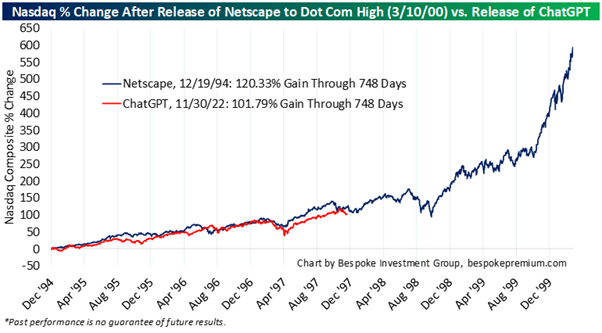
At the economy level, the US economy remains supported by strong earnings, pro-growth policies, active capital markets, and ongoing AI investment—benefits that are likely to ripple across global sectors. The major AI stock rally may still be ahead, potentially mirroring the trajectory of Netscape’s 1994 launch. So far, the pattern is strikingly similar (chart below).

That said, the equity markets are broadening. Leadership is moving beyond the AI mega-caps to companies building AI’s physical backbone and those set to benefit from sector rotation.

International and small-cap stocks are gaining appeal, fuelled by fiscal stimulus and improving global cyclical trends.

AI-related investment—spanning cloud infrastructure, chips, data centres, and automation—could drive double-digit earnings growth in large-cap tech through 2026.

Early enterprise AI adoption, highlighted by big tech CEOs in recent media appearances, points to a productivity surge not seen since the late 1990s. Coupled with re-shoring and structural investments in manufacturing, energy, and semiconductors, this makes annual S&P 500 gains of around +10% plausible, with the Nasdaq poised to lead.

Expansionary policies outside the US, especially in Germany, have been swift and significant. Aggressive easing by the European Central Bank, Bank of England, and emerging-market central banks further supports international equities.

Small caps stand to benefit the most as markets broaden beyond mega-cap tech and rates cuts in the US follow. Even modest flows away from the “Magnificent Seven,” could boost smaller stocks, which also thrive in lower-rate environments.

U.S. fiscal stimulus – including tax incentives for capex – backs growth, but policies like tariffs and immigration restrictions remain inflationary. With inflation near or above 3%, bonds may underperform, reinforcing equities as the preferred play.

I am a buyer of crypto – Bitcoin, Solana, and Ethereum. I view gold more as jewellery, though it still deserves a role as a portfolio hedge for when geopolitical risk become concern. I’m less convinced by illiquid private assets and believe structured equity investing, as we practice it, offers a better risk-adjusted path to generating 10–12% on an equity allocation.

History shows that market leadership always evolves over time and revolve around themes.
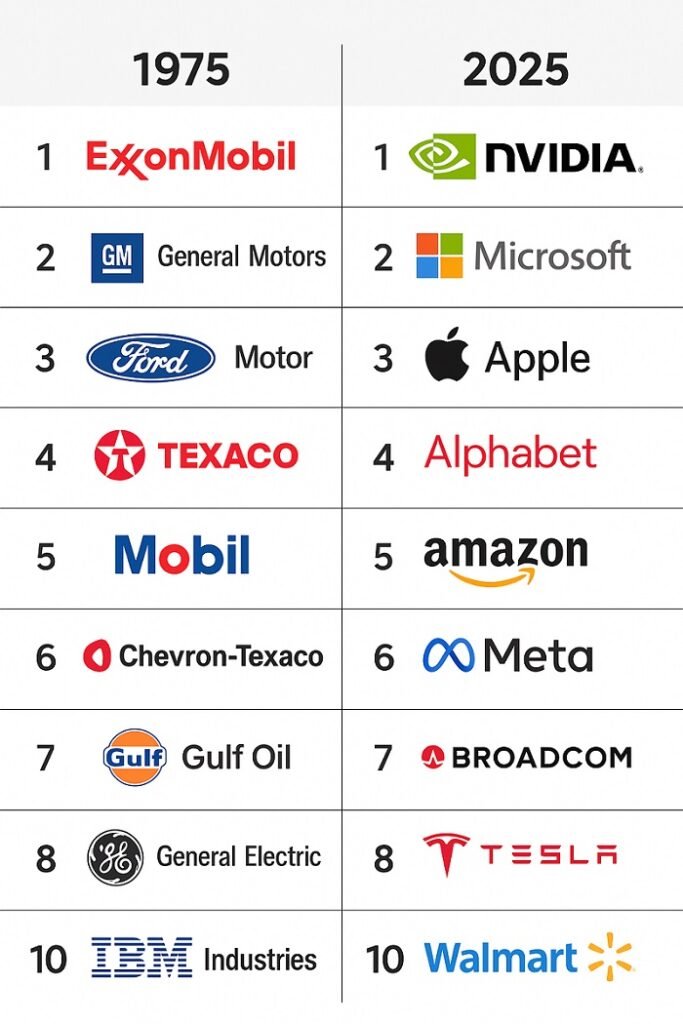
None of the top 10 companies by market cap in 1975 remain in the top 10 today, and even from 2005, only Microsoft survives in the top 10 today.

Times for significant technological disruption tend to disrupt moats, we are in midst of it, but big tech has a big lead and over time they have consolidated their monopolistic position.

From Oil Titans to Tech Giants: Top 10 US Companies, 1975 vs 2025

Source: ChatGPT

What could disrupt all the positivity? Tariff-driven inflation, AI spending slowdowns, U.S. fiscal stress, and geopolitical shocks.

However, the lesson from 2023–2025 is clear – staying invested has consistently outperformed attempts to time the market, as structural themes like AI reward patience over precision. Time in the market, especially during technological inflection points, remains the most reliable path to long-term gains.

Markets aren’t just numbers – they’re stories about people navigating uncertainty, emotion, ambition, fear, and hope.

Never forget – investing is less about predicting the future and more about understanding human behaviour. And few things illustrate that better than the Christmas classics we return to every December. Because those movies beneath the sparkle and nostalgia, explore those same forces far more honestly than most investment textbooks or newsletters ( with possible exception of this one, I know I am biased)

Wishing you and your loved ones a joyful holiday season and a prosperous New Year. For those celebrating Christmas, may it be a wonderful celebration full of warmth and joy.

 
Best wishes,

Manish Singh, CFA


Crossbridge MVP October 2025 - From Tariff panic to Tech Euphoria

“Scepticism often spikes at the top — but it also tends to keep investors from participating in ongoing structural shifts.”

Summary

Investor scepticism tends to peak when markets are making new highs. But history shows that doubt alone doesn’t protect capital — it often sidelines it. Even the most seasoned investors can misread complex market cycles. The real challenge is not being wrong – it’s refusing to adapt. As Marcel Proust observed, “The real voyage of discovery consists not in seeking new landscapes, but in having new eyes.” That’s increasingly true in today’s market. The advantage now belongs to investors who can look at familiar conditions with a fresh lens, not those clinging to outdated assumptions.

As headlines warn of market froth, institutions are positioning for a multi-decade transformation. JPMorgan’s CEO may express caution publicly, but the firm is committing over $10 trillion to future-focused sectors – AI, quantum computing, and cybersecurity. It’s a clear signal: beneath the noise, capital is flowing into the technologies reshaping global growth. Corrections will come – they always do — but history has consistently rewarded those who stay invested, manage risk, and evolve with the cycle rather than exit it.

Digital assets, meanwhile, continue to offer rare optionality — asymmetric return potential, innovation at the edge, and exposure to structural change. But fundamentals still apply: Disciplined sizing, risk management, and cycle awareness. Bull markets may flatter, but true investing skill is proven through drawdowns. As Warren Buffett reminds us, “Only when the tide goes out do you discover who’s been swimming naked.” In crypto, that tide moves quickly – and often. Staying solvent, informed, and opportunistic will matter more than ever.

From Tariff panic to Tech Euphoria

US GDP surged +3.8% in Q2, up from the earlier +3.3% estimate, marking the strongest growth since Q3 2023.

The engine? Robust consumer spending and a surge in AI-driven tech investment.

As one prominent Wall Street analyst quipped, “Without tech spending, the U.S. economy would be close to recession.”

I always smile at these “without” GDP analyses — they miss the point.

Is Superman still Superman if he can’t fly? Is James Bond still Bond without his gun? Or Taylor Swift still Taylor Swift without her songs?

Technology is the US economy — its defining strength and the envy of the world.

Without it, America would resemble the Eurozone — minus the cheese, the wine, and perhaps with a few too many guns.

But let’s add some perspective.

In December 1981, when recession fears were thick in the air, the Blue-Chip Economic Indicators survey showed forecasts for 1982 ranging from +4.0% growth to a –1.7% contraction, with profit expectations swinging between –19.9% and +19%.

The consensus gloom proved misplaced: The economy rebounded sharply, ushering in the Reagan-era boom. Back then, there was no AI revolution to lean on — just tight monetary policy, an inflation fight, and a resilient private sector.

History reminds us that forecasts are guesses wearing ties, and humility is the economist’s most underrated skill.

Early October gave investors two big milestones — and a reminder of how fast sentiment can shift. October 8 marked six months since the “tariff crash” bottomed, while October 12 celebrated three years since the current bull market began in late 2022 — just before the AI revolution transformed everything.

”Liberation Day” tariffs market collapse now feels like a distant memory. The S&P 500 plunged -10% in two days amid tariff panic, falling nearly -19% from its February’s highs. Yet, true to form, markets recovered with stunning force. Since those April lows, the S&P 500 has surged +34% (see chart below), while the Nasdaq 100 — boosted by AI, semiconductors, and data-centre exuberance — has rocketed almost +50%.

Global Equity Index Performance (2025 YTD, since April 4 YTD and 2022-25 YTD)

Step back further, and the numbers tell an even bigger story. Since the October 2022 bear-market bottom, the S&P 500 has climbed nearly +90%, and the Nasdaq 100 over +125% — one of the most powerful recoveries in modern market history.

It hasn’t been a straight line, though. The rally has seen three full-blown corrections over 10% across the S&P, Dow, and Nasdaq:

  • October 2023: A -10% drop driven by inflation and rising yields.
  • July–August 2024: A 10–12% pullback on recession fears.
  • March 2025: A -13% slide amid Trump’s tariff shock and China’s retaliation.

Each dip sparked new waves of doubt — and each has been followed by record highs. As the bull enters its fourth year, scepticism is rising again, with the word “bubble” making the rounds. Yet it’s often when investors grow most certain of doom that markets climb higher.

Scepticism often spikes at the top — but it also tends to keep investors from participating in ongoing structural shifts.

Even market legends stumble here: Paul Tudor Jones warned in May that stocks would fall “to new lows.. even if Trump dials back China tariffs by 50%.”

At the time, the S&P 500 stood at 5,606. Today, it’s above 6,700

Markets are complex systems — rarely obeying clean narratives or linear logic. The costliest mistake isn’t being wrong; it’s staying wrong because ego overrides evidence.

As JPMorgan’s CEO Jamie Dimon sounds alarms about “market froth,” his bank is simultaneously pledging $10.5 trillion towards long-term US. economic renewal — investing in AI, quantum computing, and cybersecurity.

The paradox is clear: While many worry about bubbles, institutions are preparing for the next decade of transformation.

The labour market, while still resilient with unemployment around +4.2–4.3%, has softened at the edges. The ADP report showed private payrolls falling 32k in September, the weakest print since March 2023, with August’s gain revised down sharply. With the Employment Situation Report delayed by the government shutdown, that weak ADP reading makes October rate cut of 25bps next Wednesday a formality.

Inflation remains sticky but cooling — headline CPI at +2.9%, core around +3.1% — keeping the US Federal Reserve (Fed) cautious but aware that credit conditions are tightening and growth momentum is fading. The Fed’s data-dependent approach means it will follow the labour signals more than the rhetoric, and on current trends, a 50bps rate cut before year-end wouldn’t surprise me at all.

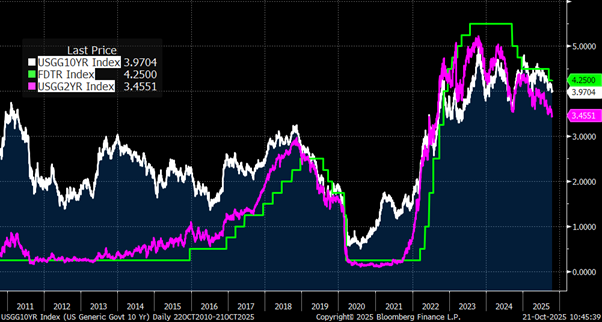
As the chart below shows, the 10-year U.S. Treasury yield (USGG10Y), typically moves in lockstep with the 2-year yield (USGG2Y), as one would expect, and generally trades above the Fed funds target rate (FDTR).

US Treasury 10-year yield (USGG10Y), 2-year yield ( USGG2Y) and Fed fund target rate (FDTR) – 15-year price chart

Source: Bloomberg

Today, however, the 10-year yield sits firmly below the policy rate — the bond market’s quiet way of signalling that it expects the Fed to cut rates more deeply, and soon. That shift in expectations tends to be supportive for equities, particularly small-cap and growth stocks, which are most sensitive to falling rates and an improving liquidity backdrop.

Markets need both optimism and fear to function. Bulls and bears, in a sense, should thank each other. Because without that tension — that push and pull — there would be no market at all.

Yes, this bull market will correct — all of them do. But history has been far harsher on sideline-sitters than on disciplined investors who adapt rather than abandon.

There’s a difference between being cautious and being paralyzed. The intelligent approach is to stay invested, manage risk, and evolve with the cycle, not against it.

Structured products and adaptive strategies remain essential tools for balancing participation and protection.

Markets need both optimism and fear to function. Bulls and bears, in a sense, should thank each other. Because without that tension — that push and pull — there would be no market at all.

The AI and frontier-tech boom will one day slow — but it’s still shaping the next generation of growth. For investors, the key is to stay on the field, not in the stands.

“The real voyage of discovery,” Marcel Proust wrote, “consists not in seeking new landscapes, but in having new eyes.”

The same applies here. The future of investing will belong not to those who predict perfectly, but to those who can see the same market — through new eyes.

Markets and the Economy

The US federal government has been shut down since Oct 1, 2025, after Congress failed to pass a 2026 funding bill amid deep partisan rifts over spending, foreign aid, and healthcare. Now in its 22nd day, it’s the third-longest shutdown in US history.

About 750,000 workers are furloughed, and another 700,000 are working unpaid in essential roles. Critical agencies like the NIH, CDC, and WIC have scaled back operations, while courts are running out of funds. Markets are feeling the pinch as key data releases are delayed, adding uncertainty to already fragile sentiment.

Economists estimate each week of closure shaves 0.02 percentage points off GDP, with risks compounding if the stalemate drags on.

Political dynamics remain frozen: President Donald Trump and House Speaker Mike Johnson refuse to negotiate on healthcare or foreign spending, while Senate Democrats push to preserve ACA subsidies. A growing group of moderates from both sides is now urging compromise to reopen the government.

This week’s 11th Senate vote on a short-term funding bill will be pivotal—but expectations for a breakthrough are low. With another missed federal payday looming Oct 24, pressure on Capitol Hill is set to intensify.

The bankruptcy of First Brands Group — an auto-parts supplier — has triggered alarm bells. Its liabilities are reported more than $11 billion, with investigations into alleged accounting irregularities and “vanishing” funds.

Moreover, Tricolor Holdings — a sub-prime auto lender — also collapsed, raising broader questions about credit quality in the auto & consumer-finance sectors.

Leading banking executives, including  Dimon of JPMorgan Chase, have publicly warned that “when you see one cockroach, there are probably more,” signalling heightened concern about hidden exposures in non-bank or private-credit channels.

These developments underscore why the sub-prime story has leapt back into the spotlight: It’s not just about distressed borrowers anymore — it’s about how that stress interfaces with credit markets, shadow banking, and downstream exposures.

While the consumer credit weakness is real and should not be ignored, the structural risk to the financial system appears contained for now.

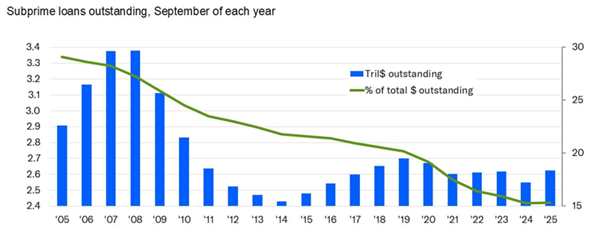
There has been much handwringing lately about the increasing credit problems among sub-prime borrowers and what the fallout might mean for the broader economy. And make no mistake: Sub-prime borrowers are indeed under serious strain. The delinquency rate on loans to borrowers with a Vantage score below 660 jumped to 8.3% in September — the highest September reading since 2010, in the wake of the Global Financial Crisis. That’s just more evidence of how hard-pressed lower- and middle-income Americans have become.

However, the notion that losses on sub-prime loans will deal a brutal blow to banks or the financial system appears overdone (see chart below).

Outstanding sub-prime loans currently total about $2.63 trillion, or roughly 15.3% of all household debt. By contrast, at the 2007 peak they were over $3.38 trillion, or approximately 28.2% of debt. Sub-prime first mortgages are a shadow of their former size per data from Moody’s analytics.

Even though sub-prime auto loans have grown — with over $400 billion outstanding — that’s still relatively modest in the context of the system. Not enough, in my view to bring down the economy or the financial sector. That said, the First Brands/Tricolor saga underscores that we are further into the cycle, underwriting standards are thinning, and subtle cracks may presage larger issues. In short: Watch with respect and discipline.

Source: Moody’s analytics, Equifax

I don’t often talk about crypto in these pages, so let me spend some time on it, as the digital asset world is growing and becoming more popular and acceptable than ever as mainstream institutions move in with large investment and plans for the sector. Even BlackRock’s Larry Fink, once a sceptic, now speaks of crypto with the conviction of a convert. His shift is telling. It’s a sign that the centre of gravity in finance is moving — quietly, steadily — toward the digital frontier.

Last week, I spoke at the Digital Asset Summit (DAS) in London organised by Blockworks. I shared what I called the allocator’s perspective on digital assets. My message was simple: The timeless principles of investing still apply. You understand risk. You weigh reward. You value optionality. You manage the trade with discipline.

But I’ll tell you something more personal. It took me a long time to get here. Years ago, my friend Kelly told me, “Buy Bitcoin.” It was four hundred dollars. I laughed. I thanked her. And I didn’t buy it.

I couldn’t make it fit inside my equity mindset — the one that wants to see cash flow, dividends, tangible proof. Bitcoin had none of that. It felt abstract, speculative, unserious. Another tulip craze, I thought. Another dot-com waiting to burst.

But then time passed. And I watched.

I saw that every great innovation begins as a punchline. The railroad. The telephone. The Internet. They all started in mania, ended in transformation.

So, I stopped asking, “Is this a bubble?” and started asking, “What is this trying to tell us?”

And what it told me was that trust — that fragile, essential thing that underpins all markets — was being rebuilt from the ground up. That money itself was being re-imagined, not by decree, but by design. So yes, I found my way to crypto the old-fashioned way — I ignored it for years, mocked it once or twice, then surrendered.

It’s still a risky asset, of course. But it’s one with immense optionality. And optionality is something to respect, not to leverage. Some learned that lesson again last weekend, when the market turned and liquidity vanished. An asset that can change the world doesn’t need leverage; it needs patience.

There will always be sceptics. There were with NVIDIA, too — remember that? The analysts who called it a bubble and taped a Cisco chart next to it? Sceptics are good for markets. They keep our confidence honest. I’d be worried if everyone were bullish.

The builders I meet in the crypto world today aren’t chasing memes or momentum. They’re tokenizing real-world assets. They’re fixing the plumbing of finance — settlement rails, infrastructure, security. It feels less like a casino and more like the early Internet again. Less noise, more engineering. Less flash, more foundation.

Digital assets remain one of the few corners of the market where you can find real optionality — asymmetric upside, uncorrelated innovation, and a front-row seat to the next market structure.

But one truth will never change. The old rules still apply. Discipline. Research. Sizing. Risk management. Understanding cycles. Anyone can look smart in a bull market — it’s staying solvent through the bear that defines you.

As Warren Buffett likes to say, “Only when the tide goes out do you discover who’s been swimming naked.” And in crypto, the tide goes out often.

Digital Asset Summit 2025, London UK (October 2025)

Source: DAS 2025, Blockworks

This moment feels like the early 2000s — when people said the Internet was finished, and quietly, Amazon and Google were being built. That’s where we are now: The boring but brilliant phase.

Every great innovation begins as a bubble — the railroads, the radio, the Internet, even AI. The bubble isn’t the end of the story; it’s the beginning of adoption.

Crypto is no different. It may still look strange, volatile, half-formed. But so did every idea that changed the world.

Moving on to one other sector that caught my attention – Biotech.

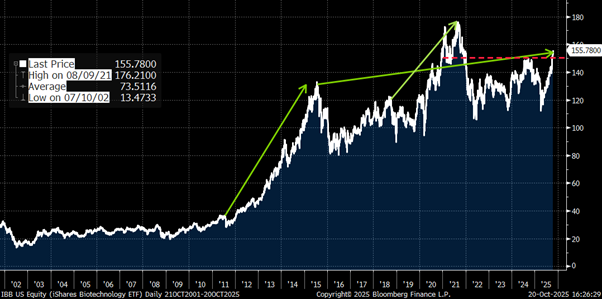
Biotech finally wakes up and IBB breaks out (chart below)

The Biotech ETF (IBB) has staged a notable recovery, advancing roughly 36% since the April 8 “tariff turmoil” low in the S&P 500. That puts the sector broadly in line with the broader market’s rebound. More importantly, last week’s move saw IBB break decisively above its late-2024 highs near $150, clearing a key technical resistance level and signalling renewed momentum.

However, the longer-term picture tells a different story.

Over the past five years, S&P 500 index (SPY) has appreciated nearly +90%, while IBB has gained only +7%. The sector’s last significant rally came during the pandemic, driven by vaccine and mRNA innovation, but since then, investor focus has shifted toward GLP-1 therapies and the technology sector’s AI-driven boom.

Biotech ETF (IBB): Last twenty-three years

Source: Bloomberg

Historically, Biotech’s last major multi-year advance occurred in the early 2010s, following the financial crisis and the passage of the Affordable Care Act (ACA), when capital flowed aggressively into healthcare innovation. The past decade, however, has been marked by relative underperformance and multiple false starts.

With IBB now breaking out in the short term and the integration of AI in drug discovery, clinical design, and data modelling accelerating, the conditions could be forming for a structural re-rating of the sector. While it remains too early to call a sustained cycle, Biotech’s combination of depressed relative valuations and emerging productivity gains from AI warrants closer attention from long-term investors.

Finally, the dot-com comparisons are inevitable — they always surface when tech leads the market. That’s why it’s worth grounding the conversation in data.

On forward earnings multiples today: NVIDIA trades around 26x, Costco about 47x, and Walmart near 40x. For context, in 1998, Cisco was trading at roughly 60x earnings — and by the peak of the bubble, that multiple had soared to 210x.

By that measure, we are nowhere near bubble territory. Still, after the extraordinary rally since the April lows, a correction — for reasons related or unrelated to fundamentals — wouldn’t be surprising. The key is to stay focused on quality: companies with proven earnings power or clear, structural relevance to the future economy.

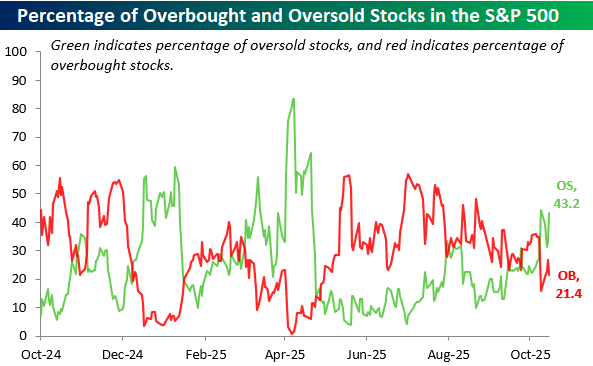
And here’s one overlooked data point: despite endless talk of “overbought” conditions, there are currently twice as many oversold stocks (43%) in the S&P 500 as overbought ones (21%).

Source: Bespoke Invest

As always, disciplined investing through trusted structures that manage downside risk, remains the most reliable way to compound returns over time.

For specific stock recommendations and insights related to structured products, please do not hesitate to reach out to me or to your dedicated relationship manager.

 
Best wishes,

Manish Singh, CFA

MVP Sept 2025 - US Labor Market Fragility Puts Fed on Track for Cuts

“Inflation is easing, equities remain resilient despite short-term volatility, and rate cuts are now firmly on the table.”

Summary

The latest US Labor Department report showed 263,000 first-time jobless claims – well above expectations and the highest since October 2021. Combined with weak payroll growth, this reinforces the growing fragility of the US labour market. Inflation data suggests modest easing at the consumer level, while producer prices point to potential deflationary pressure. The Fed’s preferred inflation gauge, the Personal Consumption Expenditure (PCE) index, won’t be released until later this month. But the bond market isn’t waiting. The US 10-year yield is on the verge of breaking below +4%, as investors increasingly price in a looser policy path. Futures now imply three rate cuts by year-end and six by the end of next year. As interest rates fall, the critical question is whether the $7.3 trillion currently sitting in US money market funds begins moving into risk assets. We won’t have to wait long to find out.

Technological breakthroughs often reset the rules of competition, creating new winners while leaving others behind. Just as alternating current displaced direct current and reshaped the energy sector, today’s AI, cloud computing, and infrastructure revolutions are beginning to challenge established market leaders. Companies that adapt and innovate may find outsized rewards; those that don’t risk irrelevance. Disruption rarely moves in straight lines, but history is clear—transformation brings both risk and opportunity, and investors need to be positioned for both.

Despite some near-term volatility, the broader equity market remains resilient. Strong corporate earnings, accelerating investment in transformative technologies—particularly AI—and the prospect of falling rates continue to underpin confidence. While short-term corrections are always possible, the structural backdrop suggests the rally still has meaningful room to run.

US Labor Market Fragility Puts Fed on Track for Cuts

In July, US Federal Reserve (Fed) Chair Jerome Powell described the US labour market as “solid – historically low unemployment.” Six weeks later, the data tells a very different story.

The August jobs report showed only 22,000 payroll gains, while June was revised down to a 13,000 loss – the first decline since 2020. The three-month average has slumped to 29,000 – the weakest in five years. Unemployment climbed to 4.3%, its highest since October 2021, while cumulative payrolls have now been revised down by over 2 million across the past three years.

The Bureau of Labor Statistics’ preliminary benchmark revisions:

  • 2023: -306,000
  • 2024: -818,000
  • 2025: -911,000

That’s more than two million jobs that never existed – an unprecedented downgrade, surpassing the previous record revision of -824,000 in 2009 during the global financial crisis.

It would appear that when the Fed pressed ahead with rate hikes last year, it was tightening into an already fragile labour market—one whose weaknesses were masked by the liquidity and fiscal support unleashed under former US President Joe Biden. The broader economy may have avoided a technical recession, but the jobs market was effectively in one.

U.S. Jobs Report: First negative print since December 2020

Source: Bloomberg

Additionally, a separate US Labor Department report this week showed 263,000 first-time jobless claims, surpassing expectations and marking the highest level since October 2021. This surge, coupled with sluggish job growth, underscores the growing fragility of the US labour market.

This week’s other key data releases – August Consumer Price Index (CPI) and Producer Price Index (PPI) – set the stage for this week’s Federal Open Market Committee (FOMC meeting on September 17.

  • Consumer Prices (CPI): Headline inflation rose +2.9% YoY (up from +2.7%), with core CPI (excluding food and energy) steady at +3.1%, and month-on-month gains of +0.3%, in line with forecasts
  • Producer Prices (PPI): Final demand PPI fell -0.1% MoM, driven entirely by trade services, which declined at a -19% annualised rate – tying the fastest drop in the series back to 2009. Core PPI (excluding food, energy, and trade services) rose +4.0% annualised, slower than last month, but still robust. Lower energy prices also weighed on headline PPI

Both readings point to modest easing at the consumer level, while producer prices raise some deflationary concerns.

Tariff-driven price pressures remain uneven. Cars and clothing saw faster increases, while items like tires and furniture showed only muted gains. Groceries, however, surged – up +0.6% in August, with coffee up +21%, beef steaks +17%, and apples +10% over the past year.

This raises an important question: Are tariffs fuelling a temporary inflation spurt, or something stickier?

I see the potential for a one-off inflation spike – for example, coffee prices jumped +21% after President Trump imposed a 50% tariff on Brazil. But consumer behaviour will eventually push back: People may simply delay or forgo purchases. This adjustment can happen quickly, creating rapid deflationary pressure.

For me, the outlook is clear: Disinflation is the path forward, not persistent inflation.

The Fed’s preferred inflation gauge, the Personal Consumption Expenditure (PCE) index, won’t be out until later this month, though forecasters expect a softer reading than CPI.

Still, the central dilemma lingers: Are tariff-driven price hikes temporary, or do they risk embedding into wages and broader inflation, as in 2021–22?

The answer may not be clear until well into next year – leaving the Fed to navigate policy with more uncertainty than clarity.

The bond market is not waiting for Fed. The US 10-year yield is poised to break below +4% and as investors price in a much looser policy path. Futures markets now imply three rate cuts by year-end and six by the end of next year (see chart below)

Fed rate-cut bets, as priced by Money Market Futures

Source: Bloomberg

Historically, US rates have hovered only marginally (50-100 bps) above ECB levels (see chart below). Today, they are 235 bps higher. Against this backdrop, the fourth quarter is shaping up to be highly consequential for both markets and policymakers.

Meanwhile on the US GDP growth front, US growth showed resilience in Q2, with GDP expanding at an annualized +3.3%, a rebound from the Q1 contraction and evidence that domestic demand – particularly consumption and a drop in imports – supported activity.

Business surveys however tell a split story. The ISM manufacturing PMI remains in contraction territory at 48.7 in August, signalling continued factory-sector weakness and softer production and employment in goods-producing industries.

By contrast, ISM’s services index rose to 52.0, indicating modest expansion in services and stronger activity in areas like new orders and business activity.

S&P Global’s PMI composite also points to continued expansion, with the composite at the mid-50s – consistent with steady, if not blistering, growth.

Importantly, America’s technology leaders have pledged massive domestic investments that could help offset broader economic weakness.

Apple and Meta have each pledged $600bn in US investment through 2028, Google committed $250bn, and Microsoft is ready to spend up to $80bn a year—part of nearly $400bn in AI infrastructure spending this year alone.

With OpenAI and Anthropic raising billions at valuations nearing $500bn, analysts see global data-centre outlays topping $3trn by 2028. Corporate America is betting big that AI will power the next leg of growth.

As interest rates come down, the big question is whether the $7.3 trillion currently parked in US money market funds will begin rotating into risk assets?

We shall find out soon enough.

President Trump continues to demand aggressive rate cuts while questioning Powell’s leadership. Trump would like a 75bps rate cut this week, but that is unlikely. Chances of a 50-bps rate cut are not insignificant anymore, with Polymarket indicating a 20% probability.

Markets and the Economy

Last week, the blue-chip Dow Jones Industrial Average (DJIA or The Dow) index surpassed 46,000 for the first time. The S&P 500 (SPX) and Nasdaq have now hit records 24 times this year, and are both up at least +12% year-to-date (YTD, see table below).

On the bright side, the spending as outlined in the section above continues.

On the whole, price increases this year haven’t been as stiff as feared this spring, when Trump announced large and broad increases in tariffs.

And if there’s a downturn, rate cuts are coming. This has kept the equities well supported (see table below).

Global Equity Index Performance (2025 YTD, since April 4 YTD and 2022-25 YTD)

Meanwhile in the UK, the UK economy has stalled. The latest Office of National Statistics (ONS) data, showed GDP flat on the month, with services barely expanding while industrial output dropped -0.9% and manufacturing fell -1.3%. These figures highlight how the drag from past tax hikes is biting, while the prospect of further fiscal tightening in the upcoming budget adds to the headwinds.

The Labour government of UK Prime Minister Keir Starmer, looks paralysed by its own contradictions. Labour’s majority counts for little when it can’t even pass its own welfare bill – a measure that could have trimmed spending, improved fiscal headroom, and created space for growth-friendly tax cuts. Instead, ministers are hostage to activists, MPs to ministers, and the Prime Minister to his own shadow.

The Bank of England (BoE) meets this week and is expected to hold rates at +4%, after five cuts since last summer. Policymakers face an impossible balancing act: Growth is weak, and the labour market is softening, yet inflation at +3.8% remains stubbornly above target.

In Westminster, “full confidence” from the Prime Minister has become the kiss of death – first for Angela Rayner, then Peter Mandelson. One can only hope he quickly extends the same to Ed Miliband. With the UK still burdened by the highest energy prices of anywhere in the developed world, stifling what’s left of its manufacturing base, millions of Britons would welcome both the endorsement and the results it could bring.

What the UK needs are tough decisions on spending, starting with public sector pensions and final salary schemes. A reduction in the civil service through natural attrition, to simply bring government in line with the private sector. Instead, we face the grim prospect of more taxes and less money in people’s pockets – a path that leads only to deeper stagnation.

A government hamstrung by internal divisions and stalled reforms leaves little room for decisive fiscal support. For investors, the combination of policy paralysis, high energy costs, and structural drags points to continued underperformance in UK assets – GBP and Gilt relative to peers.

The UK economy stagnates: UK GDP growth, month-on-month

On the continent, the European Central Bank (ECB) held its benchmark rate at +2% for the second consecutive meeting.

ECB President Christine Lagarde emphasized that “the domestic economy is showing resilience, the labour market is solid, and risks are more balanced,” adding that inflation is “where we want it to be.” The decision followed the EU’s trade deal with the US in late July, which imposed 15% tariffs on much of the bloc’s exports.

Eurozone inflation rose slightly to +2.1% in August, while revised forecasts now point to +1.7% in 2026, up modestly from +1.6% in June, indicating a slight upward shift in medium-term expectations.

The ECB has largely tamed inflation, and prices appear set to continue falling. So why not support the economy with a rate cut? Businesses facing higher US tariffs could certainly use the relief. Yet with Eurozone rates already over 200bps below those in the UK and US, the ECB has limited room to manoeuvre if growth surprises to the downside.

Bond investors have endured one of the most difficult stretches in modern history. The Bloomberg US Aggregate Bond Index (LBUSTRU), the broad benchmark for fixed income, has delivered an average annual return of roughly 0.0% over the last five years — a sharp reversal from its +4.1% average over the past 25 years and +6.7% since 1976.

On a rolling 2-, 5-, and 10-year basis, returns sit in the bottom 1% of all historical observations.
This weakness marks the end of the four-decade bond bull market (1980s–2020), when steadily falling interest rates drove consistent gains. The rapid rate hikes beginning in 2022 triggered historic losses, especially in longer-duration Treasuries. Yet, there are signs of renewal with rate cuts ahead and bond yields today are the most compelling in over a decade:

Bloomberg Global Aggregate Bond Index – highest since December 2021

Source: Bloomberg

With inflation easing and rate cuts increasingly likely, the rest of 2025 and 2026 are shaping up as a much friendlier environment for fixed income.

It has been a brutal half-decade, but in markets – as in life – it’s always darkest before the dawn.

Shifting to an asset class we don’t discuss often – Private Equity (PE) and alternatives.

A recent Wall Street Journal piece on endowments really caught my eye. I’m not a fan of investing in PE, just for the sake of diversification. It’s often marketed that way, but that marketing can lure investors into long lock-ups, illiquidity, and promised returns that rarely materialize. Evaluating these investments is notoriously difficult, and the glossy Internal Rate of Returns (IRR) you see, are often not a true measure of performance, leaving them open to manipulation.

Endowments, which are a good proxy for PE-heavy portfolios, are reporting returns clustering around +8–10% (see chart below), and that’s still based on valuations I suspect are overstated. The era of “easy alpha” in private equity seems increasingly over.

Typical Endowment allocations are roughly:

  • Private Equity: 30–40%
  • Public equities: 25–35%
  • Real assets (real estate, infrastructure): 10–15%
  • Fixed income/hedge funds: 10–15%

It seems the alpha disappears once everyone follows the same playbook: Pile into PE and lock up capital for a decade.

As I often remind people: If you can compound at +10–12% annually in listed equities, you’ll outperform most hedge funds or private equity over a 5–10 year cycle. Those flashy +20% IRRs usually compress to something closer to 8% annual cash-on-cash when measured properly.

The power of compounding over 10 years is striking:
10% p.a. turns $1 → $2.6
11% p.a. turns $1 → $2.83
12% p.a. turns $1 → $3.1

I have nothing against Private Equity – they’ve mastered a compelling sales pitch, and some firms genuinely deliver. But those are the exceptions, not the rule. Hopefully, endowments and private investors are starting to realize this – and early signs suggest they are.

There are now more exchange-traded funds (ETF) than individual stocks. We’ve created more baskets than there are apples to fill them.

Every niche, sector, and theme seems to have its own ETF, and the proliferation shows no sign of slowing. Maybe that’s a signal that active investing is due for a comeback. When the shelves are overflowing with passive options, skilful stock pickers who can cut through the noise may finally find their moment.

I’m not saying we’ve hit peak ETF – far from it – but it’s hard to ignore that the market is already well-stocked. At some point, having too many baskets might just remind investors why focusing on the fruit inside still matters.

Bull markets in equities typically last four times longer than bear markets, and this current run is far from over.

Despite periodic volatility and pullbacks, the bull market shows few signs of exhaustion. Strong corporate earnings, robust technology investments -especially in AI. -and supportive monetary conditions continue to underpin investor confidence. While short-term corrections may occur, the broader trend suggests the equity rally still has considerable runway.

Looking at technology specifically, the trajectory of the Nasdaq following the release of ChatGPT in October 2022 mirrors the path after Netscape’s 1994 debut—the browser that made the internet accessible to mainstream users and sparked the Dot Com Boom.

Source: Bespoke Invest

Netscape’s debut in 1994 was a watershed moment: it made the internet accessible to millions, fuelled enormous excitement about the digital future, and helped trigger a surge of investment and innovation that defined the late 1990s.

The release of ChatGPT synonymous with AI, LLM and expanding data centre spend shows the strongest correlation to Netscape’s launch.

As illustrated in chart above, the two patterns remain strikingly similar.

By late 1997, the Nasdaq had climbed slightly higher than its current level, but the overall resemblance endures. If history serves as a guide, the AI Boom still has substantial room to grow in the coming years. A relentless investment race is underway, with tech giants pouring resources into the computing power required for increasingly sophisticated AI models.

Just as alternating current (AC) eventually overtook direct current (DC) in 19th-century America, reshaping the entire electricity industry, innovations can transform sectors in ways that catch investors off guard.

Thomas Edison championed DC, which powered early electric grids, but it had severe limitations in transmitting electricity over long distances. Nikola Tesla and George Westinghouse promoted AC, which could efficiently carry power across cities and regions. Firms tied to DC infrastructure were forced to adapt, consolidate, or disappear, while AC became the industry standard, creating massive value for the winners.

This episode illustrates a broader lesson for investors today: Technological breakthroughs often redefine the competitive landscape, leaving some companies behind and propelling others to dominance. Just as AC disrupted DC, AI, cloud computing, and other emerging technologies may upend current market leaders, rewarding those that innovate and penalizing those that fail to pivot. The path of progress is rarely linear, and historical precedent reminds us that disruption can create both risk and opportunity in equal measure.

Hence, I highlight the value of equity structured products, as a highly effective investment tool to manage and potentially capitalize on increased market volatility. These products offer a degree of capital protection, while helping to identify advantageous entry points. They also present opportunities to generate returns, even in flat or declining market conditions.

Yet today’s financial system appears well-positioned to absorb shocks. Unlike past bubbles—such as Britain’s railway crash in the 1860s, which triggered bank losses and a credit crunch – much of today’s AI infrastructure spending is being financed from big tech’s deep cash reserves, robust earnings and free cash flow reducing systemic risk while fuelling continued growth.

For specific stock recommendations and insights related to structured products, please do not hesitate to reach out to me or to your dedicated relationship manager.

 
Best wishes,

Manish Singh, CFA


We’re seeing a subtle shift in tone from key Fed officials, yet Fed Chair Jerome Powell may be gone soon.

Summary

President Donald Trump is done waiting. He wants interest rates cut—and if Fed Chair Jerome Powell won’t deliver, Trump is ready to replace him.

Historically, U.S. interest rates have hovered just 50 to 100 basis points above those set by the ECB. Today, the gap has ballooned to 235 basis points. With inflation cooling, the Fed’s stubbornly high rates appear increasingly detached from economic reality—anchored in outdated fears rather than current data.

If the Fed holds rates steady at the July 30 FOMC meeting, expect fireworks. Trump may waste no time: Announcing a preferred successor to Powell that same evening, effectively installing a “Shadow Fed Chair.” From that moment, markets could begin tuning Powell out entirely. And if the pressure continues, Powell may even step down before his term ends in May 2026—opening the door for a Trump-appointed Chair as early as this Christmas. Trump’s criticism of the Fed resonates with many investors and economists. But his confrontational style and willingness to upend norms risks undermining the credibility of his message—and alienating moderate support.

Meanwhile, after a near -20% slump during April’s tariff-induced sell-off, the S&P 500 has roared back with a classic V-shaped recovery, hitting new all-time highs. The 10-year Treasury yield slipping below +4.20% adds further fuel, reflecting cooling inflation and rising confidence in monetary easing. The S&P 500 has rebounded +26% from its April 8 lows—yet it’s up only ~+7% for the year. This still feels like the early innings of the 2025 rally. And as the old market adage goes: “Don’t fight the tape.”

Trump Wants Rate Cuts — And He Wants Them Now

President Donald Trump has repeatedly pushed US Federal Reserve Chair Jerome Powell to slash interest rates in a bid to stimulate growth. Earlier in June, Trump publicly called for the Federal Reserve (Fed) to cut its benchmark rate from +4.3% down to the +1–2% range, citing the rising costs of servicing US government debt.

More recently, Trump escalated his pressure campaign by posting a comparative chart of global central bank rates—highlighting the Fed’s relative hawkishness and insisting the appropriate Federal Funds Rate should be in the +0.25% to +0.50% range (see below).

I’ll let you judge for yourself where interest rates should be — but let’s give credit where it’s due: Trump’s penmanship is surprisingly tidy. All caps. Clear. Impossible to miss.

On Monday, in typical Trump fashion, he didn’t hold back:

“He [Powell] just refuses to lower rates. I don’t even think he’s political — I think he hates me. He probably should. I’ve called him every name in the book trying to get him to cut.”

Clashes between Presidents and Fed chairs aren’t new — Franklin D. Roosevelt vs. Marriner Eccles, Harry Truman vs. William McChesney Martin, Richard Nixon vs. Arthur Burns, Ronald Reagan vs. Paul Volcker, even Bill Clinton had his moments — but this one is uniquely personal, thanks to Trump’s trademark style.

When Roosevelt considered appointing banker Marriner Eccles to head the Fed, Eccles insisted on fundamental reform. He famously said the Fed needed more centralized, public interest control—or “it should be considered simply an agency…whose primary function is to carry out the job of Government financing at the will of the Treasury.”

Truman clashed repeatedly with Fed Chair Martin, who refused to accommodate policies aimed at financing post-war spending and the Korean War

Nixon leaned on Fed Chair Burns to boost the economy ahead of the 1972 election, directing him to cut rates. Burns initially resisted, but ultimately complied, stating privately: “We dare not exercise our independence for fear of losing it.”

Volcker, appointed by President Jimmy Carter and retained by Reagan, made the politically painful decision to raise interest rates to ~20% to crush inflation—despite opposition from the Reagan White House.

Trump is done waiting. He wants interest rates lower, and if Powell won’t deliver, Trump wants him out.

Trump’s Commerce Secretary, Howard Lutnick added fuel to the fire:

“Why do we have one of the highest central bank rates in the world? We have a roaring economy, low inflation, trillions in new investment, and $88 billion in tariff revenue. Powell is part of the ‘expert class’ that’s been wrong about Trump from day one. This is a sad situation for our country. Powell and the Fed board should be ashamed.”

What we’re seeing isn’t just a disagreement over monetary policy — it’s a political and institutional standoff, that could reshape the Fed’s independence. And it’s only just heating up.

There’s some merit to Trump’s argument. A basic comparison between the US Fed Funds Rate and the European Central Bank (ECB) base rate, shows US rates are currently at least 100 basis points higher than normal.

Historically, US rates have hovered only marginally (50-100 bps) above ECB levels (see chart below). Today, they are 235 bps higher.

With inflation showing signs of cooling, the Fed’s elevated rate stance now appears increasingly driven by inflationary fears rather than current inflation realities—a dynamic that is arguably holding back growth.

Trump’s critique of the Fed’s rate posture touches a nerve with many investors and economists. However, it’s his combative tone and unconventional methods that tend to undermine the seriousness of his message and alienate potential allies—even when the economic argument has substance.

5-Year chart: US Federal Funds rate v/s ECB main refinancing rate

Source: Bloomberg

We’re already seeing a subtle but meaningful shift in tone from key Fed officials including Fed Chair Powell

Powell said this week that he “can’t say” whether a rate cut will happen in July — but he hasn’t ruled it out either.

Fed Governor Christopher Waller and Vice Chair Michelle Bowman have publicly signalled that rate cuts could be on the table as early as July — if inflation continues to ease. Even former St. Louis Fed President Jim Bullard, now outside the voting circle, has re-emerged to push for a cut, reinforcing what markets are increasingly pricing in.

Let’s be clear: Rate cuts aren’t coming just because Trump is demanding them. They’re coming because the data is starting to justify them.

Core PCE inflation for May came in cooler than expected at +2.7%, while retail sales have shown signs of fatigue — both classic indicators for a dovish policy pivot. Oil prices have softened too, thanks to easing geopolitical tensions in the Middle East, helping push headline inflation lower and fuelling risk appetite in equity markets.

Meanwhile, labour market cracks are beginning to show. ADP’s June report revealed a surprise contraction in private-sector hiring, with payrolls falling by 33,000 — the first decline since March 2023. That’s a sharp miss against expectations for a 100,000 gain. Even May’s already-weak figures were revised lower.

Put simply: The Fed’s tone is softening because the economy is too.

Price chart: ADP National Employment Report

Source: Bloomberg

If the Fed doesn’t cut rates at the upcoming FOMC meeting on July 30, brace for impact. Fireworks are almost guaranteed.

And don’t be surprised if, that same evening — or the very next day — Trump announces his preferred successor to Powell, effectively installing a “Shadow Fed Chair.” At that point, markets may start tuning Powell out entirely.

If the political pressure keeps building, Powell may opt to step down before his term ends in May 2026 — opening the door for Trump to appoint a new Chair as early as this Christmas.

All that said, no — rates aren’t going back to +1%, let alone +0.5%, even if Trump somehow made himself the Fed Chair.

Ignore the noise of – inflation may yet come.

Focus on what’s most likely to happen, not what’s loudest.

And stay out of “emotional debates” — they rarely help your investment decisions.

“Thank you for your attention to this matter”

Markets and the Economy

While much of the market remains focused on the Federal Reserve and potential rate cuts, attention is also turning to the “One Big Beautiful Bill” (OBBB)—a sweeping legislative package that combines tax cuts, spending reductions, and enforcement reforms.

The bill narrowly passed the Senate in a 51–50 vote, with Vice President JD Vance casting the tie-breaking vote. However, it faced strong resistance in the House of Representatives, as a group of Republican holdouts voiced objections to key provisions in what had become Trump’s signature legislative package.

With the GOP holding a narrow 220–212 majority—and at least five members, including several from the Freedom Caucus, having already opposed a procedural vote over concerns about insufficient spending cuts and reductions to Medicaid—the bill appeared to be in jeopardy. Nonetheless, Speaker Mike Johnson and President Trump launched an intensive lobbying effort in the lead-up to the self-imposed July 4 deadline. Trump’s mix of persuasion and political pressure ultimately proved effective.

The House passed the bill on Thursday afternoon, reinforcing President Trump’s firm grip on the Republican Party. In the end, only two House Republicans and three GOP senators voted against the measure.

President Trump is set to sign the legislation into law on Friday, marking the occasion with an Independence Day celebration at the White House, including a picnic for military families. The event will feature a flyover by a B-2 stealth bomber—the same aircraft used in the recent surprise U.S. strike on Iran’s nuclear facilities.

The One Big Beautiful Bill (OBBB) passed by the House includes a sweeping package of tax cuts and spending changes, totalling roughly $4.5 trillion in tax relief. Key provisions include the extension of Trump-era tax cuts, new exemptions for tips and overtime pay, and a significant expansion of the child tax credit—estimated at $817 billion. The bill also raises the SALT deduction cap to $40,000, benefiting residents in high-tax states.

On the spending side, it rolls back clean energy tax credits from the Inflation Reduction Act, imposes limits on Medicaid growth, and introduces cuts to discretionary spending. It includes increased support for rural hospitals and infrastructure, along with expanded IRS enforcement measures.

According to the Congressional Budget Office, the legislation would add $3.3 to $3.4 trillion to the federal deficit over the next decade, despite efforts to offset costs through spending reductions and enforcement provisions.

Global Equity Index Performance (2025 YTD and from April 8 market lows, 2022-2025 YTD and 2024 Performance)

So far, the US Treasury market has shown little reaction—suggesting investors may have already priced in the bill’s fiscal impact. Let’s see how things unfold in the coming days, and if the bill is beautiful – or just big.

Meanwhile, across the Atlantic, the UK’s Labour government is grappling with its own fiscal challenges. A proposal to cut welfare benefits—part of an effort to rein in a £59.6 billion deficit over the past year—was overwhelmingly rejected in Parliament, with a sizable number of Labour MPs rebelling against the leadership.

The government, under pressure to improve deteriorating public services, while reducing the deficit, has opted for benefit cuts rather than tax hikes—a politically fraught path for a centre-left party. Prime Minister Keir Starmer has so far resisted raising taxes, but the backlash over benefit reductions has exposed deep divisions within the party.

Chancellor Rachel Reeves faced speculation over her future earlier in the day, which fuelled volatility in UK bond markets, until a statement from the Prime Minister’s office reaffirmed its support for her, helping to pull Gilt yields back from session highs. Although yesterday’s 19 basis point surge in UK 30-year gilt yields, wasn’t the largest recent move, it was still significant.

The UK’s limited fiscal flexibility, despite a debt-to-GDP ratio similar to that of the US, leaves it more vulnerable to bond market reactions. This episode is the latest in a pattern of developed economies coming under bond market pressure—following earlier flare-ups in the US in April and in Japan earlier this summer.

Meanwhile, after a rocky March and early April, equity markets have bounced back sharply both in the US and abroad (see table above).

After a -19% drop during April’s tariff-driven market tantrum, the S&P 500 (SPX) has staged a sharp V-shaped rebound, climbing to new all-time highs.

While the index is up +26% from its April 8 lows, it’s only up +6.8% for the year.

While US markets have done well, many international markets have done even better.

Countries like Germany (DAX), Italy (FTSEMIB), Hong Kong (HSI), and Spain (IBEX) have outperformed the S&P 500 by over +10% YTD.

We have seen similar rallies across sectors. The only sectors that have lagged are Healthcare (XLV) and Consumer Discretionary (XLY).

Benchmark US equity sector performance (2022-2025 YTD, 2023-24, 2025 YTD and 2025 YTD relative to the S&P 500 Index)

What we’ve seen so far in the SPX, appears to be a recovery rally. When measured by the pace of new all-time high closes, the index’s 2025 advance may still be in its early stages.

On Friday last week, the SPX surged to a fresh all-time high — its first since late February.

Meanwhile, 10-year Treasury yields are now below +4.20%.

The yield decline reflects growing market conviction, that the Fed may begin trimming rates as early as July 30.

As indicated in the section above economic data has started to soften. May’s Core PCE inflation cooled to around +2.7%, slightly below forecasts, and retail sales showed signs of fatigue.

Technical indicators are also flashing positive signals. The SPX recently formed a “golden cross,” where its 50-day moving average rose above the 200-day—a bullish pattern last seen in February 2023. Market breadth has improved, too, with sectors beyond mega-cap tech—such as financials, industrials, and utilities—joining the rally.

Source: Bespoke Investment Group

Looking at seasonality in stock performance, July has historically been the hottest month not just in terms of weather, but also for markets—especially the SPX.

Since World War II, July has ranked as the fourth-best month for the SPX, with an average gain of +1.2%.

Over the past 25 years, its average return improves to +1.5%, making it the third-best month, and over the last 10 years, it climbs even higher—ranking second with an average gain of +3.4%, just behind December’s +4.1%.

What’s particularly notable is the consistency: The SPX has finished higher in July for ten consecutive years.

But enjoy the strength while it lasts—August has historically been a weak spot, ranking as the third-worst month since WWII and the fifth worst over the past 25 years. September has been even worse, standing as the weakest month across all three-time frames.

Source: Bespoke Investment Group

Momentum often builds on itself, and it’s likely we’ll see more of this in Q3. As the old market saying goes, “Don’t fight the tape.”

The technical outlook for semiconductors has improved markedly in recent weeks. Both price action and relative strength show the sector breaking out of the downtrend that began after last summer’s peak.

Nvidia (NVDA), the sector’s largest and most influential stock, recently reached a new high and is on track to become the first company in history to hit a $4 trillion market cap.

While Nvidia leads the charge, the rally in the Philadelphia Semiconductor Index (SOX) has been broad-based: since the April low, its components have averaged a +45.8% gain, with all but three outperforming the SPX.

The broader market, however, paints a more nuanced picture. Those concerned about high tech and semiconductor valuations should note that although the SPX market-cap-weighted price-to-earnings multiple is nearing late-2020 levels, the equally weighted version of the index trades at valuations more typical of the 2010s (chart below)—underscoring how much of the recent rally has been driven by the largest names.

Source: Bespoke Investment Group

Bottom line: The SPX ‘s climb to fresh all-time highs, combined with the 10-year yield dipping below +4.20%, reflects a nuanced but promising backdrop: A Fed signalling growing comfort with easing, inflation gradually cooling, and technical turning constructive. While the recent rally appears more like a recovery than a breakout, the frequency of record closes suggests the bulk of 2025’s upside may still be ahead.

 
Best wishes,

Manish Singh, CFA