“It’s not whether you’re right or wrong that’s important, it’s how much money you make when you’re right and how much you lose when you’re wrong.”

George Soros

Summary

The US budget balance has been in deficit for the last two decades. It is a deficit that just keeps on growing. It now stands at -16.3% of US GDP, the largest since 1945, a time when the country was financing massive military operations to help end World War II. Granted that the current pandemic is a significant reason for this record deficit, but the trend line indicates things started going south well before, at the time of the Great Financial Crisis of 2007-08, and it hasn’t reversed since. Continued stimulus and the “check is in the email” are now looking like regular promises for US households. The $1,400 check just received, follows the $600 check received in December and $1,200 early last year. This new round of stimulus will cost US taxpayers $1.9 trillion. The administration of US President Joseph Biden, is now crafting infrastructure spending plans that could cost as much as $3 trillion. All of it paid for through debt and a resulting increase in the deficit. The big question is therefore: Can the US wean itself off stimulus?

Thankfully, the major part of the pandemic seems to be behind us, as vaccinations globally have accelerated. We are moving ahead to the economic re-opening that everyone so keenly awaits – everyone except bond investors that is. In my view, rising bond yields are not currently of concern, and are more an indicator of things heading back to normal. The risk to equities will only come from an anticipated change in monetary or fiscal policies – be it the threat of increased taxation or relaxing the stimulus sooner than the market anticipates. It was very clever of US Federal Reserve Chairman Jerome Powell at a recent press conference, to warn the markets that the Fed “will not act on forecasts but will wait to see actual data.” That’s a sharp jab at the markets anticipating inflation that may or may not materialize over the short to medium term. If the “supply” can meet the “demand” created from the economy re-opening, then an inflation overshoot can be contained and indeed will be transitory. Expect earnings surprises to abound when the re-opening is in full throttle. Barring the volatility that inflation prints (or anticipation of such) will bring, the risk to equities remains to the upside.

Can the United States wean itself off stimulus?

The US Federal Reserve (Fed) met this month and concluded that there was no need to ease monetary policy further and I don’t disagree. By any standard, monetary policy is currently ultra-loose and US economic growth and inflation are both looking up. However, the US fiscal authority is, at this time, in no mood to rein in debt or the deficit. Continued stimulus and the “check is in the email” are now looking like regular promises of cash for US households.

Last week, a third round of “stimulus checks” started showing up in the accounts of millions of Americans. The $1,400 check, follows the $600 check per recipient received in December and $1,200 early last year. This new round of stimulus will cost US taxpayers $1.9 trillion. The administration of US President Joseph Biden, is now crafting infrastructure plans that could cost as much as $3 trillion. This would go towards much needed spending to repair roads, bridges and other infrastructure projects, nonetheless all of it paid for through debt and a consequent increase in the deficit.

Therefore I ask – Can the US wean itself off stimulus?

As the chart below indicates, the US budget balance has been in deficit for the last two decades. As the trend line indicates, it is a deficit that just keeps on growing. The deficit now stands at -16.3% of the US Gross Domestic Product (GDP), the largest since 1945, when the country was financing massive military operations to help end World War II.

At the same time, US Federal debt is over 100% of the US GDP for the first time in 70 years and that has put the US in same league as Greece, Italy and Japan, as among the most heavily indebted nations in the world. Granted that the pandemic is a significant reason for this record deficit, but the trend line indicates things started going south well before the pandemic, at the time of the Great Financial Crisis of 2007-08, and it hasn’t reversed since.

US Budget Balance as % of US GDP (1971-2021)

Source: Bloomberg

To the best of my knowledge, there is not a single instance in history that a developed nation successfully reined in its deficit and debt after such an expansion. So let’s see what lies ahead for the US, and this is the reason why so many question the fate of the US dollar.

One instance of an attempt to rein in loose fiscal policy is worth taking note of however. It happened in Japan in the 1930s – with a tragic ending. Japan’s Finance Minister Korekiyo Takahashi, the architect of Japan’s loose fiscal policy that got Japan out of the Great Depression, was assassinated by rebellious Japanese soldiers in 1936, for trying to dial back the fiscal stimulus.

In 1931, the US and Europe were in the middle of the Depression and Japan feared the worst, as this threatened to spread to its shores. Takahashi was summoned from retirement at age 77 to once again run the Finance Ministry. Takahashi was a brilliant man who worked his way up from lowly beginnings to occupy the highest positions in his country. Born illegitimate and adopted into the lowest stratum of the Samurai class, he became Finance Minister seven times between 1913 and his untimely death in 1936. He was also briefly Prime Minister and in 1905 secured crucial foreign funds for Japan’s military victory over Russia.

Viscount Takahashi Korekiyo (27 July 1854 – 26 Feb 1936)

Source: Wikipedia

Takahashi’s predecessor at Finance ministry favoured tight money policy – a strong yen and fiscal discipline, while Takahashi preferred – powerful stimulus, deficit financing and progressive taxation. No wonder he is such a role model to many Keynesians including the former Fed Chairman Ben Bernanke who gave a 2003 speech noting how “Takahashi brilliantly rescued Japan from the Great Depression.”

To steer Japan out of the great depression, Takahashi abandoned the gold standard, driving down the Yen’s value and lifting exports. He cut interest rates and started deficit spending. His most controversial act however, was to direct the Bank of Japan, then controlled by the Finance Ministry, to buy newly issued bonds directly from the government i.e. printing money to directly fund government deficits. It is a line few central bankers dare to cross even to this day.

The effort helped pull Japan out of depression and deflation, well before the United States and Europe.

Happy with the success by 1935, Takahashi decided to cut spending to prevent economic overheating. This made him a target of Japan’s increasingly aggressive military, which was demanding funds for its expanding China incursion. At 5 a.m. on Feb. 26, 1936, two rebel officers plotting a coup stormed Takahashi’s bedroom. One officer shot him with a pistol and the other slashed him with a sword.

It was a case of feeding the stimulus hydra that led to such a brutal end for Takahashi. Takahashi was right in stimulating the economy at the time of depression but it was for his attempt to moderate and balance his actions that he was murdered by those used to stimulus and free government spending.

Modern proponents of stimulus, whether at the central bank or in politics, will do well to heed the lessons of the past. Do not turn stimulus into a habit, else it will be very difficult to turn off the taps. The withdrawal symptoms could lead to bigger troubles, if not a tragedy. I particularly fear this for the Eurozone where the prospect of economic growth is bleak, while the debt and deficit keep piling up, without any degree of structural reform at the national levels.

There is also lesson in what happened after Takahashi’s murder. Inflation in Japan spiked to double-digits as confusion ensued. In the decades since his death, policymakers blamed Takahashi, and not the military, for the high inflation. Nearly half a century later, referring to Takahashi’s Depression-era policies, the Bank of Japan wrote in its official chronicle marking its 1982 centennial – “This is the bank’s biggest mistake in its 100-year history.”

It took Prime Minister Shinzo Abe’s decisive election victory in 2012 to restore Takahashi to some extent. Abe, in a speech after taking office said, “My forerunner Takahashi has emboldened me,” and Abenomics policies soon ensued.

Markets and the Economy

What a 12 month we’ve had! Negative interest rates, negative oil prices, a global pandemic, the undermining of an effective vaccine in a pandemic by certain leaders, the S&P 500 index (SPX) up over +70% from its March’20 lows, “roaring kitty” talking up certain stocks and most recently, a 1,300 foot long ship blocking world trade.

In a few years, when my children are old enough to understand it all and I tell them about the last 12 months, I do not expect them to believe me.

Thankfully, the major part of the pandemic seems to be behind us, as vaccinations have accelerated. We are moving ahead to the re-opening that everyone so keenly awaits – everyone except bond investors that is!

The chart below shows the historical returns of the Long term US Treasury Index. On a quarter-to-date (QTD) basis and up to but not including the final week of the quarter, with a decline of -12.68%, Q1 2021 is the worst quarter for the index in over 30 years. It’s also just one of two quarters where the index was down over -10%.

This clearly shows us the extent to which the bond market has so far this year rerated risk in anticipation of inflation and an interest rate rise.

Source: Bespoke Invest

In February’s Market Viewpoints I wrote that rising yields are grounds for anxiety, but not yet a cause for alarm. I continue to hold this view. Rising bond yields are more an indicator of things heading back to normal, as vaccine distribution accelerates, social distancing measures ease and economic activity picks up.

The risk to equities will only come from an anticipated change in monetary or fiscal policies – be it the threat of increased taxation or relaxing the stimulus sooner than the market anticipates.
This is also borne out by survey data. For the first time since February 2020, the pandemic is no longer the biggest risk for fund managers surveyed by Bank of America (BofA). Inflation and tapering of Quantitative Easing (QE) purchases by the Fed (“taper tantrum”) are now more feared by investors.

Investing doesn’t come without risk. Last March, Covid-19 took the market by surprise. At least now the risk is clear – i.e. inflation (or the anticipation of it). Now, whether we get that anticipated inflation or not, is an entirely a different thing.

I thought it was very clever of Fed Chairman Jerome Powell at his press conference following the March Federal Open Market Committee (FOMC) meeting, to warn the markets that the Fed “will not act on forecasts but will wait to see actual data.” That’s a sharp jab at the markets anticipating inflation that may or may not materialize over the short to medium term. While there will be plenty of speculation regarding the forward path of rates, the actual data is what matters, not an evolving Fed reaction function as was the case in the last few iterations of QE and tightening since 2012. If the “supply” can meet the “demand” created from the economy re-opening, then inflation overshoot can be contained and indeed will be transitory.

The Fed expects:

  • US GDP to grow by +6.5% in 2021 (up from their December expectation of +4.2%)
  • Unemployment to fall to 4.5% by year’s end (from 6.2% in February)
  • Most of the 18 Fed officials want to stay put at zero rates, but 7 now expect to start lifting rates in 2022/23 (up from 5 in December)

In summary therefore: No tapering in asset purchases anytime soon, no rate hikes for a long time, strong economic recovery and transitory inflation pressures. I don’t know about you, but in my investing career of nearly 18 years, I haven’t seen a US GDP growth of high single-digit the likes of which the US Fed predicts.

I would hazard a guess that the management team at many of the listed companies haven’t seen such growth either. One has to go back to 1984 to see an annual US GDP growth of over +6%. So how are these management teams supposed to provide forward guidance on earnings? will they be able to model it?

Expect earnings surprises to abound when the economic re-opening is in full throttle. Barring the volatility that inflation prints (or anticipation of such) will bring, the risk to equities remains to the upside.

Benchmark Equity Index Performance (2020 and 2021 YTD, MTD)

I do not doubt that if inflation does start setting higher than 2% for a few months in a row, then the Fed will intervene to control the long end of the yield curve and ensure an orderly move to higher levels of bond yields. Powell also stressed that financial conditions remain accommodative i.e. the FOMC still sees little reason to push back on higher longer-term rates.

While Powell has said repeatedly in recent weeks that the Fed is in no hurry to change its easy-money policies until it attains its goals for higher inflation and a strong labour market, the US Treasury Secretary, Janet Yellen, has been more circumspect on tax hikes though she has ruled out any tax increase in the near term. In a hearing before the House Financial Services Committee, Yellen’s first since being sworn in as Treasury Secretary, she said post-pandemic spending plans will likely need to be paid for with an increase in corporation tax but that wouldn’t come until the pandemic is over. Yellen said – “a package that consists of investments in people, investments in infrastructure, will help to create good jobs in the American economy, and changes to the tax structure will help to pay for those programs.” i.e. she kept the door open to possible tax hikes in not too distant future.

I am not sure if it was by design or by chance, but so long as the risk of a tax increase remains, it will act as a downward pressure on spending and thus inflation i.e. it aids the current stance of the Fed’s monetary policy – delay the rate increase for as long possible.

While the horizon looks bright in the US and the UK, it’s cloudy on the European continent, as the Covid-19 crisis in the European Union (EU) deepens.

The EU muddled the procurement and approval process for the vaccine and national leaders like President Emmanuel Macron of France and German Chancellor Angela Merkel, made it worse by casting doubt on the efficacy of the Oxford-AstraZeneca vaccine. The result – surging cases and death numbers on the Continent that seem to be getting out of control.

In France, which has vaccinated less than 10% of its adult population, about 2,000 people a week are dying of Covid-19 and 41,682 new cases were recorded last Sunday. The corresponding number for the UK which has vaccinated nearly 60% of its adult population is 150 and 3,800 respectively.

Macron’s hubristic policy of delaying the lockdown and talking down the Oxford-AstraZeneca virus, has backfired tragically for the French people who are now paying the price. The situation is made worse by the shortage of vaccines in the EU. Last week, Merkel apologized to Germans for making a mistake in her handling of the pandemic. Macron on the other gave himself top marks – “We were right,” he said of his delayed lockdown strategy. “I have no mea culpa, no remorse, no sense of failure.”

One would think there would be lessons in humility, instead the EU lead by Macron sought to fight a “vaccine war” with the UK. Mercifully for the people of the EU, Macron’s efforts were overruled by the level-headed leaders of Holland, Belgium and Ireland.Merkel backed talks with the UK to resolve the AstraZeneca dispute, rather than use export bans. Former EU Commission President Jean-Claude Juncker issued a stern rebuke to Ursula von der Leyen, his successor, for her attempts to wage a “stupid” vaccine trade war on Britain and added – “What the EU is asking for cannot be dealt with in a war atmosphere. We are not in war and we are not enemies – we are allies.”

Let’s hope the EU gets past this crisis soon and the UK, as a good neighbour, offers all the help it can. A true re-opening of the UK economy cannot happen if there is a fire burning across the channel.

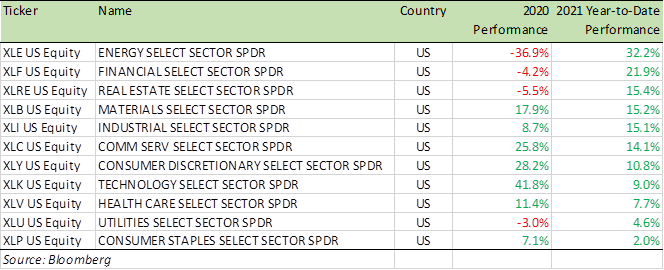
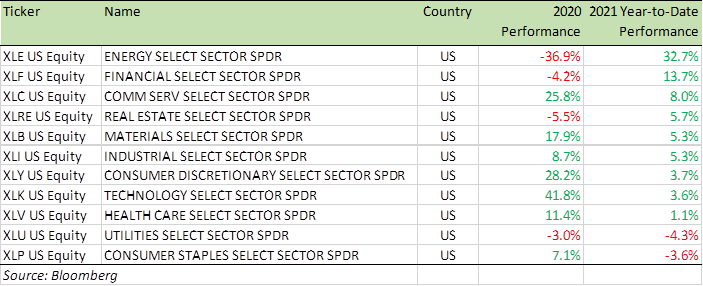
Benchmark US equity sector performance (2020 and 2021 YTD, MTD)

In terms of sectors to invest in, the recent sell-off in Technology (XLK), Healthcare (XLV), Biotech (XBI) and Communication (XLC) sector stocks provides a good opportunity to add to one’s holdings. As the table above indicates, XLK and XLV are now laggards, as investors have rushed to trade them for value stocks – Industrials, Financials, and Energy. The Biotech ETF (XBI) is now down -25% from its all-time high in February. Both the Healthcare and Biotech sectors seem oversold to me and provide an opportunity to add to ones holdings. It’s not like the world will not need vaccines and cures once the pandemic is over. Big pharma gets the blame but just imagine how much worse the Covid-19 crisis would be right now if the world didn’t have such an innovative pharma and biotech sector. Schools closed for years on end and lockdowns forever.

I, continue to be bullish on equities and see any sell-off as an opportunity to “buy the dip.” My favourite sectors to pick stocks from – Consumer Discretionary (XLY), Healthcare (XLV), Technology (XLK) and Communications (XLC).

For specific stock recommendations, please do not hesitate to get in touch.

 
Best wishes,
Manish Singh, CFA


“The desire to perform all the time is usually a barrier to performing over time.”

Robert Olstein

Summary

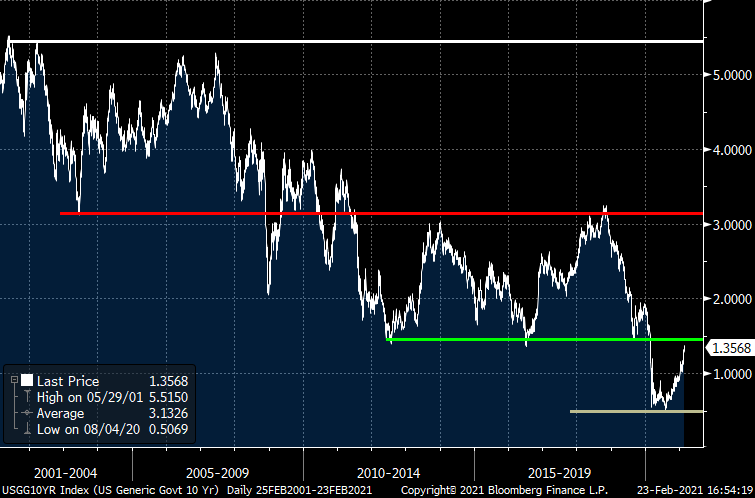
Around this time last year, Covid-19 was threatening to run amok and that it did, causing hundreds of billions of dollars in economic damage globally, the deepest recessions since WWII and record job losses. Yet here we are,12 months later, thanks to the rapid success of virologists and vaccine science, we now have a choice of vaccines to inoculate ourselves against Covid-19. The 10-Year US Treasury that cratered and reached a new low of +0.5% is now back at +1.4% and threatening to head higher. Inflation, not disinflation, is suddenly the talk of the market.

Rising yields are grounds for anxiety, but not yet a cause for alarm. Rising bond yields are more an indicator of things heading back to normal – as the vaccination program achieves its intended outcome – stopping infection and achieving “herd immunity” against the Covid-19 virus. The equity risk premium (ERP) – how much stocks will outperform risk-free investments over the long term – is at a still very attractive level of over +3.1%. During the 1990s dotcom boom, at the time of the market crash, the ERP was negative. At that time, there was the alternative of keeping money in cash, as yields were a chunky +4-5%. No such alternative exists today, with the base rate standing at zero and central banks determined to keep it low for the next 12-24 months at least.

A hot housing market in the US is churning out job opportunities for blue-collar workers. Jobs in residential construction, package delivery and warehousing exceed pre-pandemic levels—and many companies are struggling to find enough workers to keep up with demand. The job gains largely result from the growing adoption of online shopping during the pandemic, which is likely to last permanently.

In a recent survey by the technology company Pitney Bowes, consumers said they are conducting close to 59% of their shopping online, and they expect to do 56% online after the pandemic ends. Before the coronavirus hit, the shopping online percentage stood at 39%. This is a signification change in consumer behaviour and one that will have a profound effect on productivity and GDP numbers in the medium and long term.

Herd immunity and rising bond yields

Around this time last year, as the fears of Covid-19 rampaging the globe grew, an already historically low yield on 10-Year US Treasuries of +1.6% – cratered and reached a new low of +0.50%. Barring a few false dawns in early summer 2020, when the virus looked defeated, resurgent infections led to more (and longer) lockdowns, and the yield stayed at the +0.5% level.

All that changed on November 9, when Pfizer (PFE) and BioNTech (BNTX) announced that their vaccine candidate demonstrated evidence of efficacy against Covid-19 in participants without prior evidence of an infection. Bond yields started rising and a month later when Margaret Keenan, 91, a UK grandmother became the first person in the world to be given the Pfizer Covid-19 jab as part of a mass vaccination programme, yields took off and they are now approaching the +1.5% level fast.

Should we be worried about rising bond yields? Are higher yields bad news for equity markets?

In short: No we shouldn’t be worrying and No it’s not all bad news. We must however watch the yields carefully.

Rising bond yields in themselves are not a problem and they are more an indicator of things heading back to normal – as the vaccination program achieves its intended outcome – stopping infection and achieving “herd immunity” against the Covid-19 virus.

The vaccination program in the UK has been running for over 10 weeks now, with over 18 million – 34% of adults – having received at least a first dose of the vaccine. Three UK studies released this week by Public Health England (PHE) all indicate that vaccination against Covid-19 provides high levels of protection against infection, illness and death. The PHE scientists reported that the Pfizer-BioNTech vaccine reduced the risk of infection by more than 70% three weeks after the first jab, rising to 85% after the second dose.

Coloured transmission electron micrograph (TEM) of a SARS-CoV-2 coronavirus particle

Source: Public Health England (PHE)

One of these studies was particularly significant, given the controversy in France and Germany regarding the effectiveness of the Oxford-AstraZeneca vaccine. The study, based on data from 1.14 million vaccinations (over 60% of whom received the Oxford-AstraZeneca vaccine) administered in Scotland, indicates that both the Pfizer-BioNTech and Oxford-AstraZeneca vaccines are highly effective and that by the fourth week after receiving the initial dose, the risk of hospitalisation from Covid-19 was reduced by up to 85% and 94%, respectively.

Shame therefore on President Emmanuel Macron of France, the German government and all those who have erroneously tried to undermine confidence in the Oxford-AstraZeneca vaccine and thereby reducing the uptake of the vaccine on the Continent.

There is good reason to now believe that the world is accelerating towards a “herd immunity” against Covid-19 at a rapid pace – except for the European Union (EU) for now. Having said that, we are already seeing signs of a U-turn in Germany. Germany has now launched a public relations push to reassure the people about the Oxford-AstraZeneca vaccine. Chancellor Angela Merkel’s chief spokesman Steffen Seibert said: “The vaccine from AstraZeneca is both safe and highly effective. The vaccine can save lives.”

European Commission Chief Ursula von der Leyen has also sought to quell doubts by saying that she would take the Oxford-AstraZeneca jab. “I would take the AstraZeneca vaccine without a second thought, just like Moderna’s and BioNTech/Pfizer’s products,’ von der Leyen told The Augsburger Allgemeine.

In yet more encouraging news, the US health regulator, the Food and Drug Administration (FDA) is set to relax requirements for the Pfizer-BioNTech vaccine to be stored at ultra-low temperatures, potentially allowing it to be kept in pharmacy freezers. This will be a big boost for the distribution and availability of the Pfizer-BioNTech vaccine.

US 10-Year Treasury Yield (USGG10YR Index) – last 20 years

Source: Bloomberg

Covid-19 cases in the US and UK are already down by more than -75% over the last six weeks, as vaccination programs have accelerated, and both the nations are racing towards a very low level of infection and indeed ‘herd immunity” by end of April, allowing people to resume a normal life. Professor Devi Sridhar, Chair of Global Public Health at the University of Edinburgh, said: “There’s no reason we have to live with this virus, or even see it as a seasonal flu because we’re seeing with a vaccine as effective as this – a better analogy is probably measles, which is a virus that’s endemic in parts of the world.But we don’t accept living with measles here – we vaccinate against it.”

This is all good news but what this means for the financial markets is: Bond yields are heading higher.

Rising yields are grounds for anxiety, but not yet a cause for alarm. Higher yields might call for a judicious tilt towards long-dated bonds in a balanced portfolio, as yields get attractive again, but not much more. The equity risk premium (ERP) – how much stocks will outperform risk-free investments over the long term – is at a still very attractive level of over +3.1%

Of course, if bond yields rise further, or stock prices rise much faster than earnings, the ERP will fall. Over the past 20 years, the ERP has been in a range of +3-4%. During the 1990s, during the dotcom boom, the ERP was negative. At that time, there was the alternative of keeping money in cash as yields were a chunky +4-5%. No such alternative exists today, with the base rate standing at zero and central banks determined to keep it low for the next 12-24 months at least. Real interest rates today, despite the increase in yield, are still negative i.e. bonds and cash still don’t offer a good enough hiding place from riskier assets like equities.

Higher bond yields are good news if they are prompted by an improvement or expectations of improvement in economic data. The latter is certainly the case this time. The National Bureau of Economic Research (NBER) has not yet announced the end of the recession in the US, but clearly, the recent set of retail, housing and industrial production data suggest that the US economy is leaving the 2020 slump in the rear-view mirror. Improving economic conditions despite the volatility (as we have seen this week for technology and growth stocks) make investors more confident about owning equities, and less keen on the safety of government bonds.

The big question is whether the very long bull market in government bonds is over? My answer to that is an emphatic Yes – at least as far as US Treasury bonds are concerned. Eurozone government bonds are a different kettle of fish and the economic malaise in the Eurozone is far from over, even if the Eurozone eventually manages to inoculate itself against Covid-19.

Markets and the Economy

As per my comments above, I am firmly of the view that the multi-year rally in US government bonds is over.

In recent days, we have seen the inflation measures in the UK print far above forecasts, despite the continued lockdown and the rising currency. We see a similar case in Canada where the Consumer Price Index (CPI) for January jumped to +1% versus the previous month’s +0.7% increase. The US Producer Price Index (PPI) data came in above expectations too and saw the biggest surge since 2009. All these are still backward-looking, as they do not take into account the recent rise in energy prices (especially pronounced in the US). Of course, we still have to look for more data before we conclude that the dis-inflation fear is gone. However, the recent press readings and commentaries tell us that the “zeitgeist” on inflation is changing.

In such a scenario, bond yields in the US will only rise if we see a change in fiscal policy in the US – of which there are absolutely no signs, and this policy continues to be expansionary. A monetary policy change – a hike in interest rates – still lies ahead – so that’s another negative for bonds. Of course, when the yields do get attractive, a new set of bond investors will get drawn into US Treasuries again or, if there is a new crisis in the world, US Treasuries will again become the asset of choice.

In summary therefore, there is little to take investors interest away from the equity markets for now.

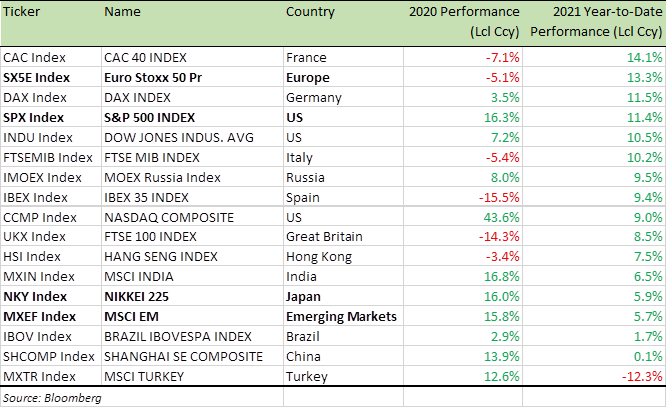
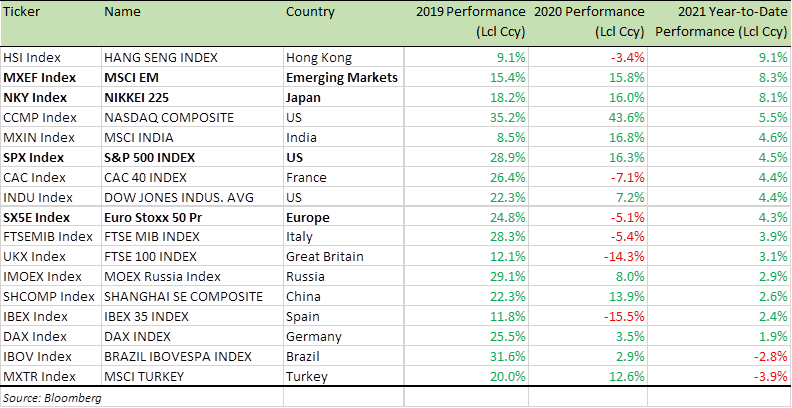
As the table below indicates, equities have performed well so far this year despite the volatility in recent days. Keep an eye on the non-US equity market, particularly Europe (including the UK), which have a lot of catching up to do, as sentiment and global growth turns positive.

Emerging market equities have shown also great strength in recent weeks and this strength is set to continue, as vaccination drives re-open the world once again to consumer demand and stellar GDP numbers in the US.

Benchmark Equity Index Performance (2020 & YTD)

This week, US Federal Reserve (Fed) Chairman Jerome Powell reaffirmed his commitment to keeping easy-monetary policies unchanged for the foreseeable future. His comments stemmed the slide we were witnessing in growth and technology stocks.

“The economy is a long way from our employment and inflation goals,” Powell said in testimony to the Senate Banking Committee, a statement he has repeated in recent weeks. The Fed will therefore continue to support the economy with near-zero interest rates and large-scale asset purchases until “substantial further progress has been made.” This should put a floor for market moves to the downside, as every dip is bought back. This has been the case over the last two months as the re-opening and reflation trades have become the talk of the markets.

A hot housing market in the US is churning out job opportunities for blue-collar workers in the US as this report in The Wall Street Journal (WSJ) indicates. Jobs in residential construction, package delivery and warehousing exceed pre-pandemic levels—and many companies are struggling to find enough workers to keep up with demand.

The report further highlights that the blue-collar job gains largely result from the growing adoption of online shopping during the pandemic, which is likely to last permanently. You will recall in last month’s Market Viewpoints I discussed this transition to digitisation – “during the 1920s, the US transitioned from an agrarian to an industrialized nation. Now, along with the rest of the world, it is transitioning to an era of “digitisation.” “

Furthermore, in a recent survey by the technology company Pitney Bowes, consumers said they currently conduct around 59% of their shopping online, and they expect to do 56% online after the pandemic ends. Before the coronavirus hit, 39% of their shopping was conducted online. That’s a signification change in consumer behaviour.

So now that we have more evidence of the effects of digitisation and the change in consumer behaviour in the US, I feel even more confident about my – “Are the second Roaring ‘20s on their way?” thesis as outlined in last month’s newsletter. Productivity gains and high GDP numbers are down the line.

In terms of sectors – consumer sectors have always been my favourite ones to pick stocks from and I continue to maintain this bias.

The interest that banks pay on deposits – the short end of the interest rate curve – is anchored at zero as the Fed is in no mood to raise interest rates. While the interest that banks charge for lending – often linked to the longer end of the interest rate curve – keeps on increasing as yields rise. The banks therefore will keep churning out better earnings.

I am also not too concerned about equity market corrections. There are still record levels of cash on the side-lines. Anecdotally, there are still many people who regret being in cash over the past 6 months (if not longer) and want to get back into the stock market – but are deterred by all-time high levels. Any dips in the market will get these investors back in.

Benchmark US equity sector performance (2020 and YTD)

Stocks linked to Electric-Vehicles (EV) are another good bet to focus on as the industry grows.

Last week we learnt that luxury car and Sports Utility Vehicle (SUV) maker Jaguar will become an all-electric brand by 2025. The first all-electric Land Rover vehicle is due to be launched in 2024 and Jaguar will phase out diesel engines by 2026 and ditch the internal combustion engine entirely by 2036.

General Motors (GM) – an icon of the “old auto” industry has also announced it is going all-electric by 2035. GM will end production of all diesel and gasoline-powered cars, trucks, and SUVs by 2035.Other traditional names like Ford, BMW, Volkswagen are also pumping in billions of dollars and euros in their drive to have EV supremacy.

Source: Jaguar Motors

This is a big moment for EV and battery stocks that have a head start if they deliver on the promise – Tesla (TSLA), NIO (NIO), QuantumSpace (QS), Blink charging (BLNK), and Lucid motors (CCIV) to name but a few.

Globally, around 60 million new passenger cars were sold in 2020. Of those, only 5% or just under 3 million were electric vehicles. Considering that even GM is going all-electric by 2035, it’s quite likely that nearly 75% (if not all) of new car sales globally will be electric by 2036. Let’s assume that total new passenger car sales over the next 15 years increase by +2.5% p.a. (a conservative estimate given China and Emerging market growth), that puts total passenger car demand at 77 million and the demand for EV at 57 million i.e. a dizzying growth of nearly 20x from the 3 million unit sales in 2020.

The above calculation doesn’t take into account the demand for electric trucks and other commercial vehicles, which will also be significant drivers of EV demand. Last month, US President Joe Biden signed an executive order that will require the replacement of the entire fleet of federal vehicles with US-built electric cars, vans and trucks; in all, some 645,000 nationwide.

On June 29, 2010, Tesla (TSLA) made its debut as a public company — the first initial public offering of a domestic automaker in a half century. The IPO price was $17 a share. TSLA today trades at $720 after reaching an all-time high of $880.

Since its IPO, TSLA has declined:

10% – 21 times
20% – 14 times
30% – 8 times
40% – thrice
50% – twice
60% – once

EV sector stocks deserve the attention of investors – but don’t expect a smooth ride!

 
Best wishes,

Manish Singh, CFA


“Complacency often afflicts precisely those who have been the most successful.”

Andrew Grove

Summary

Covid-19 vaccination programs are accelerating globally and even rivals are teaming up for the common good. As we start a new decade the chatter is that, as we come out of Covid-19 lockdowns, we could find ourselves in a new Roaring ’20s. The parallels between the 1920s and today are clear. We are dealing with a virus now and economic activity has been badly hurt. The 1918 Spanish flu pandemic and economic malaise that came with it, preceded the original Roaring ’20s. There was pent-up demand for goods and services after the 1918 pandemic. There’s pent-up demand now and the consumer is strong.

Governments have been generous to top up income, and people have not been able to spend this money. During the 1920s, US Presidents Warren Harding and Calvin Coolidge both followed easy fiscal policies, which eased the burden on the American people and US companies. This boosted spending and set the turbines of economic growth humming. President Donald Trump was equally determined (as is President Joe Biden) to boost spending, as is evidenced by the record US budget deficit. During the 1920s, the US transitioned from an agrarian to an industrialized nation. Now, along with the rest of the world, it is transitioning to an era of “digitisation.” The dawn of technological optimism can be seen everywhere. Therefore I continue to be risk positive.

My recommendation is to focus on large secular trends: Stick to the big wave and do not to get lost in the ripples which can be exciting and make you think that you have figured everything out, only to be swept away when the big wave arrives.

Are the second Roaring ‘20s on their way?

We are starting a new decade and the chatter is that, as we come out of Covid-19 lockdowns, we could find ourselves in a new Roaring ’20s. No, not as in dress up as Jay Gatsby and Daisy Buchanan, dance the Charleston and drive in Model T Fords, alluring as that may be given the lockdown life we have had to endure, but as in the bull market in equities that marked the 1920s.

Ask me my view? I’d say the likelihood of this scenario is very high. The Dow Jones industrial Average Index (DJIA) rallied +600% between 1921 and 1929 and during this time the index expanded from 12 stocks to 30. However, when the crash came in October 1929, the DJIA was hit very hard and lost almost 90% of its value between October 1929 to June 1932, when it finally bottomed.

The grounds for a new Roaring ’20s abound. My only concern is that given how fast the world is changing (compared to the last century), a compressed timeline could see the next iteration last not a decade, but half of that or even less. This means the ’30s could follow in quick succession, and that won’t be as much fun, as the ’30s were defined by a global economic and political crisis, when many of the excesses of ’20s were undone. Anyway, let’s focus on the ’20s for now and we can worry about the ’30s later!

Covid-19 vaccination programs are accelerating globally and even rivals are teaming up for the common good. The French pharmaceutical company, Sanofi which hasn’t had success with its Covid-19 vaccine yet, has now decided to produce 100 million of the Pfizer/BioNTech “vaccine in order to be helpful as of now.” Also, data suggests the surge in new Covid-19 cases linked to increased travel and socializing over the holiday season is receding. The focus, therefore, rightly shifts back once again to re-opening the economy – and keeping it open.

The parallels between the 1920s and today are clear.

We are dealing with a virus now and economic activity has been badly hurt. The 1918 Spanish flu pandemic and economic malaise that came with it, preceded the original Roaring ’20s. There was pent-up demand for goods and services after the 1918 pandemic. There’s pent-up demand now and the consumer is strong. Governments have been generous to top up income, and people have not been able to spend this money.

Americans saved $1.4 trillion in the first three quarters of 2020, or about twice as much as in the same period of the prior year, according to an analysis by Berenberg Economics. The American consumer is in the best financial shape in modern history. More help is on its way in the form of a new round of stimulus checks from the administration of incoming US President Joe Biden. People are as eager as ever to socialize and see the world again, as is evidenced by the surge in travel bookings, as soon as any signs of lockdown ending emerge. Beaches and pubs will be crowded again come the summer months.

During the 1920s, US Presidents Warren Harding and Calvin Coolidge both followed easy fiscal policies, which eased the burden on the American people and US companies. This boosted spending and set the turbines of economic growth humming. President Donald Trump before was equally determined (as is President Joe Biden) to boost spending, as is evidenced by the record US budget deficit. The deficit even in fiscally prudent Germany has rocketed. Additionally, new US Treasury Secretary Janet Yellen, at her confirmation hearing last week, made it abundantly clear that the Biden administration would set aside concerns about rising budget deficits and “act big” to avoid a protracted economic downturn. She also assured everyone that the Biden team doesn’t immediately plan to increase taxes.

During the 1920s, America transitioned from an agrarian to an industrialized nation. Now along with the rest of the world, it is transitioning to an era of “digitisation.” The 1920s marked technological advancement that led to more automation and mass-production techniques that meant goods could be produced more quickly and in greater quantities. This led to lower prices for goods, increased demand and consequent higher employment to meet these demands. The increased employment stimulated further demand for goods, and thus created a cycle of boom which led to economic prosperity and record stock market gains.

This time around, though the transition to a high-tech economy and “digitisation” started long before Covid-19 struck, the pandemic has accelerated this transition. The dawn of technological optimism can be seen everywhere. Every business from large corporations to mom-and-pop shops have embraced technology and e-commerce. In the spring, Stripe, a firm that powers payments helped the centuries-old farmers’ market in Paris set up virtual checkouts in place of physical ones.

Look at the speed at which Covid-19 vaccines have been produced. The success of the “messenger RNA” technique behind the Pfizer-BioNTech and Moderna vaccines, and of bespoke antibody treatments, show that we are at the dawn of a new age in medicine. UK based Artificial Intelligence (AI) Company DeepMind has cracked the 50-year-old problem of biology research – determining a protein’s 3D shape from its amino-acid sequence. DeepMind’s AI program AlphaFold, can identify the shape of a protein in mere hours. This is set to vastly accelerate efforts to understand the building blocks of cells and enable quicker and more advanced drug discovery.

Necessity is the mother of inventions, as they say. Lockdowns have seen tele-medicine or tele-health come leaps and bounds make companies such as Teladoc (TDOC) a stock market success and Peloton (PTON) is changing how folk will go about exercising in the post-Covid world.

The e-commerce, data security, cloud and software services sector, logistics, biotechnology and semiconductors all have seen a series of successful IPOs and merger activities. While the new-age companies such as Shopify (SHOP), Pinterest (PINS), CrowdStrike Holdings (CRWD), Roku Inc. (Roku), Square (SQ), Zoom communications (ZOOM), Etsy (ETSY), AirbnB (ABNB), Sea Ltd. (SE), Snowflake (SNOW) are blazing a trail. The old guard – Amazon (AMZN), Google (GOOG) and Microsoft (MSFT) continue to get bigger and bigger, with revenue growth to back up the above trillion dollar valuation.

Spectacular falls in the price of renewable energy are powering the change too and driving the world towards a green agenda, which itself will be the multi-trillion-dollar economy. Even China now promises carbon neutrality by 2060. Such is the market’s optimism about green agenda and electric vehicles that Tesla’s CEO, Elon Musk is now the world’s richest man.

Cruise lines say they are getting booked up for later this year through 2023. A surge in the services economy is inevitable as soon as lockdown is lifted. Just look at China – they are printing record growth numbers and demand has shown no sign of a dip from the pre-Covid days. A record GDP growth over the next 12-18 months is certain and this will boost asset prices.

Markets and the Economy

The US equity market has continued on its positive trend this year with the Tech and Biotech heavy NASDAQ Index the clear winner (as the table below indicates). Going forward, Emerging Market stocks could be the big winners as the US economy reopens. UK equities will also fare well, and Eurozone equities will likely disappoint in the short term, due to vaccination delays and consequent re-opening delays to the economy.

Benchmark Equity index Performance (2020 & YTD)

The US Federal Reserve Open Market Committee (FOMC) met this week for its first meeting of 2021 and acknowledged the recent signs of economic weakening. The FOMC decided to keep policy on hold choosing to wait and see if business activity picks up. The US Congress and the Trump White House in December approved $900 billion in new spending measures, including sending $600 checks to qualifying Americans. The Biden administration has proposed $1.9 trillion in additional measures, including sending $1,400 checks to many households.

The surge in coronavirus cases during November and December meant that employment and retail sales fell, and the number of Americans filing new claims for unemployment benefits rose for two months in a row. Rebuilding the economy fully continues to be the focus of the Federal Reserve (Fed) and the Biden administration as outlined by Treasury Secretary Yellen. Earlier this month at a Princeton University forum, Fed Chairman Jerome Powell said “The economy is far from our goals. Now isn’t the time to be pulling back from its policies” In other words: The money printing will continue as long as it’s needed to heal the economy.

One topic that has often been discussed and no doubt will continue to be discussed is – money printing is fomenting a class war, as income inequality keeps rising. While the world has not turned violent, thankfully despite the excessive money printing, the same can’t be said of what’s happening in a corner of the stock market where “day traders” trading options are running rings around some hedge funds, whose business is to short stocks.

It’s literally Robinhood versus the Sheriff of Nottingham, in the “most shorted stocks” corner of the market.

Robinhood, a Silicon Valley start-up, with an easy-to-use app, helped draw many first-time investors to the equity market last year. It has amassed more than 13 million customer accounts, as working from home led to a boom in self-directed investment and options trading. The median age of a Robinhood investor is 31.

This week we learnt that a celebrated hedge fund, Melvin Capital, which has returned +30% a year to investors since inception, and with a sizable short equity book, ended up being run over, requiring an urgent bailout of $2.75 billion led by Citadel and Point72—two of the larger US hedge funds.

A storied hedge fund run over by day traders and small investors known as “Robin hoaders” who invest in companies championed on the Reddit forum WallStreetBets? Who would have thunk it? -I suspect there will be more such accidents in the hedge fund world given the need for US funds to publish their positions every quarter. Melvin Capital’s well-publicized short exposures opened the door for investors to congregate on the Reddit forum and other such chat sites to organize a series of short squeezes. Melvin Capital was short GameStop (GME) and the marauding online traders piled on the other side of the trade to send the stock skyrocketing by over +600%.

On Tuesday this week, GameStop was the most traded stock. It traded a bigger volume and dollar value than even Tesla , Apple, Microsoft, Amazon – as the chart below shows.

Stocks with most trading volume on Tuesday, 26 January 2021

Source: Bloomberg, @reddittrading

The US consumer continues to be strong. Consumer confidence – defined as the degree of optimism on the state of the US economy that consumers are expressing through their activities of savings and spending – in the US rose in January as expectations for the economy and the Labour market improved, according to data released the Conference Board.

The personal saving rate, the portion of after-tax income that U.S. consumers store away, was 12.9% in November, according to the US Commerce Department. That compares with a saving rate of 7.5% in November 2019, before the pandemic. All these savings are set to be spent when the economy opens up by summer.

Meanwhile, in Europe, while the UK is going gangbusters with the Covid-19 vaccination program, the European Union (EU) has been a big disappointment and mired in delays and indecisions. The EU has administered only 2 doses per 100 population compared with over 10 for the UK and 7 for the US.

The economic recovery in the Eurozone will be delayed and there is a risk that the anger in the people could boil over into the street as they see the UK across the channel start gradually re-opening from the end of next month and open fully by Easter. A full-blown political crisis in the EU now looks inevitable.

The European Central Bank (ECB) has a mighty job at its hand to keep the Eurozone economy on rails and well lubricated. ECB President Christine Lagarde sounded a cautiously optimistic note on Europe’s economic recovery but that was before the full extent of the vaccine crisis in the EU came to light. At its meeting last week, the ECB kept its monetary stimulus unchanged saying it would continue to buy up to €1.85 trillion ($2.25 trillion) of eurozone bonds through March 2022 under a plan unveiled in December. It left its key interest rate at minus 0.5%.

I expect the ECB to do more heavy lifting and the Eurozone nations allowed to run bigger deficits that a longer lockdown will demand.

Benchmark US equity sector performance (2020 and YTD)

The vaccination program is key. A successful vaccination program will quickly become the main driver of global GDP growth and risk assets. As economic activity picks up, the real rates will move higher, as investors demand higher real bond yields to compete with the prospect of improved earnings growth elsewhere and as economic slack abates, inflation expectations could also get a boost, which is likely to push nominal yields higher.

The post-Covid-19 US economy will very likely see record low unemployment once again and higher nominal prices which will get inflation back to 2% and above. The exit from the Federal Reserve’s easy money policy will be gradual and that is bullish for GDP growth and risk. I do not expect a rate increase this year. I, however, do expect the Fed to have raised rates at least once by Q2 2022.

In short, the risks for growth, inflation and bond yields are skewed to the upside as vaccine programs gather pace everywhere. Broadly, this environment should be favourable for equities, as improved earnings growth will offset the negative influence of rising bond yields.

I continue to be risk positive as I outlined in my December newsletter – V for Vaccine and V-Shaped recovery. Most of the comments from then are still valid.

My recommendation is to focus on large secular trends: Stick to the big wave and do not to get lost in the ripples which can be exciting and make you think that you have figured everything out, only to be swept away when the big wave arrives.

The big trend of Tech stocks and China stocks doing well has continued – as the table above indicates – and it has more legs to go. The valuation of Tech stocks is a concern but as the earnings from Microsoft (MSFT) yesterday indicated, “Cloud revenue” is still surging and it grew 48% YoY. Cloud adoption is now accelerating as “digitisation” of the economy continues full speed.

Microsoft CEO, Satya Nadella put it best – “What we have witnessed over the past year is the dawn of a second wave of digital transformation sweeping every company and every industry. Building their own digital capability is the new currency.”

I, continue to be bullish on equities and see any sell-off as an opportunity to “buy the dip.” My favourite sectors to pick stocks from – Consumer Staple (XLP) and Consumer Discretionary (XLY) as well as Technology (XLK) and Communications (XLC).

 
Best wishes,

Manish Singh, CFA

“Far more money has been lost by investors preparing for stock market corrections, than from the corrections themselves.”

-Peter Lynch

Summary

The Dow Jones Industrial Average (DJIA) hit the 30,000 mark in November for the first time in its history and it just had its best month since January 1987. The Index is up +60% from its March lows. By any yardstick, this is a V-shaped recovery in the equity market. Two doses of positivity are responsible for this – the positive news on the Covid-19 vaccine front and the prospect of a smooth transition at the White House. In the last few days, vaccines developed by Pfizer-BioNTech, Moderna and Oxford-AstraZeneca have opened up the possibility that the economic disruption that started in March this year is nearing its end.

The discovery of a vaccine is only half the battle however. Getting the vaccine to market is just as important. The discovery of Penicillin in 1928, was a major medical breakthrough. However, it remained a lab curiosity for over a decade, due to lack of funding to continue the research or to manufacture Penicillin for medical use. It was not until 1941 that a successful public-private partnership between the US and UK governments as well as the pharmaceutical industry, led to the development of a way to mass-produce Penicillin. While the vaccine has come too late to save President Donald Trump’s second term in the White House, Operation Warp Speed – the Trump Administration’s vaccine effort to assist with the development and distribution of medical innovations to address Covid-19, has been a big success.

The Year 2020 is when monetary policy and fiscal policy merged. Decades of separation of church and state between an independent central bank and the Treasury, have just disappeared. Nothing underlines the manifestation of this better than the person expected to take charge at the US Treasury under President-elect Joe Biden – Janet Yellen, the former Chair of the US Federal Reserve. The printing money playbook of the last few years is set to continue and get even bigger. Equities therefore will continue their upward trend in 2021.

V for Vaccine and a V-shaped recovery

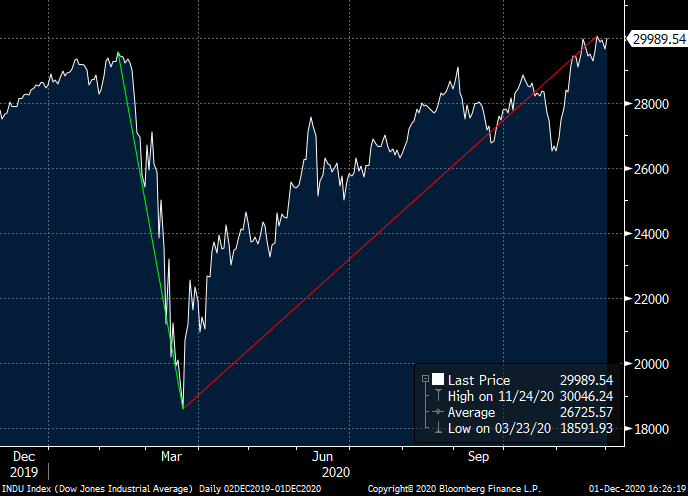
Stocks have soared during November, pushing the Dow Jones Industrial Average (DJIA) over the 30,000 mark for the first time in its history and it just had its best month since January 1987.

By any yardstick, this is a V-shaped recovery in the equity market and with monetary policy remaining accommodative for the foreseeable future – the Fed Fund Futures market is currently pricing interest rates of 0% out to 2025, the equity markets have more upside over the next 12 months.

Dow Jones Industrial Average (DJIA) Index: 12-month price chart

Source: Bloomberg

Two doses of positivity are responsible for this – the positive news on the Covid-19 vaccine front and the prospect of a smooth transition at the White House. On my morning run down Chelsea Embankment from Battersea Bridge, when I turn left into Danvers Street, a quaint side street just off the Thames River, to my right I see a English heritage blue plaque (see below)
commemorating Sir Alexander Fleming, discoverer of Penicillin. It was the first antibiotic invented that killed bacteria.

The discovery of Penicillin in 1928, was a major medical breakthrough. However, it remained a lab curiously for over a decade, as Fleming did not have the money or the facilities to continue his research in order to manufacture Penicillin for medical use. Over a decade later, two Oxford scientists, Ernst Chain and Howard Florey revived Fleming’s work and the first person to receive Penicillin was an Oxford policeman Albert Alexander, who was suffering from a bacterial infection. After five days of penicillin injections, Alexander began to recover. But Chain and Florey did not have enough pure Penicillin to eradicate the infection, and Alexander ultimately died. The supply of Penicillin in the US was similarly limited.

Discovery is only half the battle, however getting the drug to market is just as important.

It was not until 1941 that a successful public-private partnership between the US and UK governments as well as the pharmaceutical industry that led to the development of a way to mass-produce Penicillin. It was also spurred by the urgent need to aid war efforts on the battlefields of Europe during World War II, where many soldiers were dying not from combat but from bacterial infections to their open wounds.

Alexander Fleming (1881-1955) lived on Danvers Street from 1929 until his death in 1955

Photo: Manish Singh

Charles Pfizer & Co. – a relatively small chemical company at the time, based in Brooklyn and hitherto better known for making vitamins and the citric acid used in Coca-Cola, took on the challenge (and the government funding) and pioneered the deep-tank fermentation process by which Penicillin could be mass-produced. Thus, a public-private partnership took Penicillin out of the laboratory and onto the market, as highly refined Penicillin began to be manufactured not in pans and milk bottles but in 10,000-gallon tanks. Today, Pfizer is a giant in pharmaceuticals and has a Covid-19 vaccine in development.

While the vaccine has come too late to save President Donald Trump’s second term in the White House, Operation Warp Speed – the Trump Administration’s vaccine effort to assist with the development and distribution of medical innovations to address Covid-19 has been a big success. Operation Warp Speed, founded in May 2020, has spent more than $10 billion to advance vaccine clinical trials, manufacturing and distribution. The US allocated $1.5 billion to support the manufacturing and delivery of Moderna’s vaccine candidate in return for 100 million initial doses.

In the last few days, three vaccines developed by Pfizer-BioNTech, Moderna and Oxford-AstraZeneca have opened up the possibility that the economic disruption that started in March this year is nearing its end. The vaccines could be approved for use as early as this month (the Pfizer vaccine was just approved in the UK). It’s a great testament to the advances in vaccinology (and the helping hand of capitalism) that a vaccine is in production in under 12 months from the time the Covid-19 virus struck. Not only that, but one will be spoilt for choice in terms of which vaccine to use!

Covid-19 has so far killed over one and a half million people globally. Based on an estimated R number of 2.5 to 3 (R is the number of people that one infected person will pass on a virus to, on average) scientists estimate that 60% to 70% of the population might need to gain immunity to Covid-19 before “herd immunity” is reached. In New York City, an epicentre of the Covid-19 epidemic in the US, some researchers estimate 25% of the population already have protective antibodies against Covid-19. In other places, it’s much lower. Therefore, a vaccine is the only way to accelerate the build-up of the “herd immunity” against Covid-19 and for life to resume as normal.

Markets and the Economy

This time last year in Market Viewpoints I wrote – “I expect the S&P 500 (SPX) index to finish next year at 3420”.

That target looked overly optimistic in March this year, when the index dropped to 2250 as the Covid-19 led sell-off intensified. Fear was everywhere and some expected worse was yet to come. I went out on a limb to call the market bottom on Friday, March 20 (as outlined in the March Market Viewpoints). The low on March 20 on the SPX was 2,295, and after more selling on Monday, March 23, the SPX reversed course. And what a rally it has been since!

The S&P 500 index (SPX) is up over +60% from its the March lows and for the first time since 1982, the index has logged a double-digit monthly gain twice in a year – April and November. The index is currently at 3665 – well above my 3420 target and is set to go higher next year as monetary and fiscal policy both remain accommodative at least for next twelve months (and possibly many more months after).

The large positive move in equities in November (and indeed for the year) will inevitably lead to a pretty dramatic need for the rebalancing of portfolios both at the single-stock level but also across asset classes. Therefore, expect some sell-offs and sideways moves over this month. However, make no mistake, the trend is still upwards. I expect the SPX to gain at least +8%-10% (and possibly more) next year.

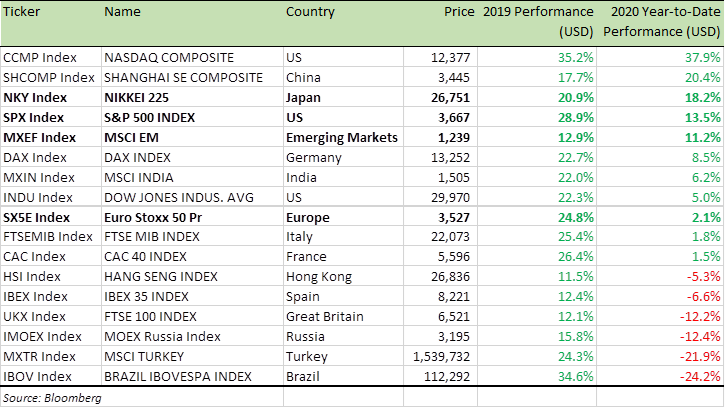
Benchmark Equity Index Performance (2019 & YTD)

This year’s spike in the US money supply has been unprecedented. 21% of all the US dollars that have ever been printed in the history of the United States were printed this year.

The printing of 1/5th of all US dollars in circulation in a single year is mind-boggling but, remember, the US Dollar is not pegged to Gold, so the US Treasury can run debt at their freewill as long as buyers have the confidence to keep buying – and it’s better still if the largest buyer of US debt is a home entity like the US Federal Reserve – with the license to print the money in the first place.

What’s happening in the US is not unprecedented and it has happened in the past during World War II and its immediate aftermath. Then as now, the Fed committed itself to buy as many US Treasuries as necessary to keep yields on US debt in check. Much of that debt once on the Fed’s balance sheet, never made its way back into private hands. In keeping those bonds permanently, the Fed effectively and directly financed much of the US budget deficit simply by printing money.

For the avoidance of any doubt, when a central bank takes permanent ownership of its own government’s debt, that debt “ceases to exist.” For the Fed may own the US government bonds, but it is the US government that owns the Fed. One can’t be meaningfully indebted to oneself. Thus, by buying up its own bonds, the US government can finance itself and avoid the austerity that would accompany, if the financing had occurred via a tax increase or a cut in spending. Japan has been doing the same – financing deficit by money printing- for over a quarter of the century now. The Bank of Japan has no intention of unwinding its balance sheet – not that they would ever admit it publicly.

The only reason money printing is not offered upfront as a policy (and actively dissuaded from being seen as a “tool” that can be readily used) is to discourage politicians from misusing it and causing hyperinflation in their pursuit for votes and power. So here lieth the noble lie– all spending must be paid for via either raising taxes or taking on new debt. Both then become a check on the powers and wanton fiscal profligacy of elected politicians.

The Year 2020 is when monetary policy and fiscal policy merged. Decades of the separation of church and state between an independent central bank and the Treasury have just disappeared. Nothing underlines the manifestation of it better than the person expected to take charge at the US Treasury under President elect Joe Biden – Janet Yellen, the former Chair of the US Federal Reserve.

Professor Janet Yellen teaching at University of California Berkeley Haas (year unknown)

Photo: Bruce Cook/University of California Berkeley Haas

The printing money playbook of the last few years is set to continue and is about to get even bigger.

I wrote in October’s Market Viewpoints “The curious thing is at least on recent evidence, financial markets do not seem to differentiate between a Democrat or a Republican in the White House. Perhaps it’s because the man in the White House at 1600 Pennsylvania Avenue is not in control of the economy as much as the person in the Eccles Building, 20th Street and Constitution Avenue – the Chairman of the Federal Reserve.” With Yellen next at the US Treasury, I have more reasons to be bullish equities and see any year-end sell-off as an opportunity to “buy the dip.” My favourite sectors to pick stocks from – Consumer Staple (XLP) and Consumer Discretionary (XLY) as well as Technology (XLK) and Communications (XLC).

A few things to keep in mind about Janet Yellen:

  • As Fed Chair from 2014-18, she navigated to a middle ground between colleagues who were eager to start lifting interest rates and those who, like herself, were reluctant to move more aggressively despite steady growth. She chose to leave rates near zero until late 2015 and then to lift them very slowly to help spur employment gains
  • Yellen advocated forcefully for more stimulus during this period. At a December 2012 meeting, some of her colleagues worried that the Fed was inviting political risks with its purchases of Treasury and mortgage-backed securities, which were intended to drive down long-term rates after the Fed had pinned short-term rates near zero. Yellen told her colleagues they should be more concerned about repeating mistakes made over more than a decade by Japan, which had been mired in deflation, by pulling back on stimulus prematurely
  • Yellen said on CNBC on April 6, 2020 “I frankly don’t think it’s [give Federal Reserve the authority to buy equities] necessary at this point … but long term it wouldn’t be a bad thing for Congress to reconsider the powers that the Fed has with respect to assets it can own”
  • A Wall Street Journal analysis of more than 700 predictions that Fed officials made between 2009 and 2012 showed Yellen had the best record. She warned others that the recovery would be slow and played down the threat of inflation

Yellen is a Keynesian from the James Tobin School, who believes in spending as fiscal stimulus and low-interest rates. Therefore, she is likely to insist on blowout spending, while urging the Fed to monetize it. In the face of this, one has to be naïve not to be long US equities and foolhardy to be short. And if this level of money printing doesn’t scream a real hidden rate of inflation eventually and therefore higher nominal prices, then I don’t know what does. There is also talk of cancelling student debt. The student debt in the US stands at over USD 1 trillion.

Dollar weakness is set to continue and therefore EUR/USD has hit the 1.20 level, despite a worsening economic situation in the Eurozone. A weak dollar will also keep driving commodity prices and Emerging Market equities higher.

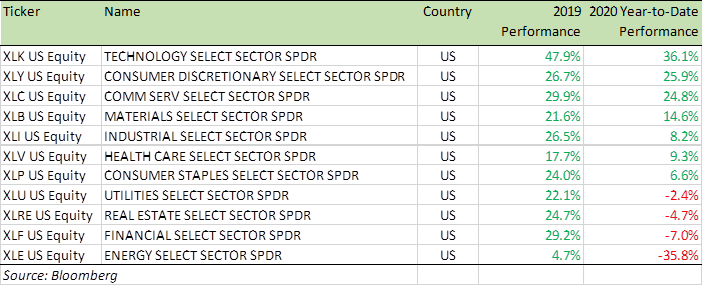
Benchmark US equity sector performance (2019 & YTD)

And if you are not feeling positive enough yet, then here is something else to mull over as you enjoy the Christmas meal and New Year festivities later this month.

This week we learnt that the UK based Artificial Intelligence (AI) Company DeepMind has cracked the 50-year-old problem of biology research – determining a protein’s 3D shape from its amino-acid sequence. DeepMind’s AI program AlphaFold can identify the shape of a protein in mere hours. An overwhelmed Andrei Lupas, biologist at the prestigious Max Planck Institute in Tübingen, Germany noted – “The model from group 427 gave us our structure in half an hour, after we had spent a decade trying everything. This will change medicine. It will change research. It will change bioengineering. It will change everything”. The ability to accurately predict protein structures from their amino-acid sequence would be a huge boon to life sciences and medicine. It would vastly accelerate efforts to understand the building blocks of cells and enable quicker and more advanced drug discovery. Another amazing continuation of the UK’s incredible contribution to computer science since the days of Charles Babbage and Alan Turing.

The Biotech ETF (XBI US) which is up +40% for the year (and up over +100% since its March lows) is best way to participate in any future application of such a research in day to day life. From finding cures for diseases to feeding future generations, there are many areas of day-to-day life that are influenced by biotechnology companies. Exchange traded funds (ETFs) are the best way to mitigate some of the risks that are inherent in investing in early stage, low revenue and high growth individual biotech stocks

And on that note, all that is left for me to say this year is thank you and to wish you and your family all the best for this holiday season as well as a very Happy New Year. And if you celebrate Christmas – hope you have a great one.

 
Best wishes,

Manish Singh, CFA

“When the winds of change blow, some people build walls and others build windmills”

Unknown

Summary

In 1948, as the campaign kicked off, Harry S. Truman’s approval rating had fallen to 36%, and polls had him trailing his opponent Thomas E. Dewey by almost 15 points. On the night of the election, news organizations called the election for Dewey before all votes had been counted. The Chicago Daily Tribune was so sure Dewey would win, that the newspaper brushed off close early returns and printed 150,000 copies of its first edition with the (now) infamous headline “DEWEY DEFEATS TRUMAN.” The morning brought confirmation. Truman had defied the predictions and won the election with 303 electoral votes to Dewey’s 189.

So can President Donald Trump do a Truman and prove the pollsters wrong again as he did in 2016? Has he taken a leaf out President Truman’s 1948 Playbook?

The parallels to the 1948 US elections are striking and while Trump may not admit it, he has in fact taken a leaf out of the Truman playbook. Truman was serene while the pollsters, scribes, Democratic establishment and most of his campaign staff were certain he would meet a crushing defeat on Election Day. The same can be said of Trump and his 2020 campaign. Truman had an unshakable conviction that the issues he had been pushing will lead him to victory and same can be said of Trump. The Trafalgar Group – the only pollster to correctly show Trump with a lead in Michigan and Pennsylvania in 2016 heading into the Election Day- now indicates that Trump is now ahead in Pennsylvania, Florida, Michigan, North Carolina and Biden has a razor-thin lead in Wisconsin. So beware of pollsters and their sweeping predictions. Those who have written off Trump could be in for a rude awakening next Tuesday.

The curious thing is at least on recent evidence, financial markets do not seem to differentiate between a Democrat or a Republican in the White House. Perhaps it’s because the man in the White House at 1600 Pennsylvania Avenue is not in control of the economy as much as the person in the Eccles Building, at 20th Street and Constitution Avenue – the Chairman of the Federal Reserve. It’s all been one big monetary policy-driven market ever since the Great Financial Crisis (GFC) of 2007. Under President Barrack Obama, the three best-performing sectors were Consumer Discretionary, Technology and Healthcare. Under Trump, the three best-performing sectors have been Technology, Consumer Discretionary, and Healthcare. Under Obama, the two worst-performing sectors were Financials followed by Energy. Under Trump, the worst performers were the same.

US election 2020: Will Trump do a Truman?

For weeks and even months now, very few in the mainstream media and political commentariat have had anything positive to say about President Trump and even fewer still consider his re-election a possibility. Some are even predicting that the Democrats will win the White House, the Senate as well as retain control of the House of Representatives. That would be a clean sweep and full control of both the Legislative and the Executive branches of the US government.
Just a few days ago, The Financial Times ran a headline – “US investors pivot to ‘blue wave’ as odds favour Biden.” Those views relied on polls that are showing Trump trailing nationally by double digits, an insurmountable lead.

Yet, these are no ordinary times and pollsters have been consistently wrong in recent times – Trump 2016, Brexit, UK General Elections 2019 to name but a few. If the pollsters get it wrong again, then that may be the end of the “polling industry” as we know it. Pollster Frank Luntz remarked – “If Trump defies polls again, my profession is done. I hate to acknowledge it, because that’s my industry — at least partially — but the public will have no faith. No confidence. Right now, the biggest issue is the trust deficit.”

In 1948, on the eve of the Presidential election, polls had Republican challenger Thomas E. Dewey leading the Democrat President Harry S. Truman by 5-6 points. The New York Times predicted Dewey would get 345 electoral votes and Newsweek predicted 366 votes.
On the night of the election, news organizations called the election for Dewey before all votes had been counted. The Washington correspondent of The Chicago Daily Tribune was so sure Dewey would win, that the newspaper brushed off close early returns and printed 150,000 copies of its first edition with the (now) infamous headline “DEWEY DEFEATS TRUMAN.”

That night, Truman had a glass of milk and went to bed early. Awakened at 4:30 am, he was told he would likely win—and went back to sleep. The morning brought confirmation. Truman had defied the predictions and won the election with 303 electoral votes to Dewey’s 189. He had beaten Dewey by more than 2 million votes and swept all but a handful of farm states and the West.

I love the morning-after photo (see below) of President Truman holding a copy of The Chicago Daily Tribune and beaming. It made for a great picture and one of the most famous political photographs in American history. Dewey went to bed as President-Elect and woke up the loser and, today, very few other than political anorak know of Dewey.

On November 2, 1948, President Truman pokes fun at the expense of his least favourite newspaper, Chicago Daily Tribune

Source: Truman Library Institute

So can Trump do a Truman and prove the pollsters wrong again as he did in 2016? Has he taken a leaf out President Truman’s 1948 Playbook?

The parallels to the 1948 US elections are striking and while Trump may not admit it, he has in fact taken a leaf out of the Truman playbook.

In 1948, a month before the election, nine out of 10 US newspapers (including The New York Times) endorsed Dewey. Certain of a Dewey landslide, one pollster even stopped polling by September. The influential Newsweek magazine took a poll of 50 political writers about the likely outcome of the 1948 election. When the issue appeared, Clark Clifford, then an aide to Harry
Truman, tried to hide the copy under his coat. Truman discovered the magazine, saw that all 50 pundits were predicting Thomas E. Dewey to be the winner, and said, “I know every one of these 50 fellows. There isn’t one of them has enough sense to pound sand in a rat hole.” There’s no love lost between Trump and the US mainstream media as you will know and “fake news” is the most polite of disdain that Trump has for them.

As the campaign kicked off, Truman’s approval rating had fallen to 36%, and polls had him trailing Dewey by almost 15 points. Trump has suffered a similar fate.

Truman was serene while the pollsters, scribes, Democratic establishment and most of his campaign staff were certain he would meet a crushing defeat on Election Day. The same can be said of Trump and his 2020 campaign.

Truman had an unshakable conviction that the issues he had been pushing and would push—affordable health insurance for all, raising the minimum wage, aid to education, civil rights, resistance to Stalinist Russia and storage for farmers’ surplus crops—would trump Dewey’s a low-risk campaign. Similarly, Trump has pursued and campaigned on policies that he thinks poll well with the people and will get him elected – tax cuts, law and order, China, energy/fracking and the Supreme Court to name a few. In contrast, Biden has run a low-risk campaign hoping to keep his lead, “play safe” and sail into the White House. Biden’s leisurely campaign in car parks resembles more a coffee shop talk. Trump’s campaign is frenetic and resembles an actual political rally dwelling on differences with his rival.

Truman had a revolutionary campaign plan – he would tirelessly crisscross the country from Labour Day to election eve in his private railroad car, the ornate Ferdinand Magellan, talking unscripted to voters from dawn to midnight. Trump is doing the same. He is campaigning with full ferocity just like Truman did in 1948. Fresh off recovering from coronavirus, Trump has scaled the length and breadth of the country displaying energy and vitality in doing as many as three rallies a day. Trump has upped the ante last few days by highlighting Biden’s flip-flop and controversial statements by playing videos of them on a giant screen at his rallies. Trump dances off stage to the Village People’s “YMCA” as the rallies wrap up. You just have to see his campaign and listen to his speeches to see the reception he gets compared to Biden.

A Trump rally in progress

Source: votedonaldtrump.com

In 2016, Robert Cahaly, senior strategist for the Trafalgar Group, made a name for himself by being the only pollster to correctly show Donald Trump with a lead in Michigan and Pennsylvania – two key states he carried – heading into the Election Day. In 2018, Cahaly’s method once again proved solid. In one of the most polled races of the cycle, Trafalgar stood alone as the only polling firm to correctly show a Ron DeSantis gubernatorial victory in Florida – as well as Rick Scott winning the Senate race there.

So what does Trafalgar say now?

In the key battleground of Pennsylvania, the Trafalgar polls have moved in favour of Trump over the last four weeks. On Tuesday, Trafalgar group indicated that President Trump is now ahead in Pennsylvania (Trump 48.4, Biden 47.6). This same poll had Biden 3 points ahead a month ago and 6 points ahead in July/August. Trafalgar poll also indicates President Trump is ahead in Florida, Michigan, North Carolina and Biden has a razor-thin lead in Wisconsin.

So beware of pollsters and their sweeping predictions. Those who have written off Trump could be in for a rude awakening next Tuesday.

Markets and the Economy

Investors spend so much time analysing US elections. Is it worth it?

Yes, there’s a difference in style and substance between the candidates but what does the outcome mean for risk assets?

The curious thing is at least on recent evidence, financial markets do not seem to differentiate between a Democrat or a Republican in the White House. Perhaps it’s because the man in the White House at 1600 Pennsylvania Avenue is not in control of the economy as much as the person in the Eccles Building, 20th Street and Constitution Avenue – the Chairman of the Federal Reserve. It’s all been one big monetary policy-driven market ever since the Great Financial Crisis (GFC) of 2007.

Numbers crunched by our research providers Gavekal Research indicate:

  • Equities, as measured by the S&P 500, delivered roughly the same return during the President Barrack Obama years as under Trump: +12.38% annualized for Obama and +13.87% for Trump.
  • Long-dated bonds delivered positive returns in the Obama years of +6.85%, and even better positive returns in the Trump years of +9.85%

  • Under Obama, the three best-performing sectors were Consumer Discretionary, Technology and Healthcare. Under Trump, the three best-performing sectors have been Technology, followed by Consumer Discretionary, and then Healthcare (charts above)
  • Under Obama, the two worst-performing sectors were Financials followed by Energy. Under Trump, the worst performers were the same
  • Trump’s promises to “make America great again,” bring manufacturing jobs home, and impose tariffs on China etc., didn’t do any good for the Industrials sector. Industrials finished in sixth place, just as they did under Obama
  • Trump years were all about deregulation yet the financial sector returns did not get a boost. Financials finished second to last again as under Obama. Fed’s zero-rate policy and flattening the yield curve, sucked the life out of financial earnings
  • Energy returns were bad in the Obama years, known for stringent regulations and climate change curbs, but at least they were positive. In the Trump years, we saw regulatory burdens slashed and Trump pulling the US out of the Paris Accord, yet Energy was the only sector to deliver negative returns

What it means is that the structural and market forces are much more powerful and long-lasting once they take shape. A country’s political leadership may think it has control, but it may not despite its best intentions and efforts.

My recommendation is to focus on large secular trends: The big wave and not to get lost in the ripples which can be exciting and you may think you have figured everything – out only to be swept away when the big wave arrives.

Benchmark Equity Index Performance (2019 & YTD)

The big trend of tech stocks and China stocks doing well has continued as the table above indicates and it has more legs to go, especially the latter as Europe and the US still struggle with controlling Covid-19.

In last month’s Market Viewpoints, I warned: “of a volatile 4-6 weeks period ahead, as we see the pre and post-US election events play out”. With the elections less than a week away, we are truly in the midst of a volatile period which has seen the S&P 500 suffer a -8% sell-off from its mid-October highs. I, however, continue to be bullish on equities and see the sell-off as an opportunity to “buy the dip.” My favourite sectors to pick stocks from –Consumer Staple (XLP) and Consumer Discretionary (XLY) as well as Tech (XLK) and Communications (XLC)

Benchmark US equity sector performance (2019 & YTD)

In Europe, it’s batten down the hatches time as France and Germany announced new lockdowns last night. A national lockdown, which will begin Friday and last at least one month, will require the French people to remain inside their homes while restaurants, bars and shops, deemed nonessential, will close. German Chancellor Angela Merkel said the country’s Federal and State governments had agreed to a one-month shutdown of restaurants, bars, fitness studios, concert halls and theatres, starting November 2. Hotels are barred from hosting tourists until the end of November, she said, and public gatherings will be limited to 10 people from two households and schools will remain open. Tough measures but not a complete lockdown.

The virus spread we are seeing now in Europe was the spread that didn’t happen in May-June because Europe imposed a complete lockdown. Lockdowns are an easy approach, but it will not help prevent the spread of the virus. Without a vaccine or wide enough immunity, every time lockdown is lifted the spread will increase, as we are seeing now. We will have to shield the most vulnerable, take all precautions and live with the virus until a vaccine is found.

The restrictions from Eurozone’s two biggest economies – Germany and France are not good news for the Eurostoxx 50 (SX5E) Index. However, I see this as an opportunity to start building long positions in SX5E. Every iteration of the lockdown will be less severe as economic costs add up rapidly. The re-opening therefore will continue. Besides, governments are compensating businesses and workers for lost earning, s so consumer spending is unlikely to take a big hit.

As the charts above show, Germany and France have borrowed lavishly relative to the size of the GDP downturns they are forecast to sustain this year. Meanwhile, Italy and Spain, which the European Commission forecasts will suffer deeper downturns, have borrowed less relative to the depths of their slumps. The roll-out next year of disbursements from the EU’s planned recovery fund will help offset some of the pain for Italy and Spain.

For specific stock recommendations, please do not hesitate to get in touch.

 
Best wishes,

Manish Singh, CFA