“It is too difficult to think nobly when one thinks only of earning a living.”

-Jean-Jacques Rousseau

Summary

The number of Covid-19 cases is on the rise globally, but thankfully the rate of death is far lower than the levels we saw in March-April this year. I do not see the “second wave” getting worse to the point that we see a widespread economic lockdown. Lockdowns don’t make the problem go away. You have to unlock sooner or later and then the infection spread accelerates again as it has now. Every country that locked down without having a strategy for what came next, followed medieval superstition, not science. Well done to Sweden for actually having a strategy. Shutting down an economy is not the way to deal with Covid-19. Protecting the vulnerable, practising safe measures and letting the non-vulnerable (who vastly outnumber the vulnerable) get on with their lives is a much better way.

The sell-off in equities during the last two weeks now seems to be behind us. However, October will be a very volatile month as we get closer to the November 3 US elections. The overall trend for US equities is still to the upside. “Don’t Fight the Tape” is still in place from a long-term perspective. With the recent comments coming out of the US Fed indicating that they do not expect fiscal stimulus, for now, expect the Fed to issue more aggressive forward guidance that will keep flattening the yield curve. How many equity investors are willing to lock in their money for a +0.66% return for 10 years in US Treasury bonds? I suspect, not many and that can mean only one thing – with nowhere to go to generate income, investors will continue to take more risk and pile into equities.

Covid-19 “second wave”?

September saw the equity markets hit an air pocket – fear of a second Covid-19 wave, a lack of urgency on the part of the US policymakers to pass a new stimulus bill, the risk of a disputed election ahead and an overly valued technology stocks.

As if that were not turbulence enough, last week, communication by the US Federal Reserve (Fed) raised market anxiety that it may be out of ammunition.

As a result, the S&P 500 index (SPX) fell by -10% at one stage, before recovering some of the losses during the last few trading sessions.

S&P 500 (SPX) Index: 2-month price chart

Source: Bloomberg

Let’s look at the concerns one-by-one and begin with the biggest: A Covid-19 “second wave.”

The number of cases is indeed on the rise globally, but thankfully the rate of death (chart below) is far lower than the levels we saw in March-April this year. This is not to say that the numbers cannot go higher, but at the same time the health-care system continues to have significant spare capacity and this gives countries some time to stabilise and reduce cases before the health system becomes overwhelmed.

I do not see the “second wave” getting worse to the point that we see a widespread economic lockdown. Lockdowns don’t make the problem go away. You have to unlock sooner or later and then the infection spread accelerates again as it has now. I don’t like to call it “the second wave,” it’s more a resumption of the first wave.

Every country that locked down without having a strategy for what came next, followed medieval superstition, not science. Well done to Sweden for actually having a strategy. Sweden relied on precedent. They learnt from what had previously been done in response to pandemics. They let the virus circulate amongst the healthy population at a “controlled rate” using sustainable and targeted safe distancing measures that didn’t cripple the economy. Sweden is not having similar levels of flare-ups as Spain, France or the UK (chart below). The UK started off doing what Sweden did, but abandoned the approach very early on due to relentless criticism from a hostile media and those opposed to UK Prime Minister Boris Johnson.

Precautions yes, protection of the vulnerable absolutely but economy-destroying lockdowns? Clearly, no. The public is being blamed for the Government’s failings and short-sightedness across Europe so far and Sweden is being deliberately overlooked as it only highlights those failings. While the UK and other nations focus on “number of death’s,” in Sweden the focus has been more on life and what makes it worth living and realising that opening and shutting down an economy is not the way to deal with Covid-19. Protecting the vulnerable, practising safe measures and letting the non-vulnerable (who vastly outnumber the vulnerable) get on with their lives is a much better way.

Weekly confirmed Covid-19 cases and deaths

Additionally, the number of deaths should not be looked at in isolation. Here are the statistics for the daily death rate in the UK (as reported in The Sunday Times recently): Cancer 450, Dementia and Alzheimer’s 214, Coronary Heart diseases 180, Stroke 99, Flu and Pneumonia 29, Covid-19 17, Accidents at home 16, and Road accidents 5. Therefore, the death from Covid-19 is about same as that from accidents at home and represents 4% of the daily deaths from Cancer, which as a disease sadly is going undiagnosed due to the disruption to normal health services.

Second, the next stimulus bill better known as Coronavirus Aid, Relief, and Economic Security Act’ (CARES) II is not dead as the markets feared last week, and the Democrats are preparing a new proposal. The Republicans are unlikely to agree to the $3.5 trillion bill the House passed in May and the White House has indicated it could support spending as much as $1.5 trillion. Monday evening, the House Democrats released a $2.2 trillion coronavirus relief package that would restore $600 weekly jobless benefits that expired in July, and include another round of direct checks to Americans, at $1,200 per taxpayer and $500 per dependent according to the text. The package would also extend the Paycheck Protection Program (PPP), which expired in August, leaving more than $130 billion in funding unused. A vote is possible later this week. Centrist Democrats are concerned by the optics of a failure by Democrats to pass a bill, with the elections less than a month away, have been pressuring Speaker Nancy Pelosi to put forward another aid bill, even if it is smaller than the bill the House passed in May.

Third, the sell-off in technology stocks seems to have abated, and it was a welcome relief, given the lofty valuations reached in a very short time. I am still underweight tech stocks and wouldn’t look to add to the sector this side of the election.

Lastly, the risk of a disputed election is probably the most disruptive risk lying ahead for markets and volatile times are upon us, as evidenced by the performance of equities in September. If your investing horizon is greater than 12-months, then I wouldn’t worry about cutting any long positions, as any election driven volatility is likely to be resolved by Q1 2021, if not before. I believe President Trump will to win and there will be many opportunities ahead in the equity markets as he looks to lower taxes, spend and cut regulations. However, given the importance of postal ballots in this election, if the results were delayed, the very short term moves in the market could be quite violent and not conducive to the health of any short-term trades in the portfolio.

Markets and Economy

Before discussing equity market performance, I would like to share an important update.

Europe’s blue-chip index, the Eurostoxx 50 (SX5E) which serves as a key benchmark for European equity portfolios as well as an important underlying index for structured products and futures trading is changing, and changing for good.

The last few years has seen the underperforming stocks (banks primarily) – Generali (G IM), UniCredit (UCG IM), Deutsche Bank (DBK GY), E.On (EOAN GY), Saint-Gobain (SGO FP), Unibail-Rodamco (URW NA), Société Générale (GLE FP), BBVA (BBVA SM) fall out of the index and be replaced by companies in the technology, retail and chemical sectors such as – Adidas (ADS GY), Amadeus IT (AMS SQ), Linde (LINU GY), Kering (KER FP), Deutsche Boerse (DB1 GY), Adyen (ADYEN NA), and Prosus (PRX NA).

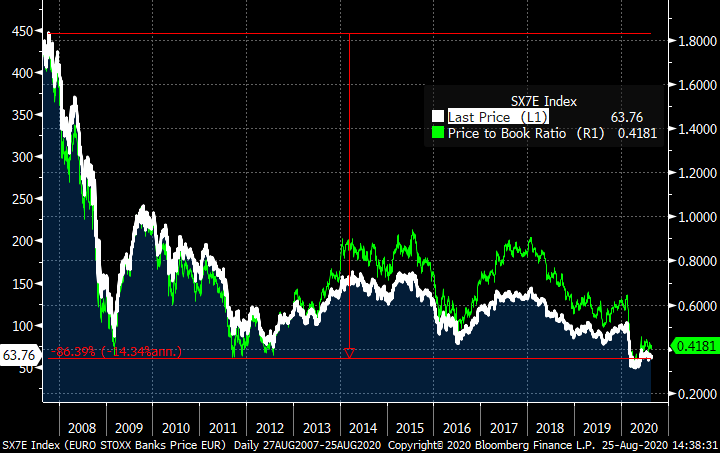
This rebalancing away from financials, which now represent under 5% of the index (down from a peak of over 20% in 2010), is good for the index and for investors tracking the index via passive funds or structured products. The European bank stocks index (SX7E) is still down nearly -90% from its June 2007 high, whereby over the last 5 years Eurostoxx Tech index (SX8E) has outperformed the SX7E by +165% (see chart below)

Eurostoxx 50 (SX5E), Eurostoxx 50 Technology (SX8E) and Eurostoxx Banks (SX7E): 5-year price chart

Source: Bloomberg

Surging technology and healthcare stocks are increasing their influence over European stock markets, as the role of car and energy companies gets reduced. This tilt away from “old economy” sectors like banks, cars and energy companies and the move towards “new economy” sectors such as technology and healthcare will serve the index well. In the SX5E, technology is now the largest sector at 15% and with healthcare, together add up to 25% of the index.

Moving on to US markets, despite the pullback last week, US stocks continue to outperform the rest of the world -except China and the tech-heavy NASDAQ Composite – (see table below)

Benchmark Equity Index Performance (2019 & YTD)

The sell-off of the last two weeks now seems to be behind us. However, as I pointed out in the section above, we will see more volatility as we get closer to the November 3 election. October will be a very volatile month, although the overall trend for US equities is still to the upside.

“Don’t Fight the Tape” is still in place from a long-term perspective, as the S&P 500 index (SPX) remains in a bull market and within its long-term uptrend channel. Besides the Fed’s regime of “lower for longer” is positive for equities.

With the recent comments coming out of the Fed indicating that they do not expect fiscal stimulus, for now, expect the Fed to issue more aggressive forward guidance that will keep flattening the yield curve and that can mean only one thing – with nowhere to go to generate income, investors will continue to take more risk and bid up equities.

Equity bears have been so wrong for so long but it doesn’t stop them from incessantly predicting the next correction, every time they see a -5% pull back. Meanwhile, the SPX keeps notching new highs.

Investors value equities with reference to a “risk-free rate”- the 10 Year US Govt bond (USGG10) yield to put it simply. When you buy equities, you take into account the return you would get compared to the return you are foregoing by not investing in “risk-free” asset. The Question is – do I buy Microsoft (MSFT US) or the US 10Y bond?

The Yield on the US 10y bond is currently +0.66% (in comparison, the SPX dividend yield is +1.83%). During the last two big equity sell-offs in 2007 and in 2000, the USGG10 yields were +5% and over +6% respectively (see chart below).

S&P 500 index, US 10 Year Treasury yield: 20-year price chart

Source: Bloomberg

At that time, if you felt nervous about stock valuations, you could say to yourself – well, equities look expensive/speculative and moving to US Govt bonds offering a risk-free return of +5-6% seems a good bet. When enough people did that in response to any scare, you had a deep correction.

Now, how many equity investors are willing to lock in their money for a +0.66% return for 10 years? I suspect, not many.

It’s better to have blue-chip stocks in the portfolio that pay a dividend and give you an “option” on future earnings, than to get stuck with a bond with +0.66% yield for 10 years. Of course, all of this can change if the Fed indicates it is looking to raise interest rates, but we’ve just been told by the Fed that “interest rates will have to stay near zero through 2023.”

A reflation trade will eventually come and when it comes it will very likely be slow and steady and well preambled and telegraphed, given how carefully the Fed has been managing the messaging. In the present circumstances, if you still have to hold a bond, please hold a majority of floating-rate bonds and not long duration fixed-rate bonds.

I continue to be bullish on equities with consumer stocks – both Staple (XLP) and Discretionary (XLY) are my favourite sectors to pick stocks from. I however, warn of a volatile 4-6 weeks period ahead, as we see the pre and post-US election events play out.

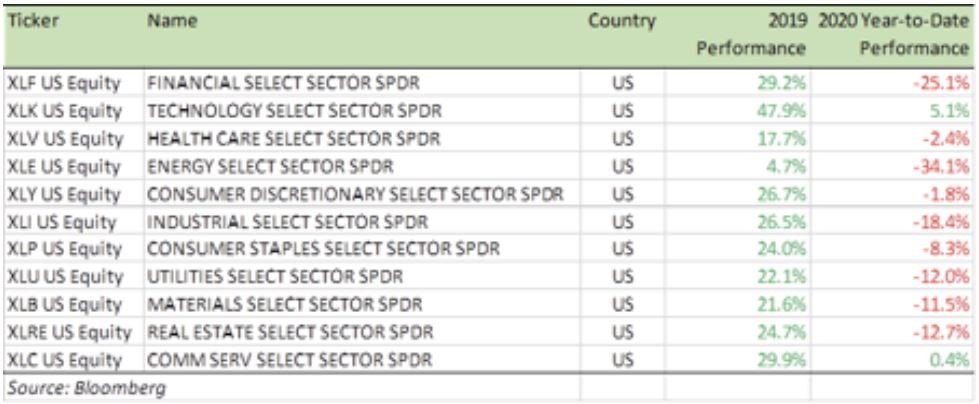
Benchmark US equity sector performance (2019 & YTD)

The rally in EUR/USD seems to be over for now and the weakness will help the Eurozone stocks as will a let-up in Covid-19, which will most definitely come. On a 12-month basis and also bearing in my mind the changes we have seen in the SX5E index (as outlined above), I would recommend the SX5E as a buy.

We have also seen a -20% sell-off in Silver and an over -10% sell-off in Gold this month. As I’ve pointed out in the past and on my email updates – a reflation trade will come, but not so soon. Investing in Gold is insurance and be prepared for the volatility and sharp moves. It’s best to buy Gold on pullbacks and accumulate a 5-10% holding in a portfolio, over time, for a rainy day and forget about it until the rainy actually arrives.

For specific stock recommendations, please do not hesitate to get in touch.

 
Best wishes,
Manish Singh, CFA


“Buy when everyone else is selling and hold when everyone else is buying. This is not merely a catchy slogan. It is the very essence of successful investments.”

-Jean Paul Getty

Summary

Despite a record contraction in US GDP during the second quarter of 2020, the S&P 500 Index hit a new all-time high. So why this rally when the economy is in a downturn? Well, the stock market is not the economy. The US stock market is less service driven than the US economy and Covid-19 hit the services economy much harder than it hit manufacturing The US stock market is also more global, while the US economy, as you would suspect, is more local. Demand for US made goods, particularly technology, has continued to be strong despite the pandemic. The US stock market is also more investment driven while US economy is more consumption driven. Capital investment which increasingly is supported by higher and higher technology spend, has been hit far less than the hit to consumer spending. Finally, equity returns are driven by surprises relative to the expectations. Whether positive or negative, surprises have a big impact on equity returns. Covid-19 turned sentiment very negative. However, unprecedented government stimulus combined with optimism among investors about the world’s ability to manage the pandemic have been the positive surprises, that have lifted equity markets.

Now that the SPX has erased all its losses from the Covid-19 meltdown, where do we go from here?

In my view, the risk is still to the upside, albeit, technology stocks look overvalued and could be in for a short term reversal. As equity sector returns indicate, besides the technology and the communications sectors (and a few consumer discretionary stocks such as Amazon), most sectors are still barely positive for the year. Most importantly, fiscal stimulus is still in place and more is to follow as the CARES II deal takes shape in the US. The Federal Reserve still seems concerned with the plethora of unknowns that could stall, or in the worst case, exacerbate the downward pressure on growth. It will be a very long time before interest rate increases are discussed, let alone actually raised. At the last Federal Open Market Committee (FOMC) meeting, most officials didn’t expect to raise interest rates at least through 2022.

The Stock Market is not the Economy

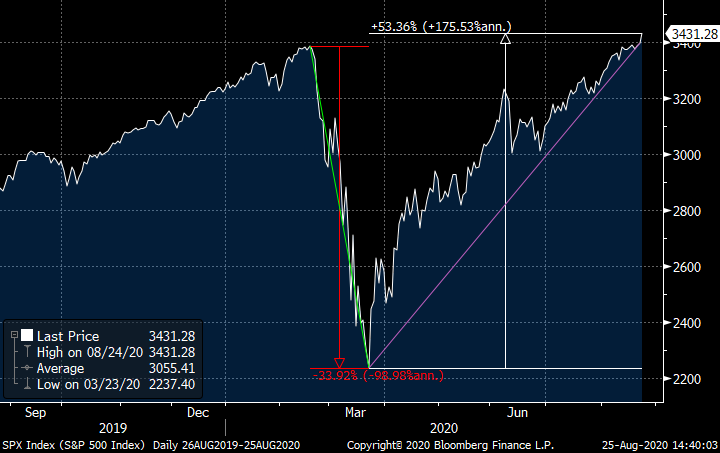
US GDP contracted by $1.8 trillion (an annualised rate of -32.9%) during the second quarter of 2020. The collapse was unprecedented in its speed and severity. Yet, we saw the S&P 500 Index (SPX) hit a new high. The SPX has now rallied by more than +50% from its March lows (see chart below).

Although meant as a tongue-in-cheek remark, it’s often said that “a bubble is a bull market in which you don’t have a position.” There’s something frustrating in seeing someone other than yourself make all the gains as you sit on the side lines. So, you do the only thing that comes to mind – call the whole thing a bubble, wait for a correction and pray. Of course, in doing so, you risk doubling your pain, as the rally continues and, after a point, you finally decide to throw in the towel and join in. We saw something of the sort last week.

S&P 500 (SPX) Index – 12 month price chart

Source: Bloomberg

In the August month BAML Global Fund Manager Survey (FMS) – a monthly report that canvasses the views of approximately 200 institutional, mutual and hedge fund managers around the world – investors finally agreed that we were no longer in a “bear market rally.”

The survey, released on the same day the SPX hit record highs, found that investors were now most bullish on equities, since the start of the Covid-19 induced market sell-off that started in late February.

The August survey also noted that 79% of the survey respondents said they believed global growth over the next 12 months would be positive, representing the highest reading since December 2009. This is a dramatic turnaround from the June month FMS survey, where 78% of the participants said the stock market was “overvalued.” The SPX is up +10% since then.

So why this rally when the economy is still in a downturn? Well, the stock market is not the economy.

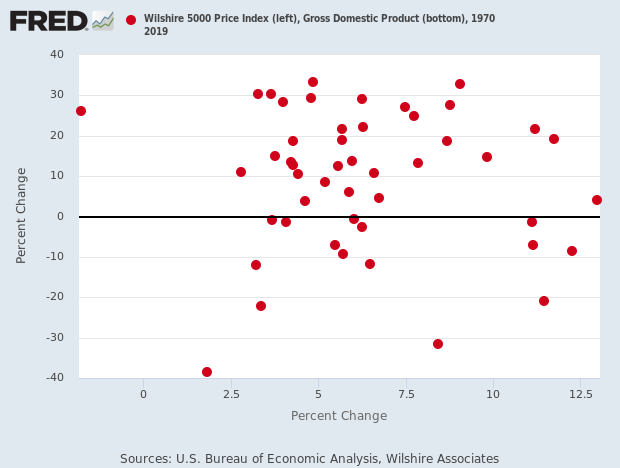
Below is an interesting chart from Eddy Elfenbein editor of the Crossing Wall Street blog. On the x-axis is the annual change in US GDP from 1970-2019 and on the y-axis is the corresponding stock market return. As you may note, the results look like a random scatter diagram, without any correlation. How can this be?

  • The SPX is less service driven than the US economy. Goods-producing firms make up 44% of the SPX whereas manufactured goods comprise just 29% of US GDP. Covid-19 hit the services economy much harder than it hit manufacturing. Many of the services are still in the doldrums, whereas manufacturing has shown a healthy recovery.
  • The SPX is more global, while US GDP, as you would suspect, is more local. Approximately 43% of the sales of the SPX are derived internationally, while US exports in the GDP calculation make up only 12%.
  • The SPX is more investment driven while GDP is more consumption driven. Capital investment which increasingly is supported by higher and higher technology spend, has been hit far less than the hit to consumer spending due to widespread lockdown of avenues to spend – airlines, restaurants, retail, etc. As a result, the SPX has been more resilient to the pandemic.
  • Equity returns are driven by surprises relative to the expectations. Whether positive or negative, surprises have a big impact on equity returns. Covid-19 turned sentiment very negative. However, unprecedented government stimulus combined with optimism among investors about the world’s ability to manage the pandemic have been the positive surprises that have lifted the equity markets. Writing the March month market viewpoints on March 23, 2020 where I made a case for – the market having bottomed. I wrote– “The bear case for equities …are also the very arguments for how the bull case for stocks starts. Fear is indeed palpable but it’s also the reason to start buying.” Looking back now, it all looks so prophetic.

Most things in economics and markets are relative and not absolute. When sentiment gets too bearish (as it did in March), I always countenance – do not ignore the reaction function. Those that turned bearish even when the SPX was at 2,300, were not taking into account the fiscal reaction that was to follow during an election year. The Trump administration was quick to compare the pandemic to a war, so it seems fitting it oversaw levels of stimulus and borrowing last seen in World War II, and the bears were caught on the wrong side of the trade.

Markets and the Economy

The Dow Jones Industrial Average (DJIA) is getting a makeover.

Salesforce (CRM), Amgen (AMGN) and Honeywell International (HON) will join the DJIA replacing Exxon Mobil (XOM), Pfizer (PFE), and Raytheon (RTN) respectively. Exxon, which joined the index in 1928 as Standard Oil of New Jersey, has been the longest-tenured member of the DJIA. While Amgen and Honeywell are like-for-like replacements, Salesforce, a technology company replacing Exxon, an oil major, after Exxon’s 92 years in the DJIA, is a sign of the times.

Tech companies are not just tech companies just as Amazon is anything but a “bookseller.” Tech companies are the retailers (Apple, Amazon), transporters (Uber, Lyft), healthcare providers (Taladoc, Livingo), bankers (Square, Paypal, Ant) and so many other things. They are present everywhere and in every sector of the economy.

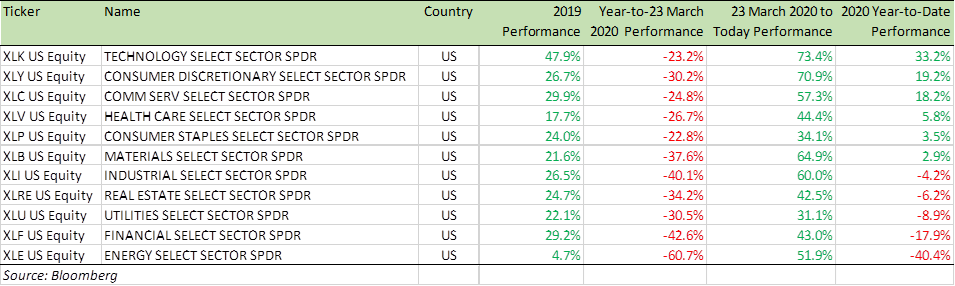
Just to underscore this point and the importance of tech and big data stocks, 2020 has been a case of the have and have nots (see equity sector chart below). There was a time, not long ago, when Energy (XLE) and Financials (XLF) were considered the life-blood of a capital intensive economy. However, these two sectors have been deemed irrelevant by the market in the current work-from-home world, where interest rates are close to zero and money is practically free. Instead, Communications, Technology, and Consumer/Retailer stocks with a strong online infrastructure, are the ever-important sectors of the economy.

Benchmark US equity sector performance (2019 & YTD)

Separately, the Covid-19 situation in the US continues to improve.

Last week, 44,779 new cases per day were recorded, the lowest since July 1 and down from over 70,000 cases per day in late July. Deaths per day from Covid-19 were also down to 1,017 over the past week, the lowest since July 30 and well below the over 2,000 deaths per day we witnessed in April at the peak of the coronavirus crisis in the US.

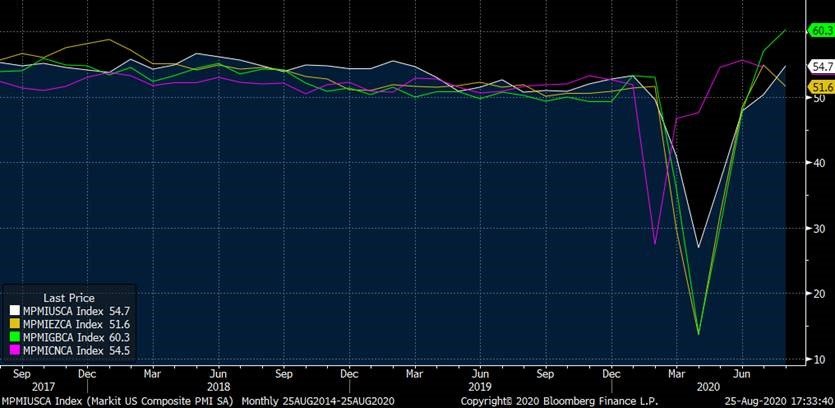
Recent data indicate that the US economy has so far managed to weather July’s sharp rise in Covid-19 cases, which some called the “second wave”. The increase in cases threatened business closures that could have knocked the recovery off course. The US Purchasing Managers Index (PMI) composite (MPMIUSCA in the chart below), a measure of manufacturing and services activity, rose to 54.7 from 50.3 in July, an 18-month high, with both sectors seeing a big increase. A reading above 50 is a sign of expansion while a reading below 50 is a sign of contraction in the economy.

Meanwhile, in Europe, the UK PMI composite (MPMIGBCA) rose to a seven year high of 60.3, indicating that the recovery has gained speed across both the manufacturing and service sectors since July.

The composite PMI for the Eurozone however fell to 51.6 in August from 54.9 in July, indicating its expansion has slowed. This comes as infections are again surging in Europe. Thankfully those affected have been much younger on average than during the first wave of the pandemic, and hospitalizations and deaths have been much lower. This makes it less likely that governments will revert to widespread lockdowns. Preventive quarantine measures however have pushed back the recovery in the European services sector, particularly its tourism industry, which has its busiest time of the year around now in the third quarter.

IHS Markit Composite Purchasing Managers Index (PMI) – August 2020

Source: Bloomberg, IHS Markit

Also, the housing data continues to be the most redeeming area of the US economy shaking off still high unemployment rate. The pandemic is reshaping where and how Americans want to live in a post Covid-19 world and home buyers have returned in force.

The July sales numbers were among the strongest the housing market has ever seen. Sales of previously owned homes jumped +24.7% from a month earlier to a seasonally adjusted annual rate of 5.86 million, according to the National Association of Realtors (NAR). That was the strongest monthly gain ever recorded, going back to 1968.

A big factor supporting housing demand – record low mortgage rates. In July, the average rate on a 30-year fixed mortgage fell to 2.98%, according to Freddie Mac, its lowest level in nearly 50 years of record-keeping. Also, buying surveys suggest housing demand looks strong in the near term. About 40% of home buyers polled by Realtor.com in June said they are looking to buy a home sooner because of Covid-19, while only 15% said the pandemic slowed down their timeline. Home sales can have positive knock-on effects as buyers spend on durable home goods and renovations.

Don’t just look at the encouraging data in the US! China, the second largest economy in the world is out of Covid-19 lockdown. Its restaurants and gyms are busy again and airport departure lounges are getting packed. This has led to economists at the World Bank and elsewhere upgrading their forecasts for China, the only major economy expected to grow this year.

Where do equity markets go from here?

Now that the SPX has erased all its losses from the Covid-19 meltdown, where do we go from here?

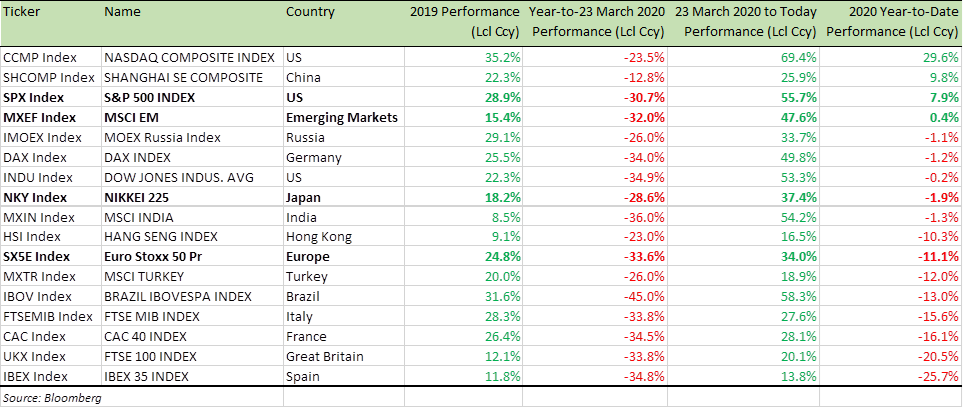
In my view, the risk is still to the upside albeit tech stocks look overvalued and could be in for a short term reversal. As the equity sector return table below indicates, outside of the tech and communications sectors (and a few consumer discretionary stocks such as Amazon), most sectors are still barely positive for the year.

Benchmark Equity Index Performance (2019 & YTD)

Most importantly, the fiscal stimulus is still in place and more is to follow as the CARES II deal takes shape in the US. Federal Reserve Chairman Jerome Powell and other Federal Reserve policymaker still seem concerned with the plethora of unknowns that could stall, or in the worst case, exacerbate downward pressure on growth. With low inflation and interest rates making the Fed’s conventional tools less powerful than before, Fed policymakers have been weighing inflation targeting – a policy of seeking to make up for periods of low inflation by allowing subsequent periods of somewhat higher inflation. The practical effect – it will be a very long time before interest rate increases are discussed, let alone actually raised. At the last Federal Open Market Committee (FOMC) meeting, most officials didn’t expect to raise interest rates at least through 2022.

All these, of course, are bullish risk and bullish equities.

I continue to be long equites with a bias to Consumer Staple (XLP) stocks which have more upside as the economy re-opens. I also favour Financials (XLF), Industrials (XLI) and Materials (XLB) stocks, which will play catch up. “Work from home” is good, but I refuse to believe it is a secular shift in a very meaningful way. When “back to work” returns, and it will, there will be a need for bigger infrastructure projects once again and for people and goods to move. The cost of capital will go up and industrial and material sector companies will be back in demand for their products and services.

Despite the surge in cases in Europe, there is room for a rally in European equities and indeed UK equities, which have fared badly when compared to their US counterpart (as the table above indicates).

Talking about Europe, no sector has been as beaten down in the post 2007 Great Financial Crisis (GFC) world as Eurozone banks. The Eurostoxx bank index (SX7E) has lost -87% since its 2007 high and is down -36% this year alone. The market capitalisation of the entire index is now smaller than that of JP Morgan. This year Covid-19 induced losses on loan books, and the ECB’s advice to put a stop on dividend payments, both have hit the sector hard. All that is now behind us. A great deal of bad news is already reflected in the price. So is it time to look at Eurozone bank shares again?

Eurostoxx Bank Index (SX7E) – 2007 to today

Source: Bloomberg

As a tactical recovery trade, yes. It is amply clear that “Keynesian policies” and not “austerity” will be the buzzword in the Eurozone for few years. This week, Germany extended a program that has kept millions of Germans from losing their jobs. Chancellor Angela Merkel’s coalition agreed to extend until the end of 2021 the job-preserving subsidies known in German as “Kurzarbeit” that pay the bulk of pay checks and allow companies to hold on to workers during an economic shock. It will cost Germany 10 billion Euros, which the government can easily fund through bond issues with negative yield. Therefore, any upturn in economic activity from expansionary fiscal settings in Germany and other Eurozone nations could see under-performing Eurozone bank shares react first and by the most. For specific stock recommendations, please do not hesitate to get in touch.

 
Best wishes,

Manish Singh, CFA


“America will never be destroyed from the outside. If we falter and lose our freedoms, it will be because we destroyed ourselves.”

– Abraham Lincoln, 16th US President

Summary

Presidential transitions in the US have existed in one form or another since 1797, when George Washington handed over the Presidency to John Adams. As per tradition, every four (or eight years for two-term Presidents), the clock hits noon on January 20 and the nation learns whether the outgoing President has accepted the legitimacy of the incoming President. Most transitions have gone well except a few. So what of the next one on January 20, 2021?

Opinion polls have proven untrustworthy and postal ballots, a bone of contention in the best of times, are going to play a very important role in the November US elections. This election cycle is set to see a dramatic increase in mail-in votes on account of Covid-19, from a normal 4-5% of the electorate voting by mail to a massive 20% by one estimate. President Donald Trump is fiercely critical of postal balloting and sees it vulnerable to voter fraud. This lays the groundwork for questioning the result of the election, if the contest is close. A close electoral loss for Trump is a nightmare that nobody in Washington is prepared to deal with, as it could most certainly lead to a constitutional crisis. Yet, recent war-gaming by the Transition Integrity Project indicates that “in three out of four scenarios the US Republic will hit constitutional impasse by the conclusion in January 2021.” Only a decisive win for Joseph Biden will avert a constitutional crisis that may yet befall on the United States in January next year.

The S&P 500 index (SPX) is down only -1.4% year-to-date (YTD). The federal stimulus programs – unemployment payments to supplemental lost income from layoffs – are still in place and there’s talk of extending them beyond the July 31 deadline. There could also be a second stimulus check for individuals and families. Yet, given the rise in the number of new cases and lack of a cure so far, US authorities will practise caution, and therefore the chances of a speedier re-opening are unlikely. Therefore, the summer months will unlikely get us a new high in the SPX. There is room however for a rally in European equities which have fared badly this year and have seen less of a recovery compared to their US brethren. The UK and European Union (EU) nations have managed to beat back the virus and this allows their governments to speed up their economic re-openings. In particular, travel for summer vacations is resuming and the spending it brings, will help the overall economy and the bounce in economic sentiment.

US Presidential transitions, will the next one go smoothly?

Congratulations to us all. We made it through to the second half of the year!

Presidential transitions have existed in one form or another since 1797, when George Washington handed over the Presidency to John Adams. As per tradition, every four (or eight years for two-term Presidents), the clock hits noon on January 20 and the nation learns whether the outgoing President has accepted the legitimacy of the incoming President. Most transitions have gone well, except for two noteworthy ones:

President Adams to President Thomas Jefferson in 1800-01: The first transfer of power between political parties and a turn away from the rule by the aristocratic elite to democratically elected leaders. Adams turned the transition into a display of personal pique, refusing even to accompany Jefferson to the Capitol for the inauguration. In later years they renewed their friendship through an exchange of 158 letters. “You and I,” Adams told Jefferson in 1813, “ought not to die before we have explained ourselves to each other.” Adams and Jefferson famously died on the same day, July 4, 1826, the 50th anniversary of the Declaration of Independence.

President James Buchanan to President Abraham Lincoln in 1860-61: Arguably the most catastrophic transition in American history. It was a time when sectional strife and division rose to such a high level that it split the Democratic Party and caused many to worry that the President-elect would not live to see his inauguration. With the country sliding toward civil war, outgoing President Buchanan sat passively as state after state seceded from the union. On the way to his inauguration, travelling by train from his home in Springfield, Illinois, Lincoln addressed crowds and legislatures along the way. He evaded possible assassins in Baltimore, who were discovered by Lincoln’s head of security, Allan Pinkerton. By the time Lincoln was inaugurated, seven states had left the Union to form the Confederate States of America and the stage was set for a conflict that would claim the lives of more than 600,000 Americans before peace and the Union were restored in 1865.

Source: National Museum of American History

So, just for a moment, let’s imagine it is the morning of January 20, 2021, at the White House in Washington DC and it’s all set for the transition of power. President Donald Trump is writing a letter for incoming President Joseph Biden. Later, President Trump and his wife, Melania welcome President-elect and his wife, Jill Biden at the North Portico of the White House. The couples exchange greetings and gifts and head inside for coffee. Later, they leave the White House in separate cars to meet again on the Capitol for the swearing-in ceremony. Swearing-in done, solemn words spoken and the 45th and 46th presidents say their final goodbyes as Trump salutes and boards the waiting helicopter on the South Lawn, or maybe not.

Now, you may think “maybe not”, is far-fetched but some in Washington are war-gaming this exact scenario – What if President Trump doesn’t accept the legitimacy of a Biden victory? (Particularly if it’s a close contest)

Don’t be fooled by Biden’s nine point lead, as some polls are indicating. We all remember what happened to Hillary Clinton’s 10-12 point lead, which she held on to until Election Day. If those polls had been right, Clinton would be up for re-election and not sitting on the side-lines hoping for Trump to be kicked out of the White House this November.

Source: CNN, Time

Opinion polls have proven untrustworthy and postal ballots, a bone of contention in best of times, are going to play a very important role in the November elections. This election cycle is set to see a dramatic increase in mail-in votes on account of Covid-19, with many state legislatures and governors, who tend to oversee election rules, sending out more, given the risks of in-person voting. Norman Ornstein, a scholar with the think tank American Enterprise Institute and a member of the National Task Force on Election Crises, a bipartisan body doing worst-case election planning says that normally states conduct approximately 4-5% of their electorate voting by mail, but this year that figure could be a massive 20%. It could take a week or more to count them and the uncertainty would make it worse, if it were a close election.

Trump is fiercely critical of postal ballots. He recently tweeted that mail-in ballots “will lead to the most corrupt election in US history”, a message he has echoed repeatedly in recent weeks and months. Trump sees mail-in ballots vulnerable to voter fraud whilst his critics claim Trump’s views on postal ballot as more driven by his belief that voting by mail will more likely result in a Democratic vote.

This lays the groundwork for questioning the result and could lead to a constitutional crisis if the contest is close. Trump could look to contest the results and claim he’d won. Remember he’d still have control of the government machinery including the Department of Justice (DOJ) for 11 weeks after Election Day, unlike in the UK, where the newly elected leader could be in power as early as the day after election results are declared. Those 11 weeks leave a lot of room for complications and uncertainly to arise.

A close electoral loss for Trump is a nightmare that nobody in Washington is prepared to deal with, as it could most certainly lead to a constitutional crisis. Yet, recent war-gaming by the Transition Integrity Project – created by two academics- Nils Gilman, a historian who has run scenario planning exercises for the US government for years, and Rosa Brooks, a former Pentagon official in the Obama administration and now a law professor at Georgetown University – indicates that “in three out of four scenarios the US Republic will hit constitutional impasse by the conclusion in January 2021.”

Only in one scenario, a massive Biden victory, did Trump not seek to remain in power. The bipartisan group’s focus has been the 78 days between the election on November 3 and the inauguration on January 20, when at noon the US Constitution demands that a president leaves office.

The identities of those who took part in the Transition Integrity Project war-gaming is closely guarded. However, as per reports, it is understood members include two former Governors, a former US cabinet Minister, ex-chiefs of staff to a US President and Vice President as well as retired members of the Pentagon and Congress – a sign of how seriously its work is taken.

Only a decisive win for Biden will avert a constitutional crisis that may befall on the United States in January next year.

Markets and the Economy

The S&P 500 index (SPX) wrapped up the second quarter of 2020, up + 20%, its biggest percentage gain since the last three months of 1998. A remarkable rally given the pessimism of March, when many were predicting new lows and a deeper correction, even as the index had fallen by -35%. Of course, the bears, in their enthusiasm to outdo the most bearish of predictions, completely overlooked the possibility of a fiscal response and the determination of the authorities to help and support people, jobs and the broader economy. An unprecedented $1.6 trillion stimulus package from the Federal Reserve (the Fed) and the US Congress set a fire under the rally, as investors bought back what they had sold and more.

The SPX as of today is down only -1.4% year-to-date (YTD). Only the tech-focused National Association of Securities Dealers Automated Quotations exchange (NASDAQ) index and the Shanghai Composite (SHCOMP) index have done better than the SPX. While the NASDAQ has rallied steadily all through the second quarter reaching new all-time highs, the SHCOMP surged by +16% in the last 10 days, as economic numbers in China continue to get stronger. Just five tech stocks – Apple, Microsoft, Amazon, Alphabet, Facebook make up over 20% of the SPX and that has certainly helped the index.

Benchmark Equity Index Performance (2019 & YTD)

Covid-19 will continue to be the focus this quarter as the number of cases in the US are surging. However, what matters the most is the number of deaths. As long as the number of death do not increase appreciably, and I hope they don’t, the markets will continue to stay positive and edge higher slowly as the economy continues to reopen. Also, remember the federal stimulus programs – unemployment payments to supplement lost income from layoffs – are still in place and there’s talk of extending them beyond the July 31 deadline. There could also be a second stimulus check for individuals and families.

These measures together with an improving economy will continue to keep the US consumer’s balance sheet in good health.

Based on the evidence so far (see chart below), even as the 7-day moving average (MA) of the number of new cases has surged from 20,000 to over 50,000 over the last four weeks, the number of deaths continues to tick down to new lows. This is encouraging. This virus didn’t come with a manual, so one can’t be certain that the number of deaths won’t tick up. However, it will be a mistake to pre-empt and implement lockdowns, in a haste, given the damage these can do to the economy and overall mental health.

The essence is that the US economy is moving in the right direction, as many economic data points are coming in substantially better than what economists expected. From the May job gains coming in more than 10 million higher than expected and retail sales soaring a record +18%, how quickly the economy is bouncing back has surprised nearly everyone. However, before one gets too bullish, one ought to bear in mind that the federal stimulus programs cannot continue to go on forever, and businesses will have to pick up the full tab before year end and, for that, they need to see the demand for their product/service grow.

As I wrote in the May newsletter, a 3,100-3,200 level on the SPX seems a fair range for me, where the index will hover barring a big economic surprise on the upside coming from speedier re-opening of the economy due to a breakthrough on a vaccine. Given the rise in the number of new cases and lack of a cure so far, the authorities will practise caution and therefore the chances of a speedier re-opening are unlikely. I suspect the summer months will unlikely get us a new high in the SPX.

There is room however for a rally in European equities and indeed UK equities, which have fared badly (as the table above indicates).

After failing badly at the start of the Covid-19 crisis, the UK and the European Union (EU) nations have managed to beat back the virus, help people to keep their jobs and wages, ready the healthcare system to deal with any new wave of the virus and lay the ground for economic growth.

In the UK, last week, Chancellor Rishi Sunak announced a stimulus package of £30 billion that amongst other things will help pay for people’s meals in restaurants and pubs, cut Value Added Tax (VAT) from 20% to 5% until January and raise the threshold at which people start paying stamp duty from £125,000 to £500,000 when buying property, meaning nine in ten people will be exempt from the levy.

Meanwhile, in the Eurozone, the years of austerity policies (as advocated by Germany) are history and the only disagreement among EU nations is – how to spend, not how much to spend. Germany’s embrace of fiscal stimulus is a welcome change in a Eurozone starved of growth and with China showing signs of recovery and acceleration, Eurozone stocks look to have a good summer ahead. It’s also aided by the excellent work Europe has done – relative to the US – and Emerging Markets in controlling the virus. This allows European governments to speed up their economic re-openings. In particular, travel for summer vacations is resuming and the spending it brings will help the overall economy and the bounce in economic sentiment. We are seeing signs of it already in the recent Purchasing Manager Index (PMI) data for services and manufacturing.

This will undoubtedly be positive for EUR/USD as foreign capital comes back chasing returns. A rally to above 1.15 is possible however I see EUR/USD stays in the 1.12 to 1.15 for next few months. The same goes for the GBP/USD which I also see range-bound in 1.25 – 1.30 even as data and sentiment in the UK improve. There is no appetite for big directional move given the overhang of the US elections, the uncertainly of GDP loss due to Covid and global economic growth which will be hamstrung due to fear of a new wave of coronavirus in the winter months.

Benchmark US equity sector performance (2019 & YTD)

In terms of sectors, the rally in Tech stocks looks overdone and a shift to more cyclical sector stocks in Energy (XLE), Industrial (XLI), Consumer Discretionary (XLY) and Materials (XLB) are a better bet. I am however not bearish on the Tech sector, I just advocate more stock-specific investing rather than buying the Tech sector index (XLK) as the way forward. I am particularly bullish on the payment services stocks and semiconductor stocks.

As I’ve mentioned before, I am in the camp that believes inflation and nominal growth will be engineered as a way out this recession and growth crisis and, therefore, I continue to be long floating rate bonds and financial stocks – both of which will benefits from shift in the steepening of the yield curve as economic data improves and market rushes to second guess the monetary tightening.

I’d also like to highlight the Biotech (XBI) sector which has broken out after 5 years of range-bound existence (chart below) and offers upside as the search for drugs to deal with coronavirus continues and we see a secular shift in increased healthcare spending globally.

SPDR S&P Biotech ETF (XBI) price chart

Source: Bloomberg

According to a survey of 190 fund managers by Bank of America in June, a second wave of coronavirus cases was cited as the most prominent risk facing stocks for a fourth consecutive month, followed by permanently high unemployment and a Democratic sweep of the election. These surveys are useful, but one also has to bear in mind that, if you ask traders about coronavirus you are essentially asking them to opine on a medical problem, which some may have no clue about.

So in these conditions, it is best to buy high quality stocks that one understands and hold your position through sell-offs or indeed if you have cash, then buy some more of the same good names.

For specific stock recommendations, please do not hesitate to get in touch.

 
Best wishes,

Manish Singh, CFA


“A dangerous ambition more often lurks behind the specious mask of zeal for the rights of the people, than under the forbidding appearance of zeal for the firmness and efficiency of Government.”

– Alexander Hamilton, First US Secretary of the Treasury

Summary

By now, it must be abundantly clear to even the most ardent of Europhiles, that the level of debt, particularly that of Italy and Spain (and soon France) is unsustainable. This, especially in light of the ongoing Covid-19 induced global contraction of yet-unknown magnitude. If the Euro currency is to survive, then a European fiscal union has to take place sooner rather than later.

The Franco-German proposal for a €500 billion European Recovery initiative announced last week – financed by bonds issued by the European Union (EU), directly in its name and guaranteed by its revenues has got Europhiles calling it – Europe’s “Hamiltonian moment,” referencing Alexander Hamilton, the first US Secretary of the Treasury. Details remain sketchy and the proposal has already met with opposition from member nations. Additionally, the initiative does not make provisions for a permanent increase in the EU’s meagre annual budget of €165 billion or give the European Commission the ability to raise funds under its name. The Recovery Fund is therefore not a “Hamiltonian moment,” by any stretch of the imagination.

The S&P 500 index (SPX) reached the 3,000 levels this week and is now trading back above its 200-day moving average, for the first time since February 27. Very reassuringly, we are now seeing a broadening out of the rally and a move away from stocks benefiting from a surge in “work from home.” Financial and industrial stocks have rallied this week as have other “re-opening” economy stocks in the leisure, consumer and travel sectors. This means that the SPX could easily get to over 3,100. I would, however, keep an eye on the 3,080 level, where the SPX broke down in March. The technology sector has rallied massively of late and may not have the legs to keep carrying on, particularly as GDP growth will suffer and sentiment and price-earnings (P/E) multiple expansion can only carry stocks so far. Fears of a second wave of coronavirus infections are not going away and the long-lasting economic fallout from stay-at-home orders and escalating trade tensions with China will only weigh on equities over the summer months.

Europe’s Hamiltonian moment? Probably not

Since the introduction of the Euro over two decades ago as the “single currency” of the European Monetary Union, several commentators and economists have pointed to the inherent flaws and fragility of this Union – namely, the lack of shared financial and banking systems or the existence of a common fiscal authority.

After the 2008 financial crisis, some progress was been made on the banking system front, although it still remains an incomplete Union, without a Euro area-wide common deposit insurance scheme.

On the fiscal front, a rescue fund, the European Stability Mechanism (ESM) was created in 2012 – with a maximum lending capacity of €500 billion – to help nations in financial distress. The real help however over the last decade or so has come from the European Central Bank’s (ECB) aggressive monetary easing and asset-buying programs, under the leadership of Mario Draghi, its former President.

Draghi’s “whatever it takes” speech in July 2012, has done more to keep the Eurozone together than any other political initiate before or since.

By now, it’s abundantly clear to even the most ardent of Europhiles that the level of debt particularly that of Italy and Spain (and soon France) is unsustainable, especially in light of the ongoing Covid-19 induced global contraction of yet-unknown magnitude. If the Euro is to survive, then a full fiscal union or a near fiscal union has to take place sooner rather than later.

German Chancellor Angela Merkel holds a joint video news conference with French President Emmanuel Macron, May 18, 2020

Source: Kay Nietfeld/Pool via REUTERS

Therefore, the unveiling at a socially-distanced press conference last week of the Franco-German proposal for a €500 billion European Recovery initiative – financed by bonds issued by the European Union (EU), directly in its name and guaranteed by its revenues, instead of using funds raised by national governments – has got many market and economic commentariat quite excited.

Can this really be the first step to a fiscal union or is it just another episode of an EU muddle-through?

Only time will tell. Details remain sketchy and the proposal has many teething issues to be debated and resolved but it hasn’t stopped the Europhiles from calling it – Europe’s “Hamiltonian moment.” The reference is to Alexander Hamilton (1755-1804), the first US Secretary of the Treasury. I would recommend caution.

Firstly, at this stage, it’s just a proposal and the Frugal Four as they are known- Austria, Netherlands, Denmark and Sweden, were quick out of the blocks to express their opposition to various elements of the plan. Over the weekend, they announced their counter-proposal, binning the key idea of the Franco-German proposal of debt-pooling. German Chancellor Angela Merkel and French President Emmanuel Macron now have to rally the other EU 27 nations to their vision of an EU that can tax, borrow and spend. However, all it takes is just one veto – and the plan collapses.

Alexander Hamilton is one of the few American figures featured on the US currency, who was never actually President. He features on the $10 currency note. George Washington ($1), Abraham Lincoln ($5), Andrew Jackson ($20), and Ulysses S. Grant ($50) are the Presidents that appear on US currency notes.

Alexander Hamilton, First US Secretary of the Treasury

Source: United States Treasury Bureau of Engraving and Printing

When George Washington became the first President of the United States, he made Hamilton the country’s first secretary of the Treasury. Hamilton learned about central banking at an early age, when he read about how the Bank of England (BoE) provided liquid capital as a way to expand commerce – which in turn helped Great Britain become a global trading power. Drawing on readings on political economy, credit markets, and central banking, Hamilton set the ball rolling for a historic constitutional comprise between the northern and the southern states that transformed the young United States nation from a largely rural and agrarian country into a commercial powerhouse.

The key feature of the plan was the US federal government consolidating the debt incurred by the US states during the War of Independence into US Treasury debt, laying the foundation for a strong central federal government, which could tax and issue debt in its name and thus expand the supply of money with the help of the central bank at the time – the First Bank of the United States – which Hamilton helped set up. This is known as the “Hamiltonian moment”

What the EU Recovery initiative does not do, is make provisions for a permanent increase in the EU’s meagre annual budget of €165 billion or give the European Commission the ability to raise funds under its name. Nor will the existing debts of EU nations be subsumed into joint obligations of the union, as done by Hamilton’s plan. The possibility of a new debt shared jointly among all EU countries – the so-called “coronabond” – has already been jettisoned. The Recovery fund is therefore not a “Hamiltonian moment” by any stretch of the imagination. At best, it is an apt historical reference perhaps, but the America of the 1780s and 90s couldn’t be more different than the present-day EU.

The American States then, as they are now, are still far more homogeneous in terms of culture, ideology, and their views of the purpose of money, the role of government in the lives of people collectively and individually – than Europe ever has been or will ever be. That homogeneity of political and economic principles is critical to holding together any sort of fiscal union. The situation of the member states of the EU is vastly different and in many ways is the exact opposite of the US. EU nations were formed over several centuries and throughout that, they have kept their language, currencies, distinct culture and ideologies. So will the EU ever have its “Hamiltonian moment”?

I have always been a sceptic of the EU and I don’t believe there will ever be the United States of Europe. Without a fiscal union however, the Euro cannot survive. Therefore, the bigger risk – the dissolution of the Euro – will focus even the hard-core nationalist German mind, as Germany has been the single largest beneficiary of the Euro.

Markets and the Economy

In the last month’s newsletter, I wrote: “I feel even more positive about the equity markets than last month. I also feel that the SPX could ramp up not just over 3000 but set new highs later this year as many investors are still beholden to their bearish bias ignoring the amount of stimulus money that is flowing in or set to flow into the system.”

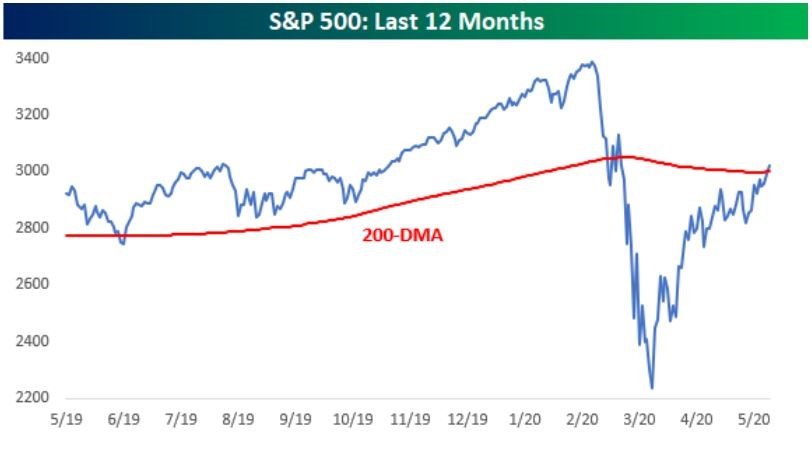
The S&P 500 index (SPX) reached the 3,000 levels this week i.e. it is now trading back above its 200-day moving average for the first time since February 27.

Source: Bespoke Investment Group

The 200-day moving average is seen as a classic momentum indicator and some investors view it as a signal to go long above this level, but not below it. Very reassuringly, we are now seeing a broadening out of the rally and a move away from stocks benefiting from a surge in “work from home.” Financial and industrial stocks have rallied this week as have other “re-opening” economy stocks in the leisure, consumer and travel sectors.

This means that the SPX could easily get to over 3,100. I would, however, keep an eye on the 3,080 level, where the SPX broke down big in March. I don’t see such a risk this time.

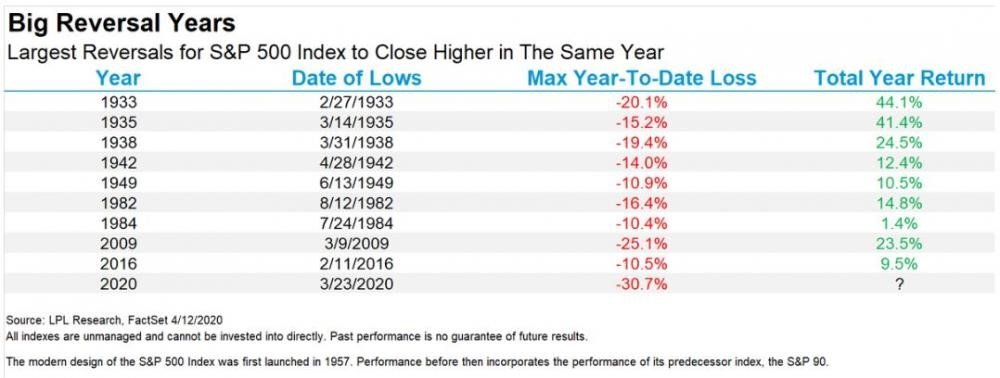
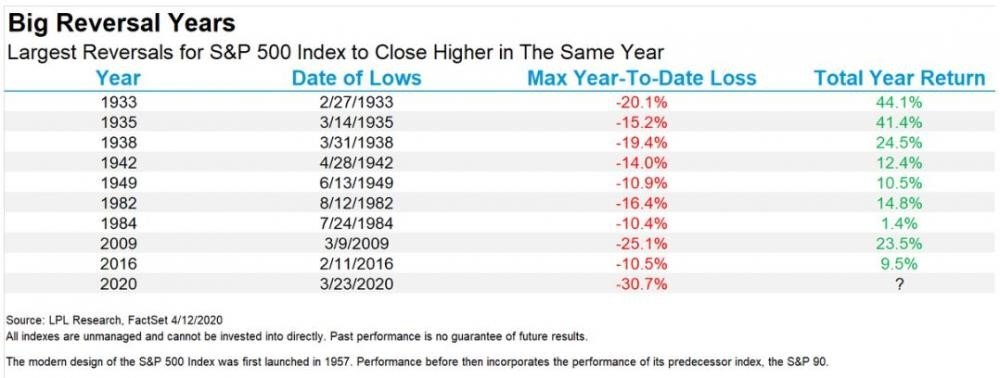
At its lows, the SPX was down more than -30% in 2020 and remains down -6% YTD. All previous reversals of -10% and over (see table below), have finished the year on a positive note. Can 2020 do the same? I suspect it can and it will.

While the rally has been spot on from an oversold position. I do now believe that it may stall over the coming weeks as the SPX reached 3,100. The technology sector has rallied massively of late and may not have legs to keep carrying on, particularly as GDP growth will suffer and sentiment and price-earnings (P/E) multiple expansion can only carry stocks like Shopify (SHOP) so far. Fears of a second wave of coronavirus infections are not going away and the long-lasting economic fallout from stay-at-home orders and escalating trade tensions with China will only weigh on equities over the summer months. Don’t forget that over 30 million Americans are still unemployed and while liquidity is not a concern, solvency of small businesses will be.

Lingering questions remain – Will planes fly half-empty until a vaccine is found? Will we ever be able to try on clothes in the shops again or try on shoes or browse in a bookstore? If not, will that affect our decision to buy? Perhaps it may postpone such a decision until later, thereby keeping GDP growth from getting back to normal.

The road back from today to pre-coronavirus days is going to be long or as Federal Reserve Bank of New York President, John Williams put it – “let’s not forget this is an extreme decline in economic activity, an enormous hardship for people in this country. So even if we are starting to see perhaps stabilization there in terms of the economy and maybe a little pickup, we are still in a very difficult situation.”

A sharp sell-off in the SPX, however, is unlikely. Near-zero interest rates and the US Federal Reserve’s (Fed) buying of corporate bond ETFs are going to carry on. The Fed is also considering what’s called Yield-Curve Control (YCC), where the Central Bank takes action to actively manage borrowing costs across different maturities. The need for a YCC policy may not be urgent as there is little doubt in anyone’s mind that rates will stay low for a long time to come. Also, as various parts of the economy re-open, equities will form a solid base on the downside with earnings estimates starting to increase.

As I have written since calling the March SPX lows, the ramp-up usually is always a slow burn compared to the sell-off, so be careful not to be too bearish. We have seen a near +34% rally in the SPX since the March lows, although it may not feel like that for those still holding on to cash. The rally, of course, has not been broad-based and major US financial stocks such as – Citi (C US), JP Morgan (JPM US), and Bank of America (BAC US) are still down more than -30% year-to-date, as are industrial and energy sector stocks.

The ECB’s ability to purchase bonds under a longstanding program came under fire earlier this month when a top German court demanded to know the justification for the program, prompting concern about the ECB’s ability to backstop the region’s debt markets. However, that concern seems to have been side-lined for now and European stocks are rallying in the wake of the “Hamiltonian moment” hope. I would suggest using the rally to sell long positions and re-position for a sell-off in European equities. My overweight continues to be US equities where both the outlook and return look much better.

I am not bullish on Emerging Markets (EM) equities at all and see them as a significant drag on performance.

I forecast a crisis building up in EMs and particularly in India if the lockdown continues. Listening to India’s Finance Minister Nirmala Sitharaman last week felt as if she was giving an online swimming lesson to someone who was drowning. It’s easy to shut down and economy, but difficult to reboot it and India is heading towards its first recession since 1979. It is one thing to say we will re-open, quite another to get it going. There has been little economic activity in India since March and the fourth phase of the lockdown started a week ago. The fiscal support offered is modest and mostly ineffective and will not have big impact. These factors also easily apply to other EM nations too.

Benchmark Equity Index Performance (2019 & YTD)

From a safety point of view, the Consumer Staples (XLP) and Healthcare (XLV) sectors are my favourites, however, as the economy keeps re-opening the gains are more likely to come from Consumer Discretionary (XLY), Industrials (XLI) Communication Services (XLC), and Technology (XLK) sectors.

For specific stock recommendations, please do not hesitate to get in touch

 
Best wishes,

Manish Singh, CFA

“If you are filled with pride, then you will have no room for wisdom”

– African proverb

Summary

The difference in approach taken by Sweden and the UK to deal with the COVID-19 outbreak has again led to a debate about basing significant policy action on computer models alone. Whether you are drawn to the Swedish or the UK approach is not a matter of how many more deaths you are willing to accept. The fact is, herd immunity is where we are all heading. We have herd immunity against many diseases and this is achieved via a vaccine or through the controlled spread of a virus. Your choice of one approach over the other is unlikely to be entirely down to your assessment of the science. It’s more likely a complex combination of your mental and physical age, politics, your life experience, as well as your attitude to risk, amongst other factors. Both the Swedish and the UK teams are made up of highly accomplished scientists, doing their best to understand a pandemic. It is down to policymakers to take their advice and make a judgement call which should take into account more than forecasts from a computer model. The epidemiologists and their forecasting models have never been under wider public and social media scrutiny. A vigorous debate is to be had once this is over!

Tuesday marked a key milestone in the US equity market’s rally from its late March lows. It was the first time since February 21 that the S&P 500 (SPX) opened above its 50-day Moving Average (MA) and stayed there the entire trading day. The US monetary and fiscal policymakers’ efforts to preserve household incomes and stop the massive bankruptcies, of the sort which ensured that the crash of 1929 turned into the Great Depression of the 1930s, should be applauded. Beyond the US, we have also seen massive fiscal and monetary action too and all that money will keep flowing into the real economy as activity picks up. So those caught up in a valuation fetish and looking for the March lows to be re-tested, may be in for a massive disappointment. As you may have gathered by now, I feel even more positive about the equity markets today than I did last month.

Trust but verify

Do you remember when IBM’s Watson took part in the quiz show Jeopardy! against two champion players – Brad Rutter and Ken Jennings?

This was nearly ten years ago. Watson, of course, won the contest (and the $1 million), but when Watson gave a wrong answer, it was spectacularly wrong. For instance, in the category “US CITIES,” in response to the question – “Its largest airport is named for a World War II hero and its second-largest, for a World War II battle.”

Watson’s answer was “Toronto,” which as many of you know is not in the US, but in Canada.

What this showed was the flaw of “computer models.” They are good at crunching data and, more often than not, can be right. However, a model or simulation is only as good as the rules used to create it. Putting your full confidence and faith in computer models and acting upon their forecasts, may not always be the best course of action.

The difference in approach taken by Sweden and the UK to deal with the COVID-19 outbreak has again led to a debate about basing significant policy action on computer models alone. Like IBM’s Watson, the forecasts made can be wrong and could lead to a non-optimal course of action being taken.

The UK’s policy response has been guided by the team at Imperial College led by Professor Neil Ferguson. Ferguson described COVID-19 as “a virus with comparable lethality to H1N1 influenza in 1918.” The 1918 virus better known as “Spanish flu” is estimated to have killed 50 million people worldwide. To date, just over 228,000 people have died from COVID-19 worldwide and the growth rate of new cases continues to fall.

Former US President Ronald Reagan used to say: “Trust but verify.” So I have looked into the past predictions of the Imperial College team as reported by The Times newspaper and have found that the Imperial team’s forecasts have previously been as spectacularly wrong as IBM Watson’s response to some questions on the quiz show. For example, Ferguson was behind the disputed research that sparked the mass culling of more than 11 million sheep and cattle during the 2001 epidemic of foot and mouth (FMD) disease, a crisis which cost the UK billions of pounds.

He also predicted that up to 150,000 people could die from bovine spongiform encephalopathy (BSE, or “mad cow disease”) and its equivalent in sheep if it leapt to humans. To date, there have been fewer than 200 deaths from the human form of BSE and none resulting from sheep to human transmission. A subsequent government inquiry was damning of the general approach and said: “The culling policy may not have been necessary to control the epidemic, as was suggested by the models….it must be concluded that the models supporting this decision were inherently invalid.”

Eight years later in 2009, Ferguson, then an advisor to the government and the World Health Organisation (WHO), sounded the alarm over swine flu, warning that it could cost up to four million lives globally and he floated a study on the antiviral benefits of closing all UK schools. In the end, the schools stayed mostly open and the worldwide death toll was 18,500 (not 4 million as predicted). There was again an inquiry — which concluded that ministers had treated modellers as “astrologers”, asking them to provide detailed forecasts when they had too little data.

Imperial’s forecasting model is also subject to many challenges in the academic world. Thankfully we do not have a pandemic that often – which also gives you an insight into how few cases the computer models have to learn and forecast from in order to understand their limitations. Diseases and illnesses have plagued humanity since the earliest of days. The table below outlines some of history’s deadliest pandemics, from the Antonine Plague to the current COVID-19.

Global Pandemics over the years

This interview with Professor Johan Giesecke, one of the world’s most senior epidemiologists and an advisor to the Swedish Government is a must-see. Giescke is the brains behind the Swedish COVID-19 strategy and he hired Anders Tegnell, Sweden’s chief epidemiologist, who is currently directing Sweden’s COVID-19 strategy.

In the interview, Professor Giesecke lays out in typically Swedish direct way, why he thinks the UK policy on lockdown (and that of other European countries) is not evidence-based. In his opinion, the correct policy is to protect the old and the frail only, as Sweden has done, and that this will eventually lead to “herd immunity” (an epidemiological concept where a population is sufficiently immune to disease) as a by-product. Herd immunity was the initial UK response, before the “180 degree U-turn” in favour of a lockdown. He also argues that the Imperial College model is “not very good,” far too pessimistic and any such models are a dubious basis for public policy. He has never seen an unpublished paper have so much policy impact. In his opinion, the flattening of the curve is due as much to the most vulnerable dying first as to the lockdown. He concluded that the results will eventually be similar for all countries and it was the novelty of the disease that scared people. The actual fatality rate of COVID-19 is in the region of 0.1%.

A busy park during the Covid-19 pandemic in Stockholm, Sweden, April 22

Source: ANDERS WIKLUND/ASSOCIATED PRESS

Now whether you are drawn to the Swedish or the UK approach is not a matter of how many more deaths you are willing to accept. The fact is, herd immunity is where we are all heading. We have herd immunity against many diseases and this is achieved via a vaccine or through the controlled spread of the virus. Your choice of one approach over the other is unlikely to be entirely down to your assessment of the science. It’s more likely a complex combination of your mental and physical age, politics, your life experience, your attitude to risk and your relationship to authority amongst other things.

Both Giesecke and Ferguson are highly accomplished scientists, doing their best to understand a pandemic. It is down to policymakers to take their advice and make a judgement call which takes into account more than forecasts from a computer model. The epidemiologists and their forecasting models have never been under wider public and social media scrutiny. A vigorous debate is to be had once this is over!

Markets and the Economy

Tuesday marked a key milestone in the equity market’s rally from its late March lows. It was the first time since February 21 that the S&P 500 (SPX) opened above its 50-day Moving Average (MA) and stayed there the entire trading day. That is a big positive, but the SPX has to stay over 50-day MA for a few days in a row to build confidence among the bulls. The next area of resistance for the market is just above 2,900, and then after that the 200-day MA at just above 3,000.

Source: Bespoke Invest

In my March newsletter Market Viewpoints I said: “I feel more assured that the market is bottoming …$2 trillion stimulus plan is a powerful weapon which short-sellers won’t want to face and buyers won’t want to miss.” Fast forward four weeks and we are almost 400 points higher on the SPX as it has eclipsed the 2900 level. The SPX has gained over +30% from its March lows and, on a 12-month basis, the SPX is now down only -0.21%.

The US monetary and fiscal policymakers’ efforts to preserve household incomes and stop the massive bankruptcies of the sort which ensured that the crash of 1929 turned into the Great Depression of the 1930s, should be applauded.

On the household income side, the US has expanded unemployment insurance eligibility at both the State and Federal level, so that almost anyone who cannot work due to COVID-19 disruption, is covered. The over 26 million American workers who have filed jobless claims since mid-March, will get an extra $600 a week from the Federal government through July 31 in addition to State-level benefits. That should raise the average benefit across states to around $1,000 a week and comes on top of other benefits that low-and middle income workers can claim. All this adds up to working full time at $25 an hour.

The Federal minimum wage followed by 21 US states is $7.25 an hour and has been unchanged for a decade. Washington D.C. has the highest minimum wage at $14.00 per hour whilst California, Massachusetts, and Washington have the highest State minimum wage at $13.00 per hour.

What this means is that roughly half of all US workers stand to earn more in unemployment benefits than they did at their jobs before the coronavirus pandemic shut down wide swaths of the US economy. I would call that a powerful stimulus that the market has not yet seen the impact of. As the lockdown eases, the next leg of the rally will be driven by increased consumer spending. With shops and other venues closed and only essential items available to buy, the weekly and monthly outgoings for many was vastly reduced. That saving will find its way into the real economy sooner rather than later.

Benchmark Equity Index Performance (2019 & YTD)

On Wednesday this week, we learnt that in Q1 2020, US Gross Domestic Product (GDP) contracted at an annual rate of -4.8%. This is the steepest pace of contraction of US GDP since 2008. The contribution to the percentage change in real GDP from the Services sector was -4.99%, which explains all the decline in GDP. That shouldn’t be a surprise as, like most economies, the US is mainly a Services economy and services were hit hardest given the lockdown. However, guess what the leading contributor to the decline in Services was? Answer: Reduced Healthcare spending.

That’s right. The healthcare spending contribution to the percent change in real GDP was -2.25% i.e. nearly half of all the decline in Q1 GDP. In US Dollar terms, GDP in Q1′ 2020 fell by -$234 billion and US Healthcare Spending fell by -$110 billion. A healthcare emergency leads to GDP contraction/recession – led by – drum roll please -reduced healthcare spending. Who’d have thunk it? Think of all those regular treatments, elective procedures, non-critical operations, cancer scans, preventative visits – all postponed as people were advised to stay away to create capacity (rightfully) so as not to overwhelm the hospital system and give priority to COVID-19 cases. Since these are all delayed spending, one has to be careful and not be too bearish regarding US GDP growth for Q2 and the rest of the year.

Beyond the US, we have also seen massive fiscal and monetary action too and all that money will keep flowing into the real economy as activity picks up. So those caught up in a valuation fetish and looking for the March lows to be re-tested, may be in for a massive disappointment.

Over the weekend, the Bank of Japan (BOJ) replaced its previous target of buying about ¥80 trillion Yen of Japanese Government Bonds (JGB) annually, with a new pledge to buy as many bonds as needed to keep the 10-year JGB yield at zero. The BOJ also increased its limits on purchases of longer-term corporate bonds and short-term commercial paper by ¥15 trillion Yen to a new limit of ¥20 trillion Yen i.e. a three-fold increase to help meet the capital needs of corporates affected by the COVID-19 pandemic. It also doubled its annual limit on purchases of Exchange-Traded Funds and Real-Estate Investment Trusts to ¥12 trillion Yen.

The BOJ’s move is the latest in a flurry of Central-Bank actions to combat the economic damage from the coronavirus. The US Federal Reserve (Fed) which was already buying investment-grade bonds, pledged on April 9 to purchase corporate bonds recently downgraded to junk status. The European Central Bank (ECB) has said it would accept some junk-rated bonds as collateral for its loans and the Bank of England (BOE) has spared no effort to help UK corporates.

The response to COVID-19 by various Central Banks is redefining the role, and remit, of monetary policy – like never before. By lending widely (directly or indirectly) – to businesses, states, municipal corporations, investment funds etc. to insulate the economy and avoid a 1930s-like depression, Central Banks are breaking century-old taboos about who gets money in a crisis and on what terms. Wide-scale direct financing of fiscal deficits isn’t too distant.

It’s worth reflecting how shocked we all were by Quantitative Easing (QE) in 2009. Those extraordinary measures never really faded away despite having been widely viewed as “temporary.” The baseline is – Central Banks and fiscal authorities will do what it takes to keep the system from collapsing. If some gasp, then so be it. There is no external moral authority to run the world system. So blaming Central Banks is an exercise in futility and virtue signalling, when they’ve been tasked with the job to keep the system from disintegrating.

“None of us have the luxury of choosing our challenges; fate and history provide them for us,” Fed Chairman Jerome Powell said in a speech this month. “Our job is to meet the tests we are presented.” The Fed and Powell deserve all the applause for dealing with the fallout of COVID-19 with great timeliness and competence. It is not to say Central Banks should continue to choose losers and winners. In that, I entirely agree with Oaktree Capital’s Howard Marks’ comment – “Capitalism without bankruptcy is like Catholicism without hell.” Securities regulators have their job cut out once the COVID-19 crisis is over.

Meanwhile in the Eurozone, the Italian, French and Spanish demand for a vast issue of “corona bonds” jointly guaranteed by all EU governments has fallen on deaf ears in Germany and Netherlands. One reason French President Emmanuel Macron has put his weight behind the “corona bonds” is that the economic consequences of dealing from COVID-19 could turn France’s debt into another Italy (as the chart below indicates). France’s debt/GDP ratio could vault to over 120%, following Italy’s experience in the aftermath of 2008-09.

France – Government debt projections

Italian public opinion is shifting against the Europe Union (EU), such is the disappointment with the way the EU has handled the COVID-19 crisis. If Germany continues to prevent pan-European “solidarity,” Italy’s departure from the EU may be more likely than ever. The market will then waste no time in pricing more exits. Germany must be aware of this risk and therefore it’s very likely they will show some form of contrition and help mitigate departures from the EU or indeed the very break-up of the Euro.

In this respect, George Soros’ proposal for the EU to raise the over €1 trillion needed for the European Recovery Fund to fight the COVID-19 pandemic by selling “Perpetual bonds” on which the principal does not have to be repaid has made everyone take notice. Particularly those that are bearish on Eurozone assets.

Soros makes a powerful plea in saying – “The EU is facing a once-in-a-lifetime war against a virus that is threatening not only people’s lives, but also the very survival of the Union. If member states start protecting their national borders against even their fellow EU members, this would destroy the principle of solidarity on which the Union is built.” A €1 trillion Perpetual bond with a 0.5% coupon would cost the EU a mere €5 billion per year, less than 3% of the 2020 budget.

It’s worth noting that one of the oldest examples of a Perpetual bond was issued in 1648 by the Dutch water board of Lekdijk Bovendams. It is currently in the possession of Yale University, the interest was most recently paid by the eventual successor of Lekdijk Bovendams.

As you may have gathered by now, I feel even more positive about the equity markets than last month. I also feel that the SPX could ramp up not just over 3000 but set new highs later this year as many investors are still beholden to their bearish bias ignoring the amount of stimulus money that is flowing in or set to flow into the system.

Nobody knows if there will be a second wave of COVID-19 in the winter and should there be one, then the template is very clear: Social distancing, more fine-tuned lockdowns and fiscal support. Debts and deficits may increase and puritans may not like the levels, but this is about the real economy, real life and not academic debates anymore. Besides, the level of debt alone is not the defining factor. The debt service cost is what matters. The Fed’s target Federal Funds rate is effectively zero, and 10-year Treasury yields are below +1% for the first time. Don’t expect this to reverse and increase anytime soon.

The Consumer Staples (XLP) and Healthcare (XLV) sectors are my favourite sectors at this time, although big gains will likely come from the Consumer Discretionary (XLY), Communication Services (XLC), and Technology (XLK) sectors. For specific stock recommendations, please do not hesitate to get in touch.

Benchmark US equity sector performance (2019 & YTD)

A few words on Oil and the Energy sector (XLE). Dysfunction reigned in commodity markets last week as crude oil prices traded at previously unthinkable negative prices thanks to worries over storage capacity. Energy stocks, however, rallied more than any sector this week. The case for bullish energy stocks is building up. Low oil prices will see massive cuts not just in production but also in capital expenditure (Capex) and other long term investments.

 
Best wishes,

Manish Singh, CFA