Stocks have rebounded since Trump’s tariff backpaddling and concessions. But there are still signs of strain in the bond market.

Summary

After weeks of mounting tension, the US and China opted to de-escalate over the weekend, marking a potential turning point in a trade war that has shaken markets and frayed diplomatic ties. This shift signals renewed pragmatism and a reminder of what built America’s economic strength: Not isolationism, but open trade and global engagement. Smart, targeted policy—not blunt instruments like sweeping tariffs—is what will secure US influence in the decades ahead.

Markets welcomed the news. Equities have rebounded since President Donald Trump began walking back tariff threats and offering concessions. However, strain lingers in the bond market. Yields on 10-year U.S. Treasuries have climbed back to +4.5%, highlighting persistent concerns around long-term fiscal sustainability. Unlike short-term rates, which the Federal Reserve can manage, longer-term yields are shaped by inflation expectations and fiscal credibility—particularly important in a country carrying growing debt burdens.

With fears of tariff-driven inflation now easing, the door is opening wider for the Fed to resume interest rate cuts. And while markets have rallied sharply, history suggests this isn’t necessarily the end of the move. Since 1953, when the S&P 500 has risen +10% or more in a month—especially following a prior sharp drop—continued gains have often followed.

If catalysts like interest rate cuts, lighter regulation, tax relief, renewed trade flows, and stronger global growth remain in play, there’s every reason to believe the rally has more room to run.

Decoupling Delayed: US & China reassess economic separation

So much for a clean break—Washington and Beijing seem to be reconsidering just how far this “decoupling” dance really goes.

After months and years of tough talk and the recent tariff escalations, signals suggest both the US and China are edging back from the brink, opting instead for a more pragmatic, if uneasy, economic coexistence. The weekend’s “tariff truce” points to a shift in tone, if not policy—a recognition that fully unwinding the world’s most important trade relationship is easier said than done.

More on these developments a little further down.

As we ease into the long days of summer, it’s hard to believe this chaos all belongs to the same year!

We’ve got the first American Pope (yes, really)—and if you have young kids and know your way around Paddington Bear lore, you might notice some parallels. Pope Leo XIV is not only a naturalized Peruvian, but he’s also been conducting services in Quechua, the language of the Incas. Somewhere, Paddington is probably nodding in approval.

“DeepSeek” has gone viral, taking a sledgehammer to the supposedly unbreachable moats of AI giants like OpenAI—prompting some frantic footwork, hasty feature drops, and even deal renegotiations with Microsoft. It’s also thrown cold water on Nvidia’s chip-fuelled money machine, sparking doubts about how durable that growth story really is—concerns Nvidia is answering well so far.

US President Donald Trump, never one to shy away from theatrics, cranked tariffs on China up to 145%, as if he were swapping Pokémon cards with China’s President Xi Jinping—then turned around and called Fed Chair Jerome Powell a “fool” for not slashing rates on command. Markets, naturally, responded with drama: A sharp correction, a whiplash recovery, and April 2’s so-called “liberation day,” which mostly liberated investors from their gains—and in many cases, their sanity.

And just when you thought things couldn’t get any more surreal, the US and China spent the weekend agreeing to a 90-day tariff cooldown. Apparently, even trade wars need a timeout.

Meanwhile, for football fans, Manchester United and Spurs— who are hanging just above the relegation zone at 15th and 16th in the Premier League—are now on track to sneak into the Champions League next season, depending on who wins the Europa League Final. And then there’s Kylian Mbappé, who left PSG for Real Madrid to chase European glory, only to watch his former team reach the final. It seems that, just like markets, trying to “time the move,” doesn’t work in football either.

So in summary, all of this—Popes, Paddington, tariffs, football and AI panic—feeds into a market environment that feels less like a rational pricing mechanism and more like a reality show with a Bloomberg terminal.

Back in March’s Market Viewpoints, I wrote “It’s time for Trump to make up his mind [on tariffs]—before the market does it for him, by selling off U.S. equities and bonds.”

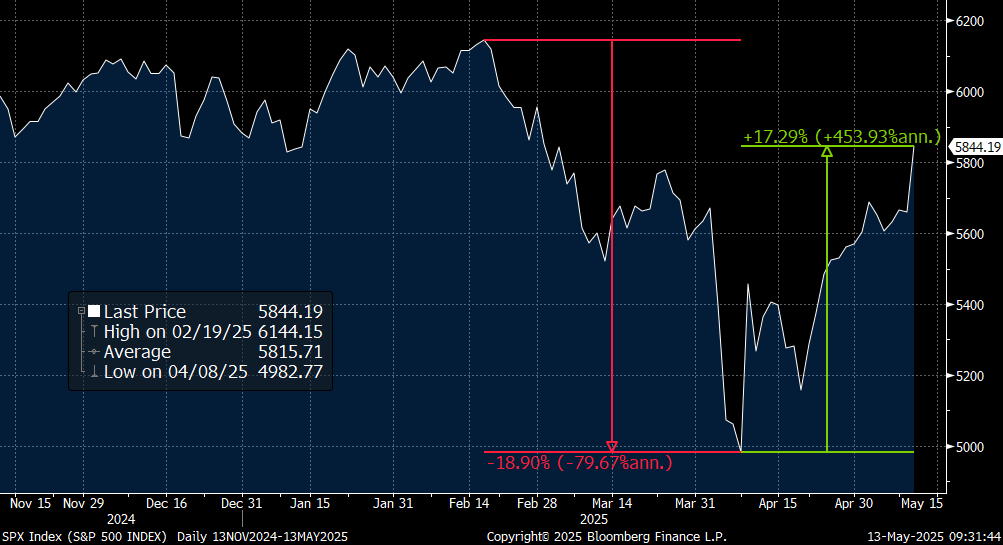
Well, the market didn’t wait. April saw a sharp -13% drop, followed by a full rebound as Trump changes tone making the April 2nd “liberation day” sell-off, feel like a fever dream.

S&P 500 Price Chart: Last 6 months

Source: Bloomberg

Such is the lack of conviction among the market bears: They know all too well that Trump can pivot faster than a meme stock on Reddit—and sure enough, he did just that. As late as Friday, he was still floating an 80% tariff on China; by the weekend, we had a truce. Classic.

The result?

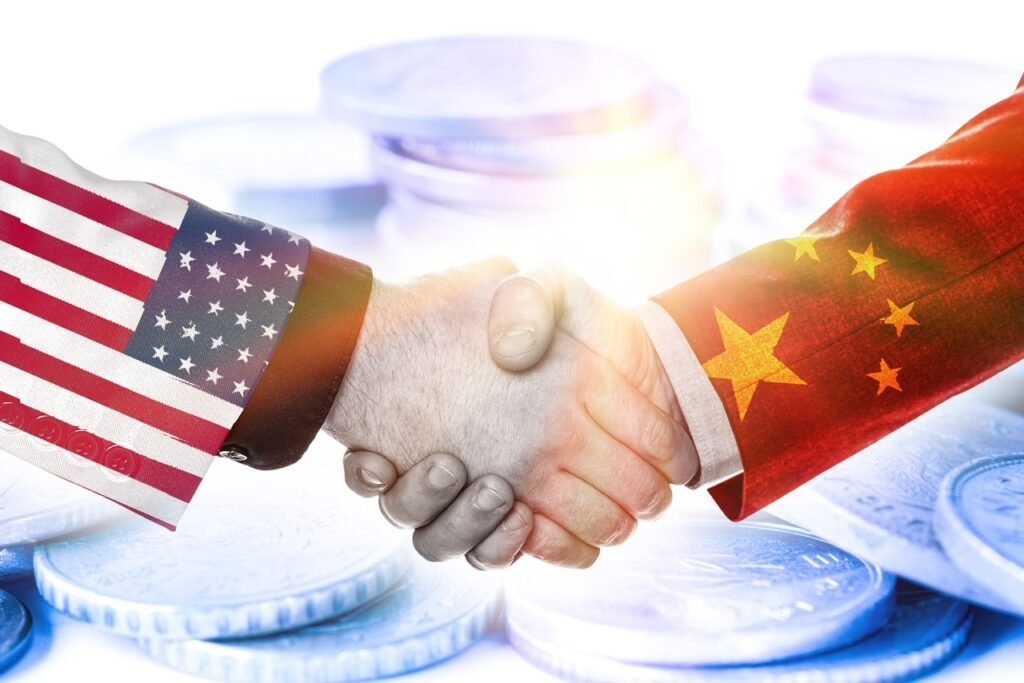
A handshake deal that amounts to a “tariff truce,” for now.

Sometimes, as the market reminded us yet again in April, the smartest way to handle non-cyclical, man-made (or Trump-made, if you prefer) crises, is to sit on your hands and let the chaos unfold—rather than place bets on known unknowns, unknown unknowns, and everything else we think we understand just because we went to a top university and paid handsomely for the privilege. Regret tends to cost more.

After weeks of escalating tariffs and strained relations, over the weekend, the United States and China chose to de-escalate . This development signals a potential thaw in the ongoing trade war, that has disrupted global markets and strained bilateral ties.

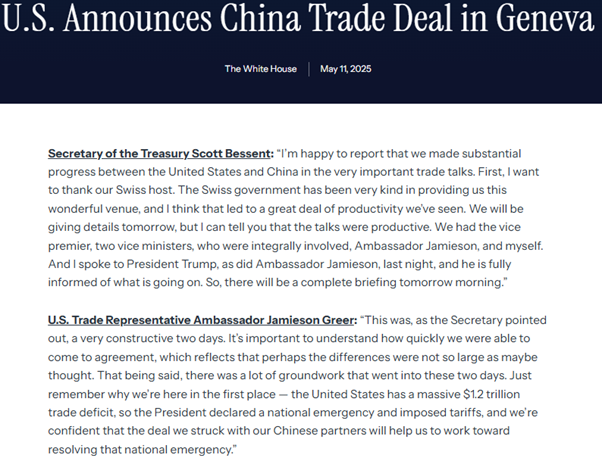
US Treasury Secretary, Scott Bessent said at a briefing in Geneva on Monday. “Neither side wants a decoupling. We want more balanced trade, and I think both sides are committed to achieving that.”

Source: White House

China released the joint statement with the US simultaneously. “This move meets the expectations of producers and consumers . . . aligning with the interests of both nations and the common global interest,” China’s Ministry of Commerce said.

“No decoupling,” is a welcome news as the US and China trade and economic relations hold the fortune of global growth and peace.

The trade conflict intensified earlier this year when Trump imposed tariffs exceeding 145% on Chinese goods. China retaliated with tariffs of up to 125% on U.S. exports, leading to significant disruptions in trade flows and economic uncertainty. A shared concern over the fentanyl crisis has opened channels for renewed dialogue. China’s recent efforts to address the issue, including crackdowns on chemical precursors, have been met with cautious optimism from the US administration. This common ground paved the way for the talks over the weekend.

The urgency to a do deal with China on tariffs, is evident and deteriorating data puts it in perspective too.

US productivity slipped at a -0.8% annual rate in Q1, marking its first drop since mid-2022. Over the past year, productivity has inched up just +1.4%, the slowest pace since early 2023.
Meanwhile, unit labour costs—basically wages—spiked +5.7% in the first quarter, more than double the +2.0% increase in the previous quarter. In short: workers are costing more and producing less. Not exactly the combo you want on your economic scoreboard.

Just over a week ago at his annual Berkshire conference in Omaha, Warren Buffett emphasized that trade should not be used as a weapon and that we should be looking to engage with the rest of the world. Buffett is absolutely right: Trade is not a weapon.

It’s a bridge — a long-term tool for building influence, prosperity, and yes, empires.

History backs this up.

Spain, France, the Dutch, Britain, and eventually the United States, all leveraged trade as a foundation for global expansion. Their economic networks supported military, cultural, and political influence far beyond their borders. Trade enabled not just economic growth but strategic reach. China, the latest entrant to this centuries-old game, is pursuing a similar path — using trade as a cornerstone of its rise.

The irony is that the US, having built much of its global position through open markets and economic engagement, now risks undermining that very legacy.

By turning trade into a zero-sum, tit-for-tat battlefield, Trump is playing a short-term game with long-term consequences. Yes, there are structural imbalances and real issues that need addressing — from intellectual property to market access. But the solution isn’t to break the system; it’s to outsmart within it.

Smart, targeted policy — not sweeping tariffs and trade wars — is what will keep America competitive and respected.

Because if the US wants to extend its influence into the future, it must remember what built its empire in the first place: Not isolation, but connection.

Not threats, but trade.

Markets and the Economy

Stocks have rebounded since Trump’s tariff backpaddling and concessions. But there are still signs of strain in the bond market.

The equity market recovery rally is easy to explain — Trump imposes punitive tariffs, the market drops. Then Trump gives waivers, rolls back some of them and signals that most of the tariffs may be lifted. The market rebounds.

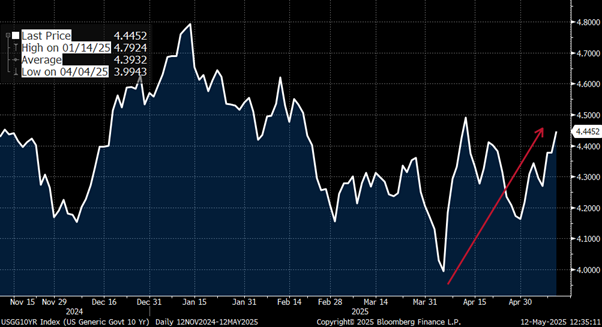
Yields on US 10-year Treasuries, however, refuse to go down and are now back to +4.5% level (see chart below)

Longer-term yields, which are critical in determining borrowing costs for long-term projects and, more importantly, for the fiscal health of a country with ongoing debt to service, renew, and repay, are primarily driven by expectations of inflation and fiscal policy. While the Federal Reserve (Fed) has control over short-term rates through its monetary policy, its ability to directly influence long-term yields remains limited.

6-month chart: US Treasury 10-year yield

Source: Bloomberg

The US House and Senate Republicans have been working for months on major tax-cut legislation, which may or may not include significant spending reductions. Meanwhile, the Department of Government Efficiency (DOGE) has had limited success in identifying and cutting wasteful spending. Additionally, tariff collections are expected to fall, as the US reduces its tariff levels. While budget concerns have existed long before Trump took office, if he moves forward with unfunded tax cuts, the market is unlikely to look kindly on it.

Investors are expected to remain cautious about purchasing longer-term Treasuries, due to fears that the growing supply of bonds needed to fund the federal budget deficit, could put downward pressure on prices.

If long-term rates don’t decline or, conversely, rise, it will keep mortgage rates and other forms of debt elevated—just when the central bank might try to encourage borrowing by cutting short-term rates to stave off any signs of recession.

The US-China deal struck over the weekend is certainly welcome, but given it’s more of a pause than a permanent resolution, its impact on long-term yields is likely to be limited.

Going forward, both sides have agreed to hold regular talks—alternating between the US, China, or a neutral third country—to negotiate more comprehensive trade terms. Notably, the joint statement appeared to shut down any serious discussion of a full-scale trade rupture between the world’s two largest economies, whose bilateral relationship—though heavily skewed in favour of Chinese exports—remains the most significant in global trade.

The fears of inflation due to tariffs, is now alleviated and it should open room for the Fed to cut rates.

These two points from Bessent’s comments at the press conference in Geneva, is very telling. There’s room for a grand deal.

  • “The consensus from both delegations this weekend is that neither wants a decoupling”

  • “What occurred with these very high tariffs was the equivalent of an embargo. Neither side wants that.”

In April, the US economy added 177,000 jobs — better than many had feared. The S&P 500 responded with a +1.5% jump, pushing it above its April 2 closing level, the day the president announced his “reciprocal tariffs.”

That marked the index’s ninth straight daily gain — its longest winning streak since 2004.

Getting back to how much difference a month can make—consider this: just a month ago, US stocks were staggering under the weight of the “Liberation Day” tariffs announced by Trump in the White House Rose Garden.

On April 8, the S&P 500 had fallen nearly -19% from its February highs, teetering on the edge of a bear market.

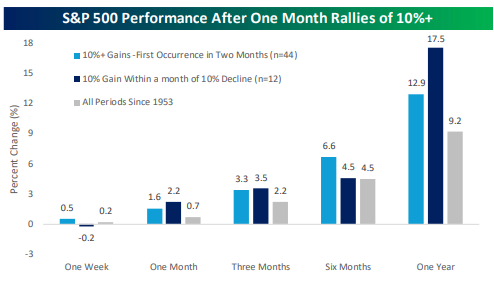
Fast forward to today, and the index is up over +17.3% from that low—marking the strongest one-month rally since April 2020, when markets were clawing their way back from the COVID crash. It’s rare enough to see a +10% monthly rally. It’s even rarer for such a surge to follow so closely on the heels of a 10%+ monthly decline.

Source: Bespoke Invest

While the market has rebounded sharply, history suggests that strong rallies don’t necessarily imply an imminent reversal.

The data backs this up (see table above). Since 1953, following one-month gains of +10% or more—or such gains occurring within a month of a 10%+ decline—the S&P 500 has historically continued to post solid returns over the following weeks and months. Charts on the next page show median returns and the frequency of positive outcomes in the 1-week, 1-month, 3-month, 6-month, and 12-month periods that followed.

So don’t be surprised if the rally has more legs—especially if the underlying catalysts strengthen rate cuts, easing inflation, tax cuts, lighter regulation, revived trade flows, and an improving global growth outlook.

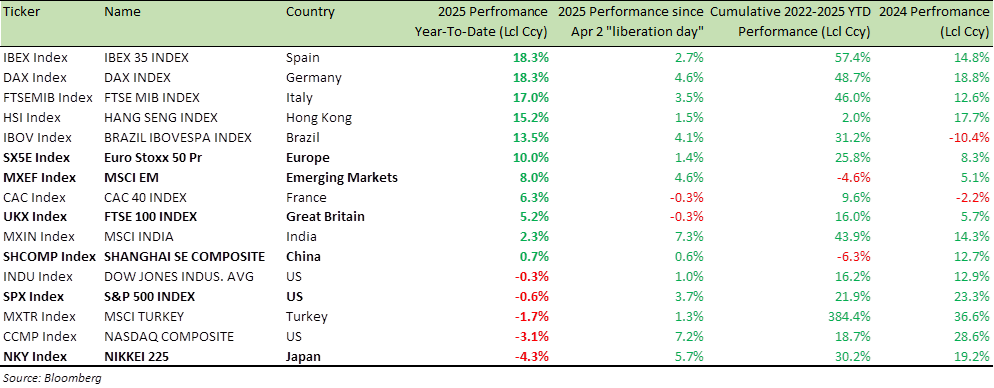
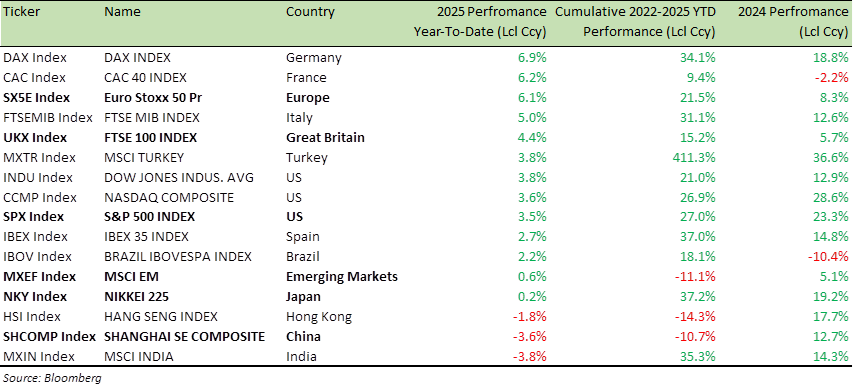
Global Equity Index Performance (2025 performance YTD, since Apr 2 “Liberation Day”, 2022-2025 YTD and 2024)

Meanwhile, over in Europe—and closer to home in the UK—the Bank of England (BoE) finally delivered a 0.25% rate cut last Thursday.

Fair enough.

Something is better than nothing, especially given how far behind the curve the BoE has been in pivoting toward looser policy. For context, the Eurozone’s central bank rate now sits at 2.25%—nearly half of the UK’s still-lofty 4.25%.

But what really turned heads was the vote split on the Monetary Policy Committee (MPC).

Five members voted for the modest quarter-point cut. Two pushed for a deeper, 50-basis-point reduction. And—brace yourself—two voted to hold rates steady.

Hold rates? In this environment? Seriously?

At this point, you have to wonder: Are they setting monetary policy or just treating the UK economy like a petri-dish for academic theory?

Because the data isn’t subtle.

The UK’s Purchasing Managers’ Index (PMI) tells a clear story: growth is sputtering, and the £26 billion hike in employers’ national insurance contributions is about to hit like a brick.

Job losses are looming.

And while falling oil prices (down over 15% in recent weeks) are good news for inflation, tariffs and weaker global trade are piling on new risks to growth.

Given all this, you have to ask: Should the Bank of England be doing more—and faster?

GBP/USD strength is masking the weakness of the UK economy. I expect BoE to cut rates by at least 100 bps by the end of the year.

Finally, a lesson from market history:

In 2008, BlackBerry (then Research In Motion) was worth more than Amazon, Nvidia, Netflix, AMD, Salesforce, and Starbucks combined. With a market cap near $80 billion, BlackBerry was the global smartphone leader.

At the time in 2008, those now-dominant names were still emerging:

Amazon: ~$30B
Nvidia: ~$10B
Netflix: ~$3B
AMD: <$4B
Salesforce: ~$6–7B
Starbucks: ~$15B

Fast forward to 2025, and the reversal is staggering:

Nvidia: >$3T
Amazon: >$2.2T
Netflix: > $450B
AMD, Salesforce: each >$200B
Starbucks: ~$100B
BlackBerry: acquired by Fairfax Financial Holdings for $4.7B in 2013

The takeaway:

Markets—and fortunes—can change drastically.

If you’re ahead, don’t get complacent.

If you’re behind, keep pushing.

Success (in investing, sports or life) isn’t owned—it’s rented, and rent is due every day.

In last month’s Newsletter, I wrapped up with this: “Come May, I suspect President Trump will strike a broad deal with China, take a victory lap, and we all can take respite that we survived the trade war.”

Well, here we are in May, a US–China deal is on the table (with more likely to follow), and markets are breathing a little easier. The balance of risk for equities now tilts to the upside, and any meaningful signs of a US recession remain elusive.

For specific stock ideas or structured product strategies, feel free to reach out to me directly—or connect with your relationship manager. We’re happy to guide you through it.

 
Best wishes,

Manish Singh, CFA


Tariffs are once again thrust into the spotlight.. However, there is a silver lining: Bond market volatility is not showing signs of stress

Summary

As April 2 looms, tariffs are once again thrust into the spotlight. President Trump’s ambitious vision to reshape America comes with high stakes, yet intentions alone do not always lead to success. Unchangeable shifts, such as China’s manufacturing supremacy, its advanced STEM workforce, and rapid innovation efforts, stand firm against the backdrop of these plans.

The US economy is wrestling with significant challenges: escalating debt, a widening budget deficit, and an increasing trade gap. Central to America’s economic strategy is its reliance on printing dollars to fund imports—a system that remains viable as long as global partners continue to engage with the dollar. Beyond trade imbalances, the more pressing issue is the sustained global demand for these dollars. The limitations of debt-driven consumption are becoming apparent, and genuine growth will require a boost in productivity—an outcome unlikely to be fostered by a trade war. Ideally, a trade agreement that benefits both the US and China would circumvent these issues. Without such an agreement, we may revert to a cycle of disinflation and stagnant low interest rates as China enhances its production and floods markets with exports, exacerbating the US trade deficit.

Amidst this, President Trump’s erratic tariff strategy adds to market volatility, leaving investors to manage ongoing uncertainty. Despite significant rallies, the S&P 500 has struggled to maintain gains, reflecting persistent bearish sentiment—the second-longest on record since 1987.

However, there is a silver lining: Bond market volatility is stable and range bound, as evidenced by the MOVE index. Given that the bond market is significantly larger than equities and often a harbinger of financial stress, this tranquillity could be a stabilizing factor in the turbulent weeks ahead.

Back to Tariffs Again, but Credit Markets Remain Calm

On Wednesday, US President Donald Trump announced a 25% tariff on “cars not made in the United States.”

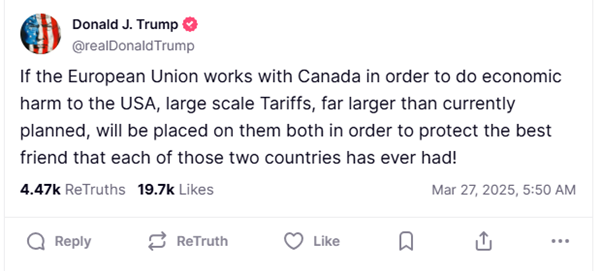
By Thursday, he escalated this further, warning on Truth Social that he would impose “far larger” tariffs on the European Union and Canada, if they coordinated retaliation against his measures.

It’s as if Trump were playing ball with Canada, took the ball, and walked away—only to now be upset if Canada started playing with Europe instead. It’s clear he is overplaying his hand. The more he threatens allies with tariffs, the more he pushes them to work together—ultimately to the detriment of US interests.

Also last week, Trump floated the idea of lowering tariffs on China—if Beijing approved the sale of TikTok. “China is going to have to play a role in that, possibly, in the form of an approval maybe, and I think they’ll do that. Maybe I’ll give them a little reduction in tariffs or something to get it done,” he said during an Oval Office press conference.

Trump needs to ask himself: What is the actual goal of these tariffs? Because it seems to change by the day.

The US has a trade imbalance with China, and its economy remains heavily reliant on Chinese imports. Tying TikTok into that equation, signals a lack of focus and clear decision-making. This kind of mixed messaging is doing little to help markets.

A more pragmatic approach would be negotiating a deal that addresses Trump’s valid concerns about unfair tariffs on US goods, eliminating the need for reciprocal tariffs in the first place.

With Trump’s tariff strategy shifting as often as a cat chasing a laser pointer, market volatility and investor anxiety remain the only constant—and equities are feeling the impact.

The S&P 500 is right back where it was at the end of October last year, despite rallying more than +6.5% from that level not once, but three times.

This week marks the fifth consecutive week that bearish sentiment has exceeded 50%, tying for the second-longest streak in the survey’s history since 1987.

Similar five-week stretches occurred in October 2022 and January 2008, while the only longer streak was in October 1990, when bearish sentiment dominated for seven weeks straight.

Given the market’s resilience over the past four decades, it’s striking that today’s largely self-inflicted uncertainty has led to one of the most prolonged periods of bearish sentiment on record.

Source: Bespoke Invest

Periods of heightened bearish sentiment typically coincide with a risk-off environment, where investors flock to safe-haven assets.

However, that hasn’t been the case over the past five weeks.

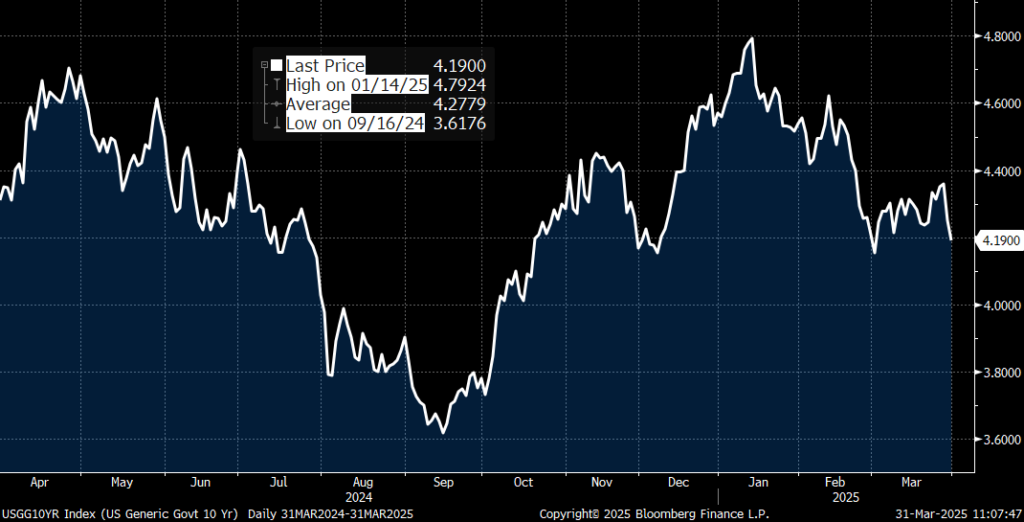
The bearish sentiment first crossed 50% on Feb 27. At the time, the 10-year yield on US Treasuries closed at +4.26%, and as of today, it’s hovering just below +4.20%—a 6 basis point (bps) decrease.

Yields generally drop in risk-off. The five-week streak ending in January 2008, saw yields decline by nearly 50 bps, and during the seven-week streak in 1990, yields dropped by about 20 bps—though back then, yields were in the +8% range, roughly double today’s levels.

10-Year US Treasury Yield: Last 12 months

Source: Bloomberg

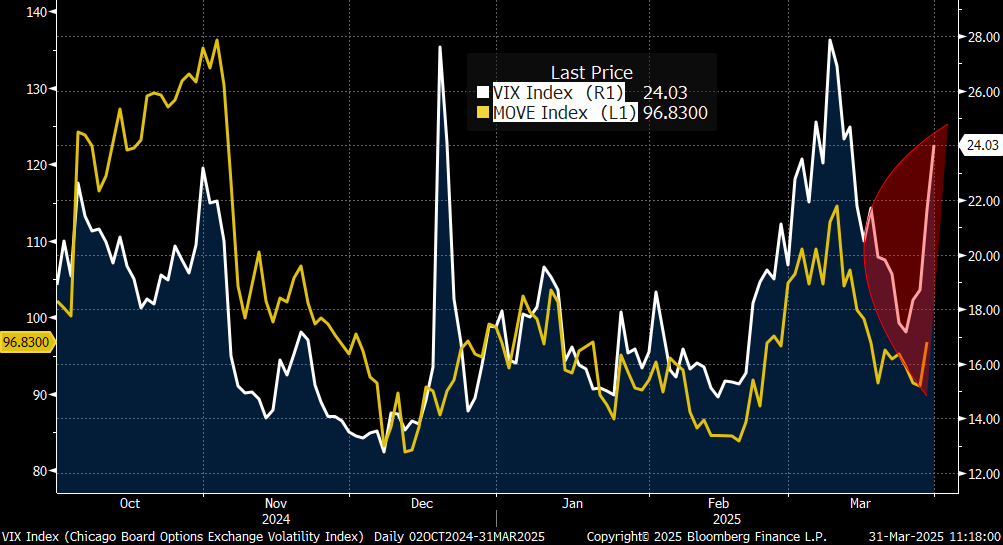
The VIX index, which measures expected stock market volatility over the next 30 days based on S&P 500 options, isn’t at extreme levels but it has shown a big jump.

On the bright side, bond market volatility—tracked by the MOVE index (often called the “VIX of bonds”)—continues to remain stable and range bound (see chart below). That’s reassuring, given that the bond market dwarfs equities in size, and financial stress typically shows up in bonds before spreading to other asset classes.

If ever there was a time for the US Federal Reserve (Fed) to be truly “data dependent,” it is now.

At its latest rate-setting meeting on March 18, the Federal Open Market Committee (FOMC) held the benchmark federal funds rate steady at around +4.3% as it evaluates how the Trump administration’s flurry of policy changes could reshape the economic landscape.

Officials now expect inflation to rise to +2.7% this year, up from +2.5% in January. “That’s really due to the tariffs coming in,” Fed Chair Jerome Powell said, adding that progress on reducing inflation “is probably delayed for the time being.”

“We think it’s a good time for us to wait for further clarity,” Powell stated at the post-FOMC press conference last Wednesday.

Policymakers also revised their 2025 GDP growth forecast down to +1.7%, from the+ 2.1% they projected in December.

6-month price chart: VIX index and MOVE index

Source: Bloomberg

Looking ahead, the Fed faces a binary choice: Hold rates steady for the rest of the year or cut them twice in quick succession. But no monetary policy decision can fully offset unpredictable executive actions from the White House. While lower energy prices could help mitigate some risks, the broader picture remains highly uncertain.

The Summary of Economic Projections (SEP) released last week showed a narrower majority of Fed officials expecting rate cuts—11 of 19 policymakers now anticipate at least two cuts this year, down from 15 in December.

Projections rely on a stable policy backdrop. But with Trump’s tariff strategy shifting almost daily, the Fed is left with little certainty.

It’s time for Trump to make up his mind—before the market does it for him, by selling off US equities and bonds.

Markets and the Economy

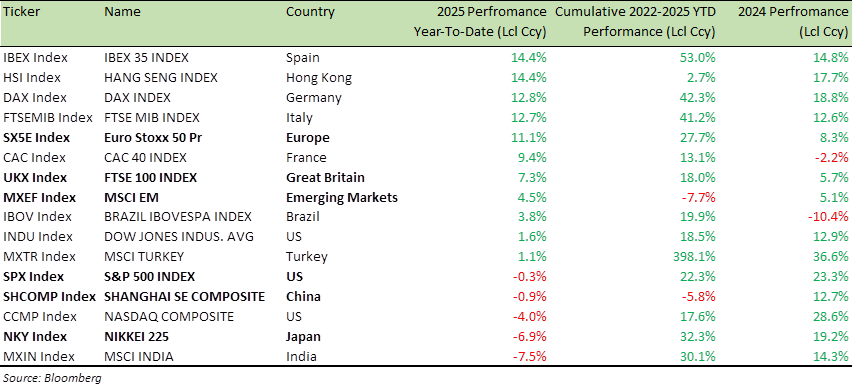
European equities have taken off this year, as you can see in the table below, with the EuroStoxx (SX5E) outperforming the S&P 500 (SPX) by 13% year-to-date.

However, it will be wrong to turn off US equities, as risks still lurk that could derail the rally in European equities.

On March 14, Germany’s Bundesrat approved a €500 billion spending plan to boost growth and expand the military, marking a historic shift away from fiscal conservatism. The legislation relaxes borrowing rules and rolls back the “debt brake” imposed after the 2008 financial crisis.

Soon after, the newly convened Bundestag saw Bernd Baumann, chief whip of the far-right AfD, accuse the centrist parties of “gigantic electoral fraud” for pushing through constitutional changes in the last days of the previous parliament. Baumann declared, “We from the AfD are stronger than ever before.” With 152 MPs, the AfD is now the second-largest party in the Bundestag, holding nearly a quarter of the seats. The party’s influence has grown significantly, securing key committee positions and increasing its ability to challenge the ruling coalition.

Meanwhile, AfD support continues to climb, polling at a record 23.5%—three points higher than its election result and edging closer to becoming Germany’s most popular party. As its influence grows, so too does its potential to create obstacles for the government, reshaping the political landscape in ways that many find deeply unsettling.

So, do not be lured into European equities based on Germany’s spending plans alone for that may be delayed if not scuppered partly.

Global Equity Index Performance (2025 YTD, 2022-2025 YTD and 2024 Performance)

Meanwhile, in the US, the Fed is waiting to cut rates, if only President Trump took a step back from his “tariff war.”

Small businesses are stalling as combination of economic slowdown, tariff scare, business anxiety starts percolating through.

Momentum from the pandemic recovery has stalled for most small-business owners, presenting potential challenges for the broader US economy.

Small businesses employ nearly half of the nation’s workforce and contribute over 43% to the country’s economic growth. However, according to the Fed’s latest small business credit survey, more businesses are reporting revenue declines, stagnant employment growth, rising debt levels, and a drop in optimism.

In 2024, 41% of small businesses reported a decrease in revenues, while only 38% saw an increase. This marks the first time since 2021 that more businesses experienced revenue declines than growth.

It’s inevitable that Trump will need to shift focus to the domestic economy, which will likely mean scaling back the trade war, as it’s affecting the very people he aims to support.

Sentiment towards US equities remains very bearish, as shown in the AAII sentiment chart in the section above.

This combination of relief on the trade war front and potential Fed rate cuts is likely to benefit US equities more than European ones.

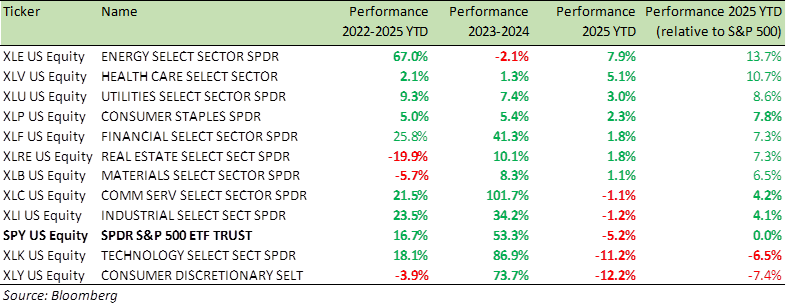
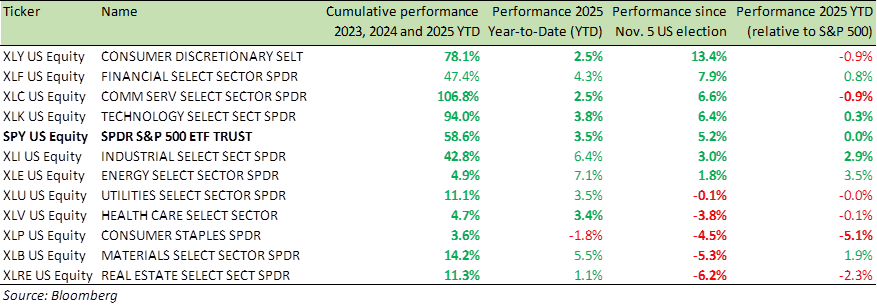
Benchmark US equity sector performance (2022-2025 YTD, 2023-24, 2025 YTD, and 2025 YTD relative to the S&P 500 Index)

On Monday, Trump nominated Michelle Bowman as the next Federal Reserve Vice Chair for Supervision, signalling a shift toward lighter banking regulations. As a known advocate of less stringent oversight, Bowman’s confirmation is expected to lead to the following key changes:

  • Lighter Capital Buffer Requirements: Bowman’s leadership will continue the rollback of strict capital requirements. Banks will retain flexibility in using proprietary risk models, reducing capital burdens

  • More Coordinated, Business-Friendly Regulation: With Trump’s executive order consolidating regulatory control under Treasury Secretary Scott Bessent, financial regulators will align for more industry-friendly oversight, aiming to reduce compliance costs and burdens

  • Boost for Bank Mergers & Acquisitions (M&A): A more lenient regulatory environment is expected to revive US bank M&A activity, which slowed under Biden. Bowman’s support for regulatory transparency could help accelerate deals, like Trump’s first term, where M&A activity was robust

Early signs show an improvement in bank lending, as commercial banks ease lending standards, with small businesses benefiting from improved loan availability. If this trend continues, private sector re-leveraging could accelerate, benefiting US bank stocks and sectors reliant on commercial bank financing.

Deregulation will also support bank buybacks, as lower capital buffer requirements allow banks to return more capital to shareholders, further boosting financial stock valuations.

In summary, Bowman’s appointment paves the way for a more favourable environment for banks, with lower capital requirements, increased M&A activity, and potential for higher buybacks driving positive momentum in the financial sector.

This will be good news for US economy as a whole.

Here’s an interesting chart for those growing sceptical about Nvidia (NVDA) and tech stocks, thinking Deepseek’s success might burst the tech stock bubble.

Take a look at how closely the release of ChatGPT mirrors the release of Netscape, with both events tracking the Nasdaq’s performance.

If history is any guide to innovation and its impact on productivity gains and GDP growth, then enduring the volatility could lead to significant long-term gains in both NVDA and tech stocks.

Source: Bespoke Invest

Given the US’s growing debt, budget deficit, and widening trade deficit, it’s not an exaggeration to say that the US economy is heavily reliant on printing dollars to purchase goods.

However, this system only functions effectively if allies are willing to buy, save, invest, and trade in those US dollars.

President Trump’s ambition to remake America is noble, but intent alone doesn’t guarantee results.

There are many things the US simply can’t undo—China’s rise as a manufacturing giant, its highly skilled STEM graduates, and its growing drive for innovation are just a few of them.

The real issue is the lack of global demand—debt-fuelled consumption can’t sustain itself forever.

For demand to grow, we need higher productivity—and trade wars won’t achieve that. A “trade deal” would benefit all nations and particularly the US and China.

Without one, we’re back to the same cycle—disinflation and low rates—as China continues ramping up supply and exporting it to the US and Europe. Just look at the US trade deficit with China—it’s only getting worse.

I suspect a US-China deal is already being shaped behind the scenes, and the sabre rattling of announcements we’re seeing, are all part of the “tariff show.”

Come May, I suspect President Trump will strike a broad deal with China, take a victory lap, and we all can take respite that we survived the trade war.

 
Best wishes,

Manish Singh, CFA


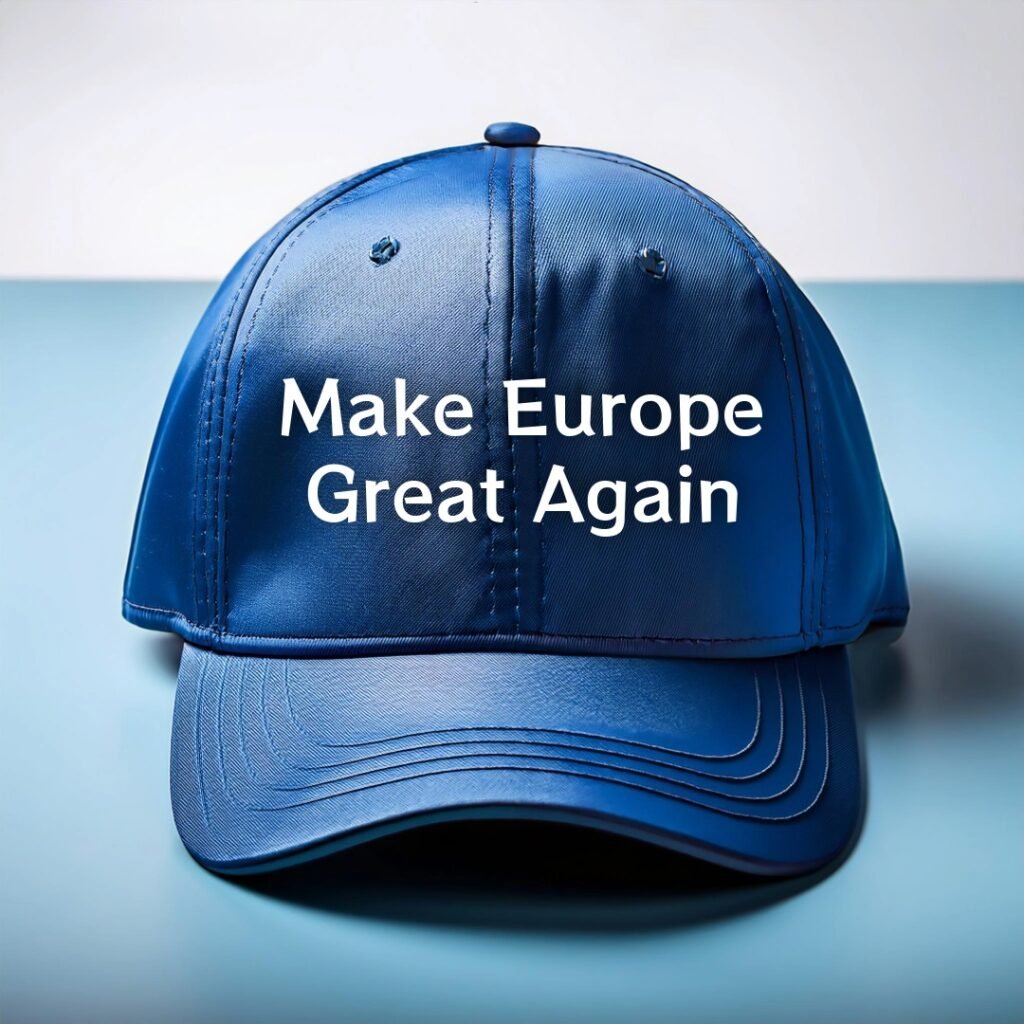
“Europe is at a crossroads and must embrace reform to revitalize its economic prospects and Making Europe Great Again (MEGA)”

Summary

In his address to the UN General Assembly in September 2018, President Donald Trump cautioned that Germany could become heavily dependent on Russian energy if it didn’t alter its course. This remark, met with derisive smirks from the German delegation including Foreign Minister Heiko Maas, has proven prophetic as Germany now teeters on the edge of a third year of recession. After two years of downturn, Germany’s hopes for a post-COVID recovery have vanished, with manufacturing output dropping 10% and rising energy costs and declining exports leading to significant job losses.

Trump’s stance on reciprocal tariffs, insistence on NATO members contributing their fair share, and his “America First” policy have underscored the theme of “Europe Alone,” prompting a re-evaluation of economic policies across Europe. Germany’s economic slowdown is largely due to self-imposed factors such as an aging workforce, rigid labour laws, and excessive regulations which hamper growth and competitiveness. These challenges are the result of domestic policy decisions rather than the US.

However, there’s a silver lining: these self-inflicted issues present an opportunity for change and improvement. Europe is at a crossroads and must embrace reform to revitalize its economic prospects. The call for “Making Europe Great Again” (MEGA) resonates with the proposed solutions by Germany’s likely next Chancellor, Merz, who advocates for extensive corporate and income tax reductions, the construction of new power stations to lower some of the world’s highest electricity costs, and swift economic deregulation. Concurrently, the SPD aims to boost government investment in infrastructure and military enhancements.

Meanwhile, Trump and US Treasury Secretary Scott Bessent are focused on reducing and stabilizing US Treasury yields, weakening the US dollar, and cutting oil prices to stimulate the American economy. While bond yields and oil prices have reacted positively, the US dollar remains strong. Trump’s policies are poised to bolster both the US economy and its stock market in the foreseeable future, suggesting a strategic advantage in staying overweight US equities.

Is MAGA Becoming Too Much? Time to Shift the Focus to MEGA?

President Donald Trump, reflecting on his first term, has likely adapted his strategy from merely responding to and refuting media claims about his statements and intentions. Now, he is taking a more proactive approach, bombarding the media—and indeed everyone—with a relentless stream of daily announcements. This tactic aligns with what former White House Chief Strategist Steve Bannon has termed, a “day of thunder” approach to media management.

Trump is banking on the idea that the media can only focus on one issue at a time.

By relentlessly flooding the news cycle, his administration keeps the press overwhelmed, leaving little room to shape a coherent narrative—let alone craft a credible response to each announcement.

One day it’s the Department of Government Efficiency (DOGE), the next it’s tariffs on, then tariffs delayed. China deal, China no deal. Europe bad, Europe good. Canada tariff, Canada 51st state, Gulf of Mexico renamed. Federal employees fired, sackings at the Department of Defence and Department of Justice. USAID defunded; contracts cancelled. Zelensky is a dictator, Russia didn’t start the war, we need Ukraine’s mineral rights. Peace deal with Russia, ceasefire now, vote alongside Russia at the UN.

And so, it goes—chaos by design.

Trump backed Elon Musk’s demand that federal employees explain their recent accomplishments by the end of week or risk getting fired, even as government agency officials were told that compliance with Musk’s edict was voluntary.

So, what’s next?

Trump holds press conferences almost every other day, commanding the spotlight from the Oval Office, like a seasoned pro. One moment he’s scolding reporters, the next he’s cracking jokes—turning what starts as a 30-minute briefing into a 90-minute spectacle.

We are not even two months into his 4-year term. So, if you’ve had enough of MAGA, maybe it’s time to focus on MEGA – Make Europe Great Again?

Navigating Troubled Waters: Europe’s Quest for Economic Sovereignty

Trump’s policies— reciprocal tariffs on trade partners, demanding that NATO nations pay their fair share and “America First”—are forcing Europe to confront the reality of “Europe Alone.”

But Europe has no one to blame but itself. European Union (EU) leaders have long talked about strengthening the bloc and making grand promises of reform.

Yet, like a procrastinating student, they’ve pushed the hard work aside, always postponing it to another day.

Well, that day has arrived. The homework is due, and there’s no more time to delay.

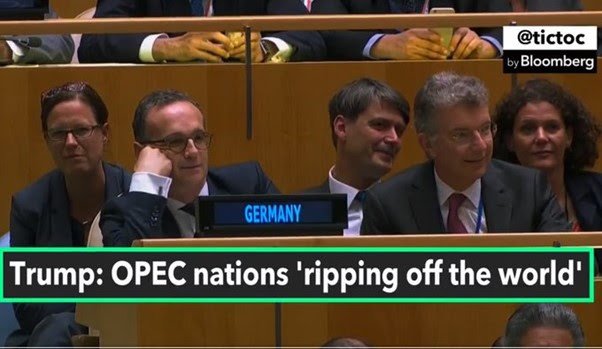
Remember this image from September 2018 (see photo below)?

It belongs in The Louvre or The Smithsonian museums: “German delegation laughs after Trump warns of reliance on foreign oil.”

German delegation at the United Nations, September 2018

Source: Bloomberg

The context:

“Germany will become totally dependent on Russian energy if it does not immediately change course,” Trump warned during his UN Speech.

The German delegation, caught on camera, smirked in response. That wasn’t nervous laughter—it was outright scorn. How wrong they’ve been proven, and Germany is about to enter its third year of recession as its manufacturing prowess strains under the cost of high energy prices and competition from China.

Renowned German columnist Wolfgang Münchau, author of Kaput—The End of the German Miracle, put it bluntly:

“The problem with consensus societies is that sometimes the consensus is wrong, and when it is, there is no corrective mechanism. It’s the opposite of a whistleblower society.”

He was speaking about Germany, but it applies to Europe as a whole.

Europe needs decisive leadership, not the hesitation and indecision that defined former Chancellor’s Angela Merkel’s tenure—failures that led to the “immigration crisis” and fuelled the rise of far-right Alternative for Germany (AfD), in Germany.

Robin Alexander, deputy editor of Die Welt, details this in his 2017 book Die Getriebenen (The Driven) – the biggest influx of people in postwar German history, wasn’t the result of a bold decision, but rather the absence of one.

“The border stayed open, not because Merkel deliberately decided so, nor anyone else in the federal government,” Alexander writes. “At the crucial moment, there was simply no one willing to take responsibility for closing it.”

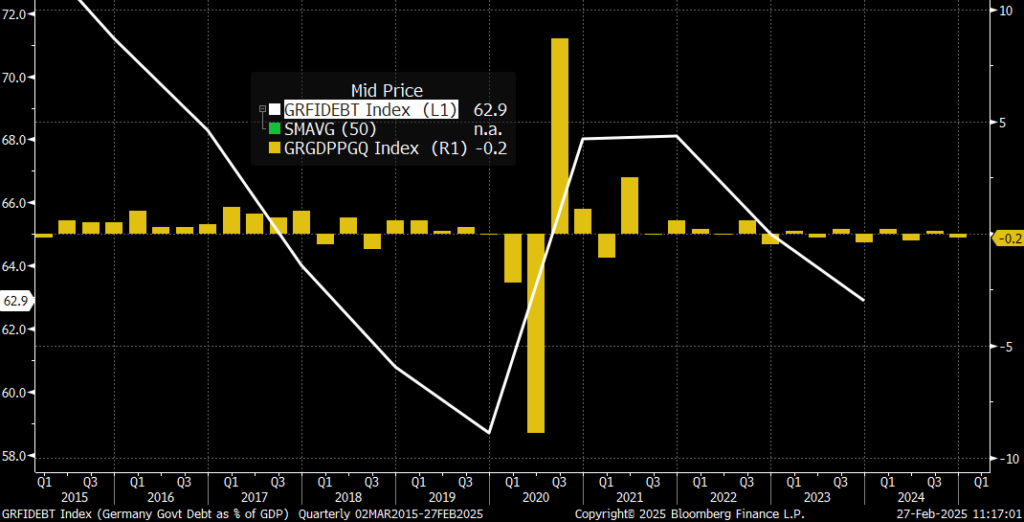
Europe’s former growth engine, Germany has shrunk for two years in a row (see chart below), erasing any recovery made sense the Covid-19 pandemic. Its manufacturing output is down about -10% over the same period and its companies, squeezed between rising energy costs and falling exports, are shedding thousands of jobs a month.

5-year chart: Germany debt as % of GDP (white line) and Germany QoQ GDP growth as % (yellow bars)

Source: Bloomberg

Very soon Germany will have a new Chancellor and it’s likely going to be the CDU/CSU candidate Fredrich Merz. If Merz fails to solve Germany’s growth, migration, and economic issue then the AfD, could be in office in four years’ time or before.

Besides the national issues of EU nations, at the European level, if MEGA is to be a success, then some fundamental changes must take place. Here’s one reminder from a recent speech by Mario Draghi, former Italian Prime Minister, and former President of the European Central Bank (ECB)

“The IMF estimates that Europe’s internal barriers are equivalent to a tariff of 45% for manufacturing and 110% for services.”

Europe is an ageing, debt-ridden continent, struggling with stagnation and unable to defend itself without US assistance. To make matters worse, the global order—trade, borders, defence, and technology—is being rewritten. Now, this can be threat or an opportunity. I hope it’s the latter.

Europe will need to reduce welfare spending (with the region making up 7% of the world’s population, 25% of global GDP, but accounting for 50% of social spending), boost defence spending, and work towards unifying its capital markets, as Draghi has emphasized. It will also need to deregulate and create a more business-friendly environment, strengthen ties with the UK, and challenge the bureaucratic barriers that hinder growth and entrepreneurship.

There is hope!

Germany’s incoming chancellor, Merz, has called for sweeping corporate and income tax cuts, building 50 new power stations to bring some of the world’s highest electricity prices down, and for the rapid deregulation of the economy.

The SPD, meanwhile, wants to unleash government investments to help fix Germany’s decrepit infrastructure and prop up its military.

On the US, Merz’s remark was very eyebrow raising. He said – “It is clear that the Americans—at least this administration—are largely indifferent to the fate of Europe,” he declared. He then made his stance clear: his “absolute priority” is to help Europe achieve “independence from the USA.”

Reality is very different.

None of the challenges Merz faces within Germany, seem to stem from US actions.

Take the energy crisis, for instance—this was largely the result of Germany’s own push for renewable energy (Energiewende) and the premature closure of nuclear power plants, policies driven by the country’s green agenda. This choice made Germany heavily reliant on Russian natural gas, which backfired when tensions with Russia escalated.

Germany’s productivity and labour challenges are also self-inflicted. A rapidly aging workforce, inflexible labour laws, and an overregulated economy have all slowed economic growth and raised concerns about competitiveness. None of this was imposed by the US, no matter what the Trump haters in Germany (and Europe) would like to say.

While some comments from American politicians may seem harsh, the truth is that Germany—like much of Europe—is dealing with the consequences of its own policy decisions.

There’s a silver lining: Self-inflicted problems require one to change and make amends. Europe must seize the moment and get working on Making Europe Great Again (MEGA).

Markets and the Economy

The S&P 500 (SPX) is back to early November levels, when Trump won the US election. The euphoria has given way to inflation and trade war fears, as Trump continues to issue executive orders like confetti.

Now, I don’t mean to be bearish. There’s always something to worry about in the market—that’s nothing new. Uncertainty feels more pressing, when too many pieces are moving – fiscal, monetary, political, international and trade security, and geopolitics.

Global Equity Index Performance (2025 YTD, 2022-2025 YTD and 2024 Performance)

Analysing the recent news flow, reveals several concerning economic indicators:

  • Despite the SPX reaching new highs, its cumulative advance/decline (A/D) line has not kept pace, indicating a negative divergence.
  • The U.S. housing market remains sluggish—high mortgage rates continue to suppress demand, and conditions have not shown improvement even after the Federal Reserve began cutting rates in September. With the spring selling season on the horizon, prospects for recovery appear limited.
  •  Inflation remains a pressing issue. Recent CPI and PPI reports have demonstrated price pressures exceeding expectations, with significant spikes in the Prices Paid and Prices Received components of the New York and Philadelphia Fed surveys.
  • Although the earnings season has generally been positive, corporate outlooks are trending negative, with twice as many companies revising their forecasts downward as those reporting optimistic projections.

On the brighter side though:

  •  The 10-year Treasury yield has dropped significantly since the latest CPI report and is currently at +4.3% far cry from fears of +5% couple of months ago, suggesting the market isn’t pricing in another inflation surge.
  •  Sector breadth has also been strong. Seven of the eleven S&P 500 sectors are outperforming the index by over +4%—a historically strong indicator of market resilience.
  • Additionally, since the January lows, the market has seen consistent buying on weakness (Friday being an exception). Over the last five weeks, the S&P 500 SPDR ETF (SPY) closed higher than it opened on 18 of 25 trading days—the highest rate since late 2023. That signals accumulation and investor confidence.

Benchmark US equity sector performance (2022-2025 YTD, 2023-24, 2025 YTD, and 2025 YTD relative to the S&P 500 Index)

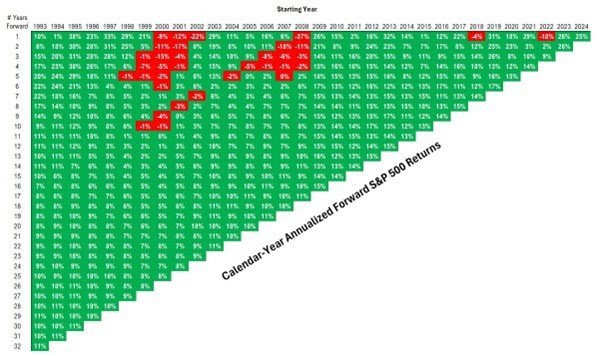
Take a look at this insightful chart from Ben Carlson’s A Wealth of Common Sense blog, showcasing the SPX annual returns since 1993.

As you can see, there are significantly more green (gains) than red (losses), highlighting a key takeaway—despite the market upheavals of the past 30 years, patience and a medium-term investment approach have consistently outperformed short-term trading strategies.

How to read the chart: Select a starting year and follow the timeline downward to see the corresponding annualised return.

For example, a nine-year investment beginning in 1993 would have delivered a 14% annual return. The chart reveals more green (gains) than red (losses) over the years, though investors have certainly faced some tough stretches along the way.

A historical analysis of SPX returns since 1993 highlights the power of long-term investing.

  • Long-Term Wins: Holding for 11+ years never resulted in losses, while shorter periods (2-5 years) saw multiple downturns.
  • Return Ranges:

    • 10-year annual returns varied from -1% to 17%.
    • 15-year returns ranged from 4% to 14%.
    • 5-year returns spanned -2% to 29%.

  • Consistency Over Time: Despite major crises—including the dot-com bubble, 9/11, the Great Financial Crisis, and the pandemic—the market still averaged a 10% annual return over 31 years.
  • Key Takeaway: While market timing affects short-term results, a long-term approach smooths out volatility and remains the best investment strategy.

S&P 500 annualised gains grid 1993-2024

Source: Ben Carlson, A Wealth of Common-Sense blog

Trump and US Treasury Secretary Scott Bessent have three main goals: Drive down and stabilize US Treasury yields, weaken the US dollar, and lower oil prices—all aimed at fuelling a US economic boom.

Bond yields have responded and so have oil prices, the US dollar is unlikely to for now.

Trump’s policies are set to benefit the US economy and stock market—both in the short term and over the long haul. Staying overweight US equities remains the trade.

Here’s why:

What DOGE is doing in the US may look a bit erratic sometime but cutting spending, lowering deficit is the path that the US is on.

There’s a precedent to it.

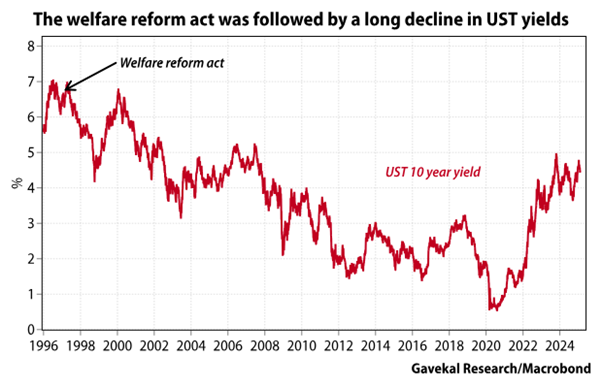
In August 1996, then President Bill Clinton signed the Republican-backed Welfare Reform Act, officially known as the Personal Responsibility and Work Opportunity Reconciliation Act (PRWORA), which reduced US public welfare payments.

At the time, US Treasury yields were nearly +7%, a level they would never reach again. Critics feared the worst. Defenders of the status quo were alarmed that lawmakers had not only imposed a work requirement on recipients, but restricted welfare benefits to five years.

“We know how welfare reform will turn out,” warned an article in the New Republic after Clinton signed the Act. “Wages will go down, families will fracture, millions of children will be more miserable than ever.”

  • Between August 1996 and September 2000, the number of families on welfare declined by 50%. Welfare caseloads dropped substantially, from 5.5% of the total US population in 1994 to 2.1% in June 2001
  • Prior to the Act’s passage in 1996, there were 12.6 million Americans enrolled in the nation’s welfare program. Two decades later, only 2.8 million remained in welfare. Many former welfare recipients entered the workforce, and poverty among children overall fell from 1993 to 1999

While several factors contributed to this shift, including the surge in tax revenue from the dot-com boom in 1996-99, the Welfare Reform Act did achieve its intended goal.

A similar outcome could improve the US fiscal and budget situation this time around. Many people believe that reducing government spending and achieving greater efficiency is nearly impossible. A prime example is the UK’s National Health Service (NHS), where budget allocations keep increasing, yet longer delays in patient care remain the result. We’ve grown accustomed to expecting continued government spending.

However, it’s likely that the world, particularly Europe, will soon learn how spending cuts, better allocation, and greater efficiency can be accomplished.

On an external front, the US is looking to make more savings (and increase revenue).

Trump and Vice President Vance have effectively declared NATO obsolete, asserting that the US will no longer solely fund Europe’s security. This situation forces European countries, especially Poland, Germany, and the Baltic states, to consider two main options:

  • Strengthen ties with the US – Increase defence spending, purchase more American-made military equipment like F-35s and missile systems, and maintain favourable relations with Trump.
  • Seek a new understanding with Russia – If US-Russia relations improve under Trump, Eastern Europe might recalibrate its approach, perceiving Moscow as a reduced threat.

Regardless of the perceived threat from Russia, European nations must maintain strong relations with the US. Ultimately, Washington holds the essential military and geopolitical power to ensure Europe’s security..

The stock market is unique, in that people often flee during a “sale” rather than capitalize on it. Investors flock to buy when prices are high, fearing they’ll miss out on the gains others are achieving. Yet, paradoxically, they hesitate to purchase when prices drop, only to buy back in when prices climb again.

It’s essential to become comfortable with market downturns.

Embrace the “bear” market.

Make friends with the “bear.”

You can learn a lot from “bears.”

As legendary investor Warren Buffett once said – “If a stock [I own] goes down 50%, I’d look forward to it. In fact, I would offer you a significant sum of money if you could give me the opportunity for all of my stocks to go down 50% over the next month.”

If you own quality stocks, you should hope for prices to drop, not rise—that way, you can buy even more at a discount before they rebound. It’s just common sense.

The key? Good stocks.

For specific stock recommendations and insights related to structured products, please do not hesitate to reach out to me, or to your dedicated relationship manager.

 
Best wishes,

Manish Singh, CFA

As MAGA returns to Washington, should President Trump advocate for more tariff or smaller Government?

Summary

As President Donald Trump embarked on his second term, he immediately set forth expansive plans to revamp immigration, the economy, and the justice system, including lifting the TikTok ban, demonstrating his intent to make impactful decisions quickly. For those worried about Congress limiting the President’s deal-making authority—which could affect U.S.-China relations—referencing the 1937 United States v. Belmont case is instructive. It highlights the considerable powers a President has to negotiate agreements independently of Senate or House interference.

While many pundits predict another tariff war with China, it’s more plausible that Trump will negotiate aggressively to forge a beneficial US-China deal. Such an agreement could rejuvenate the fortunes of America’s rust-belt regions, neglected by previous administrations, and potentially ignite a rally in Chinese equities, commodities, and related markets.

Targeted tariffs will continue to be a crucial strategy for protecting U.S. economic and international interests. However, in today’s global economy, the impact of broad tariffs as a major revenue source is considerably diminished. The real answer to America’s fiscal challenges lies in reducing government size, cutting regulations, and lowering taxes, as incoming Treasury Secretary Scott Bessent emphasized, pointing out America’s “spending problem” rather than a revenue issue.

With the resurgence of the “drill baby drill” policy, we anticipate significant reductions in energy costs this year. Despite signs of weakening in the labour market, I expect the Federal Reserve to implement more than two rate cuts this year. Questions about the Fed’s independence persist, especially under pressure from President Trump, who is likely to criticize the Fed at any sign of labour market downturn, pushing for aggressive rate cuts—which the “independent” Fed is likely to enact.

For market sceptics who have dismissed the recent bull market trends as merely a bear market rally, attributing it to various factors from greed to FOMO, the first quarter may prove challenging as the S&P 500 is set to climb higher.

MAGA returns to Washington

President Donald Trump is back—and he’s not holding back. Four criminal cases and a near-miss assassination couldn’t stop him. Sworn in as the 47th President, he thundered: “The golden age of America begins right now,” and unleashed sweeping plans to overhaul immigration, the economy, and the justice system.

Before addressing tariffs, the President’s issued day-one executive orders, with market implications and potential consequences for the future.

On Monday, hundreds of crypto executives and political power players gathered in the nation’s capital to toast what they believed would be a golden age for digital assets under the Trump administration. What they didn’t expect was Trump’s own foray into the meme coin frenzy.

“It’s time to celebrate everything we stand for: WINNING! Join my very special Trump Community. GET YOUR $TRUMP NOW,” Trump announced on Truth Social at 9 p.m., catching everyone off guard. A day later, Melania Trump upped the ante, revealing her own token, $MELANIA.

But the shocks didn’t stop there.

On Tuesday, at 11:38 a.m. (ET)—just 22 minutes before his Presidency officially ended— President Joe Biden issued sweeping, unconditional pardons for his siblings and their spouses. Earlier, Biden granted similar clemency to several prominent Trump critics, including Gen. Mark Milley and Members of Congress who investigated the Capitol riot on Jan. 6, 2021.

These “pre-emptive” pardons unprecedented in history of America, can have a huge bearing in the future. Trump and those that follow him, can now greenlight illegal actions by members of their administration, friends, or family, allowing them to operate without fear of consequences, knowing they will be pardoned. This opens the door to the alarming prospect of a lawless administration, whether driven by self-enrichment or the goal of undermining opponents.

As history echoes back to 1787, when Benjamin Franklin famously remarked that the Constitutional Convention had given the nation “a republic, if you can keep it.” This question now looms larger than ever.

What will the next four years bring? Will the republic endure, or will the boundaries of power be tested beyond repair?

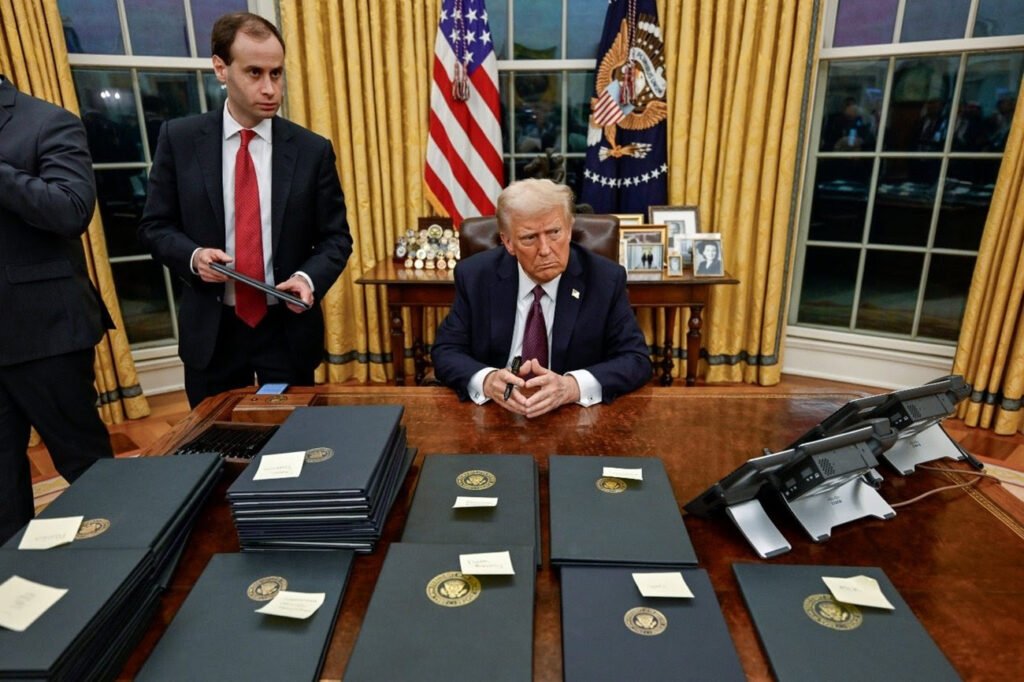
Trump Returns: A New Chapter in the Oval Office

Source: The White House @WhiteHouse

Moving on to markets and the threat of tariffs.

At a hedge fund (HF) macro dinner last week—and during a breakfast meeting four weeks earlier with portfolio managers from several key HFs—I was struck by the strong views on tariffs and the possibility that Congress could limit the President’s authority in foreign policy. Such restrictions could hinder efforts to “ease” relations with China, a prospect causing considerable unease among market participants.

To understand the breadth of presidential power in this arena, one must revisit the landmark 1937 United States v Belmont case. This case emerged from the aftermath of the Soviet Revolution, during which the Bolsheviks seized and nationalized various industries and assets, including some held in the US.

Justice George Sutherland, delivering the Supreme Court’s opinion, affirmed that the external powers of the United States are exercised independently of state laws or policies. Article II, Section 3 of the Constitution grants the President authority to conclude binding agreements with other nations, underscoring the executive branch’s pivotal role in shaping international relations.

A summary of the case and context:

  • U.S. v. Belmont (1937) examined whether the president could make binding legal agreements with foreign states. The case arose after the Bolshevik Revolution, which left ownership of some US-held assets unclear.
  • In 1933, President Franklin Roosevelt recognised the Soviet Union and negotiated the Litvinov Assignment, an executive agreement to settle mutual claims. It transferred American-held assets of Russian companies to the Soviet government and vice versa, aiming to normalise relations.
  • August Belmont Co., a New York bank holding Russian assets, challenged the agreement, arguing the president lacked constitutional authority to make binding agreements without Senate approval. New York state courts sided with Belmont, dismissing the lawsuit, citing conflict with state public policy against confiscating private property.
  • The Supreme Court unanimously reversed this decision, affirming the president’s authority to recognise foreign states and use executive agreements, which are part of the “supreme Law of the Land” and override conflicting state laws.
  • This ruling, reaffirmed in U.S. v. Pink (1942), established executive agreements as a constitutional tool in foreign policy, bypassing Senate ratification and expanding presidential flexibility in diplomacy.

This precedent highlights the significant implications of any congressional moves to curb the President’s executive power in trade and foreign policy—particularly as markets brace for potential tariff shifts.

This doesn’t rule out the use of higher tariffs—or the threat of them—as a negotiation tool. However, it underscores the significant power the President wields to strike deals, bypassing Senate or House constraints.

Trump wasted no time in lifting the ban on TikTok, signalling his readiness to act decisively. While many anticipate another tariff war with China, I believe a more likely scenario, is Trump driving a tough bargain to secure a mutually beneficial US-China agreement. Such a deal could revitalize the fortunes of Americans in rust-belt states, long overlooked by successive administrations, and potentially spark a rally in Chinese equities, commodities, and related markets.

Staying on Tariffs: Should Trump Advocate for More Tariffs or Champion Small Government and Lower Taxes?

The answer is clear: The latter.

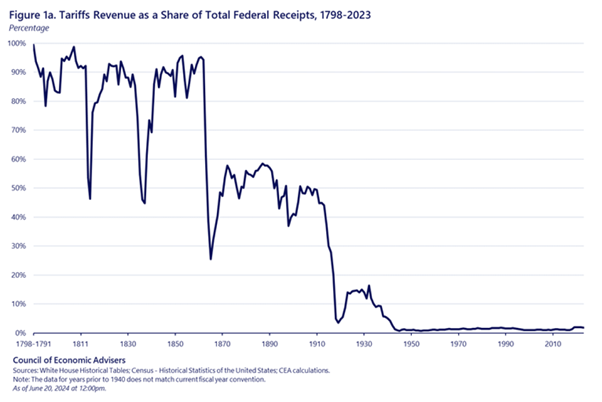
To understand why, let’s look back at history and examine the plausibility of tariffs as a significant revenue source—starting with a chart that highlights tariffs’ limitations.

Strategically targeted tariffs remain a valuable tool for safeguarding the economic and international interests of the United States. However, in today’s interconnected global economy, the effectiveness of broad tariffs as a significant revenue source is severely limited. Elevating federal reliance on tariff revenue would likely worsen long-standing income inequality by shifting more of the tax burden onto lower-income households, while also introducing severe negative distortions to the broader economy.

In the late 18th and early 19th centuries, higher tariffs were essential for protecting the nascent US economy and its fledgling industries.

In the early 19th century, US industrialisation focused on labour-intensive industries like textiles, relying on imported machinery and exporting raw materials, leading to trade deficits. Protective tariffs supported emerging industries, while access to imports boosted development. Post-Civil War, industrialisation shifted to capital-intensive mass production, driven by advanced techniques and railroad expansion.

From 1870 to 1914, the US achieved trade surpluses, reducing import dependence, and increasing exports of manufactured goods during rapid economic growth. By the early 20th century, the US had emerged as a global industrial leader, running sustained trade surpluses. As its manufacturing base matured and exports outpaced imports, tariffs became less necessary and began to decline.

Over the next 70 years, US manufacturing dominance and innovation drove sustained trade surpluses, reinforcing the country’s economic strength.

Today, tariffs are no longer a critical revenue source. Consider the fiscal year 2023:

  • Revenue Comparison: Tariffs generated $80 billion—just a fraction of the nearly $2.2 trillion collected in individual income taxes.
  • Limited Impact: With $3.1 trillion in goods imports last year, even a universal tariff of 70% (unrealistic in practice) would barely replace individual income tax revenue, as such tariffs would decimate import levels.

It’s worth noting that 1913 saw the introduction of income tax, which significantly fuelled the expansion of the federal government.

The US federal government’s size and revenue needs have expanded dramatically since Alexander Hamilton’s tenure as Treasury Secretary in 1789. Even then, tariffs alone were insufficient to cover spending. Today, tariffs play a minimal role in federal funding, reflecting the evolution of the US economy.

If you think tariffs had little impact on the trade deficit during Trump 1.0, just imagine the fallout from a proposed 10% general tariff across the board. It won’t be the “big”, “beautiful”, “massive” win that Trump desires.

The true solution to America’s challenges lies not in higher tariffs, but in shrinking the size of government, reducing regulation, and lowering taxes.

As incoming Treasury Secretary, Scott Bessent aptly stated, “We do not have a revenue problem in the United States of America; we have a spending problem… This spending is out of control.”

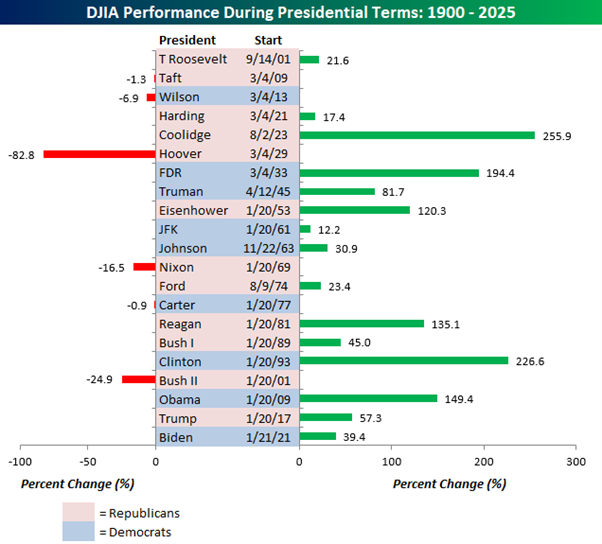
As Trump 2.0 begins, the presidential stock market scorecard resets.

During Biden’s presidency, the Dow Jones Industrial Average (Dow) gained +39.4%—18 percentage points below Trump 1.0’s performance but still marking the third consecutive term of strong gains. While Biden’s Dow performance was the weakest of the last three presidents, it’s far from insignificant and places him among the top ten performing presidents since 1900.

Source: Bespoke Invest

Politics and markets operate on completely different dynamics, as businesses adapt to the policies and politicians of the moment.

Take all the Tech leaders who are now lining up to “kiss the ring” of Trump, despite having largely “sided” with his opponents over the last eight years.

In 2008–09, many investors who feared Obama’s so-called “leftist” policies missed out on a +149.4% rally in the Dow.

The same pattern repeated with scepticism around Trump in 2016 and Biden in 2020—both of whom delivered strong market returns despite being labelled a “dictator” and a “socialist“ respectively.

Let’s see what next four years bring!

Markets and the Economy

This week, Scott Bessent, President Trump’s pick for Treasury Secretary, appeared before the Senate Finance Committee, for his confirmation hearing.

There were several nuggets but this response to Senator Ron Wyden (D-OR) stood out for me.

WYDEN: “We’re in a clean energy arms race with China. Which side are you on?”

BESSENT: “China will build a hundred new coal plants this year. There is not a clean energy race. There’s an energy race.”

Bessent sought to ease concerns about Trump’s tariff proposals—especially the pledge for universal tariffs on imports—by arguing that factors like currency fluctuations and the actions of foreign exporters would mitigate potential inflation.

According to Bessent, a 10% universal tariff would likely cause the dollar to appreciate by approximately 4%, preventing the full tariff cost from being passed on to consumers. Moreover, he suggested that foreign manufacturers, particularly those in China, might lower their prices to maintain market share, further reducing the tariffs’ impact on consumer prices.

Bessent said Trump has “a generational opportunity to unleash a new economic golden age that will create more jobs, wealth and prosperity for all Americans.”

Global Equity Index Performance (2025 YTD, 2022-2025 YTD and 2024 Performance)

On Monday, legendary investor Stan Druckenmiller appeared on CNBC and shared his perspective on the new administration:

  • “I’ve been at this for 49 years, and it looks like we’re shifting from the most anti-business administration to the exact opposite”
  • “From our conversations with CEOs and companies on the ground, I’d say they’re feeling somewhere between relieved and outright giddy.”

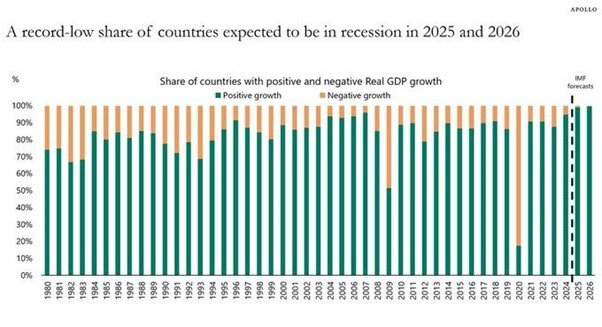
A record-low percentage of countries are expected to be in recession in 2025 and 2026. (see chart below)

Is this a case of everyone finally jumping on the same side of the boat after repeatedly getting the recession call wrong?

Thanks to social media, the battle between bulls and bears has become more dramatic than The Lord of the Rings.

Regardless of the data, there’s always someone predicting a recession. The mantra seems to be – good news can’t last forever.

Source: Apollo

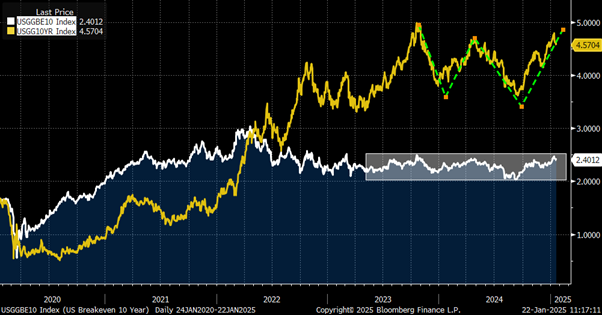
While much focus is placed on the US 10-year yield, attention should instead centre on the 10-year breakeven yield—the difference between nominal and real yields—which is widely regarded as a market-implied gauge of inflation expectations.

Over the past 2.5 years, breakeven have remained range-bound, signalling that markets are not overly concerned about inflation. The recent rise in 10-year yields reflects the market pricing in fewer rate cuts rather than inflation fears. However, expectations around rate cuts could shift again.

Could the 10-year yield reach 5%?

Yes, this is possible.

Here’s a straightforward breakdown of the math behind the 10-year bond yield:

  • 2% inflation target + 0.25% inflation risk premium
  • 2% real GDP growth + 0.25% growth risk premium
  • 0.5% term premium

Total: 5%

Alternatively:

If growth falls short and drops from +2% to +1%, the 10-year bond yield could decrease to 3.5% or lower.

I’d be happy to lock in 4.5% on the 10-Year, as I do expect yields to go lower by the end of year and the US Federal Reserve (the Fed), to cut rates more than twice this year.

I say that because energy costs are set to decrease significantly over the year.

In my view, energy prices are by far the most influential drivers of inflation, with the labour market coming in as a secondary factor (after all, a strong labour market is generally a positive, unlike these inflationary pressures).

The final point that’s often overlooked is Trump is in the (White) House.

Do we really believe the Fed will remain fully independent? And Fed Chairman Jerome Powell can ignore what Trump says?

As soon as there’s a hint of weakness in the labour market, Trump will likely blame the Fed for not acting sooner, and he will exert heavy pressure to push for rate cuts and I can assure you the “independent” Fed will follow suit.

Also, we should not underestimate the deflationary potential of AI, which could serve as a balancing force in the “animal spirit” economy.

5-year price chart: US 10-Year breakeven yield (USGGBE10) and US 10Y Treasury yield (USGG10YR)

Source: Bloomberg

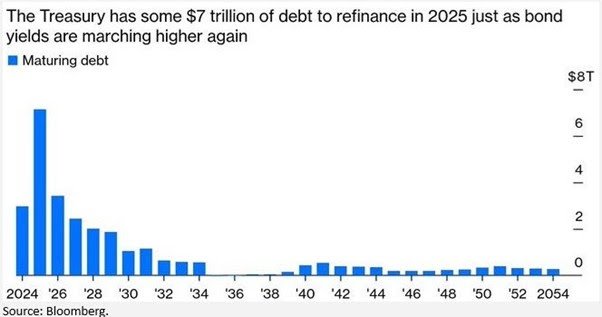
The US Treasury faces a significant amount of debt issuance over the next 12 months (see chart below), and maintaining Fed funds rates at current levels seems counterproductive, especially as inflation appears to have bottomed out. The only factor keeping headline inflation from approaching the +2% target is the distortion caused by “rents.”

In the most recent data, the core Consumer Price Index (CPI)—which excludes volatile food and energy prices—increased by just +0.2%, the smallest gain since July and below economists’ expectations of a +0.3% rise.

Headline CPI remains anchored in the +3% range, driven largely by owners’ equivalent rent (OER), which constitutes about 37% of the CPI basket. OER has moderated, with a year-over-year increase of +4.8% in December, down from +6.3% the previous year.

New tariffs didn’t materialize on Day 1 of Trump’s second term, as many had feared. For now, it seems a full-blown trade war may also be off the table.

Instead, Trump has directed his administration to investigate why the US trade deficit in goods continues to widen and to provide a compelling case for why this poses a national security risk.

Agencies tasked with this review face an April 1 deadline to report back, potentially setting the stage for new tariff proposals or hikes. By then, the Senate is expected to confirm two key figures in shaping and implementing these policies: Howard Lutnick as Commerce Secretary and Jamieson Greer as U.S. Trade Representative.

For those who’ve spent the past two years fighting this bull market—dismissing it as a bear market rally or blaming the yen, the Fed, valuations, buybacks, greed, FOMO, memes, bubbles, and more—it looks like Q1 may bring more pain.

Sorry!

Benchmark US equity sector performance (2023-2025 YTD, 2025 YTD, Since Nov. 5 US election, and 2025 YTD relative to the S&P 500 Index

Materials (XLB), healthcare (XLV), and consumer staples (XLP), appear particularly appealing as interest rates decline and recession fears recede. These sectors have underperformed the S&P 500 (see table above) by more than 40% over the past three years, making them potential opportunities for investors.

Tech (XLK), Communication Services (XLC), and semiconductor stocks have further room to grow as Trump doubles down on his “Make America Great Again” agenda. His announcement yesterday on Artificial Intelligence (AI) is a prime example. Trump’s message to the AI community is clear: Build aggressively and keep the US ahead of China in AI development, contrasting with the Biden administration’s more cautious stance on AI and its societal implications.

Also, since Trump is back, expect market volatility and drawdowns to increase as the market wakes up to his posts on social media. However, these are not anomalies, but rather inherent features of investing and should be anticipated, embraced, and strategically addressed. Predicting short-term market movements can be extremely challenging.

Hence, I highlight the value of equity structured products, as a highly effective investment tool to manage and potentially capitalize on increased market volatility. These products offer a degree of capital protection, while helping to identify advantageous entry points. They also present opportunities to generate returns, even in flat or declining market conditions.

For specific stock recommendations and insights related to structured products, please do not hesitate to reach out to me or to your dedicated relationship manager.

 
Best wishes,

Manish Singh, CFA


Rigid tariff policies may not yield the desired economic invigoration or solidify the legacy Trump wants.

Summary

In a remarkable turn of events, the American electorate has afforded President Donald Trump a rare second chance. Unwavering in his commitment, Trump is poised to intensify his signature “Make America Great Again” (MAGA) agenda, focusing on reshaping trade and immigration policies. His strategy includes employing tariffs to redirect trade flows and deporting illegal migrants to enhance safety, improve wages, and fulfil the prosperity he promised during his campaign.

Despite Trump’s conviction that higher tariffs will bolster the U.S. economy, historical outcomes, particularly with China, suggest a complex reality. Businesses have repeatedly adapted to overcome trade barriers, suggesting that rigid tariff policies may not yield the desired economic invigoration or solidify the legacy Trump aims to establish. A more beneficial approach could involve negotiating a China-U.S. trade agreement—potentially a “Mar-a-Lago Accord”—that emphasizes mutual benefits rather than continuing a protracted tariff dispute. However, any agreement might be preceded by a temporary escalation in tariffs as the administration reassesses its strategy.

While President Trump relishes the rhetoric of protectionism, his preference for a buoyant stock market significantly overshadows it. With the potential shift of the House to Democratic control post-midterm elections, Trump has a narrow window of 18 months to advance his agenda. It is hoped that Treasury Secretary Scott Bessent will guide the administration towards strategies that avoid harmful tariffs, which could undermine economic momentum, reintroduce inflation, and interrupt the Federal Reserve’s cycle of rate cuts.

On the markets front, there is substantial cause for celebration. This year, the S&P 500 has achieved an impressive +25% return year-to-date, building on strong performance from the previous year. Even with a -20% dip in 2022, the three-year cumulative return stands at +27%, averaging an annual return of +8.3%. History shows that consecutive +20% gains in equities, such as those seen since 1950, do not necessarily predict a downturn; in fact, in six out of eight such instances, the following year continued to see gains, averaging +12% and a median of +13%.

Holiday Cheer Gives Way to Tariff Season

We’ve had Thanksgiving, Advent is underway, and Christmas is just around the corner.

Thanksgiving— centred around gratitude—is a holiday I believe that deserves more celebration and emphasis. Don’t get me wrong, spreading cheer is wonderful, but as Arthur Brooks, the Harvard professor, columnist, and podcast host, reminds us, it’s gratitude that truly brings lasting happiness.

Gratitude is a kind of psychological superpower. Unlike cheerfulness, which is fleeting, gratitude trains us to focus on what we already have rather than what we lack. The human brain is hardwired to process negative emotions, like resentment, much more efficiently than positive ones—a survival mechanism from when spotting danger meant staying alive. But in modern life, this negativity bias can make us miserable. Gratitude flips this script, grounding us in reality and encouraging us to appreciate what’s good in our lives.

Addiction, by contrast, feeds on emptiness, an endless chase to fill what we think is missing. Gratitude, on the other hand, fills us with contentment for what we already possess. It’s a simple shift in perspective, but one with profound effects—perhaps the best gift we can give ourselves this holiday season.

So, what are we thankful for this year?

There’s plenty to appreciate, but since this is a market commentary, let’s highlight the impressive +27% return on the S&P 500 (SPX) Year-to-Date—building on a similarly robust performance last year (see table below).

However, when factoring in the -20% decline from 2022, the cumulative three-year return comes to +26%, equating to an average annual return of +8.3%.

Global Equity Index Performance (2024 YTD, 2022-2024 YTD and 2022 Performance)

Significantly, a consecutive +20% gain in equities does not necessarily justify a bearish outlook. Since 1950, the SPX has posted +20% gains in two consecutive years on eight occasions. In six of those instances, the third year saw positive returns, with an average return of +12%, and a median return of +13% (see table below).

The US Federal Reserve (Fed) began cutting short-term interest rates in September, as inflation neared its +2% target. Minutes from the latest Fed meeting suggest that policymakers plan to continue gradually lowering rates.

The US economy remains on solid footing, and corporate profits are still rising. Bond yields are falling, like the conditions during the rally of the mid-1990s.

The final S&P Global manufacturing PMI for the US in November came in at 49.7, surpassing the preliminary estimate of 48.8.

Chris Williamson, Chief Business Economist at S&P Global Market Intelligence commented, “The mood among US manufacturers brightened in November. Optimism about the year ahead has improved to a level not beaten in two and a half years, buoyed by the lifting of uncertainty seen in the lead up to the election, as well as the prospect of stronger economic growth and greater protectionism against foreign competition under the new Trump administration in 2025.”

How rare it is to be given a second chance. That’s exactly what the American people have offered President Donald Trump. True to his style, Trump isn’t one to dwell on past missteps; instead, he’s likely to double down on his signature policy—Make America Great Again (MAGA). At the heart of this agenda lie trade and immigration—or more precisely, using tariffs to redirect trade and deporting illegal migrants to reduce crime, boost wages, and deliver the prosperity Trump promised on the campaign trail.

As the legendary baseball player, Yogi Berra might say if he were alive today: It’s tough to make predictions, especially about the future—and even more so when it comes to Trump and his tariffs. So, instead of predicting, let me lay out a few key points.

President Trump has unveiled plans to impose a 25% import tariff on goods from Canada and Mexico starting on day one, with an additional 10% levy on Chinese imports. To help implement this strategy, he has appointed Jamieson Greer as his trade representative. A protégé of Trump’s former trade chief, Robert Lighthizer, Greer is determined to bring manufacturing and industry back to the U.S. from China, regardless of the cost.

Trump has appointed Scott Bessent to be the new US Treasury Secretary. A former hedge fund manager at George Soros’s firm and later at his own, Bessent specialized in macro investing, using geopolitical analysis and economic data to make large-scale market predictions.

As an economic historian, Bessent understands the US’s unsustainable trajectory. Steering the nation towards sustainability amid conflicting priorities and entrenched interests will be challenging.

Bessent, a follower of late Japanese Prime Minister, Shinzo Abe, advocates a “3-3-3” policy for President Trump:

  • Cut the budget deficit to 3% of GDP by 2028
  • Raise GDP growth to 3% via deregulation
  • Increase daily oil output by 3 million barrels

This approach, aimed at stimulating the economy and reducing energy costs by boosting oil production, is not about protectionism or free money. Instead, it focuses on free-market principles without excessive government spending, which can lead to debt and perverse incentives. While increasing oil production could help reduce both the current account and fiscal deficits and potentially strengthen the dollar, this may conflict with Trump’s preference for a weaker USD

In addition, cost-cutting measures from the newly established Department of Government Efficiency (DOGE), co-led by Elon Musk and Vivek Ramaswamy, could spur robust growth in the US by allocating capital more effectively, reducing debt and deficits, and boosting productivity.

Bessent has characterized Trump’s tariff threats as a tactical approach to secure concessions, stating, “My general view is that at the end of the day, he’s a free trader. It’s escalate to de-escalate”. Tariff war may gather headlines, but it will not benefit the US or achieve its goal to the extent Trump thinks.

Semiconductors: A Case in Point

US semiconductor equipment sales to China have remained robust, even under existing tariffs and the threat of further restrictions (see figure below from CSIS).

However, a notable shift has occurred: Since Trump’s election in 2016 and the onset of the tariff war, US firms have increasingly exported semiconductor equipment to China from non-US locations.

Between 2016 and 2020, the ratio of sales to exports rose by 34%, from 1.1 to 1.5. This trend accelerated significantly from 2021 to 2024, with the ratio nearly doubling from 1.6 to 3.1.

In practical terms, this means that while exports to China and sales within China, were almost equal in earlier years, post-2020 sales have far outpaced direct exports. This shift coincides with the imposition of stricter US export controls, underscoring how businesses adapted their strategies to maintain access to the Chinese market despite heightened restrictions.

Trump may believe that increasing tariffs will benefit the U.S., but evidence tells a different story when it comes to China. Businesses consistently find ways to navigate restrictions, adapt, and keep making sales.

Could DOGE cut $2 trillion from government spending?

While it’s an ambitious goal, it’s highly unlikely. In reality, a cut of around a quarter of that amount is more plausible.

“Mandatory” spending—encompassing Social Security, Medicare, and Medicaid—makes up two-thirds of the $6.75 trillion federal budget. Discretionary spending on defence and domestic programs each account for about one-sixth. Given these numbers, it will be a monumental challenge for Musk and the DOGE team to find $2 trillion in cuts from these areas.

Could Trump deport 11 million illegal migrants?

It’s a tall order. The economic impact of removing such a large labour force from the US workforce, potentially driving up wages and limiting the capacity of companies to supply goods and services, is overstated.

Trump would be wise to avoid expending political capital on policies that fail to drive economic growth, bolster markets, or contribute to the lasting legacy he seeks. With the House likely to swing back to Democratic control in the mid-term elections, his window for implementing such policies is limited to just 18 months.

Let’s hope Scott Bessent can talk sense into Trump and steer him away from punitive tariffs. Such measures could disrupt the current economic momentum, bring inflation back to the US, and force the Federal Reserve to pause its rate-cutting cycle.

If Bessent’s fiscal conservatism can temper the President-elect’s protectionist tendencies, we might see a strong equity market in 2025.

Another year of +20% growth for US equities? Don’t bet against it.

Markets and the Economy

Europe is in a pickle and the chart below sums up the extent of problem Germany and the European Union (EU) faces.

Mercedes-Benz hit zero sales for EQE (its all-electric alternative to the E-Class) in China.

The EQE’s inability to compete against Chinese rivals and Tesla’s Model S, even at a reduced cost, highlights the struggle of traditional luxury brands to remain relevant in one of the world’s largest and most competitive EV markets.

Chinese brands like BYD and Nio have set new standards in technology, design, and value, leaving foreign OEMs, particularly in the premium segment, scrambling to catch up.

The auto industry is vital to the European Union, employing 6% of its workforce. However, with the EU’s ban on new Internal Combustion Engine (ICE) vehicles from 2035 and stricter emissions standards, automakers are under pressure. The resulting decline in ICE sales will make the already low-margin auto business even less profitable, raising critical questions:

How will European automakers accelerate model development, find the right partners, and outsource in areas where they lack expertise?

Meanwhile, China’s car exports have surged nearly fivefold over the past 3–5 years, now exceeding 5.7 million vehicles annually. With the capacity to produce over 40 million vehicles a year but domestic sales of only about 22 million, Chinese automakers are leveraging the excess capacity to dominate global markets.

How did China achieve this?

China’s dominance in the new energy vehicle (NEV) sector is largely due to substantial government subsidies. From 2009 to 2022, China invested $173 billion in electric vehicles (EVs) and plug-in hybrids, a strategy that transformed it into a global EV leader despite industry challenges like overcapacity. This state-driven approach provides a complex but instructive model for European automakers facing the dual tasks of adopting EV technology and remaining competitive.

The global influence of China’s model is reshaping international relations, compelling even its critics to engage pragmatically. A notable shift is seen in Argentina’s President Javier Milei, who reversed his stance from rejecting to actively pursuing trade with China, recognizing the complementary nature of the two economies:

“Not only will I not do business with China, I won’t do business with any communists.” – Javier Milei, September 2023

“Relations with China are excellent…They are a fabulous partner…We have economies that are complementary, and the well-being of Argentines requires that I deepen my commercial ties with China.” – Javier Milei, November 2024

Milei’s turnaround underscores the potential benefits of non-ideological engagement with China, especially considering the historical impact of IMF programs in Latin America.

Furthermore, a recent Financial Times report reveals that global R&D spending is now concentrated in the software and computer services sector, led by US firms and surpassing traditional industries like pharmaceuticals and auto manufacturing. China is also making significant investments in tech R&D, with ambitious plans to become a leading AI innovation hub by 2030, supported by substantial venture capital investments, second only to the US.

Gross Domestic expenditure on R&D (2000-2022)

Mergers and acquisitions (M&A) in Europe’s banking sector are expected to experience significant growth in 2025, as banks aim to capitalize on strong profitability to expand and transform their businesses. In the past, large government stakes in banks had limited cross-border M&A activity within the eurozone. However, with European governments gradually reducing their stakes in banks that were rescued since 2008, many of these sales could be completed by the end of 2025, provided market conditions remain favourable, paving the way for more deals.

One of the latest notable developments in European banking M&A is UniCredit’s increase in its stake in Commerzbank. Following the sale of a 4.49% stake to the Italian lender in an accelerated bookbuild in September, the German government now holds a 12.11% stake in Commerzbank.

The rebound in profits, driven by higher interest rates, has bolstered banks’ financial positions. As the rate cycle shifts, many lenders will turn to M&A to counteract lower lending income, sustain earnings momentum, and enhance their global competitiveness.

EURO STOXX Banks Price Index (SX7E)

Source: Bloomberg

A China-US trade deal, call it a “Mar-a-Lago accord” driven by the mutual benefits it promises, is more likely than not.

However, it may first be preceded by a period of tariffs before the Trump White House fully realizes the value of such cooperation.

In my view, President Trump enjoys the rhetoric of protectionism, but he values the US stock market even more.

He is unlikely to pursue policies that risk triggering a major market correction and can be persuaded to abandon contentious positions if stock prices falter. Add to this a likely wave of tax cuts and a rollback of Biden-era antitrust policies—setting the stage for a boom in mergers and acquisitions—and the case for another 12–18 months of gains in US assets becomes strong.

Trump is a President in search of forging a legacy. While I haven’t visited Mar-a-Lago nor claim to be clairvoyant, it’s clear that Trump seeks higher stock prices, lower interest rates, and controlled inflation. To achieve these goals, he may reconsider his stance on tariffs. As we look forward to next year, here are several developments to monitor:

  • RFK Jr.’s Senate Approval Unlikely: His confirmation as HHS Secretary appears doubtful, which might uplift healthcare stocks that have lagged recently. Nonetheless, health insurers still face significant unresolved issues.
  • Trump’s Tariff Rhetoric May Soften: The possibility of a US-China trade deal is currently undervalued. Trump, with 18 months left to cement his legacy and a House likely to flip during the midterms, may pivot towards securing a significant agreement.
  • U.S. Equities Set for Uptick: Predicting specific figures is challenging, but U.S. stocks are well-positioned to see a rise of approximately 10-15% over the next year.
  • Renewed Interest in European Equities: Post-February 25 elections, a potential increase in German fiscal spending could spark greater investor interest in European stocks.
  • Bearish on Oil Prices: Lower oil prices could serve as an economic stimulus, keeping inflation down and benefiting both the U.S. and emerging markets.
  • China’s Equity Market to Rally: Expect a robust rally in Chinese equities later in Q1 or Q2 as China methodically boosts its economy by stimulating domestic demand and addressing its prolonged balance sheet recession.
  • Strong Dollar Backed by Bessent’s Policy: Treasury Secretary Scott Bessent’s “3-3-3” fiscal conservative policy is likely to reinforce the strength of the U.S. dollar.
  • U.S. Debt Refinancing Challenges: With over $6 trillion in debt refinancing due next year, there might be crowding out effects, potentially restricting credit availability for private and corporate borrowers.

Benchmark US equity sector performance (2022-2024 YTD, 2024 YTD, November 2024, and 2024 YTD relative to the S&P 500 Index)

Looking ahead to 2025, the potential for further rallies in U.S. equities could be driven by several key factors:

  • Stable inflation coupled with declining interest rates
  • The availability of affordable energy resources
  • Expected tax reductions for both individuals and corporations, which should boost household incomes
  • An increase in corporate earnings alongside sustained high consumer confidence
  • The continuation of President Trump’s “America First” policies, aimed at bolstering the U.S. economy through strategic deals and initiatives.

As we approach the end of the year, I want to thank you for your continued engagement and trust. Wishing you and your loved ones a joyful holiday season and a prosperous New Year. For those celebrating Christmas, may it be a wonderful celebration full of warmth and joy.

 
Best wishes,

Manish Singh, CFA