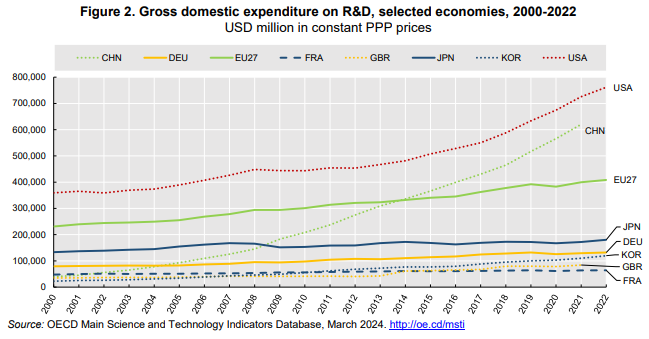
“Whatever the outcome on November 5, the US remains the world’s most innovative economy, with a system capable of resetting and correcting its mistakes and excesses”

Summary

In the current US political landscape, Real Clear Politics’ (RCP) Battleground polling averages, place former President Donald Trump ahead in all seven key states, suggesting a potential Republican sweep of the Senate. Such an outcome could see the GOP controlling the White House, Senate, and House of Representatives, streamlining the advancement of their legislative agenda. Conversely, a win for VP Kamala Harris could face significant hurdles with a Republican Senate, possibly leading to policy gridlocks and challenges in appointments, further exacerbating political stalemate as the parties pursue divergent goals.

The US labour market showed signs of improvement in September’s jobs report. However, expectations for October, set to be released this Friday, are tempered by recent natural disasters—Hurricanes Helene and Milton—and an ongoing Boeing strike, complicating Harris’ campaign for the presidency. These disruptions are also likely to pose challenges for the Federal Reserve as it deliberates over interest rate cuts. I expect the Fed to cut rates by at least 25 bps when it meets on November 7.

Whatever the outcome on November 5, the US remains the world’s most innovative economy, with a system capable of resetting and correcting its mistakes and excesses. Europe, on the other hand…resembles a pensioner gradually spending savings, with a little less money each day. In China, things rarely progress as expected. The next major policy shift is likely in Q1, but in the meantime, the People’s Bank of China (PBoC) will keep supporting asset prices, helping to maintain a floor under Chinese equities.

In financial markets, high-yield spreads have tightened to their narrowest in over 15 years relative to U.S. Treasuries. This trend typically supports rising equity markets, yet such narrow spreads also signal increasing risks, potentially indicating a looming market correction— but may take months or years to impact equities meaningfully.

The Final Week: Trump Takes the Lead as Republicans Poised for Senate Victory

As the US elections enter their final week, tensions are running high.

Over the weekend, thousands of readers cancelled their subscriptions to The Washington Post after the paper chose not to endorse a candidate in the 2024 Presidential race, marking the first time it has withheld an endorsement since 1976. Similarly, The Los Angeles Times recently decided against endorsing a candidate, provoking a backlash from both readers and staff.

In my opinion, if this trend continues, it must be seen as a positive development. The primary role of newspapers is to report the news, and readers should then reach their own conclusion.

Traditional media gained power through advertising, but that foundation has been disrupted by platforms such as TikTok, YouTube, and META. Now, news consumption is increasingly shifting toward podcasts, long-form posts on X (formerly Twitter), and various other social media platforms.

Interestingly, the rise of social media has also led to a significant increase in content creators. This statistic recently blew my mind:

  • There are now approximately 27 million paid content creators in the US, with around 44% (a staggering 12 million) treating social media as their full-time job

This raises a question: Could these figures be inflating the U.S. jobs report? While I hope not, it’s likely that some of these roles are reflected in the employment data.

This election cycle seems to illustrate how traditional media is being pushed to the sidelines.

Brian Armstrong, CEO of Coinbase, captured this sentiment well in a post on X earlier this week.

Shifting back to the US election, current betting markets give President Donald Trump an approximate 60% chance of winning, compared to 39% for Vice President Kamala Harris.

In contrast, at this point in 2020, President Joseph Biden was ahead of Trump by 64.7% to 35.2%.

According to the Real Clear Politics (RCP) Battleground polling averages, Trump currently leads in all seven key states, with Wisconsin and Michigan being the closest contests and Georgia showing the widest margin.

A quote from Bill May, a 71-year-old resident of Racine, Wisconsin, encapsulates Harris’s challenges:“Morally I think she’s better, but when it comes to the economy, you can’t keep buying votes.”

This sentiment highlights the uphill battle Harris faces, as voters weigh her policies against economic concerns.

The US jobs report for the month of October is set to be released on Friday, November 1, and it will likely add to Harris’ misery.

Hurricane Helene (Sept 24-29) marked the deadliest hurricane to strike the US mainland since Katrina, leaving many communities in recovery. Just two weeks later, Hurricane Milton followed, compounding the challenges for those affected. The October employment report is set reflect the impact of these storms. Both storms resulted in temporary job losses and closures of stores, factories, and construction sites.

The jobs report for September had painted a more optimistic picture of the labour market with an increase of 254,000 jobs that month. However, October’s figures are expected to reflect not only the disruptions caused by the hurricanes but also the ongoing Boeing strike. Economists predict that the report will indicate a gain of approximately 110,000 jobs for October. This could make the report especially vulnerable to political interpretation as candidates enter the final stages of their campaigns.

In the Senate race, Republicans are making significant inroads into the traditionally solid Democratic “blue wall” in Michigan, Wisconsin, and Pennsylvania. As the election season reaches its final stretch, the GOP is looking to destabilize a critical base of Democratic power.

The Republicans are favoured to take control of the Senate due to a favourable electoral map, with Democrats defending the majority of the approximately dozen competitive races.

The GOP anticipates a strong victory in West Virginia, where they are vying for the seat being vacated by centrist Senator Joe Manchin. Additionally, they are optimistic about their chances in Montana, where incumbent Democrat Senator Jon Tester faces tough competition amid the state’s Republican leanings. Just these two victories could potentially flip the current 51-49 Democratic advantage.

However, Republicans are also eyeing additional pickups that could further bolster their majority. Control of the Senate will be crucial for the next president in passing their legislative agenda and confirming key nominees, including potential Supreme Court appointments.

Sources:  WSJ, Cook Political Report, Inside Elections and University of Virginia Centre for Politics

A Trump victory could lead to Republicans controlling all three branches of government—the White House, the Senate, and the House of Representatives. This consolidation of power would allow the GOP to advance its legislative agenda with fewer obstacles.

Conversely, if Harris wins, a Republican-controlled Senate could act as a significant impediment, potentially resulting in policy deadlocks and appointment challenges. This scenario may lead to increased political gridlock, as the two parties would have contrasting priorities and agendas, complicating efforts to pass legislation and confirm nominees.

The Federal Reserve’s (the Fed) upcoming decision on interest rates will take place just two days after Election Day, adding to the complexity of the economic landscape. The impact of the hurricanes on recent economic data is likely to create challenges for the Fed, as it assesses whether to cut rates and by how much.These storms have the potential to skew the data, complicating the Fed’s task of maintaining economic stability while also managing inflation.

As policymakers navigate these uncertainties, they will need to weigh the immediate effects of the hurricanes alongside longer-term economic trends. The situation underscores the intricate balance the Fed must strike in its monetary policy decisions, especially in the context of an evolving economic environment.

I expect the Fed to cut rates by at least 25 bps when it meets on November 7.

Markets and the Economy

On Monday this week, Volkswagen, Europe’s largest carmaker, informed its Works Council—the company’s top employee representative body—that it plans to shut down at least three German plants, cut tens of thousands of jobs, and reduce pay by 10%. This restructuring marks an unprecedented move for Volkswagen, potentially leading to the first domestic plant closures in the company’s 87-year history, underscoring the impact of high energy costs, slowing GDP growth, and intensifying competition from China.

Meanwhile, across the Atlantic, the situation is markedly different. Boeing workers in the US recently rejected a contract offer that included a substantial +35% wage increase over four years—equivalent to an annual raise of more than +8%. This outcome reflects a tight labour market, where American workers have the leverage to push for even higher wages amidst robust job demand and steady economic growth.

This contrast in corporate strategies highlights the diverging economic landscapes: While Europe’s manufacturing sector faces headwinds from energy and competitive pressures, the US continues to experience labour shortages and wage growth as part of its resilient post-pandemic recovery.

It’s not just Germany, France is in bad shape too. France just manages to cover it with perennial borrowing. France hasn’t run a balanced budget in over 30 years (see chart below).

France’s newly appointed Prime Minister, Michel Barnier, has introduced his government’s inaugural budget, featuring €60 billion in measures designed to reduce the national deficit. The goal is to bring the deficit to 5% of GDP by 2025 and down to 3% by 2029, moving toward EU fiscal targets.

Barnier’s approach to fiscal tightening includes a temporary tax increase targeting corporations with annual revenues exceeding €1 billion, as well as households earning over €500,000. France, already the most heavily taxed economy in the OECD, risks further eroding its revenue base by edging onto the adverse side of the Laffer curve. Additional tax hikes, rather than boosting revenue, could likely deter investment, prompt more capital flight, and ultimately weaken France’s tax receipts.

Barnier’s budget now faces the challenge of navigating France’s fragmented National Assembly before year-end. The New Popular Front—a left-wing coalition that recently gained the most seats—is pushing for increased taxation on financial transactions, higher inheritance taxes, and the reinstatement of the wealth tax eliminated by President Emmanuel Macron. Marine Le Pen’s far-right National Rally advocates that budget cuts should prioritize anti-fraud measures and reduced spending on immigration. Macron’s pro-business party, typically opposed to substantial tax hikes, has shown wavering support, underscoring the difficult path Barnier faces in securing approval for his budget plan.

The unfolding budget and political crisis in France sheds light on why yields on 10-year French government bonds are now higher than those for Portuguese and Spanish equivalents. Market concerns over France’s ability to implement fiscal discipline, compounded by political fragmentation, are driving investors to seek stability elsewhere in Europe.

Separately – How bizarre is this—India, which imports 82% of its oil needs, has become Europe’s top fuel supplier (see chart below).

Before the Russia-Ukraine war, Russian oil made up less than 1% of India’s total oil imports. Now, reports indicate that Russian imports account for nearly 40% of India’s oil purchases.
Previously, the EU purchased little to no oil from India, but now they are buying Russian oil indirectly through Indian suppliers.

Next, EU nations might as well join BRICS and abandon the Euro.

Basing foreign and economic policy on faux morality only leads to mounting costs.

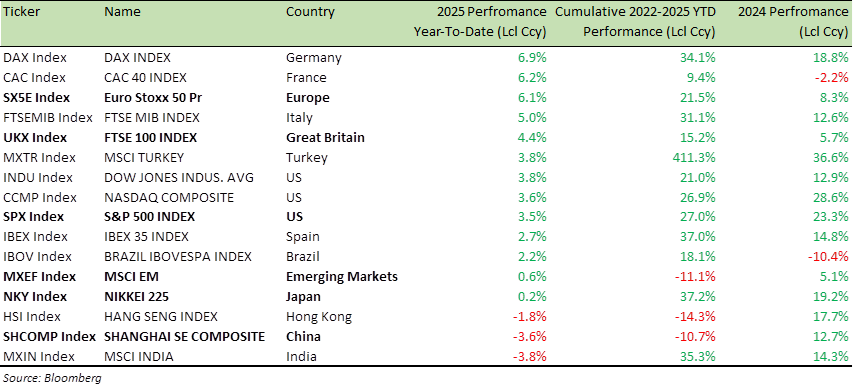
For equity investors, 2024 has been a great year to be risk-on

US equities are on track for annual gains of over +20%, a strong rebound that only tells part of the story.

As you can see in the table below, the S&P 500 (SPX) is up +22.4% YTD and +21.2% for the nearly three-year period (2022-2024 YTD) due to the sharp 2022-2023 sell-off when the index fell by -25%.

Looking ahead, the question remains: Can US equities continue to climb?

Market conditions and recent trends suggest there may be further upside potential.

Global Equity Index Performance (2024 YTD, 2022-2024 YTD and 2022 Performance)

High-yield spreads—based on the Bank of America/Merrill Lynch High Yield Master Index—have reached their narrowest levels, relative to US Treasuries, in over 15 years.

At 260 basis points above Treasuries, these spreads are near their historical low, sitting in the 5th percentile of values dating back to 1970. While extremely low spreads can eventually pose risks to equities, history suggests that the adverse effects may take considerable time to fully manifest.

The last time spreads were this low, was in June 2007, just before the SPX hit a peak, ahead of the 2007-2008 financial crisis.

Tightening high-yield spreads generally confirm rising equity markets, however, spreads cannot narrow indefinitely without increasing risk. Extremely low spreads may indicate a potential market correction but may take months or years to impact equities meaningfully.

A historical analysis shows that when high-yield spreads have reached the bottom 5% range, the SPX has typically experienced mixed performance over the next one to three months (see table below). However, six to twelve months later, the index was consistently higher, with gains ranging between +7.4% and +27.2% across three previous occurrences.

Source: Bespoke Invest

While these patterns suggest potential short-term volatility, the longer-term outlook has historically remained positive, provided the market can absorb short-term adjustments.

Also, there’s a growing debate, if one should move to the equally weighted index when investing in the S&P 500 index, given the high weight of technology in the market-cap weighted index.

Below, is a look at the differences in sector weightings for the SPX (cap-weighted) and SPX Equal Weight indices. By default, the sectors with the largest number of stocks in the index will have the highest weightings in the equal-weight index.

While the Tech sector makes up nearly one third of the cap-weighted index, it’s only 13.7% of the equal-weight index. Industrials and Financials each have a larger weight than Tech in the equal-weight index, while they combine for a weighting that’s just 2/3 of Tech’s weighting in the cap-weighted index.

When looking at the pie charts below, it’s the equal-weight version that appears more balanced and diversified now.

No sector has a weighting below 4.4% in the equal-weight index, while the cap-weighted index has four sectors with weightings below 3.3%. Movements in Materials, Real Estate, Utilities, and Energy have virtually no impact on the cap-weighted index these day.

Source: Bespoke Invest

Since 1990, the equal-weighted SPX has outperformed its cap-weighted counterpart (see chart below).

Notably, during the late 1990s dot-com bubble, the cap-weighted index surged well above the equal-weighted version as tech mega-caps soared. However, after the bubble burst and the 2003-2007 bull market unfolded, the performance dynamic shifted, allowing the equal-weighted index to take the lead as broader sectors recovered.

Today, while mega-caps have driven market gains in recent years, a prolonged period of underperformance among these giants could shift favour back to the equal-weighted index.

S&P 500 (Cap Weight, SPY) Index vs. S&P 500 Equal Weight (SPT) Index: 1994-Present

Source: Bloomberg

That said, with artificial intelligence and related innovations still in early stages, I expect the cap-weighted index to continue delivering strong returns in the near term, supported by the tech sector’s growth potential.

Just consider the capital expenditure plans of the hyperscalers, which are essentially checks written to Nvidia (NVDA).

Last week, Tesla announced its capital expenditure plan for the upcoming year, setting it at $11 billion.

  • Meta’s expected CapEx ranges from $35 billion to $40 billion

  • Microsoft’s CapEx has seen a significant jump to $58 billion, up from $28 billion two years ago

  • Google plans to allocate $50 billion for CapEx in 2024, up from $30 billion just two years ago

These substantial increases underscore the tech giants’ aggressive investment in AI and infrastructure, particularly in relation to NVIDIA’s advanced Blackwell chips.

Notably, a Blackwell GB200 CPU+GPU combo chip can cost between $60,000 and $70,000, reflecting the high stakes and costs involved in this tech race.

Gold has risen over +30% year-to-date, while the SPX has gained more than +20%. If both assets maintain these gains through the end of the year, it will mark the first time since 1976—when the US fully left the gold standard—that both assets achieved such simultaneous strength.

Gold’s recent rise aligns with a technical “cup and handle” formation, a bullish pattern that has developed over a decade for the gold ETF (GLD). This long-term pattern suggests further upside potential, as longer formations tend to lead to more substantial and extended gains once a breakout occurs.

While it looks good for Gold to rally more. What’s the bear case?

There are several scenarios where demand for gold as a safe-haven asset could weaken. A more stable trade environment with reduced market uncertainty would likely make gold less attractive as a hedge. Additionally, if fears about the US deficit are exaggerated and Trump’s policies emphasize spending cuts rather than expansion, this could bolster confidence in the US dollar and overall economic stability, further reducing gold’s appeal. Improved US-China relations would similarly boost market optimism, potentially steering risk-averse investors away from gold.

Finally, if China’s stimulus efforts successfully fuel stronger growth, Chinese investors—who are significant buyers of gold—might shift toward growth-focused assets like domestic equities, making gold less appealing, especially since it performs best in times of economic uncertainty or downturns.

Source: Bespoke Invest

Bloomberg News reported that, Taiwan Semiconductor Manufacturing Co. (TSMC) has achieved early production yields at its first Arizona plant that surpass those at comparable facilities in
Taiwan, marking a key milestone for TSMC’s US expansion—a project initially plagued by delays and workforce challenges.

This development holds significant, if understated, implications for US strategic positioning and Taiwan’s role in global tech supply chains.

Potential Implications:

  • Strengthened US Chip Manufacturing: With high production yields in Arizona, the US could secure a critical foothold in semiconductor manufacturing, reducing reliance on imports

  • Taiwan’s Strategic Value Shift: As the US builds local capacity, Taiwan’s strategic importance to the US might lessen, potentially altering the region’s geopolitical dynamics

  • Taiwan-China Relations: Taiwan could see increased pressure to integrate with China through non-military means, as its unique strategic leverage diminishes

Investor Relief: TSMC shareholders may find reassurance in the successful launch of US operations, despite previous hurdles

Source: Bloomberg

This shift will be gradual, but the path forward is clear. Both TSMC and ASML remain central to the US, in securing advanced chip technology. Although ASML, a Dutch company, is subject to US export restrictions due to the inclusion of American-made parts, this reinforces the US approach to securing semiconductor technology through both domestic production and international controls.

Whatever the outcome on November 5, the US remains the world’s most innovative economy, with a system capable of resetting and correcting its mistakes and excesses. Europe, on the other hand…resembles a pensioner gradually spending savings, with a little less money each day.

In China, things rarely progress as expected. The next major policy shift is likely in Q1, but in the meantime, the P The People’s Bank of China will keep supporting asset prices, helping to maintain a floor under Chinese equities.

If Chinese policymakers succeed in boosting China’s consumption and asset prices start growing again, gold could face significant downward pressure.

 
Best wishes,

Manish Singh, CFA


“Employment risks now overshadow inflation challenges, a 50-basis point rate cut this Wednesday could be a prudent adjustment.”

Summary

As US job openings revert to pre-COVID levels, employment risks now overshadow ongoing inflation challenges. Amid this shift, businesses serving lower and middle-income groups face increasing pressures, and the personal savings rate has dipped to 2.9% in July, its lowest since 2007. This context places the US Federal Reserve at a crossroads: Continue the stringent measures of the current tightening cycle or ease up as the unemployment rate surpasses expectations and the road to +2% inflation appears clear. A 50-basis point rate cut this Wednesday could be a prudent adjustment.

While the U.S. economy reportedly grew around +3% last quarter, not all segments of the population are experiencing prosperity. Potential further softening in the labour market might necessitate larger rate cuts, potentially at odds with the Fed’s long-term objectives. Regardless of whether the cut is 25 or 50 basis points, market sentiment is tilting towards additional reductions over the coming year, as evidenced by the 2-year Treasury yield dropping to +3.54%, significantly below the current upper boundary of the Fed Funds Rate.

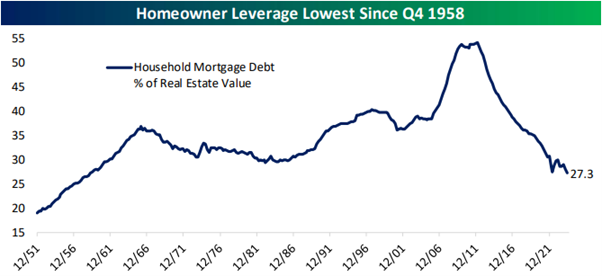
Contrary to some expectations of a looming US recession and market downturn, several factors suggest resilience. Households are seeing the lowest mortgage debt relative to property values in nearly seven decades, bolstered by rising home values and consistent mortgage payments. Additionally, the restrained cash-out refinancing and low turnover in mortgages have lessened real estate leverage. This robust financial footing, combined with gains from high home prices, stock market improvements, and steady incomes—all amplified by high interest rates—continue to drive consumer spending.

Meanwhile, a U.S. fiscal deficit nearing 10% of GDP offers substantial support, reducing the likelihood of a sharp demand drop. With consumer spending remaining strong, the probability of a recession appears low, suggesting equities still have room to grow.

Why the US Fed must cut rates in a “Healthy” Economy

In 1959, economist Milton Friedman addressed a joint session of the US Congress, explaining that monetary policies “operate with a long lag and with a lag that varies widely from time to time.” He compared changes in US Federal Reserve (Fed) policy to “a water tap that you turn on now, and it only starts to flow six, nine, 12, or 16 months later.”

Friedman further stressed the uncertainty of these lag effects, stating, “…we know too little about these lags or what the economic situation will be months or years from now, when the chickens we release come home to roost, to effectively counteract the myriad of factors causing minor fluctuations in economic activity.”

Today, with the Federal Funds target rate (FDTR) held at +5.25% for 14 months, following  the steepest interest rate hike cycle seen in over four decades (see chart below), Fed Chair Jerome Powell and his colleagues on the Federal Open Market Committee (FOMC), face the challenge of navigating these “long and variable lags.”

The task, however, is not how much to raise rates to combat inflation but determining when and by how much to cut rates, without tipping the economy into a future recession.

All signs point to a rate cut starting this Wednesday. Current market pricing indicates a 70% probability of a 50 bps rate cut.  

We have a flurry of communications from “Fed surrogates.”

Last Friday, two strikingly similar articles were published in The Wall Street Journal (link) and The Financial Times (link) written by Nick Timiraos and Colby Smith respectively.

If you know the Fed meeting coverage well, you will know Nick Timiraos and Colby Smith are two well-respected members of the Federal Reserve press corps. Timiraos, in particular, has often been viewed as a key channel through which the FOMC indirectly communicates its thinking to the market.

Both articles focused on the rate-setting decision—whether to cut rates by 25 basis points (bps) or 50 bps—and both articles presented a clear and balanced discussion of the arguments for a 25 bps versus a 50 bps rate cut, highlighting the risks and benefits associated with each option. Notably, neither story cited an explicit source within the FOMC, indicating a preferred direction for the decision.

Change in the Federal Funds Target Rate (FDTR) during the last five rate-hiking cycles

These were followed by a headline on Bloomberg the same day – [Bill] Dudley Sees Case for Half-Point Fed Rate Cut Next Week.

Speaking at a forum organized by The Bretton Woods Committee in Singapore, the former NY Fed President, Bill Dudley said – “I think there’s a strong case for 50. I know what I’d be pushing for.”

I strongly agree with Dudley.

Last week’s US jobs report revealed that the focus must shift to jobs and economy.

With job openings returning to pre-COVID levels, the risk to employment now outweighs the persistent challenges of inflation, which is projected to reach +2%.

  • The hiring rate has decreased from 4.5 to 3.5
  • Job openings have dropped from over 11 million to 7.6 million
  • Job openings per unemployed worker have halved, from over 2 to 1.07
  • Layoffs are trending upward, rising from 1.2 million to 1.7 million
  • The unemployment rate has climbed by 0.5% since the start of the year.

Any tolerance that leads to further weakness in the labour market, could prompt more substantial rate cuts down the line, which is not ideal for the Fed.

The housing market has been soft in recent months, and while the construction sector added jobs in August, declines in new residential construction, point to another source of potential weakness ahead for hiring.

Businesses and financial companies that cater to low- and middle-income consumers are pointing to signs of greater strain, and the personal savings rate fell to +2.9% in July, near its lowest level since 2007.

Let us look at the data (see chart below):

  • Federal Funds Target Rate (FDTR) Upper Bound (White) is at +5.5%
  • US inflation, as measured by US Consumer Price Index (CPI) is currently at +2.5%
  • US 2y Treasury Yield is at +3.57%
  • Spread 1 (Yellow): US 2y yield – FDTR is at -190 bps
  • Spread 2 (Green): US Inflation – FDTR is at -300 bps

The spreads are at historic levels and point to how high the Fed fund rate is with respect to other key data.

The last time, US 2-year Treasury yield traded 190 basis points below the upper bound of the Fed Funds Rate was on January 18, 2008. Just four days later, on January 22, 2008, the Fed made an unscheduled 75 bps rate cut, followed by another 50 bps cut eight days later, on January 30, 2008.

We are not in such a crisis, so we will not get a 75 bps cut.

Whether it is 25 or 50 bps cut on Wednesday, the market is now expecting a lot more rate cuts in the next year or so. The 2-year Treasury yield is a good measure of where the market expects the Fed Funds Rate to be in the next year or two, and this week the 2-year yield ticked down to +3.57%.

Price chart: Federal funds rate (FDTR) , Spread between US inflation and FDTR, Spread between US 2y yield and FDTR

Source: Bloomberg

I’ve heard arguments against cutting rates in a “healthy” economy, but what defines “healthy”?

For those benefitting from deficit spending or in the upper and middle classes, the economy may seem robust—where inflation is minor, and lifestyles are stable. Yet, many aren’t seeing these benefits.

Essential costs have surged 20-30% recently, with Dollar General (DG) noting sales declines among customers averaging $35k a year. CEO Todd Vasos attributed weak sales to financially strained core customers.

Moreover, the end of pandemic-era food stamp benefits in March 2023, alongside two years of inflation, has pushed consumers to focus on necessities over discretionary items.

Despite a +3% GDP growth last quarter, the economy isn’t “healthy” for all, highlighting the disparity in economic health across different societal segments.

As per the New York Fed’s Survey of Consumer Expectations (see chart below), the mean probability of missing a debt payment, hit its highest level since April 2020.

Source: Bespoke Invest

For those worried about inflation if the Fed cuts rates, consider this:

Rate cuts are unlikely to hit historic lows soon. I anticipate about 200 basis points in reductions over the next year or more. Contrary to some beliefs, low rates alone don’t drive inflation. Instead, inflation ties more directly to the M2 money supply, heavily influenced by government spending and debt levels. Over the last four years, the cumulative effects of Trump’s tax cuts and Biden’s stimulus significantly increased the U.S. deficit.

Moreover, high rates can trigger recessions or even depressions, as seen in the late 1920s. Economists broadly agree that the Fed’s sharp rate hikes in 1928 and 1929 contributed to the subsequent global economic collapse.

During the Great Depression, the Fed’s reluctance to cut rates exacerbated the crisis. From 1929 to 1933, consumer prices fell by -27%, yet the Fed kept rates at 3 to 5%, with mortgage rates at about 6%. This resulted in effectively +32% real interest rates during deflation, suggesting that negative rates would have been more appropriate.

Now, with rates significantly above neutral and inflation decreasing towards a 2% target, a more substantial cut than the typical 25 bps may be warranted. We need to question whether it’s justified for the Fed to maintain its most restrictive stance during a clear move towards 2% inflation.

Lastly, considering the massive U.S. federal debt—now at $35.7 trillion—do big rate cuts make sense? Given the circumstances, they do.

Markets and the Economy

Some people think a new high for the S&P 500 (SPX) and the National Association of Security Dealers Automated Quotations (NASDAQ) indices, means we are in “bubble” territory and the equity markets must correct.

Far from it.

It must be emphasised that while the stock market has been trending upward over the past couple of years following the 2022 bear market, the current environment is far from a “bubble,” when viewed through a long-term lens.

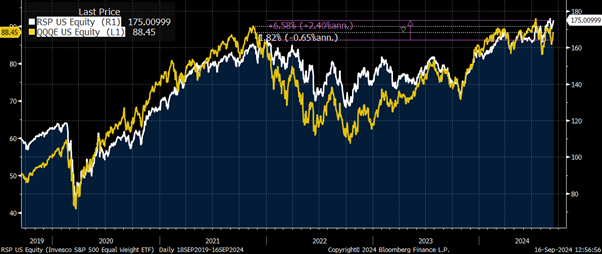
  • Cap-weighted indices like the S&P 500 and Nasdaq 100, driven by mega-cap stocks, have shown strong performance. In contrast, their equal-weighted counterparts have been consolidating sideways since late 2021
  • Charts of the S&P 500 Equal Weight ETF (RSP) and the Nasdaq 100 Equal Weight ETF (QQQE) show this extended consolidation over the past five years
  •  The S&P 500 Equal Weight ETF recently surpassed its early 2022 all-time highs, whereas the Nasdaq 100 Equal Weight ETF is still just below its late 2021 highs
  • Both equal-weight indices might see significant upward movement if they break out of this multi-year consolidation phase

5-year price chart: S&P 500 Equal Weight ETF (RSP) and the Nasdaq 100 Equal Weight ETF (QQQE)

Source: Bloomberg

Last week, Nvidia (NVDA) CEO Jensen Huang declared: “We’re at the beginning of a new industrial revolution.”

While NVDA sceptics may not want to hear it, the surge in tech spending on Artificial Intelligence (AI) is driving what many are calling the 4th Industrial Revolution.

Oracle founder Larry Ellison’s recent insights on AI demand and Oracle’s expanding pipeline are particularly revealing. Ellison noted that a few major tech companies—and potentially even a country—will be vying for AI model “technical supremacy” in the coming years, each planning to spend $100 billion.

Ellison emphasized that the AI boom shows no signs of slowing down anytime soon. “If you’re looking at the next five to ten years, there’s no need to worry,” Ellison said during Oracle’s earnings call. “This business is growing bigger and bigger. There is no slowdown or shift on the horizon.”

The most significant news is that Oracle’s AI infrastructure efforts now have full backing from Nvidia.

Nvidia’s chips are in extremely high demand across the tech industry. During a dinner with Tesla (TSLA) founder Elon Musk, Ellison personally appealed to Huang to secure more GPUs for Oracle’s AI supercluster.

“I’d describe the dinner as Elon and me begging Jensen for GPUs. ‘Please take our money. No, take more of it. We need you to take more,’” Ellison said. “It went well. It worked.”

At the Oracle CloudWorld conference on Wednesday, the two companies – Nvidia and Oracle – announced that Oracle Cloud Infrastructure (OCI) will deploy the largest-ever GPU compute cluster. Set to be available in the first half of 2025, this cluster will feature up to 131,072 Nvidia Blackwell GPUs, enabling customers to train and run AI workloads on an unprecedented scale. Oracle stated that the cluster would be six times larger than what any other cloud provider currently offers.

For context, Meta used just 16,000 Nvidia GPUs to train its latest Llama 3 model, highlighting the massive leap Oracle is making in AI infrastructure.

So, all looks good on tech and AI stock front, but the talk of “bubble” will not go away.

Those expecting a recession and hence a market correction are going to be disappointed.
Households have the least mortgage debt relative to their property value in almost 70 years, with appreciation of those homes and steady amortization of mortgage debt (alongside low cash-out refinancing activity and low turnover in mortgages overall) driving down the leverage in real estate. Consumer balance sheets are rock solid, which is another reason to question the narrative of impending recession.

Source: Bespoke Invest

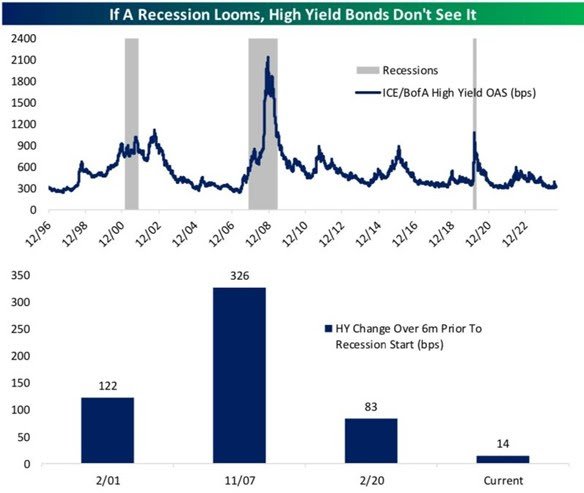
Unlike past recessions, yields on high-yield bonds have shown minimal movement so far (see Chart below). As long as consumer spending remains strong, the likelihood of a recession stays low.

While recent jobs reports indicate early signs of weakness, the unemployment rate remains historically low. The wealth effect from high home prices, stock market gains, and steady income driven by high interest rates continues to support consumer spending.

In August, the US federal deficit hit $380.1 billion, on a non-seasonally adjusted basis, significantly above the $292.5 billion expected, driven by a +9% increase in expenditures. Only a few periods have recorded larger deficits.

Relative to GDP, the deficit is approaching +10%. With this level of fiscal accommodation, it is hard to believe that final demand will slow significantly. Federal deficits are propping up strong real income growth and investment, regardless of what the payroll numbers indicate.

Furthermore, in Washington, there is a broad consensus that deficits can be expanded when needed. No politician wants to champion a balanced budget or spending cuts—it would be political suicide. As a result, the reckoning for US yields and the dollar keeps getting pushed further into the future.

Source: Bespoke Invest

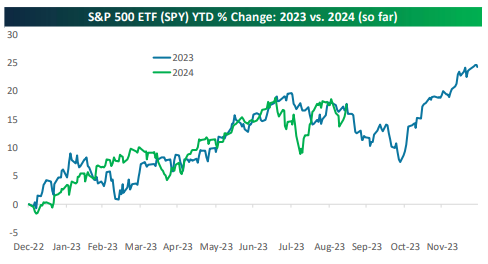
2024 is eerily like 2023… Is a dip next? or a rally with a Fed cut on the horizon?

I am expecting a 50 bps cut on Wednesday.

S&P 500 (YTD): +17.95%

As I have mentioned above, I do not anticipate a recession taking hold within the next 6 months.

A Fed rate cut would boost sentiment, and the US economy is showing no signs of a recession.

While the un-inversion of the yield curve is often seen as a worrying indicator, the effects of COVID and the policy responses have disrupted all historical models.

So, be cautious about relying too heavily on past patterns and models.

Source: Bespoke Invest

A magazine advertisement placed by The Teachers Insurance and Annuity Association of America (TIAA) and College Retirement Equities Fund (CREF) from 1996, predicted that people would pay:

– $16 for a burger and fries
– $12,500 for a vacation
– $65,000 for a “basic car”

The ad continued:

“No problem.
You’ll eat in. You won’t drive.
You won’t go anywhere.”

Reality is:

We eat out more than ever.
We drive more than ever.
We go anywhere more than ever.
So, do not get bearish on life in general. Hold on to your long equity positions. Recession is not on the horizon and equities have further to run.

For specific stock recommendations and insights related to structured products, please do not hesitate to reach out to me or your dedicated relationship manager.

 
Best wishes,
Manish Singh, CFA


“Chairman Jerome Powell’s recent remarks, recent market movements and what these developments might mean for the future”

Summary

July has proven to be a rollercoaster month for the markets. Despite numerous fluctuations, the S&P 500 has impressively advanced by +16% this year. In a typical year, such a return would be highly celebrated; however, this year’s AI-driven tech stock surge and broader market gains have heightened expectations. Notably, the market’s breadth-the balance of advancing and declining stocks within the index-is improving. This suggests that market pullbacks may present buying opportunities, indicating potential for continued upward momentum in the coming months.

This month’s market dynamics reflect the effectiveness of past rate hikes in tempering inflation, amidst evolving supply and demand conditions. Recent data pointing to a softening labour market has weakened wage bargaining power, advocating for potential rate cuts to uplift market sentiment and enhance housing affordability.

At the beginning of this year, the probability of rate cuts at the Federal Open Market Committee (FOMC) meetings in March, May, June, and July was over 80%. However, no cuts were made at any of these meetings, including the one in July. At the July meeting, Chair Jerome Powell emphasized the downside risks related to the labour market and the FOMC’s close monitoring of labour market trends. It sets the stage for cuts at the September meeting.

Market volatility and drawdowns are not anomalies but rather inherent features of investing and should be anticipated, embraced and strategically addressed. Investing isn’t about overreacting to quarterly earnings but about understanding the long-term growth potential of the markets in which the companies you invest in operate. While massive spending on AI may not benefit every firm equally, such spending still generates substantial revenue for vendors like Nvidia and Microsoft. Moreover, major tech firms have demonstrated their capacity to endure setbacks and continue to thrive, as evidenced by the recent performances of Meta, Alphabet, and Netflix.

A Bronze medal for the S&P 500

The 2024 Olympics officially kicked off on July 26, and, as always, the event was surrounded by its share of controversies.

First, arsonists sabotaged the rail network, followed by relentless rain that threatened to turn the opening ceremony into a soggy affair. There were further blunders, such as the Olympic flag being hoisted upside down, South Korean athletes being mistakenly introduced as North Korean on live television, and the uproar over the “Last Supper” and other scenes, which led to an official apology from the organizers.

A spokesperson for Paris 2024 stated, “There was never an intention to show disrespect to a religious group. If people have taken any offense, we are, of course, really sorry.”

To that, I’d add that an apology including the word “if” falls short of being a true apology. Sports, with their numerous health benefits and enjoyment, are best kept free from political controversy.

The Cauldron of the Olympic Games Paris 2024

Source: 2024 IOC

There were plenty of very good bits too – the “mystery torchbearer” running over those slippery rooftops was glorious, as was the majestically hoisted Olympic “ring of fire” torch floating 200 feet high up in the air. It wouldn’t be safe to get a real flame up to 200 feet high, as it would require pipes feeding gas or another combustible to fuel the fire, so it’s not a surprise that the “ring of fire” isn’t actually burning – it’s an illusion made up of clouds of mist and beams of light.

It’s worth noting that the first hot air balloon carrying a human, flew in Paris on November 21, 1783. About a week later, the first manned hydrogen balloon flight, took off from the Jardin des Tuileries in Paris – the same place the Olympic cauldron is today.

Final point- if you’re an organiser and want to host event outside, just presume it will rain.

Turning now to the markets.

By indicating a possible interest rate cut in September, as it did on Wednesday, the US Federal Reserve (Fed), risks becoming entangled in the US presidential election.

A rate cut before the election could attract criticism from Republicans and former President Donald Trump, while delaying a much-needed reduction, might hurt the economy and frustrate Democrats.

With the labour market weakening, inflation approaching +2%, and the Fed aiming to avoid a recession, these are delicate times. These challenging optics will likely push Fed officials to carefully manage expectations and communications over the next few weeks.

This week’s earnings reports from major companies have been significant, with Meta and Microsoft taking centre stage. However, the big report everyone is waiting for is Nvidia (NVDA), scheduled for August 28.

Let’s revisit the market reaction from this Tuesday following Microsoft’s earnings:

  • Right after Microsoft announced its earnings, its stock fell over -7% due to Artificial Intelligence (AI) revenue not meeting expectations
  • However, when Advanced Micro Devices (AMD) projected increased spending on AI chips, Microsoft’s stock bounced back by+ 5%. Nasdaq futures climbed +1.5%, and NVDA surged about +10% from its after-hours low, to its premarket high, even outperforming AMD, which had just reported positive earnings

“Is the market reacting judiciously?”

More on big tech and the Fed in the Markets and Economy section below.

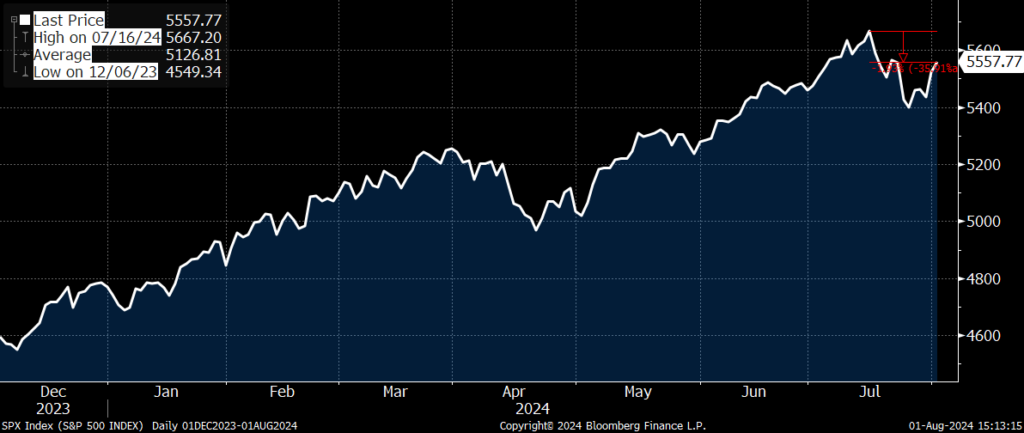
On the broader market level, July has been a tumultuous month. Despite the ups and downs, the S&P 500 (SPX) has still managed to climb +16% this year. In any given year, a +16% return would be cause for celebration. Yet, with the recent AI led tech stock rally, and overall market gains, expectations have been set higher.

Although the SPX is down -2% from its mid-July peak, it remained positive for the month of July.

The SPX in July therefore only deserves a Bronze medal.

S&P 500 price chart, (Dec 2023 – YTD)

Source: Bloomberg

Encouragingly, despite the market volatility, the “breadth of the market” – the relative number of advances and decline of stocks in the index – is getting better.

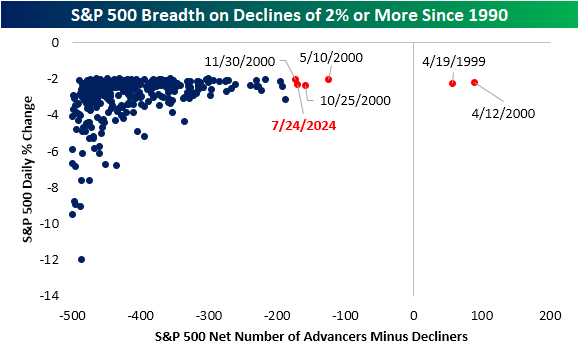
The chart below from BespokeInvest, illustrates all days since 1990 when the SPX fell by at least -2%. It compares these declines to each day’s net advance/decline reading – the difference between the number of advancing stocks and declining stocks.

As expected, on days when the SPX dropped by -2% or more, the number of declining stocks generally far exceeded the number of advancers. Typically, on such days, only about 33 stocks finished higher, compared to 465 decliners, resulting in a median net daily advance/decline reading of -432.

However, mid last week’s -2% drop, was an exception to this rule. Despite the SPX ‘s over -2% decline, nearly one third (165) of its components ended the day with gains. This resulted in a daily net advance/decline reading of -171, which is significantly stronger than the historical norm, and ranks as the fifth strongest among all days since 1990, with a -2% drop in the SPX

The most recent comparable instances of strong breadth during such declines were in October and November of 2000. Notably, there was also a day in May 2000 with even better breadth on an over -2% decline, and in April of that year, there were days when the SPX fell by -2% with positive breadth.

This type of price versus breadth action hasn’t been seen since the Dot Com Bubble burst. A rebound in breadth is a positive sign, as recent market gains have been driven primarily by large technology stocks, leaving the rest of the index behind. Increasing breadth indicate, a healthier and more sustainable bull market. Participation in the rally has broadened, particularly among cyclical sectors.

Increasing breadth readings suggest that pullbacks or corrections should be viewed as buying opportunities, as upward momentum often continues over the next few months, just as a narrowing breadth indicates oversold and bottoming market.

Source: Bespoke Invest

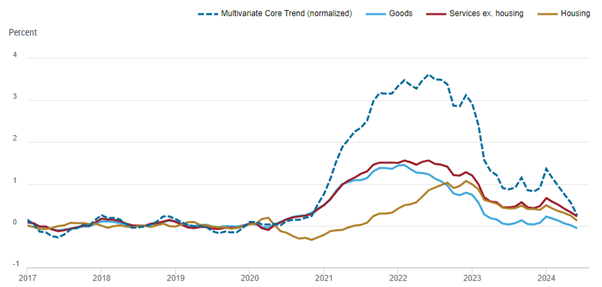
In more positive news for inflation, which could help the SPX outperform its bronze medal status, the New York Fed’ measure of inflation persistence -the Multivariate Core Trend (MCT) rate -declined again in June, reaching +2.1%. This drop is particularly notable due to significant shelter disinflation observed in June. The broad-based declines in inflation are encouraging.

The NY Fed’s MCT model evaluates inflation persistence across seventeen core sectors of the US personal consumption expenditures (PCE) price index. It is crucial for US policymakers to understand whether inflation is transient or persistent, concentrated in a few sectors, or widespread.

The NY Fed’s MCT model evaluates inflation persistence across seventeen core sectors of the US personal consumption expenditures (PCE) price index. It is crucial for US policymakers to understand whether inflation is transient or persistent, concentrated in a few sectors, or widespread.

Key findings for June include:

  • The Multivariate Core Trend (MCT) inflation fell to +2.1% in June from +2.4% in May, with a 68% probability band of (+1.6%, +2.6%
  • Compared to pre-pandemic levels, housing contributes +0.12% to the MCT estimate, while services excluding housing contribute +0.22%. Core goods had a slight negative impact of -0.06%
  • The remaining inflation persistence in housing and services excluding housing is largely driven by sector-specific factors

It can be argued that rate hikes have largely fulfilled their role in moderating inflation, given past supply and demand constraints. Lowering interest rates could enhance sentiment and improve housing affordability.

NY Fed’s Core Trend of US Personal Consumption Expenditures (PCE) price index

Source: Bureau of Economic Analysis (BEA)

After breaking through the 5,500-support level to the downside last week, the SPX made two unsuccessful attempts to reclaim that key psychological level. This recent bounce won’t be worthy of a gold medal until the SPX can break back above (as it did Wednesday) and hold those levels.

On a brighter note, the SPX briefly fell below 5,400 on two occasions, but each time, buyers quickly stepped in to support the market.

Markets and the Economy

Earlier this year, the likelihood of rate cuts at the Federal Open Market Committee (FOMC) meetings in March, May, June, and July was over 80%. Despite this, no cuts were made at any of these meetings, including the one held just held in July.

However, looking ahead to the upcoming meetings, the markets now almost guarantee a rate cut at each of the next four meetings – Sept, November, December and January 2025.

At the press conference on Wednesday, Fed Chair Jerome Powell, underscored his comfort with the idea of near-term rate cuts, suggesting that a reduction “could be on the table at the September meeting”, and “the reduction of the policy could be as soon as September”, concluding “base case [is]that policy rates would move down from here” and that the policy could be adjusted as early as September.

Rather than contesting market expectations, Powell explicitly supported the September rate cut, thus fuelling the day’s rally. In his economic analysis, Powell focused heavily on the downside risks associated with labour markets and the FOMC’s close attention to labour market trends. He characterized the current economic adjustments as “normalisation”.

The Fed’s next meeting is September 17-18, and the one after that is set to begin the day after the November 5 election.

So, what do the bond yield spreads, often predictors of an oncoming recession, have to say?
Let’s look at the data.

  • The spread between the 10-year and 2-year US Treasuries has been negative for just over two years, marking the longest period of inversion on record
  • However, since the end of June, the curve has steepened significantly, narrowing from around -50 basis points to -15 basis points this week its least inverted level in over two years

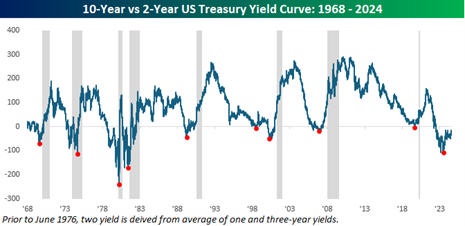
Inverted yield curves are often linked to recessions. The chart below illustrates the 10-year vs. 2-year US Treasury yield curve since 1968.

Historically, recessions (indicated by grey shading) have followed periods of curve inversion, though the timing of the economic downturn could range from a few months to several years after the initial inversion. The red dots highlight the most inverted points during each period of inversion.

While yield curves are generally associated with recessions, a more precise recession indicator is when the yield spread turns positive after being inverted.

We are currently just -23 basis points away from this transition.

Source: Bespoke Invest

While an inverted yield curve returning to a positive slope is often viewed as a stronger recession signal than mere inversion, it’s important to assess the market’s behaviour following this shift before one turns bearish, on account of a possible recession.

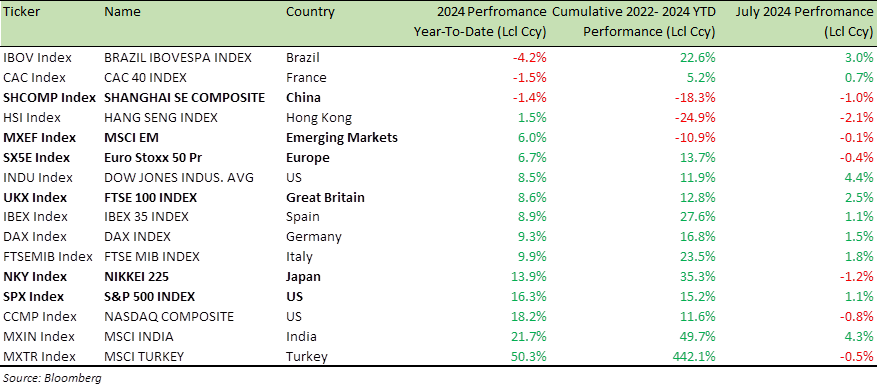
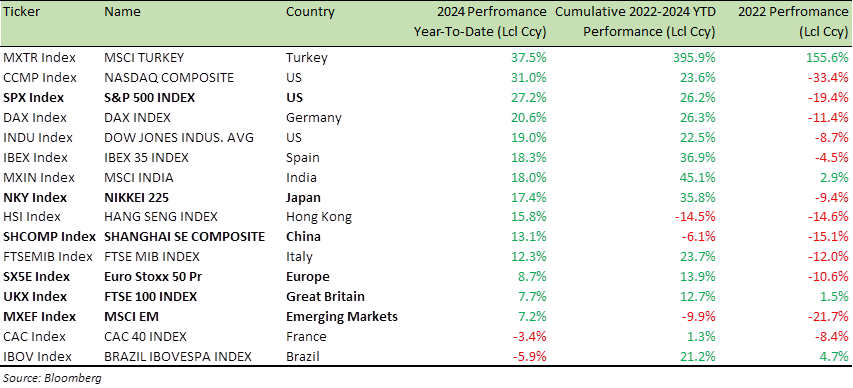
Despite the market volatility in July, the SPX index is still up +16% year-to-date (as shown in the table below), which matches its gain over the past 30 months from December 2022 to the present.

This is because SPX’s performance was flat during the 24 months of 2022 and 2023, but we are now seeing positive returns for this year.

Global Equity Index Performance (2024 YTD, Cumulative 2022-2024 YTD and July 2024)

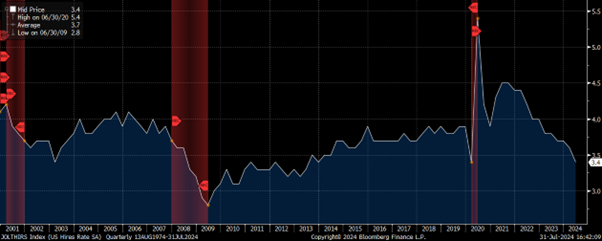
The June US JOLTS (Job Openings and Labor Turnover Survey) report was released on Monday. The Hires rate is beginning to signal potential recessionary trends (chart below with periods of US recession highlighted in red), a scenario the Fed is likely to take all measures to prevent.

  • There are currently 1.2 available jobs for each unemployed worker, down from a peak of 2 jobs per unemployed person about 18 months ago
  • The job openings rate remained steady at 4.9% in June, with 8.184 million positions available, slightly down from 8.23 million in May. At its peak in Dec. 2020, the job openings numbered 12.2 million
  • The hiring rate decreased to 3.4% from 3.6% last month, with 5.341 million new hires. The quits rate has reached a cycle low, suggesting that wage growth may continue to slow in the coming quarters

The ADP Jobs report released this week further confirms the slowdown in the US labour market, showing an addition of just 122,000 jobs—well below the 150,000 expected and down from the 155,000 added in June.

This softening labour market has diminished employees’ bargaining power, leading to smaller wage increases. The 12-month pay growth for individuals remaining in the same job dropped to a three-year low of +4.8% in July. Nela Richardson, ADP’s chief economist, commented, “with wage growth slowing, the labour market is aligning with the Federal Reserve’s efforts to curb inflation.”

This is music to the Fed ears, as the FOMC prepares to embark on a series of rate cuts.

US JOLTS (Job Openings and Labor Turnover Survey) report: Hires Rate SA

Source: Bloomberg

Continuing from our discussion on big tech:

Earlier this week, Microsoft reported a notable +15% increase in overall revenue, with Azure cloud revenue rising by +29%. Despite these impressive figures, the stock saw a sell-off, which might be attributed to overenthusiasm from investors and analysts.

  • A critical detail to note is Microsoft’s capital expenditure, which reached $19 billion last quarter—up +78% year-on-year and equivalent to what the company spent in an entire year just five years ago
  • Microsoft closed the fiscal year with a record $109 billion in operating income. That’s $2 billion per week
  • The company achieved an annual operating margin of 44.6%, a level not seen in over two decades
  • On its earnings call, Microsoft projected another year of double-digit growth in both revenue and operating income for fiscal 2025

CFO Amy Hood stated, “To meet the growing demand for our AI and Cloud products, we will scale our infrastructure investments, with FY25 capital expenditures expected to exceed FY24.”

This suggests that those anticipating a slowdown in AI spending impacting Microsoft or Nvidia might be in for a surprise.

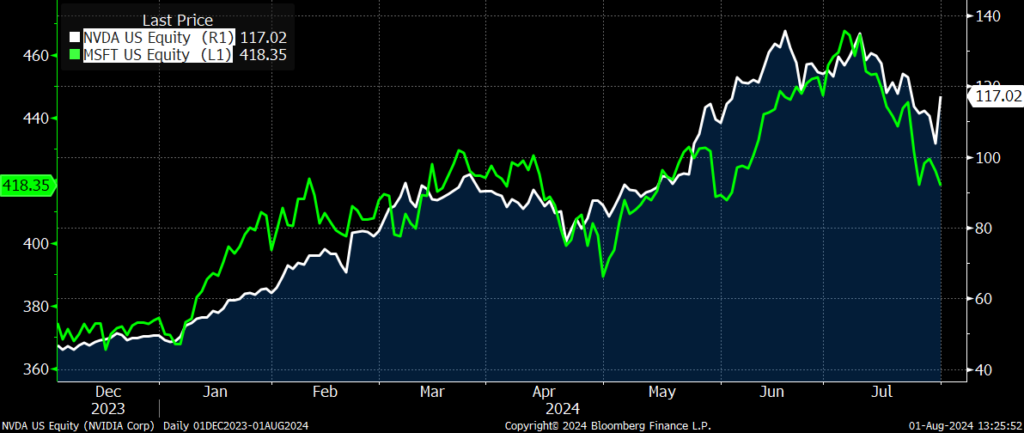
Nvidia, which sold off –25% and is now -13% from its recent high, seems to be a bargain at current levels and is likely to rebound toward its peak following Q2 results at the end of August.

6-month price chart: Nvidia (NVDA) and Microsoft (MSFT)

Source: Bloomberg

Those predicting a slowdown in AI spending may find themselves writing about missed opportunities in 2034, if they didn’t invest or hold on to MSFT, NVDA, AMD, Broadcom, Amazon etc. in 2024.

Investing isn’t about overreacting to quarterly earnings but about understanding the long-term growth potential of the markets in which the companies you invest in operate. While massive spending on AI may not benefit every firm equally much like not every child becomes a piano prodigy despite excessive sums spent on tutoring such spending still generates substantial revenue for vendors like NVDA, MSFT.

Moreover, big tech companies have the resilience to weather mistakes and continue thriving just look at Meta, Alphabet, and Netflix more recently.

Investing in large-cap companies with established revenue potential offers greater stability than chasing smaller, emerging opportunities. Microsoft and other tech giants possess the resources to outlast or acquire competitors, much like the auto manufacturers did in the 1920s.

Market volatility and drawdowns are not anomalies but rather inherent features of investing and should be anticipated, embraced and strategically addressed. Predicting short-term market movements can be extremely challenging. Hence, I highlight the value of equity structured products as a highly effective investment tool to manage and potentially capitalize on increased market volatility.

These products offer a degree of capital protection while helping to identify advantageous entry points. They also present opportunities to generate returns, even in flat or declining market conditions.

For specific stock recommendations and insights related to structured products, please don’t hesitate to reach out to me or your dedicated relationship manager.

 
Best wishes,

Manish Singh, CFA

“Increased earnings from interest and dividends are sustaining America’s economic growth; however, a slowdown is building

Summary

According to the U.S. Commerce Department, Americans earned approximately $3.7 trillion from interest and dividends in the first quarter of 2024, at a seasonally adjusted annual rate—an increase of about $770 billion from four years ago.

Most U.S. mortgages are long-term and fixed at low rates, primarily benefiting middle-to-high-income families who hold savings. This is crucial as these groups account for nearly 80% of U.S. consumption, and consumer spending makes up 68% of the US GDP. The rise in interest rates has inadvertently boosted consumption spending from “interest income,” helping to stave off a recession in the US economy.

The traditional “sell in May and go away” strategy did not hold this year—the S&P 500 surged by 4.8% in May, its best performance for the month in 15 years. Since the end of April, the S&P 500 has climbed by 5.9% and reached an all-time high. However, while the index is at a peak, it has only risen by 10% since December 2021, despite earnings per share increasing by over 20%. This indicates that the equity rally still lacks broad participation.

This performance doesn’t mean that tech stocks are mirroring the dot-com bubble of 2000. Though the price increase may seem similar, today’s earnings growth is robust and supports current valuations. Unlike during the tech bubble, we have not observed a clear disconnect between stock prices and fundamentals.

US Economy still resilient; job market cooling down

We’ve discussed high interest rates extensively in these pages over the last few months, and I will certainly have more to say on them further down and throughout the rest of the year.

First, I want to share some stunning data with you.

While high interest rates can be burdensome for borrowers, they can also be beneficial for savers.

The chart below effectively explains why those predicting a US recession have been surprised: Interest income.

People flocking to money market funds, have been earning record income, which has bolstered consumer spending.

Arguably, the primary beneficiaries of this interest income, are middle-to-high-income families with savings, which is significant, because these groups account for nearly 80% of consumption in the US and consumer spending constitutes 68% of US GDP. Thus, the inadvertent benefit of higher rates has been a boost to consumption spending from “interest income,” helping to prevent the US economy from slipping into a recession.

On the liability side, most US mortgages are long-term and fixed at low rates. Therefore, higher rates are likely to continue to help and strengthen household balance sheets until such time as we see the economy slowing down due to a rise in unemployment.

So, let’s look at the US jobs market.

The US jobs report last Friday came in higher than expectation,  albeit the unemployment rate rose to 4%

Employers added 272,000 new jobs in May, according to the US Labor Department, surpassing the 190,000 economists had predicted and outpacing April’s numbers. Additionally, average hourly earnings increased by +4.1% year-over-year, beating forecasts.

However, is there more to the US jobs report than meets the eye?

The Bloomberg headline caught my eye – US Payroll Gains Not as Robust as Reported, BLS Data Suggest. It contained some surprising details.

“Data published Wednesday by the Bureau of Labor Statistics suggest payrolls might have grown about 60,000 less per month on average last year. The new figures, from the Quarterly Census of Employment and Wages, cover more than 95% of US jobs, and are eventually used in annual revisions to the monthly data.”

A shortfall of 60,000 jobs per month equates to about 720,000 jobs for the year. The US non-farm payroll totalled 2.88 million for 2023. Therefore, according to the headline, the real number might be closer to 2.16 million, suggesting that job creation was overestimated by a significant 25%.

This implies that the US job market may be much less robust than Federal Reserve Chair Jerome Powell and his colleagues believe.

US President Joe Biden’s administration often highlights the fact that the US economy has maintained an unemployment rate below +4% for 27 consecutive months, the longest streak since 1967.

Should we really take this at face value? Expect the upcoming downward revision to US non-farm payrolls for 2023 to end that streak.

The US economy’s growth was below expectations for the first quarter of this year.  The second estimate of GDP growth revealed that the US economy expanded by +1.3% in Q1 2024, a decrease from the initial +1.6% figure. This comes after a growth rate of +3.4% in Q4 2023. A noticeable decline in the growth trend.

The slowdown in Q1, was mainly driven by a declining estimate of consumption, suggesting a flagging consumer.

During Walmart’s earnings call in May, management highlighted a strategy to attract more cost-conscious customers by lowering prices.  CEO Doug McMillon noted outright deflation in general merchandise and mentioned that overall inflation for the business, was half of what it was last year.

McMillon also announced that the company has reduced prices on 7,000 products. Walmart’s website now features a red “Rollback” button to highlight items with reduced prices.

In response, Target (TGT) announced that it is “lowering prices on approximately 5,000 of your favourite food, beverage, and household essential items.”

When was the last time you heard talk of a price war on basic grocery items?

The cumulative impact of years of inflation appears to be catching up with consumers and eroding their savings cushion—something that companies selling discretionary goods, from Starbucks to Kohl’s, are noting in their public reports.

The US Personal Saving Rate is back to around +3%, with April’s rate at +3.6%, well below the 12-month average of +5.2%.

The GDP report also revised consumer spending growth down to +2% from the initial estimate of +2.5%, while private inventory investment and federal government spending were weaker than expected. All good signs for inflation cooling down.

Fed Chair Powell often cites the ratio of job openings per unemployed worker as an indicator of tight labour markets, but it has now returned to pre-COVID 2019 levels at approximately 1.2
(chart below). This ratio was 2 to 1 when the Fed began tightening a couple of years ago.

Source: Bespoke Invest

Another critical data point to focus on is the Chicago Manufacturing PMI, which plummeted to 35.4, the lowest level since the COVID-19 lockdowns in May 2020. This completes a brutal series of drops since November’s spike to 55.6.

This is the lowest reading, not associated with a recession, on record; in other words, every other time the Chicago PMI has been this low, the US has been in or just emerging from a recession.

Will this time be different, or are we in a recession without realizing it? The Fed can avoid a recession or make it a shallow one, by cutting rates.

MNI Chicago Business Barometer seasonally adjusted (Chicago PMI Index, CHPMINDX): 1960-2024 price chart

Source: Bloomberg

Is inflation really still a problem?

The Federal Reserve’s preferred measure of inflation, the Personal Consumption Expenditure (PCE) index, is currently running at +2.7% (with overemphasis on backward looking rents data). The Fed’s target for inflation is +2%.

Shouldn’t the Fed be more concerned about the economy, given the signs of a slowdown building up?

Isn’t +5.25% restrictive? Even with a +0.25% cut, rates at+ 5% will still be restrictive.

Given the lag in the transmission of monetary policy into the economy, keeping rates at the current level until inflation reaches 2% risks overdoing restrictive policy and triggering a recession.

A recession is the last thing the US and the global economy need. It would only necessitate deeper rate cuts, something Chairman Powell and his team would prefer to avoid, given the pitfalls of excessively low rates, as seen over much of the last 15 years.

The Federal Open Market Committee (FOMC) meets this Wednesday to deliberate over the level of the Federal Funds Rate. The market is pricing in a 3% probability of a rate cut at the June 16 meeting and a 20% probability for the July 31 meeting.

That 20% probability for the July meeting is on the low side and I wouldn’t be surprised if we get first rate cut of this cycle at the July meeting.

Markets and the Economy

On Wednesday last week, the Canadian Central Bank (BoC) cut rates by +0.25% and said – while the disinflation process will be “uneven” and “risks remain,” it is “reasonable to expect further cuts,” if inflation remains contained.

In comments after the decision, Governor Tiff Macklem, emphasized that the path of cuts is “likely to be gradual,” and that the timing “depends on incoming data.” He also emphasized that the BoC “doesn’t need to move in lockstep with the Federal Reserve” and that there are “limits to the divergence with the US,” but that Canada is “not there yet.”

On Thursday last week, the European Central Bank (ECB) cut rates by +0.25%.

ECB President Christine Lagarde, explicitly refused to say that the ECB is “in a dialling back phase” and emphasized that the speed and timing of any future moves would be “determined by data.” She, however, noted that despite the cut, rates are “not close to neutral,” i.e. more cuts are down the line.

As inflation continues to fall, real rates (nominal rates minus inflation) get elevated. Higher real rates make monetary policy “restrictive” and that will force the central banks’ hands to cut rates further.

In last month’s Newsletter I wrote – Let’s hope “April showers bring May flowers” comes true and we have more green on our screens in the month of May.

As the oft repeated “sell in May, and go away” adage, failed to materialise – the S&P 500 (SPX) rallied +4.8% in May for the best May for the SPX in 15 years (and the SPX is up +5.9% since the end of April) and has hit an all-time high.

The SPX is at all time hight, but did you know that the SPX is up only +10% since Dec 2021 (see last column in the table below). In the meantime, earnings per share have increased by over +20%.

Global Equity Index Performance (2024 YTD, April 2024, May 2024 and since the peak of Dec 29, 2021)

The rally lacks broad participation.

The SPX’s year-to-date gain of +12.5% would drop to +7.9%, if NVIDIA were excluded, and it would fall to just +4.4% if the “Magnificent Seven” (Apple, Microsoft, Alphabet, Amazon, NVIDIA, Tesla, and Meta Platforms) were removed.

This isn’t to say that tech stocks are repeating the dot-com bubble of 2000, as some are suggesting. While the price increase may be similar, unlike then, earnings growth has been robust, supporting the current prices.

The chart below from Bank of America, comparing the Nasdaq 100 and SPX, in terms of earnings and performance, underlines this point.

During the tech bubble, stock prices clearly decoupled from fundamentals — a phenomenon we haven’t seen recently.

Also, despite the inflation talk, what many fail to realise is that US disposable income and employee compensation – have held up well over the last four years, when compared to the PCE measure (see chart below).

The key question is whether it will continue to sustain moving forward. While the economy has been showing signs of weakness, one thing we can be thankful for is the fact that gas prices have started to decline, and Oil has tumbled from $87 to $73 per barrel, over the last eight weeks.

US disposable income, PCE inflation, US wages – 5 year price chart

Source: Bloomberg

The US economy is healthy and the case for equities remains strong as ever. Any rate cut (if we get one this year) will only help equities.

Increasing investment income and household wealth, alongside near-full employment, have so far helped Americans cope with rising prices. Here are more remarkable stats:

  • Americans in the first quarter earned about $3.7 trillion from interest and dividends at a seasonally adjusted annual rate, according to the Commerce Department, up roughly $770 billion from four years earlier
  • In the last quarter of 2023, wealth held in stocks, real estate and other assets such as pensions reached the highest level ever observed by the Federal Reserve

It’s been a great time to be an investor, if you’ve tuned out the bearish calls, as interest rates increased.

Disposable income is being eroded, and changes are on the horizon. Nonetheless, anticipated rate cuts could support asset prices, making it premature to adopt a bearish stance. The last hike of the Fed’s tightening cycle occurred late last July, meaning that it has now been close to a year that the Fed has been on pause.

Rate cuts are expected to bolster retail and industrial stocks, as well as encourage the population to seek lower-rate mortgages for home upgrades. “Also, keep an eye on long term US Treasuries.

US Treasuries have delivered appalling returns in recent times.

Over the last year, the decline of -7.4% ranks just below the tenth percentile, relative to all other periods. If you think that’s bad, relative to history, two, five, ten, and twenty year returns, rank even worse relative to history. The fact that ten year returns for a ten-year treasury, are barely positive, is stunning when you think about it.

If we do get a rate cut on July 31, you can be certain more cuts are coming down the line. Long duration Treasury could be valuable hedge for any economic weakness that may be building up.

Source: Bespoke Invest

For specific stock recommendations and insights related to structured products, please don’t hesitate to reach out to me or your dedicated relationship manager.

 
Best wishes,

Manish Singh, CFA

“Robust US Economy Delays Rate Cuts, Potential Labor Oversupply May Reignite Discussions”

Summary

Just a few months back, US interest rate markets were bracing for six rate cuts in 2024, deemed certain by June. Yet, persistent inflation and robust job growth have altered these forecasts dramatically. Now, predictions have been pared back to a possible single cut by November, with increasing speculation that rates might not be cut at all this year. Nevertheless, I still foresee rate reductions, likely three, perhaps in July, November, and December, with the Federal Funds Target Rate potentially dipping to 4.625% or lower by year-end.

The resilience of the US economy plays a key role in this scenario. Federal Reserve Chair Jerome Powell aptly described the US as “a bigger economy, rather than a tighter one.” Furthermore, the US Congressional Budget Office projects 3.3 million immigrants entering the country this year, boosting population forecasts for 2023-2025 and subsequently driving GDP growth. This influx, though beneficial to GDP expansion, might lead to an oversupply of labour later this year, potentially easing wage and inflation pressures.

In the current bull market, Artificial Intelligence (AI) has emerged as a central theme. Remarkably, the bull market kicked off soon after the launch of Chat GPT on November 30, 2022, and AI stocks, though recently underperforming slightly compared to the broader SPX index, have not significantly dragged down the overall market rally. Therefore, despite some setbacks, the equity market’s upward trajectory appears intact.

April Showers…bring May flowers?

April showers, those gentle yet persistent rains that punctuate the transition from winter’s chill to spring’s embrace, hold a unique significance in the natural rhythm of the seasons. As the Earth awakens from its slumber, April showers serve as nature’s gentle reminder of renewal and rebirth. They nourish the soil, coaxing dormant seeds to sprout and tender buds to unfurl, breathing life into the once barren landscape.

The opening line of Karen Chapell’s poem “April showers bring may flowers” goes like this:

April showers bring May flowers,


That is what they say.

This month, the stock market has experienced its own rendition of “April showers,” with falling stock prices (see table below) dampening any signs of positive market breadth, as interest rate cuts by the US Federal Reserve (Fed) have been pushed back. Throughout last week, breadth indicators have consistently weakened, with numerous stocks currently trading at least 10% below their 52-week highs. Just four months ago, in late December, the interest rate markets were confidently pricing in six rate cuts for 2024, with a 100% probability that the Fed would begin the cuts by the conclusion of its June 2024 meeting. Similarly, there was nearly 100% certainty that the European Central Bank (ECB) would follow suit.

However, since then, inflation and hiring have proven to be firmer than expected this year, weakening the case for pre-emptive rate reductions. US inflation has remained stuck in the +3% to +3.5% range, with indications of at least a temporary acceleration. This unexpected development has prompted a significant shift in expectations, causing equities to decline this month.

At present, the market is only factoring in one Fed rate cut by November. Additionally, as the window prior to the US election rapidly approaches and Fed officials maintain a hawkish stance in their commentary, the likelihood of “No rate cut” this year, is becoming increasingly priced in.

10 Year price chart: Federal Funds Target Rate – upper bound (FDTR index)

Source: Bloomberg

I believe the market is overreacting by shifting from expecting six rate cuts to none.

In my view, we are likely to witness rate cuts this year, albeit not as many as six. I anticipate at least three rate cuts, possibly in July, November, and December, with the Federal Funds Target Rate (FDTR) potentially reaching 4.625% or lower, by the end of 2024 (as indicated in the chart above).

Furthermore, I expect that by mid-2025, we could see the FDTR fall to +3.625% before the Fed deems it necessary to pause rate cuts once again.

One significant factor contributing to the absence of a rate hike thus far, is the robustness of the US economy.

Fed Chair Jerome Powell’s assessment that the US is “a bigger economy, rather than a tighter one,” hits the nail on the head in terms what’s happening in the US.

The US Congressional Budget Office’s (CBO) updated US population projections point to 3.3 million immigrants this year.

In doing so the CBO boosted US population estimates significantly, by +0.6% for 2023 (from +0.5% to +1.1%) and +0.7% for 2024 (+0.5% to +1.2%), and by +0.5% for 2025 (+0.4% to +0.9%).

These revised projections have led to substantial increases in population estimates. This has clearly boosted GDP and while supplies have increased (and continue to improve) over the last few quarters, understandably, inflation is taking time to get to the Fed’s target of +2%.

According to CBO estimates, the initial increase in population may temporarily suppress average real wages, but this effect is anticipated to diminish after 2027.

The US labour force

Source: Congressional Budget office (CBO)

Chairman Powell and the Federal Open Market Committee(FOMC) Committee, share the view that US labour demand and supply are currently well-balanced. With the anticipated surge in immigration, the labour market may face an “oversupply” situation this year putting downward pressure on wages and inflation.

Additionally, the outcome of the US presidential election could influence immigration policies. If Donald Trump secures re-election and implements stricter immigration measures, the current tailwind of demand may transform into a headwind, potentially leading to reduced economic activity and downward pressure on inflation.

Those expecting no rate cut this year may be acting in haste.

As equities have slid, as of Tuesday, fewer than a third of stocks in the S&P 500 (SPX) were trading above their 50-day moving averages (DMAs).

Interestingly, amidst this trend, every stock in the Energy sector maintained its position above its 50-DMA, indicating a sector-specific resilience amid broader market fluctuations.

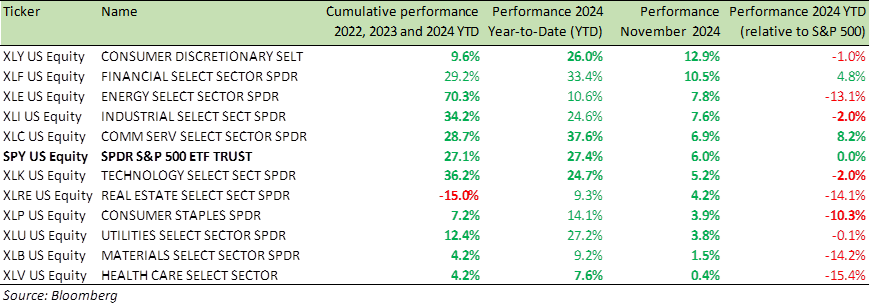
  • The Real Estate sector (XLRE) has endured the most challenging performance since the beginning of 2022, when the equity markets corrected, with the SPX down -25% by October of that year. While equities have recovered since then, the returns are not impressive at all (table below)
  • The Tech sector (XLK), often the focus of numerous positive reports, ranks as the second-best performing sector over the past 28 months. Despite its acclaim, its annualized return falls just below +5%, trailing behind the Energy sector’s impressive +26% per annum
  • And over the past 28 months, The SPX is up +6.1%, for a paltry annualised return of +2.5%

Is the SPX really overbought?

I don’t think so.

Benchmark US equity sector performance (2022 and 2023; 2024 YTD and 2024 YTD relative to S&P 500 Index)

While the SPX at the index level is less than -5% from its 52-week highs, the average stock in the index is now more that -12% below its 52-week high.

Consumer Staples, Health Care, Communication Services, and Consumer Discretionary stocks are trading the farthest below 52-week highs.

The Morgan Stanley’s proprietary Global Risk Demand Index (GRDI) Index has moved rapidly from “greed” to “fear.” The market sell-off seems overdone.

The next two line of Chapell’s poem “April showers bring may flowers” is as follows

But if all the showers turned to flowers,

We’d have quite a colourful day!

Let’s hope “April showers bring May flowers” come true and we have more green on our screens in the month of May!

Markets and the Economy

On Tuesday, a BBC news headline flashed “FTSE 100 stock index closes at new all-time high.

Financial Times (FT) headline read – “London stocks play catch-up with global peers as expectations for UK rate cuts build.” as the FTSE 100 (UKX) index closed on Monday at 8,023.87 points to mark the new record, surpassing its previous high of 8,012.53 in February 2023.

What both BBC News and the FT failed to convey to their readers is this: When accounting for currency differences, on a total return basis, the FTSE 100 in USD terms has only seen a modest increase of +30% over the past decade, with an annualized return of +2.7%. In stark contrast, the SPX has soared by +225%, boasting an annualized return of +12.5%, outperforming the UKX by a factor of five.

Before anyone rushes to attribute this divergence to Brexit, it’s important to note that it began well before Brexit, as early as 2014 (as illustrated in the chart below). Prior to 2014, UK and US equities exhibited a high degree of correlation. From 2004 to 2014, the SPX and UKX in USD terms both saw nearly identical total returns of +102% and +99%, respectively.

The UK seems to lack innovative companies and the UKX has turned into a backwater compared to the hallowed SPX index.

Great Britain, once a key player in shaping the modern world and laying the groundwork for the American legacy, now finds itself striving to even play a catch up.

A nation cannot tax and regulate its way to prosperity. With highest tax and regulatory burden in decades, you’d be forgiven for thinking that the Labour Party has been at the helm of the UK for the past decade and a half.

20 Year total return chart: FTSE 100 index (in USD) and S&P 500 index

Source: Bloomberg

Last week began with positive economic news as March’s US Retail Sales report exceeded expectations, following two months of weaker-than-expected reports. February’s report was also revised higher.

However, this was offset by Tuesday’s Housing Starts, which fell short of expectations, possibly due to seasonal issues related to Easter falling in March this year.

Jobless claims and the Philly Fed report later in the week surpassed expectations, but Existing Home Sales came in weaker than expected. Overall, the week saw a relatively even split between stronger and weaker-than-expected US economic data.

This week, a pair of S&P surveys revealed a loss of momentum in the US economy during April, marking the first decline in new orders and reduced employment since the onset of the pandemic.

  • The flash US manufacturing purchasing managers index (PMI) dipped to a four-month low of 49.9 in April, down from 51.9 in March
  • Similarly, the S&P flash US services PMI declined to a five-month low of 50.9 this month, compared to 51.7 in March

These surveys serve as early indicators of monthly economic performance. Notably, new orders, which reflect future sales, declined for the first time in six months, leading to increased pessimism among businesses regarding the economic outlook. High interest rates and elevated inflation seem to be dampening customer demand again. Inflation may be easing but the prices are still rising as the inflation rate is positive. The persistence of elevated inflation and high borrowing costs is likely to put further downward pressure on the economy in the spring and summer.

A notable phenomenon in market activity over the past month, has been the simultaneous rally in both Gold and the US Dollar.

Despite the common narrative of gold rallying due to investor scepticism towards the dollar and central banks, the USD has also been on the rise. This is unusual, as these two asset classes typically exhibit an inverse correlation.

However, in the weeks leading up to April 15, the US Dollar Index saw a +2.7% increase, while gold surged by over +10%.

Such a scenario is rare, occurring only eight times since the early 1970s, with two instances in the early 1980s and three during the Financial Crisis.

The table below outlines the performance of the SPX, gold, and the Dollar Index following previous occurrences of this phenomenon.

  • The short-term performance of the SPX varied, but over the subsequent six months, it showed a median gain of +6.4%, with positive returns six out of eight times. One year later, the median gain was even more significant at +15.8%, though there were occasional declines
  • As for gold, it typically experienced declines over the following one, three, and six months, while the Dollar Index often maintained its strength

If you fear inflation is going to stay in the 3% to 4% range, then selling your equities, as rate cuts are delayed, may be a losing trade.

Source: Bespoke Invest

One other headline that caught my attention this week – “FTC bans noncompete clauses that limit job switching, suppress wages”.

The US Federal Trade Commission (FTC) has enacted a rule banning noncompete agreements that restrict workers from joining rivals or starting similar businesses. This decision, influenced by concerns about stifling worker mobility and depressing wages, received a 3-2 approval from the FTC’s Democratic majority, led by President Joe Biden. This marks the first economywide regulatory change in over 50 years aimed at enhancing competition.

The new rule limits the enforcement of existing noncompete clauses exclusively to senior executives and prevents the creation of new noncompete agreements for them in the future. The FTC argues that such measures decrease job market fluidity, disadvantaging workers not covered by them as job opportunities diminish due to reduced turnover. This could also harm the economy by preventing businesses from recruiting essential personnel.

Despite the potential for legal challenges from business groups, the FTC’s ruling, proposed in January 2023, is set to take effect in August. The elimination of noncompete agreements is expected to boost wage growth and enhance productivity, positively impacting US economic growth.

Critics, however, worry about the shift from legislative to regulatory governance, urging Congress to address such issues through formal legislation rather than executive action. The debate extends beyond high-level executives; anecdotal evidence from social media reveals that even hourly workers have faced restrictive noncompete clauses, significantly impacting their economic freedom and wage potential. This broad application of non competes underscores the FTC’s initiative to foster a more competitive, equitable job market. There goes the “gardening leave” for job switchers and with it final hope of US inflation ever getting to +2% ever again?

I am only kidding.

Source: Federal Trade Commission (FTC)

For those outside the US, the issue of “non-compete” agreements may be unexpected. However, reading comments on social media, as highlighted below, sheds light on the concerns the FTC is attempting to address.

My younger daughter ten years ago had to sign a 50 mile/2 year non-compete clause to work at Jimmy John’s one summer. She obtained no confidential or special knowledge about how to make sandwiches through that job, but that didn’t stop Jimmy John’s from requiring her to sign the agreement to get the job.”

In some limited cases these contracts have made sense in the past, but they’ve started to permeate every industry.  My physician recently had to move when she left her current practice because they had a 30 mile non-compete agreement in place.  There aren’t any trade secrets on the line for a family physician, so a contract like that really just seems like a punitive measure intended to prevent the employee from leaving the employer.”

It seems “non-compete” has been applied to frontline workers, such as hourly employees at Wendy’s. This clearly suppresses wages as FTC has pointed out and particularly hurt employees at the bottom of the income scale. Eliminating “non-compete” will lead to higher wages and hopefully higher productivity. All good for US equities and US GDP growth

Moving on…

The Q1 earnings season for SPX companies is in full swing and while the earnings have improved on an aggregate basis, at the index level, the 4Q23 and 1Q24 are both expected to be below 3Q23 earnings. Since the start of the Q124 earnings seasons over two weeks ago, the 4Q24 earnings consensus estimates have been revised lower by -8%.

However, consensus is still pricing  +18% Earnings per share (EPS) growth for the full year 2024 (see chart below).

Source: Morgan Stanley

Every bull market has its defining theme, and the standout of this particular bull market has undeniably been Artificial Intelligence (AI). Interestingly, the bull market commenced within weeks of the launch of Chat GPT on November 30, 2022, with the Nasdaq’s closing low occurring within a month of this launch.

If the recent highs in March, truly marked the beginning of a significant downturn or bear market, we would expect the AI stocks, which were the stars of the prior bull market, to be the hardest hit. However, thus far, this hasn’t been the case. Since the closing high on 3/28, AI stocks (represented by 91 stocks, Global X Funds Global X Artificial Intelligence & Technology ETF (AIQ)) have seen an average decline of -5.5%, compared to -3.4% for the SPX index as a whole.

So, while AI stocks are underperforming, it’s hardly been by a significant margin.

As previously mentioned. The equity rally is not over by any means.

Earnings expectations remain positive, and while rate cuts have been postponed, they have not been ruled out entirely. I still anticipate three rate cuts this year, and market downturns provide an opportunity to invest in high-quality stocks.

A further increase of over +10% in the SPX from its current level, appears very feasible under the current circumstances.

For specific stock recommendations and insights related to structured products, please don’t hesitate to reach out to me or your dedicated relationship manager.

 
Best wishes,

Manish Singh, CFA