The fabled “soft landing” is still on

With the Federal Reserve signalling no further rate hikes, additional risk taking will return and equity markets will respond favourably to this shift over the next quarter.

Summary

The US Federal Reserve’s rationale for the “higher for longer” narrative, rests on the belief that the US economy has displayed a greater ability to withstand elevated borrowing costs, than previously anticipated. The significance of the Federal Funds Rate isn’t solely based on its level, but also on the duration it remains elevated. The longer interest rates stay high, the greater the potential challenges it poses for the future.

A close examination of an interest-rate sensitive sector, such as US housing construction, suggests that although there might be a delayed response between policy actions and their impact in this economic cycle, it would be unwise for the Fed to assume that the US economy can sustain higher rates for extended periods.

Over the past decade, September has consistently been the weakest phase of the late summer and early autumn consolidation period for equities. This year, September seasonality has stayed true to form, with the S&P 500 index declining by -5.17% so far this month.

However, there’s reason for optimism when it comes to seasonality. The last quarter of the year typically brings about more stable and favourable trends. Seasonal indicators make a significant shift from a predominantly bearish outlook to a strongly bullish tone. Historically, October, November, and December have consistently ranked among the most favourable months for the equity market.

The global monetary policy cycle has pivoted toward easing, led by central banks in Latin America and other Emerging Markets. Developed markets are likely to follow suit, and despite some slowing in the US consumer sector, aggregate demand remains robust. With the Federal Reserve signalling no further rate hikes, additional risk taking will return and equity markets will respond favourably to this shift over the next quarter.

The fabled “soft landing” is still on

With inflation having receded by two-thirds from its peak, a resilient job market, and the economy maintaining a solid +2% growth rate, the US economy appears tantalizingly close to achieving the fabled “soft landing” scenario – tightening monetary policy to fight inflation, without causing a recession.

This outcome has left almost everyone perplexed, especially considering that US interest rates, currently at +5.25%, stand at their highest point in 22 years.

The US Federal Reserve (Fed) is so emboldened, that it not only rejects the idea of any interest rate cuts, but also communicates that any relief from high borrowing costs, will not be swift nor substantial. “Higher for longer” is the phrase touted on newswires.

Fed Chair Jerome Powell remarked that “at some point, and I’m not specifying when,” it may become appropriate to consider rate cuts. This could occur due to “real rates rising as inflation subsides” or due to “various factors observed in the economy.” However, Powell emphasized that there is “considerable uncertainty” surrounding the timing of such a move.

The recently unveiled Fed projections, represented by the “dot plot” of individual interest rate estimates, indicate that the Federal Funds Rate is expected to peak between +5.5% and +5.75%, followed by a much slower pace of rate reductions in 2024 and 2025.

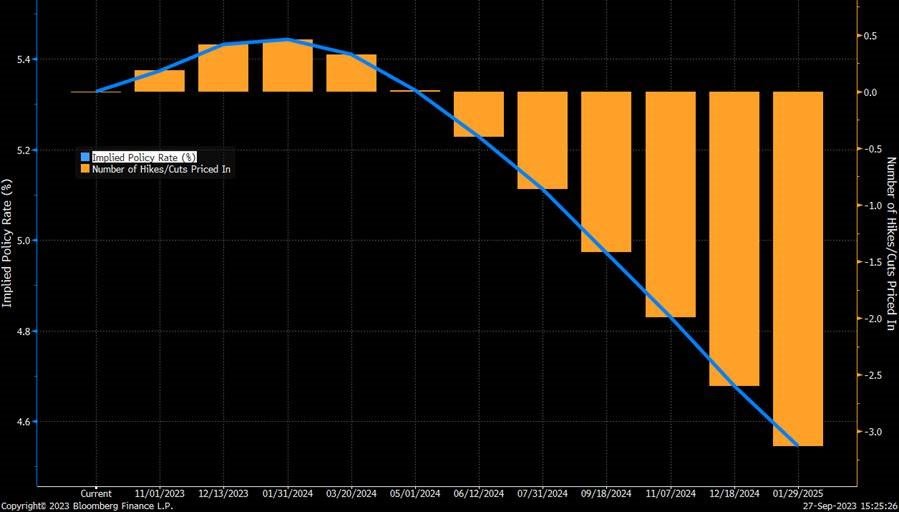
Current market expectations regarding the trajectory of the Fed Funds Rate are as follows:

  • Nov 1, 2023: Pause
  • Dec 13, 2023: Pause
  • Jan 31, 2024: Pause
  • Mar 20, 2024: Pause
  • May 1, 2024: Pause
  • Jun 12, 2024: 25 bps cut to 5.00-5.25%
  • Dec 18, 2024: rate of +4.75%

Implied Overnight Rate & Number of Hikes/Cuts in Fed Funds Rate

mvp-sept-2023-img1

Source: Bloomberg

Despite maintaining a stance of tight monetary policy, with a commitment to keeping rates higher for an extended period, the Fed projected that the US economy would continue to exhibit notable resilience, with no significant uptick in the unemployment rate.

The rationale behind the “higher for longer” approach, rests on the belief that the US economy has displayed a greater ability to withstand elevated borrowing costs than previously anticipated.

However, I am somewhat concerned that the Fed appears overly confident in its growth and unemployment rate forecast, asserting that the US economy requires and can endure prolonged periods of high interest rates.

This concern arises because, if we look back at the Summary of Economic Projections (SEP) from September 2021, the US Consumer Price Index (CPI) had already surpassed the +5% mark, and yet the Fed’s projections pointed to rate hikes of just +1% by the conclusion of 2023. We are now at +5.25% and could go 25 bps higher. That’s an astounding 4.5% between the forecast and the actual outcome

Therefore, it’s always worth bearing in mind that Fed “forecasts” and assurances are considerably less reliable than you might think, and they can change course at quite short notice.

The significance of the Fed Funds Rate, isn’t solely based on its level, but also on the duration it remains elevated. The longer interest rates stay high, the greater the potential challenges it poses for the future.

A close examination of an interest-rate sensitive sector, such as housing construction, suggests that although there might be a delayed response between policy actions and their impact in this economic cycle, it would be unwise for the Fed to assume that the US economy can sustain higher rates for extended periods.

Here are some key observations:

  • The National Association of Home Builders (NAHB)/Wells Fargo homebuilder sentiment index, depicted in the chart below, declined to 45 this month from a reading of 50 in August. This drop in builder sentiment, marks the first decline in nine months (see chart below)
  • Traditionally, when US interest rates and mortgage rates rise, it adversely affects US housing affordability, leading to reduced demand for new housing and, consequently, a decline in residential construction. However, the current situation deviates somewhat from this pattern. Homeowners who secured low-rate mortgages prior to 2022 have been hesitant to sell their homes, resulting in a reduced supply of homes available for sale in the secondary market. This phenomenon has, to some extent, supported new construction activity, giving rise to the erroneous belief that housing demand remains strong despite higher interest rates
  • Nevertheless, the tide appears to be changing. Recent data indicates that the recovery has lost momentum, and the underpinning for new construction is beginning to erode. The sentiment index, a gauge of homebuilders’ confidence, has now declined for two consecutive months, after rising for seven consecutive readings. The index has dipped below the 50-point threshold, signalling that more builders perceive conditions as unfavourable than favourable
  • Notably, 32% of builders reported reducing home prices in September, an increase from the 25% reported in August. Since the Fed initiated interest rate hikes in March 2022, mortgage rates have climbed and remained above 7% since early August, marking their highest level since 2002.

The National Association of Home Builders/Wells Fargo US homebuilder sentiment index

Source: Bloomberg

Having achieved its goal of bringing inflation down, will the Fed tempt its fate and cause a recession?

It wouldn’t be wise to dismiss this possibility.

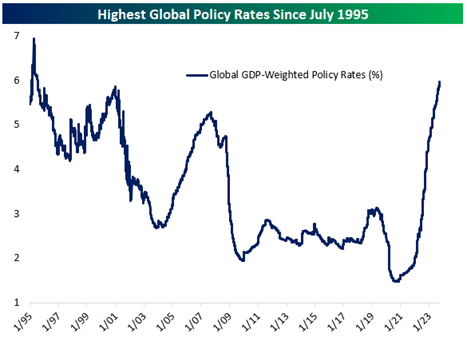
Monetary policy is highly restrictive globally.

Displayed below is a chart illustrating GDP-weighted global monetary policy rates, which encompasses 38 central banks spanning across frontier, emerging, and developed markets. Following a significant rate hike by the Turkish central bank just last week, accompanied by similar moves from Sweden and Norway, policy rates have now reached their highest collective level since July 1995.

Source: Bespoke Invest

A notable shift is beginning to take shape, and it’s a welcome development.

Just last Wednesday, Brazil took the step of reducing interest rates for the second time in two consecutive meetings, resulting in a cumulative reduction of 100 basis points. This move is in line with actions taken by several other emerging market central banks, including Chile, Peru, and Poland.

It’s worth highlighting that among the central banks that opted for rate hikes, Turkey stood as the lone exception, by not signalling an impending peak rate in the near future. In contrast, countries like the United Kingdom and Switzerland refrained from raising rates, despite market expectations to the contrary. These instances of signalling terminal rates and resisting rate hikes against market expectations collectively indicate a global shift towards easing in the overall monetary policy cycle.

Finally, there’s growing recognition within the Bank of England (BoE) that the current challenge lies in addressing cost-push/supply side inflation rather than inflation driven by consumer spending. Consumers are not the primary drivers of these inflationary pressures. Consequently, raising borrowing costs and constraining consumer spending is unlikely to be an effective strategy for combating inflation. It might just tip the economy into a recession.

Let’s hope US Federal Reserve gets that message too. Thus far, the full weight of interest rates has not been experienced by the economy as households and corporations are sitting pretty on cheap mortgages rates and borrowing costs respectively struck prior to the hiking cycles. This extension of debt maturities has deferred the impact of interest rates on the real economy. Nevertheless, over the next 12 months, we can anticipate a broadening of the refinancing cycle, which means that interest rates will begin to exert their effects more prominently and central banks will have to step in and ease interest rates or risk a recession.

Markets and the Economy

In last month’s Market Viewpoints, I wrote: “August proved to be a month of consolidation for US equities. As September approaches, further consolidation might be in the offing, due to historical seasonal patterns. Over the past decade, September has consistently been the weakest phase of the late summer and early fall consolidation period.”

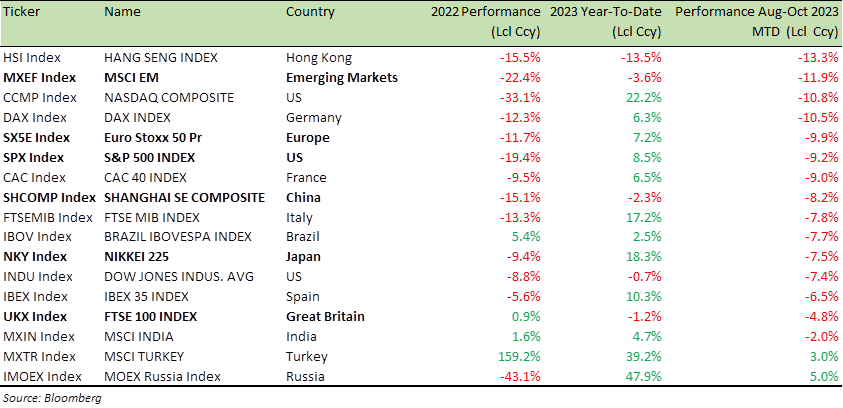
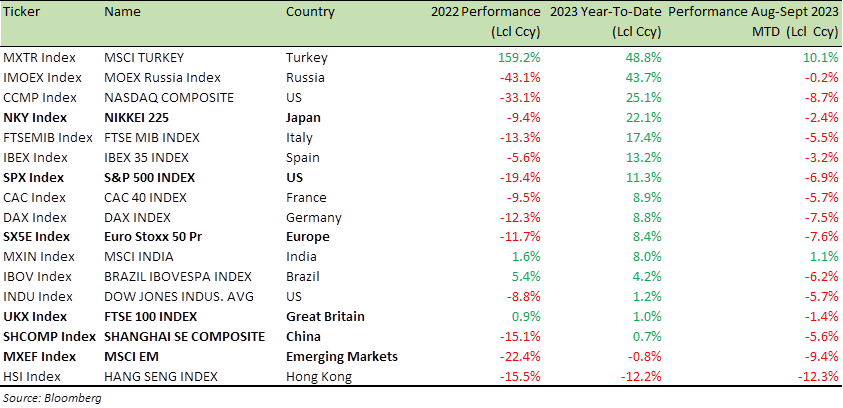
The August-September seasonality has held true to form, as is evident in the table below.

Historically, September has proven to be the most challenging month of the year for equities. So far this September, the S&P 500 (SPX) is down just over -5% (and -6.85% over August-September)

However, it’s not nearly as bad as last year where the SPX was down -4.24% in August, and -9% in September for a cumulative Aug-Sept decline of over -13%.

Benchmark Global Equity Index Performance (2022; 2023 YTD and 2023 Aug-Sept MTD)

So, does it get better from here?

According to historical patterns, the answer is a resounding yes.

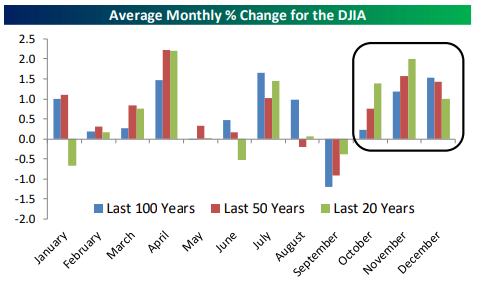
The final three months of the year typically exhibit smoother and more positive trends. Seasonal indicators shift from strongly bearish to strongly bullish, as illustrated in the chart below. October, November, and December have traditionally been among the most favourable months for the equity market.

However, a word of caution is warranted – October has witnessed some of history’s most spectacular market crashes. Events such as the Bank Panic of 1907, the Stock Market Crash of 1929, and Black Monday in 1987 all unfolded in this month. Seven of the Dow’s ten worst days occurred in October.

Nonetheless, it’s worth noting that, despite the fear often associated with October in news reports, September has historically seen more downturns than October. Furthermore, as the data below illustrates, October has, on average, delivered positive price gains over the past 20, 50, and 100 years.

Source: Bespoke Invest

Furthermore, we find ourselves in the third year of the presidential cycle, a point I previously emphasized in February’s Market Viewpoints

The third year of a Presidential cycle tends to be the most bullish for US equity markets, with a median return of +17% and with positive returns an incredible 95% of the time. Intuitively, this makes sense, as US Presidents begin eyeing re-election, in the third year of their first term, and promote growth and market-friendly policies to boost their chances of re-election.

Whatever the reason, going back to 1932, when Democrat Franklin D. Roosevelt defeated Republican Herbert Hoover in the race for the White House, the stock market’s performance in the third year of the Presidential cycle has been impressive. This is a statistic that mustn’t be ignored.

Now, shifting our focus to Europe:

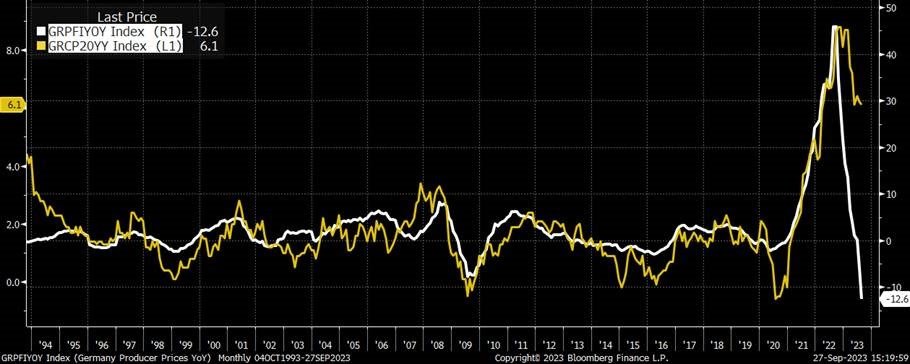
In Germany, the Producer Price Index (PPI) has plunged, by -12.6% (as depicted in the chart below), marking the most significant decline since this statistic’s inception in 1949. This sharp decline signifies a rapid dissipation of inflationary pressures in the largest European economy.

Following the recent rate hike by the European Central Bank (ECB), the market currently assigns a probability of less than 20% of another rate increase in the Eurozone during this cycle.

Germany’s energy-intensive industries are experiencing severe impact, akin to what was witnessed during COVID lockdowns, exacerbated by elevated energy prices compared to the pre-war in Ukraine era. This piece in the Financial Times ‘Everything is tired here’: gloom spreads through German manufacturing is very telling

Per the reports, corporate insolvencies in Germany are on a notable rise:

  • In the first half of 2023, German district courts reported 8,571 corporate insolvencies, representing a substantial increase of +20.5% compared to the same period in 2022
  • In June 2023 alone, 1,548 companies filed for bankruptcy, marking a substantial year-on-year increase of +36%

It’s hardly surprising that German Finance Minister Christian Lindner, has strongly criticised politicians in Brussels for pushing for stricter clean energy regulations for buildings. Lindner has cautioned that such measures could lead to a dangerous backlash among voters and contribute to the rise of far-right political movements.

Lindner acknowledged that the controversy surrounding Germany’s heating law, had served as a valuable lesson that informed his stance on the EU’s building directive. He stated that these mandates unquestionably played a role in the ascent of the far-right Alternative for Germany (AfD) party, which is currently polling at 22%, making it the second-most popular party in the country.

German Producer Price Index (PPI) and Consumer Price Index (CPI) YoY

Source: Bloomberg

There’s growing pushback on the “Net Zero” (the balance between the amount of greenhouse gas (GHG) that’s produced and the amount that’s removed from the atmosphere) targets as they get more scrutiny.

In the UK, PM Rishi Sunak ignited a backlash and a Conservative civil war on the environment, as he announced a series of U-turns on critical policies to meet “Net-zero” targets. Sunak is not the only European leader watering down his net zero ambitions, in the face of a cost-of-living crisis, caused by high inflation and the war in Ukraine.

There’s a rethink across the European Union (EU) nations too. A number of EU member states are pushing for new emission rules to be eased, before the bloc’s ban on the sale of petrol and diesel cars enters into force. France, Italy and the Czech Republic, are among a group of EU nations calling for the new emissions limits to be weakened.

It’s encouraging to see some common sense and pragmatism return to policy discussions with the focus back on – health of the economy and the population.

Shifting our focus back to the US:

In the United States, a season of strikes is underway, with writers, actors, and auto workers among those involved. Threats of strikes have already led to significant contracts for airline pilots and package workers. Strikes pose a potential negative impact on consumer spending, especially in the auto industry. Additionally, student loan repayments are poised to divert nearly $10 billion per month from consumer incomes. Furthermore, the possibility of a US government shutdown looms.

However, as mentioned in the previous section, it’s essential to maintain a long-term perspective rather than reacting to short-term volatility.

While the S&P 500 index has risen by +11% year-to-date (YTD), a closer examination reveals that several sectors have not yet reached their 2021 highs.

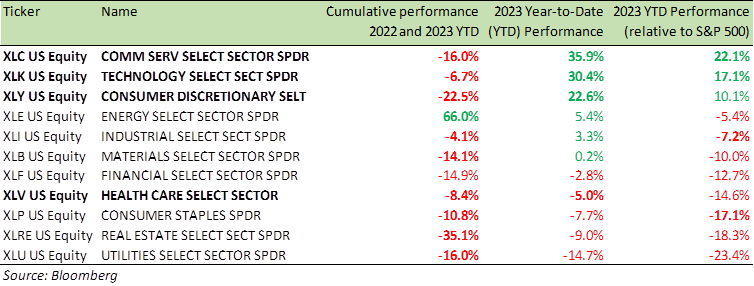
The first column of the table below illustrates cumulative returns for 2022-2023 YTD.

Apart from the energy sector, no other sector has experienced a complete recovery, despite the impressive YTD rallies witnessed this year.

The Consumer Discretionary, Communications, and Technology sectors may appear strong on a 2023 YTD basis, but the picture changes when you consider the returns from 2022 as well.

Benchmark US equity sector performance (2022 and 2023 YTD; 2023 YTD and 2023 YTD relative to S&P 500 Index)

At the end of July, the new bull market was in full swing, with the S&P 500 showing remarkable strength, up exactly +20% year-to-date and a staggering +28.3% from its bear market low on October 12th, 2022.

However, a subsequent drawdown of -6.85% since its peak on July 31st has left the S&P 500 still showing a solid +22% gain from its October 2022 low and a respectable +11% increase year-to-date.

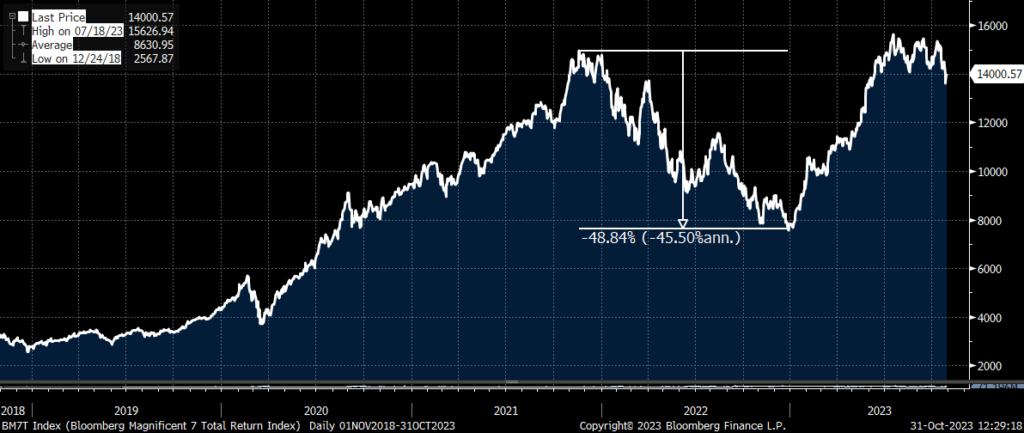
While these performance figures accurately reflect the performance of large-cap index ETFs, a closer examination reveals a more nuanced picture. Without the exceptional performance of a handful of mega-cap stocks that have surged by over +30% this year and even more since their 2022 lows, the rally would appear considerably weaker.

The key takeaway here is that equities, when viewed in a broader context, are not overvalued. The apparent stall in the recovery can be attributed to the significant increase in interest rates.

Over the past three months, an impressive 70% of earnings reports have exceeded estimates, ranking in the 93rd percentile of all 90-day periods since 2001. This is a significant improvement from the 61% rate observed last January, highlighting the momentum this year.

Additionally, the rate at which guidance is being raised has started to rise indicating that US companies are in sound financial shape. It’s also worth noting that official data on interest costs shows that the effective rate on corporate debt is the lowest it’s been since 1956, as per the Q2 Z1 Flow of Funds report of the US Federal Reserve Board.

The global monetary policy cycle has pivoted toward easing, led by central banks in Latin America and other emerging markets. Developed markets are likely to follow suit, and despite some slowing in the US consumer sector, aggregate demand remains robust. With the Federal Reserve signalling no further rate hikes, additional risk taking will return and markets will respond favourably to this shift over the next quarter.

 
Best wishes,

Manish Singh, CFA


“China’s economy is not as dire as media headlines might suggest. Chinese equities are setting up to be a good buy. Patience will be rewarded”

Summary

China’s GDP is set to grow by +5.2% for the whole of 2023, as per International Monetary Fund (IMF) estimates. Is that growth rate bad for a $19 trillion economy? It translates to an addition of $1 trillion in growth annually. A growth rate exceeding +5% in GDP, is certainly commendable, especially when compared to the US at +2%, the UK & France at sub +1%, and Germany currently in a recession.

China’s economy is not as dire as media headlines might suggest. China, however, has structural challenges – including debt concerns, diminishing productivity, a contracting workforce, elevated youth unemployment, a technological trade dispute with the US, and an ongoing rectification of the real estate bubble. China is actively addressing the slowdown and is steering its economy towards a trajectory of growth driven by consumption, as opposed to the property investment and export-led growth patterns observed thus far. Chinese economy is not ailing but evolving. Chinese equities are setting up to be a good buy. Patience will be rewarded.

The US labour market is approaching a state of “normalization,” and an unemployment rate adjustment appears imminent. Inflation within the services sector, has demonstrated stubborn resilience. As labour constitutes a significant component of services inflation, a cooling job market is poised to contribute to a further decline in services inflation. The prospect of additional interest rate hikes has been a prevailing concern for markets, and especially for technology stocks. However, as the job market normalises and services inflation recedes, the urgency for rate hikes is likely to diminish rapidly. This shift in dynamics could provide a boost to US equities, propelling them to higher levels by the end of the year.

China: “ailing” or “evolving”?

Once again, a renewed consensus has surfaced within the same cohort of economists, journalists, analysts, and experts who appear to emerge collectively to advocate their rendition of the “China is facing difficulties” narrative.

The Economist is out with a cover “Xi’s failing model” and accompanying article – Why China’s economy won’t be fixed. If you search on Google using the phrase “The Economist cover on China,” you will encounter a series of their commentaries spanning over two decades.

Their cover story – “The Great fall of China” from August 2015, is one of my favourites. Interestingly, since then, China’s GDP has surged by +72%, growing from $11 trillion to $19 trillion. The “great fall” saw China’s GDP fall upward! I am sure China (and the world) could do well with more such “great falls.”

China’s economy has structural challenges – including debt concerns, diminishing productivity, a contracting workforce, elevated youth unemployment (presently exceeding +20%), a technological trade dispute with the US, and an ongoing rectification of the real estate bubble. Nevertheless, these are predicaments that China acknowledges and is actively addressing. Some of these challenges are not exclusive to China, but also afflict the Western world.

These challenges mean that China’s growth will not return to the +10% p.a. growth that sustained from 1980 to 2010.

However, that doesn’t mean that its all doom and gloom. In fact, far from it.

1. China’s GDP growth in the second quarter of 2023, picked up to +6.3% and is set to grow by +5.2% for the whole year, as per International Monetary Fund (IMF) estimates. Is +5.2% growth rate bad for a $19 trillion economy? It translates to an addition of $1 trillion in growth annually.

2. China’s imports have exhibited a decline of -7.6% during the initial seven months of 2023, potentially indicating subdued domestic demand. Yet, this reduction in nominal import growth can be entirely attributed to price-related factors. On the contrary, when assessed in terms of volume, imports expanded by +1.0% compared to a -6.4% contraction during the same period the previous year. Therefore, imports in the first half of 2023 suggest a strengthening domestic demand.

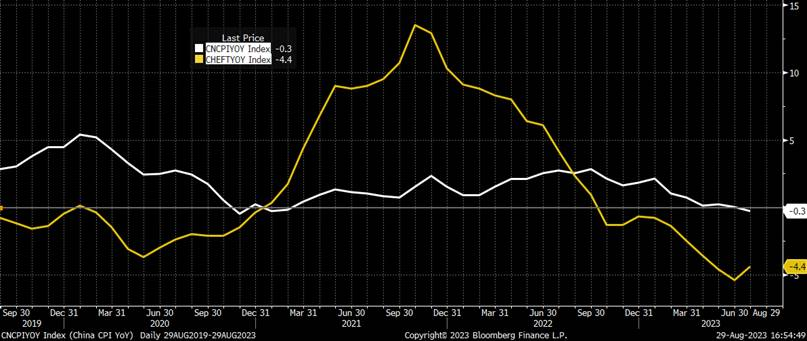
3. Regarding the “price effects” mentioned in the preceding point, it’s worth recalling that in the last month’s Market Viewpoints, I highlighted the looming spectre of disinflation faced by China (and much of the global economy). Subsequent to that, another reading of China’s consumer price index (CPI) has emerged, revealing a state of deflation with a decline of -0.3% from the previous year in July (see chart below). China’s producer price index (PPI) which measures the costs associated with producing consumer goods, has been negative since last September, and continues to be so. This situation hints at a more profound underlying dynamic, leading me to harbour a stronger conviction than before, that the Western world is inching closer to experiencing disinflation, and this might occur sooner rather than later.

4. Chinese households are increasing spending, not slashing, as some headlines suggest. For the first half of 2023, per capita consumption expanded by +8.4%, exceeding the +6.5% growth of per capita disposable income.

5. The growth of average per capita wages in the first half of 2023 was +6.8%. And, considering other sources of income, such as interest and other property income, per capita after-tax income was almost three-quarters larger than wage income and rose +6.5%, exceeding the growth of nominal GDP. Thus, the share of output accruing to households is now rising, not falling. As Nicholas Lardy of the Peterson Institute for International Economics (PIIE) reminds us, the combination of rising personal incomes and a falling savings rate, means that future household consumption growth will likely surprise to the upside.

China Consumer Price Index (CPI) and China Producer Price Index (PPI): Year-on-Year growth

Source: Bloomberg

The Chinese government’s abrupt and badly managed crackdown on privately-owned internet platform companies, which commenced in late 2020, inflicted severe damage to their profits, investments, and workforce expansion. The government has learned its lessons.

In July 2023, China’s regulatory authorities provided a green light, affirming that the financial concerns pertaining to internet companies have been effectively addressed. In response, major firms such as Alibaba, ByteDance, Meituan, and others have embarked on a hiring spree, reversing the tide of layoffs that had affected private tech enterprises in 2022. Looking ahead, these companies’ profitability under the framework of the new “normalized supervision” model is projected to be somewhat less robust than the period preceding 2020. However, their stocks remain undervalued and oversold, suggesting substantial potential for growth. That growth is likely to catalyse a resurgence in overall private investment growth within China.

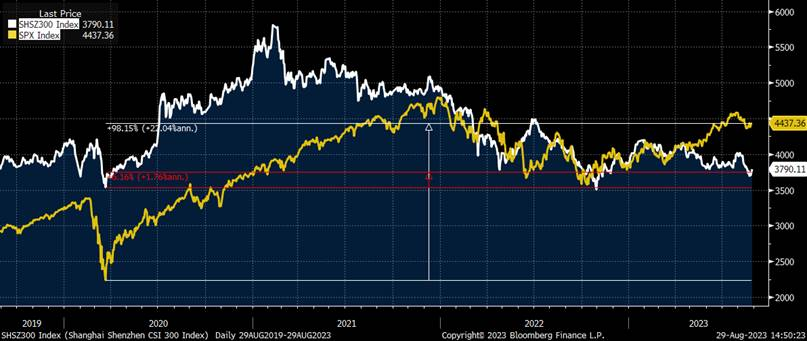
Based on the latest data from the International Monetary Fund (IMF), the United States boasts a GDP of $26.9 trillion, whereas China’s GDP stands at $19.4 trillion. Over the past half-decade, China’s GDP has exhibited a steady annual growth of +6.1%, in contrast to the United States, which has recorded a more modest +2.1% annual growth. As per IMF projections, China’s economy is anticipated to expand by +5.2% in the current year, while the US economy is predicted to achieve a growth rate of +1.6%.

Yet, if you look at how US equities and Chinese equities have performed (see chart below), you’d think China is in the throes of an economic downturn, as the S&P500 Index has outperformed the Shenzhen CSI 300 Index by a substantial margin of almost 90%, since the nadir of the COVID-19 pandemic in mid-2020.

In terms of index metrics, the S&P500 commands price-to-earnings (P/E) and price-to-book value (P/B) ratios of 20x and 4.2x, respectively. On the other hand, the Shenzhen CSI 300 is characterized by a P/E ratio of 12x and a P/B ratio of 1.6x.

Meanwhile, Beijing’s persistent efforts to rejuvenate investor confidence suggest that the decline in Chinese equities has reached a threshold that policymakers can no longer disregard. China has recently implemented a series of measures and has committed to further actions to reinvigorate economic recovery and enhance the business environment, responding to mounting concerns about growth.

S&P500 Index v Shanghai Shenzhen CSI 300 Index: 4-year price chart

Source: Bloomberg

A barrage of statements from the government and the Chinese Communist Party (CCP) since July has predominantly centred on boosting the stock market, promoting increased expenditure on consumer goods and automobiles, and encouraging private enterprises to expand their investments. With two interest rate cuts already witnessed this year, the prospect of more cuts looms on the horizon.

This suggests to me that China is actively addressing the slowdown and is steering its economy towards a trajectory of growth driven by consumption, as opposed to the property investment and export-led growth patterns observed thus far.

Beijing isn’t going to unleash a broad economy wide fiscal stimulus that many on Wall Street have come to expect of China. Unlike the West, China refrained from expanding its balance sheet extensively, to counter the demand decline caused by the COVID-19 pandemic.There were no direct cash disbursements to consumers then, and it’s likely that such measures won’t be introduced now either. Heavily indebted local governments in China will likely need to compete for favourable treatment from Beijing.

Stimulus, market reforms, and rate cuts will continue to get implemented incrementally. There won’t be any “bazooka” if that’s what some are waiting for.

China’s economy is not as dire as media headlines might suggest. A growth rate exceeding +5% in GDP is certainly commendable, especially when compared to the US at +2%, the UK & France, at sub +1%, and Germany currently in a recession.

Though real estate challenges will persist as struggling entities encounter difficulties, corporations that engaged in quick gains through property market speculation, will not be the beneficiaries of bailouts. Also, the era in China where rising property values were utilized for wealth accumulation and homes were treated as cash-dispensing “Automatic Teller Machines” (ATMs) has ended. President Xi Jinping’s distinctive motto, “houses are for living, not for speculation,” underscores this transition.

Those looking for China’s “Lehman moment” will be sorely disappointed too for a simple reason – the majority of Chinese banks are entirely state-owned. If banks get into trouble, they’ll get bailed out to prevent a Lehman-like outcome. The People’s Bank of China (PBoC) wants to cut interest rates further, but they are also mindful of hurting the profitability of Chinese banks.

On careful analysis of all available evidence, I would opine that the Chinese economy is not ailing, but evolving. The economic recovery from the impact of Covid-19 has begun, but the recovery remains fragile. Chinese equities are setting up to be a good buy. Patience will be rewarded.

Markets and the Economy

Former US President Harry Truman famously yearned for a straightforward economist who didn’t offer contradictory perspectives: “Give me a one-handed economist. All my economists say ‘“on the one hand…,” then, “but on the other…’”

Had Truman been alive today and heard US Federal Reserve (Fed) Chair Jerome Powell’s speech at the Kansas City Fed’s annual symposium in Jackson Hole, Wyoming last seek, he would likely not have been amused.

Powell’s speech embodied the quintessential “on-the-one-hand, on-the-other-hand” manner of discourse. He conveyed that the Fed’s rate hikes “are now working together to bring down inflation,” while simultaneously emphasizing that “the process still has a long way to go.”

To investors seeking clarity on the timing of potential rate cuts (or indeed, if there are more rate hikes), this speech might seem to be as clear as mud.

Despite what Powell is saying, the Fed is unlikely to raise interest rates further.

The Fed seems to be engaged in a strategy of “expectations management” to prevent prices from once again spiralling out of control. The Consumer Price Index (CPI) has declined from +9% to +3%. By leaving open the possibility of raising rates for longer, without actually raising them, Powell aims to moderate the expectation that the Fed will not hastily slash rates upon a pivot. This tactic is designed to signal both to the market and to consumers that the elevated rate environment might endure.

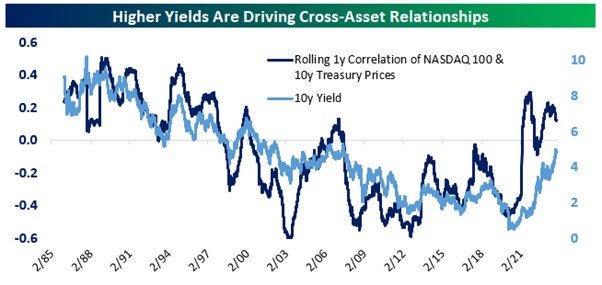
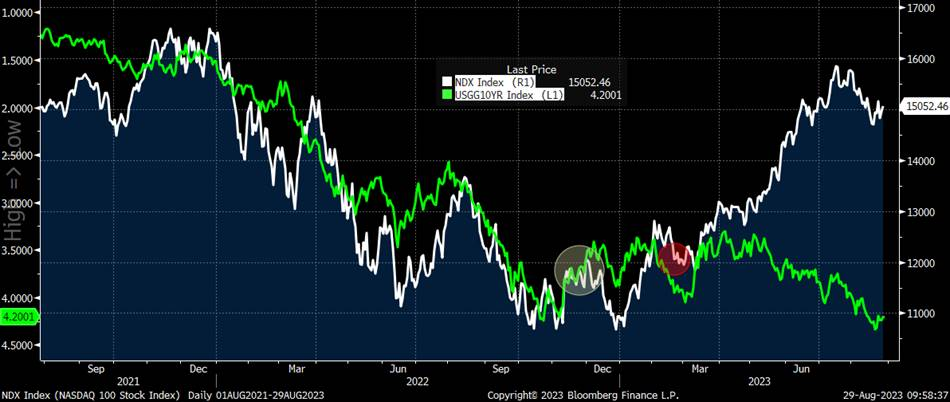
Throughout the bear market for stocks in 2022, the high-growth National Association of Securities Dealers Automatic Quotation System (NASDAQ) 100 Index exhibited an almost perfect inverse correlation with the yield on the 10-Year US Treasury.

As Treasury yields experienced an upswing, the Nasdaq declined, and conversely, when yields showed signs of levelling off, the Nasdaq saw a rebound. However, during the fourth quarter of the preceding year and the first quarter of the current year, the previously steadfast inverse relationship between the two began to unravel, leading to a substantial divergence over the last six months. Remarkably, the Nasdaq has demonstrated robust growth this year, even as the yield on 10-Year Treasury’s, has surged to new cycle highs.

So, what triggered the breakdown in the connection between the NASDAQ 100 and the US 10-Year yield?

A significant contributing factor appears to be the flourishing AI (Artificial Intelligence) trend.

Investors seem to have shifted their focus beyond short-term anxieties anbout elevated interest rates, embracing the potential long-term opportunities that the “AI” revolution could usher in. This shift in sentiment is particularly evident in the timing of key events.

ChatGPT, which catalysed the new AI wave, was unveiled on November 30, 2022 (indicated by the white circle in the chart below), shortly after US equities reached their bear market lows. Additionally, Nvidia’s (NVDA) Q4 2022 earnings report in late February 2023 (depicted by the red circle in the chart below) played a pivotal role in intensifying investor enthusiasm for AI-related prospects.

NASDAQ 100 vs. 10-Year Treasury Yields (inverted): last 24 months

Source: Bloomberg

Last week, NVDA reported its earnings for Q2 2023 and it was another stellar report.

Back in May, NVDA had projected Q2 revenue to hover around $11 billion, a staggering $4 billion higher than Wall Street’s predictions. However, the latest report disclosed actual Q2 revenue of $13.5 billion. This figure is twice what analysts had conservatively estimated for NVDA’s Q2 revenue, as recently as May. Notably, NVDA also indicated that its revenue for the current quarter would reach approximately $16 billion, surpassing expectations by about $3.5 billion.

Such a run obviously can’t last forever, but Nvidia gave strong indications that its ride is far from over. Chief Financial Officer, Colette Kress said on the company’s earnings call that its “demand visibility” extends into next year and that it expects to be able to increase the availability of its chips over the next several quarters.

It seems NVDA’s AI surge is just getting started.

In terms of noteworthy economic data past few days, the latest US Job Openings and Labor Turnover Survey (JOLTS) certainly made heads turn.

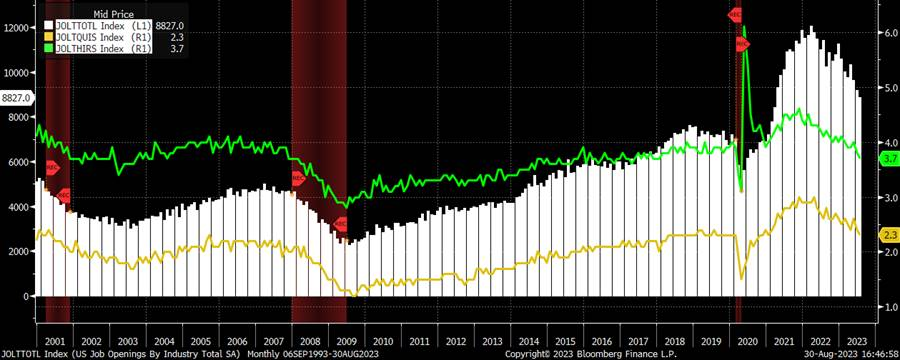
  • Data suggests US job openings are falling rapidly (JOLTTOTL, chart below). Job openings for July dipped to 8.8 million, reflecting a substantial decrease over the past few months. This drop follows a period during which job openings peaked at 12 million in March 2022 and hovered around 10 million at the close of 2022. In one of the most cyclical sectors – construction, layoffs increased by 49,000 in July compared to June 2023
  • The quits rate (JOLTQUIS) is now below pre-pandemic levels, falling to 2.3%, a touch below the peak observed in 2019. The quits rate among private sector workers fell to 2.5%, well below the most recent peak of 3.3% in April 2022. The enthusiasm for quitting jobs, which characterized the COVID era, seems to be waning. It appears that people still prioritize having jobs
  • The hires rate (JOLTHIRS) has also decreased noticeably beneath pre-pandemic levels, currently standing at 3.7%. In 2019, this rate stood closer to +4.0%. This represents another indicator of a cooling labour market

US Job Openings and Labor Turnover Survey (JOLTS) survey

mvp-aug-2023-image4

Source: Bloomberg

These indicators collectively suggest that the US labour market is approaching a state of “normalization,” and an unemployment rate adjustment appears imminent. Consequently, it’s time for the US Fed to redirect its focus from the frequently cited ratio of “job openings to unemployed workers”, which remains at 1.5. While this ratio persists, the US job market is signaling potential challenges ahead.

August proved to be a month of consolidation for US equities.

The S&P 500 index (SPX) finished in the red so did the tech heavy NASDAQ 100 index (see table below). However, on a YTD basis, both indices are up handsomely, +17% and +33% respectively.

However, as September approaches, further consolidation might be in the offing, due to historical seasonal patterns. Over the past decade, September has consistently been the weakest phase of the late summer and early fall consolidation period.

Benchmark Global Equity Index Performance (2022; 2023 YTD and MTD)

Benchmark Global Equity Index Performance (2022; 2023 YTD and MTD)

Inflation within the services sector, has demonstrated stubborn resilience. As labour constitutes a significant component of services inflation, a cooling job market is poised to contribute to a further decline in services inflation. This development is promising and offers additional relief to the Fed’s concerns about inflation.

The prospect of additional rate hikes has been a prevailing concern for markets and especially for technology stocks. However, as the job market normalises and services inflation recedes, the urgency for rate hikes will diminish rapidly. This shift in dynamics could provide a boost to US equities, propelling them to higher levels by the end of the year.

As I keep reiterating – Structured Products are a very useful means of investing in equities. They offer a degree of capital protection, while at the same time helping pick good entry points in the market, and offering means to clip coupons, in a flat to negative market.

For specific stock recommendations and ideas related to structured products, please feel free to reach out to me or your relationship manager.

 
Best wishes,

Manish Singh, CFA


Inflation,Or,Deflation,Symbol.,Turned,Cubes,And,Changed,The,Word

“With the US job creation still strong, inflation down from highs of +9.1% to +3%, and the stock market in a bull run, US consumers are more confident than they have been at any point in the last two years. US Federal Reserve has managed to squeeze in another rate hike, 11th of this cycle”

Summary

This week, the US Federal Reserve made its 11th interest rate increase since March 2022, raising the target range for the Federal Funds Rate by 25 basis points to +5.25% to +5.5%. This move brings the Federal Funds Rate to its highest level in 22 years. The questions we must ask – are these ever more restrictive rate hikes really helping, or, are they storing a problem for another day, when their impact begins to bite?

Currently, interest rate hikes haven’t had a significant impact on consumers, despite their increasing restrictiveness. However, when fixed-rate loans and mortgages come up for renewal, that will likely be the day of reckoning for the hawks at the Federal Reserve.

Recent data released by China’s National Bureau of Statistics (NBS), indicates a significant decline in China’s Producer Prices Index (PPI), which fell at the fastest pace in over seven years. Additionally, China’s Consumer Prices Index (CPI) is teetering on the edge of deflation. The impact of China’s economic situation is not confined within its borders; it has a ripple effect that percolates to the US and the rest of the world. The implications of these negative figures are clear – discussions about rate easing and the implementation of additional measures to stimulate growth will soon become the topic of the day.

US consumers are more confident than they have been at any point in the last two years. With US job creation still strong, inflation at 3% and the stock market in a bull run, you can’t fault US consumers for being more confident. Bull markets typically last much longer than bear markets and if the current bull market were to match the performance of the average bull market, the S&P 500 would need to increase another +68% from its current level, over a timeframe that extends until July 2025.

Barbie Shines Bright; Bears Surrender and Disinflation Nudges the Economy

Barbie has infiltrated every nook and cranny of our lives – from billboards to paper cups, hats, and even window decorations. The all-encompassing Barbie marketing campaign has swept through like an unstoppable force of “pink fluff,” bombarding our senses relentlessly for days on end, to the point of melting our eyeballs.

My seven-year-old, who could only endure 20 minutes of Frozen II, embraced the Barbie movie wholeheartedly, proudly proclaiming, “I saw the whole movie, daddy!” Another Barbie enthusiast for the Mattel cash register.

The movie made $155milion in its opening weekend in the US.

Inflation? What inflation. Recession? What recession.

I haven’t personally seen the Barbie movie (you couldn’t pay me enough), so I’ll withhold any comments. Nevertheless, it’s worth noting that Barbie is not exactly what she appears to be. Contrary to the image of an all-American girl next door, she is not originally American, but German. In reality, Barbie’s true name is Lilli. Her journey began in 1952, near Nuremberg in post-war Germany. Initially, Lilli was a cartoon character featured in the daily German newspaper Bild Zeitung. The paper’s editor, facing a gap in content due to a dropped story, tasked the German cartoonist Reinhold Beuthin with creating something, anything, to fill the space. That’s how Lilli came to life.

Soon after, polystyrene Lilli dolls emerged, available in 7-inch and 12-inch versions and were sold in tobacco and newspaper kiosks. However, in 1956, everything changed, when Ruth Handler, the co-founder of Mattel toy company, came across Lilli while vacationing in Germany with her children, Barbara (Barbie), and Kenneth (Ken). Impressed by the doll, she purchased several and reimagined it, eventually launching it as Barbie—a beloved toy for little girls all over the world. Notably, Rolf Hausser, the creator of the original Lilli doll and owner of the German toy company, later sued Mattel. Eventually, Mattel acquired the rights to Bild-Lilli for £21,600 and solidified Barbie’s iconic status in the toy industry.

The surge of “pink fluff” appears to have lifted spirits not only in movie theatres, but also at the International Monetary Fund (IMF). On Tuesday, the IMF revised its outlook for the world economy this year, predicting a more robust expansion. The estimate for global Gross Domestic Product (GDP) now stands at +3.0% in 2023, an improvement from the +2.8% projection made in April.

According to the IMF’s Chief economist, Pierre-Olivier Gourinchas, there is an increased likelihood of a “soft landing” in the US economy. This scenario entails reducing inflation without causing significant job losses, and the chances of achieving this outcome have risen due to a recent easing of price pressures. Currently, US inflation, as gauged by the US consumer price index (CPI), is running at an annual pace of +3%, a significant drop from the +9.1% level observed a year ago.

This Tuesday, the US Conference Board’s Consumer Confidence Index jumped to its highest level in nearly two years. The increase comes as no surprise, considering that wages are currently growing at a faster pace than prices, which has positively impacted consumer confidence.

No wonder then that even the staunchest Bears have thrown in the towel.

Earlier this week, one of Wall Street’s renowned bears, Mike Wilson of Morgan Stanley, admitted defeat. He stated, “We were wrong. 2023 has been a tale of higher valuations than we anticipated, alongside declining inflation and cost-cutting measures. We firmly believe that inflation is now decreasing at a rate even faster than what the consensus had expected.”

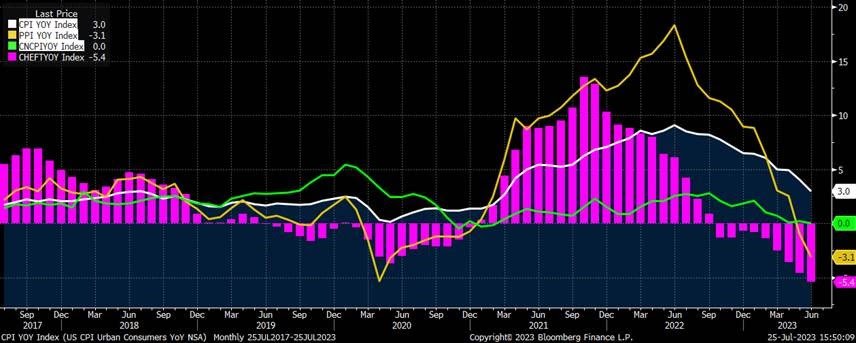
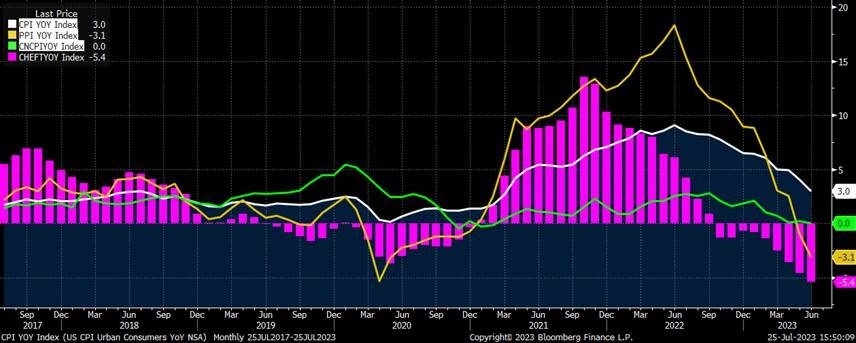
5-Year price chart: Producer Price Index (PPI) and Consumer Price Index (CPI) for US and China

Source: Bloomberg

The S&P 500 index (SPX) is up +27% since its October 2022 lows.

This impressive equity rally has surprised (and disappointed) many experts who were deterred by concerns over inflation and the fear of it surging even higher, preventing them from endorsing risk-taking. However, it appears that the Bears have finally come to accept the notion that inflation is indeed transitory.

Yet, they might be in for another surprise, as the conversation shifts towards disinflation in the very near future, particularly taking note of the developments in China.

Recent data released by China’s National Bureau of Statistics (NBS), indicates a significant decline in China’s Producer Prices Index (PPI), represented by the pink bars in the chart above, which fell at the fastest pace in over seven years, plunging -5.4% YoY (year-on-year) in June. Additionally, China’s Consumer Prices Index (CPI), indicated by the green line in the chart above, is teetering on the edge of deflation.

The impact of China’s economic situation is not confined within its borders; it has a ripple effect that percolates to the US and the rest of the world.

In any economy, there are two significant measures of inflation – the Consumer Price Index (CPI) and the Producer Price Index (PPI).

The CPI gauges the total value of goods and services purchased by consumers within a specific period, reflecting the changes in retail prices from the consumer’s perspective. On the other hand, the PPI assesses inflation from the viewpoint of producers, measuring the costs associated with producing consumer goods. Given that commodity and food prices directly impact retail pricing, the PPI is considered a reliable leading indicator of future changes in the CPI.

Regular readers of this newsletter are likely aware of my optimistic stance on US equities and my outlook for the US Consumer Price Index (CPI), which I consider to be disinflationary.

At the beginning of the year, in Skate to where the puck is going to be…not where it has been I wrote – “The US headline inflation at +6.5% doesn’t convey the full picture of where inflation is headed. Inflation is crashing. The new bull run may already be here.”

My attention was specifically drawn to the month-on-month data for the US CPI, which had started to turn, along with the anticipated reopening of China, which would alleviate concerns related to supply chain disruptions. Now, I am focused on China PPI and recent China data is deflationary.

The US Producer Price Index (PPI), represented by the yellow line in the chart above, is currently at -3.1%, pouring even more cold water on the prospects of future US inflation.

The implications of these negative PPI figures are clear – discussions about rate easing and the implementation of additional measures to stimulate growth will soon become the topic of the day.

Markets and the Economy

The US is breaking records again for crude oil production.

In April 2023, the country produced an impressive 12.6 million barrels per day (mbpd) of oil, surpassing any previous April in history, including the previous record of 12.15 mbpd set in 2019. Notably, the US has increased its oil production by approximately 1 mbpd compared to the previous year.

Despite growing calls for environmental sustainability and promises of a greener agenda, the reality is that the US continues to produce fossil fuels at an unprecedented rate. Senator Joe Manchin of West Virginia, is among those advocating for even more oil production, urging the US administration to add millions of additional barrels per day. Manchin criticized the administration for seeking new oil supplies from Iran and Venezuela during a time of global challenges, such as Russia’s invasion of Ukraine and soaring energy prices. “Our friends and our allies were hurting, and we couldn’t come to your rescue quick enough,” he said and added that the US increasing energy production now would help lower energy prices, and said he wished it could have been done last year.

The chart below perfectly exemplifies – all the gain without the pain. Inflation (green line) down from +9% to +3%, the S&P 500 (yellow line) ramped up over 1,000 points, without any noticeable uptick in US unemployment rate (white line).

1-year price chart: US unemployment rate, US inflation and S&P 500 index

Source: Bloomberg

All very bullish and sentiments positive. So, let me introduce some caution (else I wouldn’t be doing it justice)

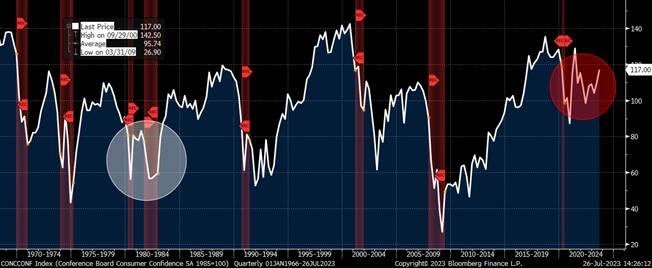
In the first section above, I referred to the US Conference Board’s Consumer Confidence Index (chart below).

The index shows that US consumers are more confident than they have been at any point in the last two years. With US job creation still strong, inflation at 3% i.e., real wage growth positive, and the stock market in a Bull run, you can’t fault US consumers for being more confident.

With all the debate over whether or not the US economy is in a recession, and if it’s not in a recession, then will it or will it not enter a recession, the pattern of Consumer Confidence in the current period looks very similar to the pattern during the double-dip recession of the early 1980s (circled in the chart below).

Like the current period, back then, there was a sharp drop and subsequent sharp rebound in confidence followed by another decline that failed to make a lower low. The only difference this time around is that following the initial COVID recession of 2020, there wasn’t another recession (shaded region) in the next two years – at least not an officially declared recession.

Price chart: US Conference Board’s Consumer Confidence Index

Source: Bloomberg

This week, US Federal Reserve (the Fed) made its 11th interest rate increase since March 2022, raising the target range for the Federal Funds Rate by 25 basis points to +5.25% to +5.5%. This move brings the Federal Funds Rate to its highest level in 22 years.

During the press conference following the rate hike announcement, Fed Chair Jerome Powell stuck to his usual cautious approach, providing limited details and occasionally repeating himself. Powell said. “We have to be ready to follow the data, and given how far we’ve come, we can afford to be a little patient, as well as resolute, as we let this unfold.”

The Fed’s response to future economic developments is straightforward – if there is a further slowdown in inflation like recent reports, interest rates are likely to remain unchanged. On the other hand, a resurgence of inflation would necessitate further rate hikes. Powell, however, argued that rate cuts “won’t be this year I don’t think,” because, “policy has not been restrictive enough, for long enough, to push growth down. He added – “We think the process still probably has a long way to go.”

Everything from here out is data dependent, and Powell cited the two US Jobs reports, two Consumer Price Index (CPI) reports due before the next Federal Open Market Committee (FOMC) meeting as the drivers of how the FOMC acts in their next policy decision in September. Powell also said the Fed’s influential staff was no longer forecasting a recession to begin this year, as they had in March, May and June, and instead was projecting a “noticeable slowdown” in growth.

The Fed is being extra cautious and doesn’t want to do or say anything that would pull forward market expectations of rate cuts.

The questions we must ask – are these ever more restrictive rate hikes really helping? Or, are they storing a problem for another day, when their impact begins to bite?

I believe it’s the latter.

This article – What Fed Hikes? Much of America’s Consumer Debt Is Still Riding Ultralow Rates in the Wall Street Journal makes a very good point.

Too many Americans were burned on Adjustable-Rate Mortgages (ARM) in 2008. They learnt their lesson and when rates dropped, they locked in ultralow fixed rates on debt such as mortgages and auto loans. While rates on certain loans, like credit cards, are rising in response to the Fed’s rate hikes, a substantial portion of consumer debt still benefits from the low rates available a few years ago. Moody’s Analytics reported that as of the first quarter, only 11% of outstanding household debt had rates tied to benchmark interest rates.

Currently, the rate hikes haven’t had a significant impact on consumers, despite their increasing restrictiveness. However, when fixed-rate loans and mortgages come up for renewal, that will likely be the day of reckoning for the Federal Reserve’s hawks.

So, as leases, mortgages, term borrowing rates etc. come for reset over the next few quarters, will that tip the US economy over?

That’s the trillion-dollar question. I have no doubt that the US Fed will respond with rate cuts and aggressive rate cuts if need be.

One more thing to consider – the China Producer Price Index (PPI) and Consumer Price Index (CPI) are indicating outright deflation. What if there’s a rapid transmission of disinflation/deflation from China to the US economy? Potentially leading to a scenario where the US CPI reaches zero.

What then?

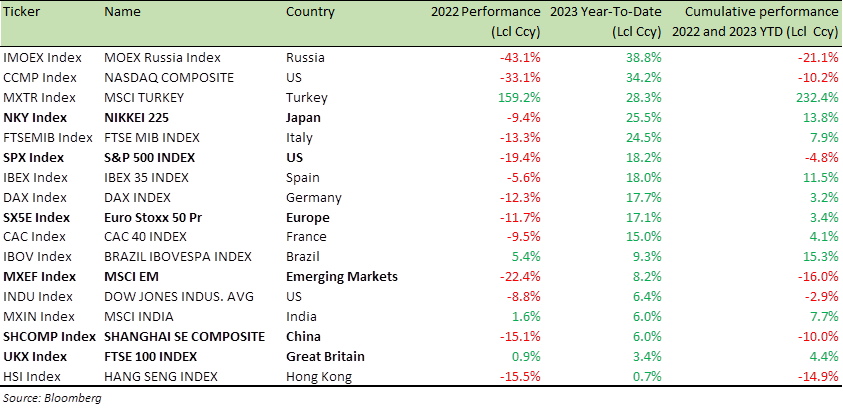
Benchmark Global Equity Index Performance (2022; 2023 YTD)

In my opinion, the Fed was behind the curve on inflation, and now seems to be behind the curve on disinflation. The Fed’s focus on the CPI and its “rent component” is too narrow, and they should adopt a more forward-looking approach. Rate hikes have already achieved their intended purpose, effectively curbing inflation as evidenced by its clear downtrend. However, the recent series of rate hikes might be creating potential issues for the future, akin to storing problems for another day. Hence my point above, regarding the risk of 1980s’ “double dip recession.”

I don’t mean to be Bearish. I just want to highlight that while the Fed may keep repeating stubbornly – more rate hikes are needed and we won’t cut rates anytime soon – the focus should be on disinflation ahead.

Meanwhile, equities continue to ramp up and after an over +25% rally off last year’s lows, market internals still remain strong.

The S&P 500 has surged +18% so far this year (table above), almost erasing all the losses experienced in the previous year. The tech-heavy NASDAQ has performed even better, recording a remarkable +34% gain for the year.

The bottom line is we’re in a bull market based on the standard +20% rally threshold, and bull markets typically last much longer than bear markets.

Looking at data since 1928, bull markets have demonstrated an average gain of +114% over 1,011 calendar days. To reach the average bull market performance, the S&P 500 would need to increase another +68% from its current level (taking it to 7,670) over a timeframe that extends until July 2025.

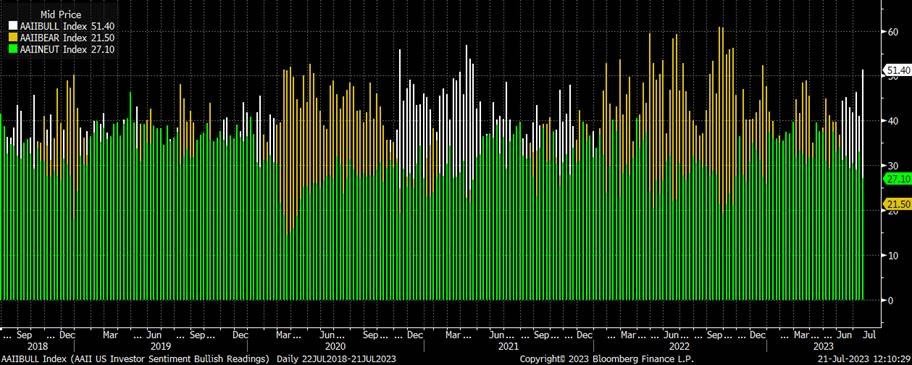
  • The latest American Association of Individual Investors (AAII) survey showed, more than half of respondents reported as bullish for the first time since April 22, 2021. Last week’s reading at 51.4% (white bars below) ended an over two-year-long streak without a reading above 50% which was the third longest such streak on record
  • Given the elevated reading of bullish sentiment, a minor share of respondents is reporting as bearish. In fact, that reading fell to 21.5% (green bars below) last week which is the lowest reading since June 2021
  • Last year saw a record streak of weeks where bearish sentiment outnumbered bullish sentiment. With the total reversal in sentiment, the bull-bear spread now heavily Favors bulls. The spread reached 29.9% last week for the highest reading since April 2021
  • The gains to bullish sentiment have not entirely come from bears. Neutral sentiment is also reaching new lows, registering just 27.1% (yellow bars below) last week. Unlike bearish sentiment, that is only the lowest level since the last week of 2022

AAII US Investor Sentiment Readings

Source: Bloomberg

We seem to be in a purple patch and equities still have upside.

Therefore, please stay risk on and like I say every time – whatever your view bullish or bearish, instead of waiting and timing a trade on, it is advisable to utilize structured products for investment purposes. Structured products present a valuable combination of capital preservation and strategic market entry.

For specific stock recommendations and ideas related to structured products, please feel free to reach out to me or your relationship manager.

 
Best wishes,

Manish Singh, CFA


The S&P 500 index is now in a bull run and investors have also turned bullish. Can equtiy markets go even higher from their current levels? Crossbridge Capital CIO, Manish Singh, CFA shares his views in this month’s MVP…

Summary

The S&P 500 index is now in a “bull run.” With the onset of a new bull market now confirmed, investors have also turned bullish.

The most recent sentiment data released by the American Association of Individual Investors (AAII), indicates a significant surge in optimism. In contrast to the average of approximately 25% of respondents reporting as bullish over the past year and a half, this week, saw a remarkable increase, with 44.5% reporting as bullish.

Meanwhile, the US Federal Reserve is considering a slowdown in its pace of interest rate hikes, as evidenced by their plan to skip an increase this month. This decision aligns with the latest US ISM Services data released last week, which indicated that the sector is on the verge of a contraction.

Nvidia surprised the market two weeks ago by announcing its sales projection of $11 billion for the three-month period ending in July. This figure surpasses the previous estimate by more than 50%. Such substantial revenue surprises are rarely witnessed among mega-cap companies. Its stock has since surged.

It appears highly likely that we are witnessing the dawn of a significant new AI-driven technological era, comparable to the advent of the PC, the internet, mobile devices, and cloud computing.

The looming risk of a US recession continues to hang over equity markets, akin to the sword of Damocles. However, the surge in construction spending on manufacturing projects and the low unemployment rate in the US, could propel equities even higher from their current levels.

S&P 500 Index in a “Bull Market”; US Federal Reserve set to pause

As summer approaches and the allure of a vacation beckons, let us take a moment to examine the market, before basking in the sun. Fortunately, there is plenty of positive news to share.

Cast your mind back to March 16, 2022, when Jerome Powell, the Chair of the US Federal Reserve (Fed), initiated a tightening cycle by raising interest rates, which has resulted in the fastest pace of tightening in over four decades.

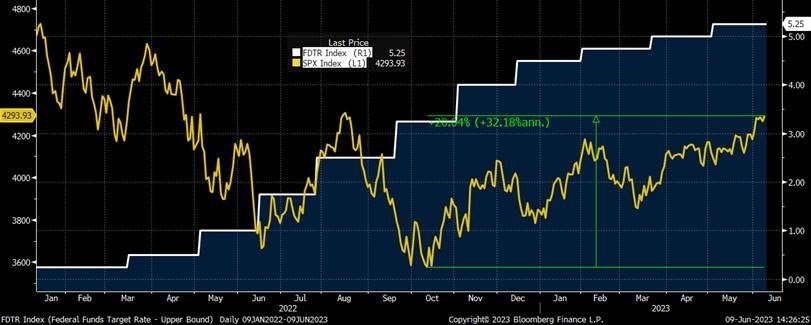
Despite concerns that this tightening would harm the stock market, as of yesterday’s closing, the S&P 500 index (SPX) has experienced a total return increase of +0.22% since that date. It seems that the fears that a Fed tightening would crush the stock market, have been proven wrong.

I consistently emphasize in my newsletters, the importance of patience and long-term thinking when it comes to investing. Market fluctuations are to be expected, and it is crucial to stay the course. The wise American investor, Shelby Davis, captured this sentiment perfectly when he said: “History provides a crucial insight regarding market crises: They are inevitable, painful, and ultimately surmountable.”

Looking at the price chart of the SPX and the Fed Funds Target Rate (FDTR) over the past 18 months, we can observe the market’s resilience.

S&P 500 index (SPX) and Fed Funds Target Rate (FDTR): 18-month price chart

Source: Bloomberg

Remember the turmoil surrounding the failure of Silicon Valley Bank (SVB) on March 10, or the recent concerns about the US debt ceiling? Despite these events, the SPX has risen over +11% since March 10.

The SPX is in a “bull run,” defined as a rally of over +20%, following a decline of -20%. Since reaching its lowest point on October 12, 2022, the SPX has now risen by +20.2%.

Within less than a year and a half, we have witnessed the SPX bouncing back. If you are not engaged in short-term trading or leveraged strategies, you have less to worry about and less to lose. As a rule: Always establish a solid investment strategy and resist the temptation to make emotional decisions driven by market noise. Discipline is key to avoiding unintended failures.

Meanwhile, the Fed is considering a slowdown in its pace of interest rate hikes, as evidenced by their plan to skip a hike this month. This decision aligns with the latest ISM Services data released last week, which indicated that the sector is on the verge of a contraction.

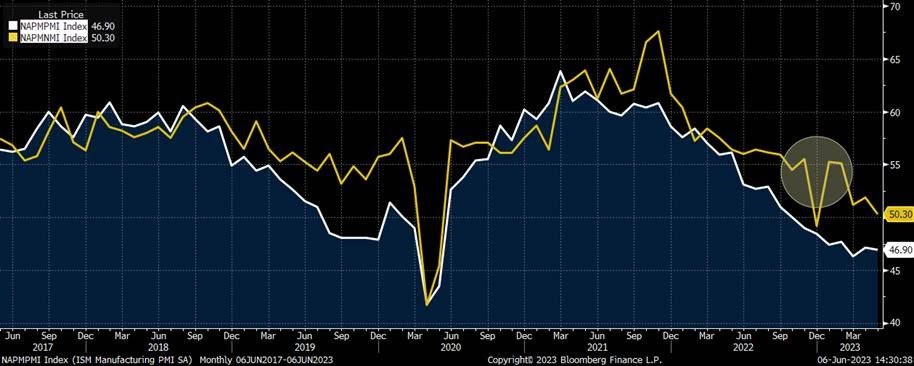
The ISM Services index declined to 50.3 (yellow line in chart below), indicating it is barely in expansionary territory (a reading below 50 signals a contraction). Components such as new orders, prices paid, and employment, all experienced drops, with employment reaching 49.2, signifying a contraction in the job market.

5-year price chart: US ISM Manufacturing PMI and ISM Services PMI

Source: Bloomberg

Over the past months, while the ISM manufacturing data slipped into contraction, the ISM Services data remained relatively stable, bolstering the Fed’s confidence in raising rates.

However, with the ISM Services index at 50.3, it is highly unlikely that the Fed will maintain the same stance.

The recent ISM Services data strongly suggests a “Fed pause.” Additionally, when we consider the average prices paid component of both the ISM Manufacturing and ISM Services, the prices paid index has returned to pre-COVID levels (see chart below). It disproves the narrative that the US economy is expanding rapidly and needs rates to stay high, let alone take in more rate hikes as some have even suggested.

5-year price chart: ISM Manufacturing and Services prices paid index and US inflation

Source: Bloomberg

The decline in ISM prices paid aligns with the significant drop in wage growth reported in the recent jobs report. Month-on-month US wage growth has cooled to +0.3% (down from highs of +0.6%)

Wages are by far the biggest expense for services firms, and the Fed has made it clear they want to see slower wage gains bear down on core inflation, ex-rent.

Therefore, the Fed will be comfortable to “pause” and not raise rates when they next meet June 13-14.

Markets and the Economy

The markets are evidently factoring in a return to an inflation rate of +2% to +3% in the US, with the expectation that other major economies will follow suit, in due course. This anticipated inflationary trend, is likely to materialize before the end of the year in the US.

One compelling indicator of the market’s confidence in managing inflation, is the trading behaviour of the 10-year US Treasury.

Despite headline inflation reaching +6%, the 10-year Treasury has remained relatively stable within a tight range of +3.5% to +3.7% over the past six months. Additionally, the downward slope of the yield curve, further supports the notion that concerns about inflation have diminished.

Consequently, the performance of equities (as illustrated in the table below), aligns with this perspective. While the potential for a recession in the US remains a challenge, the low employment rate acts as a mitigating factor, preventing it from gaining significant traction.

Benchmark Global Equity Index Performance (2022; 2023 YTD)

Another factor that could potentially help the US avoid a recession this year, is the significant construction spending on manufacturing projects.

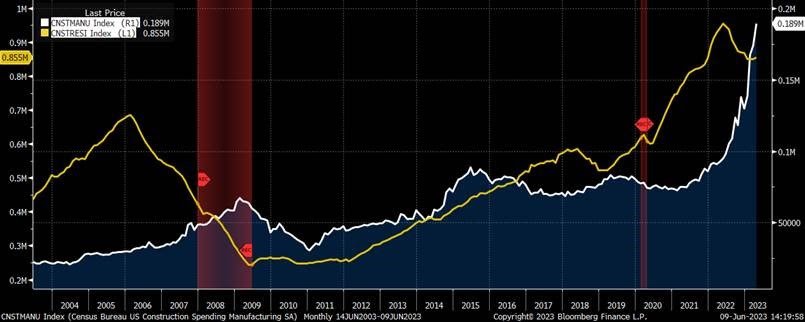
The latest data on US Construction Spending for April shows a robust increase of +1.2% (compared to the estimated +0.2% and the previous +0.3%). Notably, spending on construction for manufacturing projects (represented by the yellow line in the chart below) remains strong, compensating for declines in residential building (represented by the green line).

The resilience of the manufacturing sector’s construction spending is particularly encouraging, because it is typically among the first to suffer declines in spending and job losses, when interest rates rise. This unexpected strength has been a pleasant surprise, contributing to job creation and supporting GDP growth.

The Infrastructure Investment and Jobs Bill enacted in 2021, along with last year’s climate, tax, and healthcare legislation, all are injecting substantial funds into industrial projects. These include the expansion of manufacturing facilities, renewable energy initiatives, and railroad expansions. Such investments promise to keep workers engaged for years to come. Additionally, the computer/electronic manufacturing sector is experiencing a renaissance in the US, thanks to the $53 billion CHIPS and Science Act, which offers direct financial assistance for the construction and expansion of manufacturing facilities.

This program has already sparked an investment boom, with both domestic and foreign manufacturers announcing over 40 projects, totalling investments close to $200 billion, according to the Semiconductor Industry Association. Industry giants like Intel, TSMC, Samsung Electronics, Micron Technology, and Texas Instruments, have unveiled substantial investment plans, totalling billions of dollars.

It would be prudent for the Fed to avoid hindering this growth, by maintaining high interest rates for an extended period or even by further increasing them.

Census Bureau US construction spending (Manufacturing and Residential): 20-year price chart

Source: Bloomberg, Census Bureau

In my March Newsletter, I wrote: “Semiconductor stocks, long seen as a cyclical play, may be turning into a secular growth story, particularly if the AI-driven revolution stacks up well over the next few years. One to watch.”

Recent events have swiftly validated this prediction.

The rally in semiconductor stocks has been remarkable since then. The Philadelphia Stock Exchange Semiconductor Index (SOX) has surged over +20%, while the share price of US chipmaker Nvidia (NVDA) has skyrocketed by more than +70%.

Nvidia surprised the market two weeks ago by announcing its sales projection of $11 billion for the three-month period ending in July. This figure surpasses the previous estimate by more than 50%. Such substantial revenue surprises are rarely witnessed among mega-cap companies.

It appears highly likely that we are witnessing the dawn of a significant AI-driven technological era, comparable to the advent of the PC, the internet, mobile devices, and cloud computing.

Just two days following the ground-breaking quarterly earnings announcement, Jensen Huang, the CEO of Nvidia, delivered an inspiring commencement speech at Taiwan’s prestigious National Taiwan University. During his address, Huang shared valuable insights on entrepreneurship, humility, and perseverance. The entire speech is highly recommended, and you can watch it in its entirety at this link

Allow me to highlight one principal section from his speech, (which dates back to 2010, when the mobile phone industry was maturing) that particularly resonated with me:

Huang said:

“The phone market is vast. We could have competed for market share. However, we made a difficult decision and chose not to pursue that market. Nvidia’s mission is to construct computers capable of solving problems that ordinary computers cannot. We should dedicate ourselves to realizing our vision and making a unique contribution.

Our strategic retreat turned out to be a wise move. By leaving the phone market, we opened our minds to creating a new one. We envisioned developing a new type of computer for robotics, equipped with neural network processors and safety architectures capable of running AI algorithms.

At that time, this market was worth zero billion dollars. By withdrawing from the massive phone market and venturing into the zero-billion-dollar robotics market, we now have a thriving automotive and robotics business worth billions of dollars, essentially pioneering a new industry.

Retreat is not an easy choice for the brightest and most successful individuals, such as yourself. However, strategic retreat, sacrifice, and determining what to give up lie at the very core of success.”

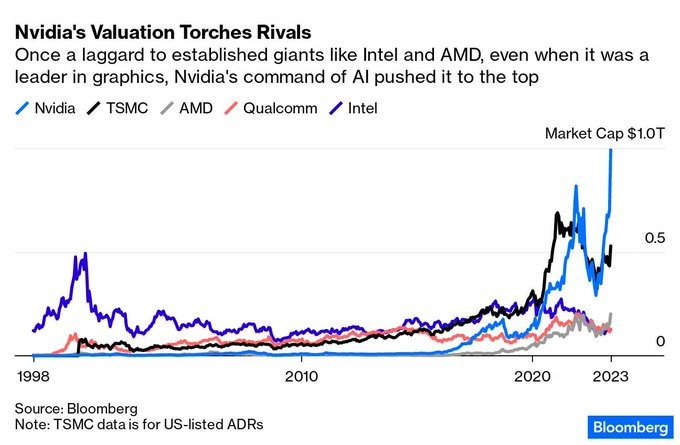
Nvidia has played a pioneering role in the development of Graphics Processing Unit (GPU) technology, which has become essential in the realms of gaming and digital production. In order to maintain a strong focus on advancing GPU chips, Nvidia made the strategic decision to sacrifice market share in other areas of the semiconductor chip industry. The chart below vividly demonstrates Huang’s visionary leadership at Nvidia, highlighting the lack of similar leadership at rival Intel.

The advent of AI is set to generate entirely new job opportunities that never existed before. Roles such as data engineering, prompt engineering, AI factory operations, and AI safety engineers are emerging as a result. Automated tasks may render certain jobs obsolete, but AI will undoubtedly transform every profession, empowering programmers, designers, artists, marketers, and manufacturing planners to enhance their performance significantly. The prospects are incredibly exciting, I must admit.

As we navigate the AI age, I firmly believe that Huang’s speech will eventually be regarded on par with Steve Jobs’ iconic 2005 Stanford commencement address. Given Nvidia’s visionary CEO and its continued involvement in shaping the AI future, the company remains a solid investment despite its lofty valuations. Huang’s propensity for making bold bets, further adds to the allure.

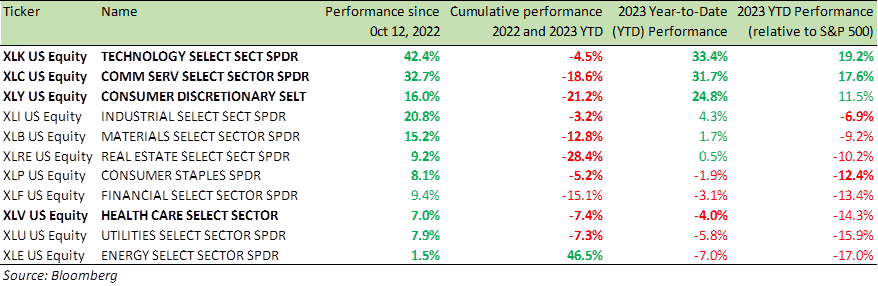
Benchmark US equity sector performance (since Oct 12, 2022; 2023 YTD and 2023 YTD relative to S&P 500 Index)

Technology and Communication sector stocks have experienced a notable upward trend, as indicated in the table above.

With the interest rate cycle approaching its peak, it is expected that growth stocks will reap greater benefits as rates begin to decline but the looming risk of a US recession continues to hang over the market, akin to the sword of Damocles.

However, as mentioned earlier, the flourishing manufacturing sector and low unemployment rate could propel US equities even higher from their current levels.

Instead of waiting for a market correction to adopt a long position, which has proven unfavourable for equity bears for the past nine months, it is advisable to utilize structured products for investment purposes. Structured products offer the opportunity to implement such a view while providing a degree of capital protection. They also facilitate the identification of favourable entry points in the market and offer avenues to earn coupons, even in a flat or negative market environment.

I consistently emphasize the usefulness of structured products for equity investments. They present a valuable combination of capital preservation and strategic market entry.

For specific stock recommendations and ideas related to structured products, please feel free to reach out to me or your relationship manager.

 
Best wishes,

Manish Singh, CFA


Recovery and recession symbol. Businessman hand turns cubes and changes the word 'recession' to 'recovery'. Beautiful white background. Business and recovery - recession concept. Copy space.

US Economic data continues to disappoint. Fed officials are increasingly looking out of touch, as they raise rates focusing largely on lagging indicators instead of focusing on the leading indicators.

Summary

US Economic data continues to disappoint. Leading indicators are flashing red and there are clear signs that the US economy is on the verge of a recession (if not in one already), whilst over the past nine months, US inflation is annualising at +3.2%, down nearly two-thirds from its highs of +9.1% in June of last year

It’s hard to imagine how anyone could, credibly, make the argument that the US economy can endure more interest rate increases. Well, there are some, and crucially (or unfortunately), they’re all on the Federal Reserve Open Market Committee (FOMC). The FOMC is set to raise interest rates by +0.25% at its meeting next week, taking the Federal Funds Target Rate (FDTR) to a range of +5.0% to +5.25%. That’s a cumulative increase of 5% over 14 months, the fastest pace of tightening since the 1980s.

Fed officials are increasingly looking out of touch, as they continue to act and sound hawkish, focusing largely on lagging indicators instead of focusing on the leading indicators. When reality hits, rate cuts will inevitably follow.

May is upon us and the “Sell in May and go away” commentary – weaker returns during May to October compared to the period from November to April – has started to pour in. However, like every other market maxim, “Sell in May” is not a hard and fast rule, and the reality is more nuanced.

In the first full quarter free of its Covid restrictions, China’s GDP grew by +4.5% in Q1. Given the size and importance of the Chinese economy, the growth marked a bright spot for a global economy facing various headwinds. Very encouragingly, the growth was driven in large part by retail sales, which jumped more than +10% in March from a year earlier. If this trend were to continue, we could easily see China’s Q2 GDP growing by of over +6%. This would please the global economic sentiment no end.

“Fool in the Shower“ moment

Over the past nine months, the headline US Consumer Price Index (CPI) is annualising at the rate of +3.2%, this is down nearly two thirds from its highs of +9.1%, in June of last year.

US Economic data continues to disappoint, and there are signs that the US economy is on the verge of a recession (if not in one already):

  • The US Conference Board leading Economic Index (LEI) is now contracting at -7.8% p.a. (see chart below). During recessions in the early 1970s and early 1980s, the annual decline was never this negative.
  • The Philadelphia Fed Manufacturing Index, released last week, came in significantly weaker than expected, falling to -31.3 versus an already pessimistic forecast of -19.3. April’s report was also the 8th straight month, where the general business outlook was negative and there has never been another streak of eight or more months that didn’t occur during a recession
  • In the last eight recessions going back to 1970, in the twelve months leading up to the recession, the US initial jobless claims rose by an average of 52,000 (or +20%) from their lowest point in that period up to the start of a recession. Following the revisions earlier this year, the US initial jobless claims have now risen by 65,000 from their low of 182,000 in September 2022 i.e. a +36% change
  • While economists were forecasting a decline of -0.5% for March US Retail sales, the actual decline was much larger at -1.0%
  • The prices paid component within the Dallas Fed Manufacturing Index continued to tick lower in April, now down to 19.4, its lowest since July 2020. Price pressures have faded quickly, considering the index was at 60.3 one year ago
  • In growing signs of slowdown, the US GDP grew at the rate of +1.1% p.a. in Q1, down from +2.6% in Q4 2022, and lower than the +1.9% expected

US Leading Economic Index (white) and US Real GDP growth (orange)

Source: Bloomberg

Last week, there was a flurry of US Federal Reserve (Fed) commentary (see summary below from Bespoke Invest, our research providers), updating us on the thinking of the Federal Open Market Committee (FOMC).

It’s hard to imagine how anyone could credibly make the argument that the US economy is “resilient” and can take more interest rate hikes. Well, there are some, and crucially (or unfortunately), they’re all on the Federal Reserve board.

Only Philadelphia Fed President Patrick Harker sounded the most realistic – “we need to slow it [rate hike] down.. we need not just respond to the current level of inflation, but where we think it’s going,” and that is down to the ugly manufacturing sector report in his Philadelphia district that was released earlier that day.

The FOMC remains set to raise interest rates by +0.25% at their May 2-3 meeting next week. This will bring the Federal Funds Target Rate (FDTR) to a range of +5.0% to +5.25%. That’s a cumulative increase of 5% over 14 months, the fastest pace of tightening since the 1980s (and nearly twice as fast as the rate hike cycle of 1988-89).

In my opinion, the FOMC is at risk of behaving like the “Fool in the Shower” in Milton Friedman’s metaphor – where Friedman likened a central bank that acted too forcefully to a fool in the shower who finds the water too cold. The fool turns up the hot water, but doesn’t realize that hot water takes a while to arrive. He turns up the hot tap even higher and ends up getting a scalding.

Fed officials are increasingly looking out of touch, as they continue to act and sound hawkish, focusing largely on lagging indicators such as CPI, and failing to look at leading indicators such as the –Leading Economic index (LEI) and the Philly Fed manufacturing data, amongst others as outlined above.

Fed officials appear to have little concern over the state of the economy, despite forecasts from Fed staff released last week, which suggested a recession in the second half of the year. For Fed officials to continue to say – “inflation is still too high and proving to be stubborn,” “we are looking for further, sustained improvement in inflation”, the US economy is “resilient,” “we’re still seeing strong economic conditions”…and use that as an excuse to raise rates even further, is negligent and speaks of the lack of “private sector” experience among the current Federal Reserve officials.

Of the 18 members on the FOMC – six members of the Board of Governors of the Federal Reserve and the twelve Presidents of the Regional Federal Reserve Banks, only four have ever worked in the private sector. Of these, only Chairman Jerome Powell and Minneapolis Fed President Neel Kashkari, have private sector experience of over seven years.

To put it numerically – on average an FOMC member has 30 years of post-grad career history. Simple maths tells me that of the 540 years of post-grad career history of the 18 members on the FOMC, only 30 years i.e. 5% of the experience is in the private sector. The rest, 510 years since graduation, has been spent in academia or government positions. That’s not to say they aren’t qualified, however, wouldn’t you want more members on the FOMC with private sector experience i.e. those who have “participated” in the real economy, rather than just “watched”, or “spoken” about it at conferences, and “written” about it in academic papers?

I would.

The recession probability model (see chart below) from the New York Federal Reserve, continues to move up and is now at its highest since 1982.

New York Federal Reserve, probability of recession in the US – 12 months ahead

Source: Bloomberg

We’ve already seen the mistakes of such a group think – the Fed sticking with “zero rates” for longer, saying “inflation is transitory” and so on – and we may be seeing another one in the making as the Fed raises rates to a higher level than warranted.

Quantitative Easing (QE) wrecked the market’s ability to determine prices and interest rates and the stimulus that followed in the wake of Covid-19, distorted things even further. Under the “fiat money” regime that we have, “group think” can just add fuel to the fire.

It’s hard to imagine that Friedman would look at the current Fed and its bloated balance sheet favourably.

When reality hits, rate cuts will inevitably follow. The FOMC focus should return to preserving (and indeed encouraging) growth, and hence avoiding a “credit crunch” and preventing a recession.

Markets and the Economy

This week is all about “big tech” earnings. On Tuesday, we had a biggie from Microsoft (MSFT), which reported 3Q revenues of $52.9 billion, a +7% increase, thanks to beats across all its segments, led by personal computing. Everything from LinkedIn to Office 365 grew more than +10% in constant currency terms as the $2 trillion software juggernaut continued to roll. Microsoft’s shares, which were up +15% year-to-date (YTD), jumped more than +9%, in after-hours trading.

Microsoft expects the integration of Artificial Intelligence (AI) tools into the MSFT suite of products, to be the new growth area for revenues. It has invested billions of dollars in OpenAI, the company behind ChatGPT, and it owns 49% of the company. Will AI be the new revenue driver? Are programs like ChatGPT doing the “thinking” or merely faking it?

We seem to have forgotten about the “Metaverse” craze and the billions Facebook threw at it, only to recoil and correct course.

I use ChatGPT, but it is still just a fancy search engine/word processor with an easy-to-use front end. Despite the buzz and billions being spent on AI startups, we are not in sight of a breakthrough that can impart actual “human feelings” to a computer. Adding GPT to Word and Excel would however enhance the productivity of the MS Office suite, just as adding a motor to a manual screwdriver, can turn it into a power screwdriver and drive productivity.

While Alphabet’s (GOOGL) earnings were not as strong as MSFT, they still topped revenue estimates with $69.79 billion for the quarter, up +3% on the year, and beating expectations of $69 billion. Management kept a lid on costs, including capital expenditures with free cash flow of $17.2 billion coming in well ahead of the $13.5 billion expected by analysts.

Resilient demand for cloud computing and digital advertising together with cost cutting, has helped shore up “big tech” earnings overall.

US tech companies had been expected to produce little growth this quarter, if any, owing to difficult comparisons with the strong start they had to the quarter in 2022 and a spending slowdown that has hit many parts of tech service and product businesses. Therefore, seeing revenue growth is a piece of welcome news and points to the fact that big tech has been on a relentless drive of cost-cutting, increased efficiency and sound execution. We’re now seeing the results

America’s largest technology companies – Microsoft, Apple, Meta, Amazon etc. have all scrambled to identify efficiencies, cutting tens of thousands of jobs, amid heightened anxiety over the state of the US (and the world) economy. We are only one-third into the year and the tech sector layoffs in Silicon Valley for the year, have already surpassed the whole of last year. Almost 169,000 people have been let go since January this year, compared to 164,411 that were let go in the whole of 2022.

Despite the strong rally in equities since the market bottomed on Oct 12, 2022 (table below), Technology (XLK) and Communication services (XLC) stocks are still down between -15% to -27% from their December 2021 highs.

Benchmark US equity sector performance (2022, 2023 YTD and 2023 YTD relative to the S&P 500 Index)

May is upon us and the “Sell in May and go away” commentary – weaker returns during May to October compared to the period from November to April – has started to pour in.

Historically the adage does hold.

Post WWII, the S&P 500 (SPX) median performance during the winter months has been a gain of +6.2% with positive returns 75.6% of the time. During the summer months, however, the SPX’s median return has been less than half this, at +3.0%, with positive returns at 65.4% i.e. 10 percentage points weaker than the winter period.

However, like every other market maxim, “Sell in May” is not a hard-and-fast rule and the reality is more nuanced.

The charts below show that the performance and consistency of positive returns of both the SPX and National Association of Securities Dealers Automatic Quotation System (NASDAQ) during the summer months, is largely based on each index’s YTD performance through April 30.

  • In the years the indices were significantly down (more than -5%) through April, the median returns during the summer months were negative for the indices – a decline of -6.3% for the SPX and a decline of over -10% for NASDAQ
  • In all other scenarios when the index was down a little (less than -5%) or indeed positive YTD through April, the index median returns were positive during the summer months

Source: Bespoke Invest

With one trading day left until the end of April, the SPX is currently up +5.7% and the NASDAQ is up +13%.

Here’s another reason why it doesn’t make sense to be bearish -positioning. Market consensus is bearish and equities are under-owned. Investors are 27.2% Bullish and 35.1% bearish, per the American Association of Individual Investors’ (AAII) stock sentiment survey. Bearish reading on the survey is above average for the 69th time out of the past 74 weeks. It’s hard to get a sustainable market crash when everyone is looking for it

  • Furthermore, the Conference Board’s ‘bull-bear’ spread remained negative for 16 consecutive months. Going back to 1987, the current streak ranks as the second longest on record, trailing only the 18-month streak during the Financial Crisis that ended in April 2009. It reflects the prolonged consumer pessimism towards equities that started in Q2 2021. In the year following previous streaks of nine months or more with negative sentiment, the S&P 500’s performance was consistently positive, suggesting that pent-up demand for stocks may emerge, once pessimism subsides
  • Despite the rally we have seen from the October 2022 lows, the SPX and NASDAQ are still -15% and -24% below their December 2021 highs

Benchmark Global Equity Index Performance (2022, 2023 YTD and 6 months)

Meanwhile, in the second largest economy in the world – China, consumer spending is playing a stronger-than-expected role in driving its recovery, after the country lifted its stringent zero-Covid measures. Beijing’s National Bureau of Statistics said Tuesday that the economy grew by +4.5% in the first three months of the year, when compared with a year earlier, the fastest such rate of growth since the first quarter of 2022, and a marked improvement from the +2.9% rate in the last three months of last year.

The strength of China’s economic recovery in Q1, free of its Covid restrictions marked a bright spot for a global economy facing various headwinds – inflation, higher interest rates and fallout from instability in the financial sector.

Very encouragingly, China’s growth in Q1 was driven in large part by retail sales, which jumped more than +10% in March from a year earlier. That was the fastest pace in nearly two years, and helped to offset a sharper-than-expected slowdown in real estate, infrastructure and other private-sector investments. This is a welcome change from the past quarter where the economic boom had been largely built on an investment-driven model which often leads to malinvestments and bubbles in the economy. Since this sharp rebound in consumer spending is largely organic and not driven by government stimulus, Q2 growth could easily get to +6% or more. That would be a bright spot for global economic sentiment.

S&P 500 Index – 12-month price chart

Source: Bloomberg

The SPX has been flat for the last 12 months (see chart above) and we may get more sideways moves in the months ahead. In such circumstances, clipping a 10%-12% p.a. coupon on a basket of large-cap stocks using income-Structured Products is still my favourite play.

For specific stock recommendations and Structured Product ideas please do not hesitate to contact me or your relationship manager.

 
Best wishes,

Manish Singh, CFA