Recovery and recession symbol. Businessman hand turns cubes and changes the word 'recession' to 'recovery'. Beautiful white background. Business and recovery - recession concept. Copy space.

US Economic data continues to disappoint. Fed officials are increasingly looking out of touch, as they raise rates focusing largely on lagging indicators instead of focusing on the leading indicators.

Summary

US Economic data continues to disappoint. Leading indicators are flashing red and there are clear signs that the US economy is on the verge of a recession (if not in one already), whilst over the past nine months, US inflation is annualising at +3.2%, down nearly two-thirds from its highs of +9.1% in June of last year

It’s hard to imagine how anyone could, credibly, make the argument that the US economy can endure more interest rate increases. Well, there are some, and crucially (or unfortunately), they’re all on the Federal Reserve Open Market Committee (FOMC). The FOMC is set to raise interest rates by +0.25% at its meeting next week, taking the Federal Funds Target Rate (FDTR) to a range of +5.0% to +5.25%. That’s a cumulative increase of 5% over 14 months, the fastest pace of tightening since the 1980s.

Fed officials are increasingly looking out of touch, as they continue to act and sound hawkish, focusing largely on lagging indicators instead of focusing on the leading indicators. When reality hits, rate cuts will inevitably follow.

May is upon us and the “Sell in May and go away” commentary – weaker returns during May to October compared to the period from November to April – has started to pour in. However, like every other market maxim, “Sell in May” is not a hard and fast rule, and the reality is more nuanced.

In the first full quarter free of its Covid restrictions, China’s GDP grew by +4.5% in Q1. Given the size and importance of the Chinese economy, the growth marked a bright spot for a global economy facing various headwinds. Very encouragingly, the growth was driven in large part by retail sales, which jumped more than +10% in March from a year earlier. If this trend were to continue, we could easily see China’s Q2 GDP growing by of over +6%. This would please the global economic sentiment no end.

“Fool in the Shower“ moment

Over the past nine months, the headline US Consumer Price Index (CPI) is annualising at the rate of +3.2%, this is down nearly two thirds from its highs of +9.1%, in June of last year.

US Economic data continues to disappoint, and there are signs that the US economy is on the verge of a recession (if not in one already):

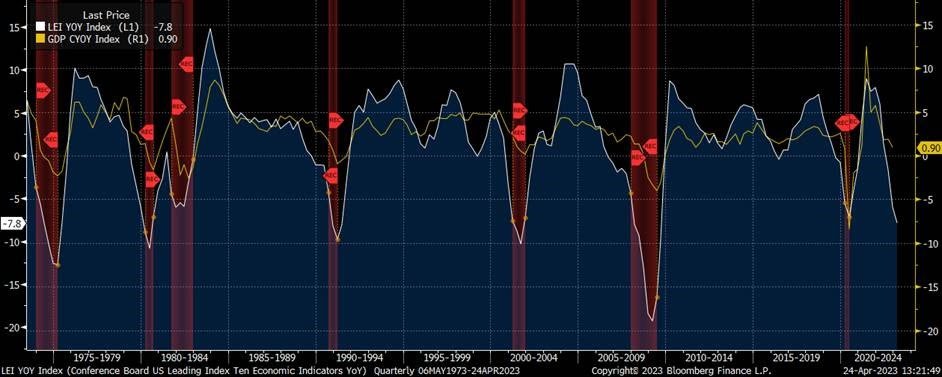
  • The US Conference Board leading Economic Index (LEI) is now contracting at -7.8% p.a. (see chart below). During recessions in the early 1970s and early 1980s, the annual decline was never this negative.
  • The Philadelphia Fed Manufacturing Index, released last week, came in significantly weaker than expected, falling to -31.3 versus an already pessimistic forecast of -19.3. April’s report was also the 8th straight month, where the general business outlook was negative and there has never been another streak of eight or more months that didn’t occur during a recession
  • In the last eight recessions going back to 1970, in the twelve months leading up to the recession, the US initial jobless claims rose by an average of 52,000 (or +20%) from their lowest point in that period up to the start of a recession. Following the revisions earlier this year, the US initial jobless claims have now risen by 65,000 from their low of 182,000 in September 2022 i.e. a +36% change
  • While economists were forecasting a decline of -0.5% for March US Retail sales, the actual decline was much larger at -1.0%
  • The prices paid component within the Dallas Fed Manufacturing Index continued to tick lower in April, now down to 19.4, its lowest since July 2020. Price pressures have faded quickly, considering the index was at 60.3 one year ago
  • In growing signs of slowdown, the US GDP grew at the rate of +1.1% p.a. in Q1, down from +2.6% in Q4 2022, and lower than the +1.9% expected

US Leading Economic Index (white) and US Real GDP growth (orange)

Source: Bloomberg

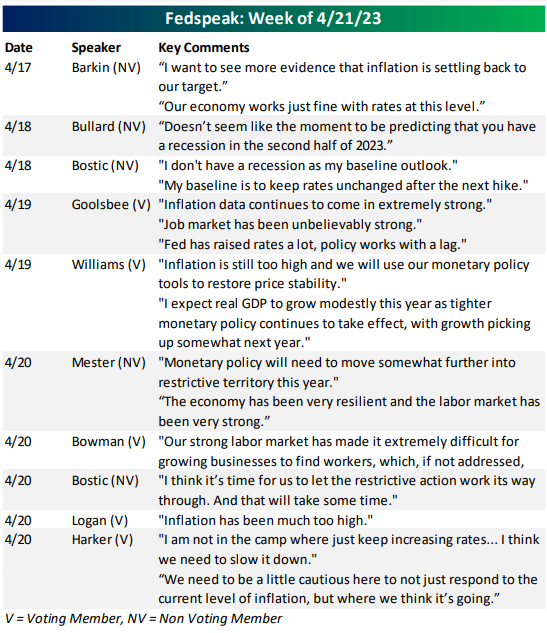
Last week, there was a flurry of US Federal Reserve (Fed) commentary (see summary below from Bespoke Invest, our research providers), updating us on the thinking of the Federal Open Market Committee (FOMC).

It’s hard to imagine how anyone could credibly make the argument that the US economy is “resilient” and can take more interest rate hikes. Well, there are some, and crucially (or unfortunately), they’re all on the Federal Reserve board.

Only Philadelphia Fed President Patrick Harker sounded the most realistic – “we need to slow it [rate hike] down.. we need not just respond to the current level of inflation, but where we think it’s going,” and that is down to the ugly manufacturing sector report in his Philadelphia district that was released earlier that day.

The FOMC remains set to raise interest rates by +0.25% at their May 2-3 meeting next week. This will bring the Federal Funds Target Rate (FDTR) to a range of +5.0% to +5.25%. That’s a cumulative increase of 5% over 14 months, the fastest pace of tightening since the 1980s (and nearly twice as fast as the rate hike cycle of 1988-89).

In my opinion, the FOMC is at risk of behaving like the “Fool in the Shower” in Milton Friedman’s metaphor – where Friedman likened a central bank that acted too forcefully to a fool in the shower who finds the water too cold. The fool turns up the hot water, but doesn’t realize that hot water takes a while to arrive. He turns up the hot tap even higher and ends up getting a scalding.

Fed officials are increasingly looking out of touch, as they continue to act and sound hawkish, focusing largely on lagging indicators such as CPI, and failing to look at leading indicators such as the –Leading Economic index (LEI) and the Philly Fed manufacturing data, amongst others as outlined above.

Fed officials appear to have little concern over the state of the economy, despite forecasts from Fed staff released last week, which suggested a recession in the second half of the year. For Fed officials to continue to say – “inflation is still too high and proving to be stubborn,” “we are looking for further, sustained improvement in inflation”, the US economy is “resilient,” “we’re still seeing strong economic conditions”…and use that as an excuse to raise rates even further, is negligent and speaks of the lack of “private sector” experience among the current Federal Reserve officials.

Of the 18 members on the FOMC – six members of the Board of Governors of the Federal Reserve and the twelve Presidents of the Regional Federal Reserve Banks, only four have ever worked in the private sector. Of these, only Chairman Jerome Powell and Minneapolis Fed President Neel Kashkari, have private sector experience of over seven years.

To put it numerically – on average an FOMC member has 30 years of post-grad career history. Simple maths tells me that of the 540 years of post-grad career history of the 18 members on the FOMC, only 30 years i.e. 5% of the experience is in the private sector. The rest, 510 years since graduation, has been spent in academia or government positions. That’s not to say they aren’t qualified, however, wouldn’t you want more members on the FOMC with private sector experience i.e. those who have “participated” in the real economy, rather than just “watched”, or “spoken” about it at conferences, and “written” about it in academic papers?

I would.

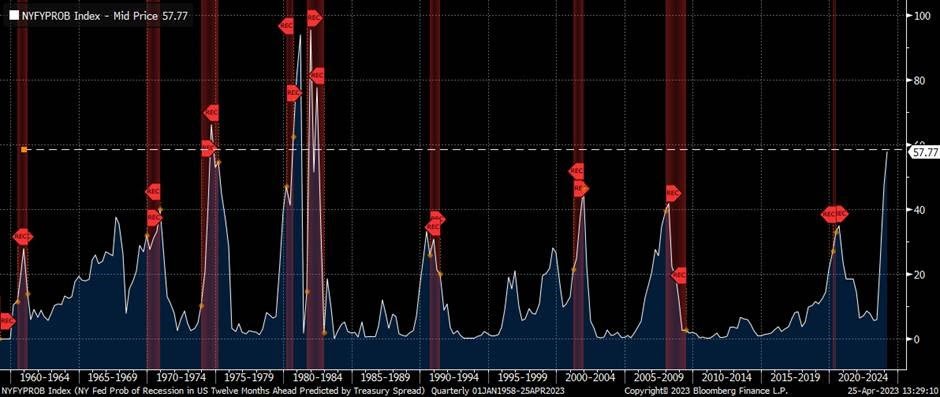
The recession probability model (see chart below) from the New York Federal Reserve, continues to move up and is now at its highest since 1982.

New York Federal Reserve, probability of recession in the US – 12 months ahead

Source: Bloomberg

We’ve already seen the mistakes of such a group think – the Fed sticking with “zero rates” for longer, saying “inflation is transitory” and so on – and we may be seeing another one in the making as the Fed raises rates to a higher level than warranted.

Quantitative Easing (QE) wrecked the market’s ability to determine prices and interest rates and the stimulus that followed in the wake of Covid-19, distorted things even further. Under the “fiat money” regime that we have, “group think” can just add fuel to the fire.

It’s hard to imagine that Friedman would look at the current Fed and its bloated balance sheet favourably.

When reality hits, rate cuts will inevitably follow. The FOMC focus should return to preserving (and indeed encouraging) growth, and hence avoiding a “credit crunch” and preventing a recession.

Markets and the Economy

This week is all about “big tech” earnings. On Tuesday, we had a biggie from Microsoft (MSFT), which reported 3Q revenues of $52.9 billion, a +7% increase, thanks to beats across all its segments, led by personal computing. Everything from LinkedIn to Office 365 grew more than +10% in constant currency terms as the $2 trillion software juggernaut continued to roll. Microsoft’s shares, which were up +15% year-to-date (YTD), jumped more than +9%, in after-hours trading.

Microsoft expects the integration of Artificial Intelligence (AI) tools into the MSFT suite of products, to be the new growth area for revenues. It has invested billions of dollars in OpenAI, the company behind ChatGPT, and it owns 49% of the company. Will AI be the new revenue driver? Are programs like ChatGPT doing the “thinking” or merely faking it?

We seem to have forgotten about the “Metaverse” craze and the billions Facebook threw at it, only to recoil and correct course.

I use ChatGPT, but it is still just a fancy search engine/word processor with an easy-to-use front end. Despite the buzz and billions being spent on AI startups, we are not in sight of a breakthrough that can impart actual “human feelings” to a computer. Adding GPT to Word and Excel would however enhance the productivity of the MS Office suite, just as adding a motor to a manual screwdriver, can turn it into a power screwdriver and drive productivity.

While Alphabet’s (GOOGL) earnings were not as strong as MSFT, they still topped revenue estimates with $69.79 billion for the quarter, up +3% on the year, and beating expectations of $69 billion. Management kept a lid on costs, including capital expenditures with free cash flow of $17.2 billion coming in well ahead of the $13.5 billion expected by analysts.

Resilient demand for cloud computing and digital advertising together with cost cutting, has helped shore up “big tech” earnings overall.

US tech companies had been expected to produce little growth this quarter, if any, owing to difficult comparisons with the strong start they had to the quarter in 2022 and a spending slowdown that has hit many parts of tech service and product businesses. Therefore, seeing revenue growth is a piece of welcome news and points to the fact that big tech has been on a relentless drive of cost-cutting, increased efficiency and sound execution. We’re now seeing the results

America’s largest technology companies – Microsoft, Apple, Meta, Amazon etc. have all scrambled to identify efficiencies, cutting tens of thousands of jobs, amid heightened anxiety over the state of the US (and the world) economy. We are only one-third into the year and the tech sector layoffs in Silicon Valley for the year, have already surpassed the whole of last year. Almost 169,000 people have been let go since January this year, compared to 164,411 that were let go in the whole of 2022.

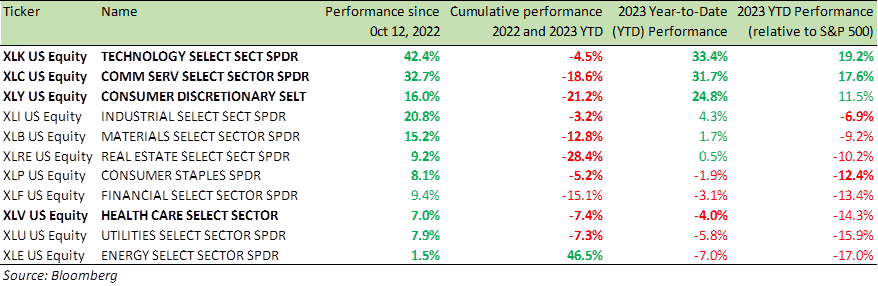
Despite the strong rally in equities since the market bottomed on Oct 12, 2022 (table below), Technology (XLK) and Communication services (XLC) stocks are still down between -15% to -27% from their December 2021 highs.

Benchmark US equity sector performance (2022, 2023 YTD and 2023 YTD relative to the S&P 500 Index)

May is upon us and the “Sell in May and go away” commentary – weaker returns during May to October compared to the period from November to April – has started to pour in.

Historically the adage does hold.

Post WWII, the S&P 500 (SPX) median performance during the winter months has been a gain of +6.2% with positive returns 75.6% of the time. During the summer months, however, the SPX’s median return has been less than half this, at +3.0%, with positive returns at 65.4% i.e. 10 percentage points weaker than the winter period.

However, like every other market maxim, “Sell in May” is not a hard-and-fast rule and the reality is more nuanced.

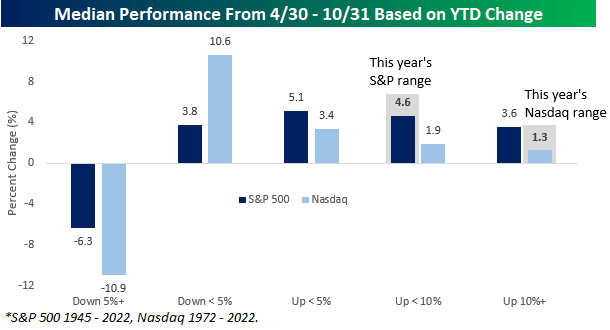
The charts below show that the performance and consistency of positive returns of both the SPX and National Association of Securities Dealers Automatic Quotation System (NASDAQ) during the summer months, is largely based on each index’s YTD performance through April 30.

  • In the years the indices were significantly down (more than -5%) through April, the median returns during the summer months were negative for the indices – a decline of -6.3% for the SPX and a decline of over -10% for NASDAQ
  • In all other scenarios when the index was down a little (less than -5%) or indeed positive YTD through April, the index median returns were positive during the summer months

Source: Bespoke Invest

With one trading day left until the end of April, the SPX is currently up +5.7% and the NASDAQ is up +13%.

Here’s another reason why it doesn’t make sense to be bearish -positioning. Market consensus is bearish and equities are under-owned. Investors are 27.2% Bullish and 35.1% bearish, per the American Association of Individual Investors’ (AAII) stock sentiment survey. Bearish reading on the survey is above average for the 69th time out of the past 74 weeks. It’s hard to get a sustainable market crash when everyone is looking for it

  • Furthermore, the Conference Board’s ‘bull-bear’ spread remained negative for 16 consecutive months. Going back to 1987, the current streak ranks as the second longest on record, trailing only the 18-month streak during the Financial Crisis that ended in April 2009. It reflects the prolonged consumer pessimism towards equities that started in Q2 2021. In the year following previous streaks of nine months or more with negative sentiment, the S&P 500’s performance was consistently positive, suggesting that pent-up demand for stocks may emerge, once pessimism subsides
  • Despite the rally we have seen from the October 2022 lows, the SPX and NASDAQ are still -15% and -24% below their December 2021 highs

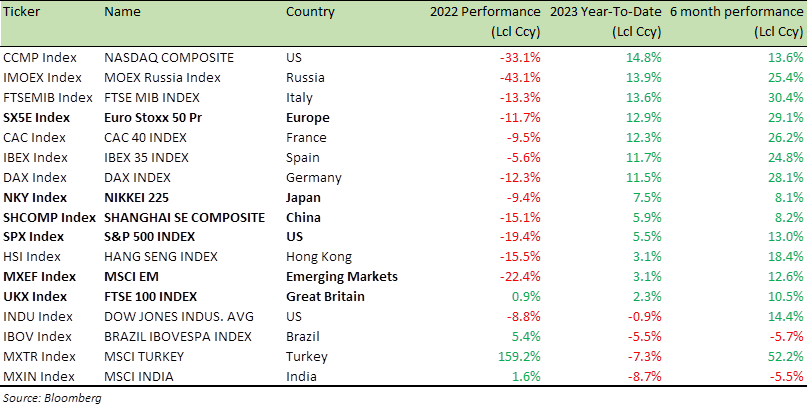
Benchmark Global Equity Index Performance (2022, 2023 YTD and 6 months)

Meanwhile, in the second largest economy in the world – China, consumer spending is playing a stronger-than-expected role in driving its recovery, after the country lifted its stringent zero-Covid measures. Beijing’s National Bureau of Statistics said Tuesday that the economy grew by +4.5% in the first three months of the year, when compared with a year earlier, the fastest such rate of growth since the first quarter of 2022, and a marked improvement from the +2.9% rate in the last three months of last year.

The strength of China’s economic recovery in Q1, free of its Covid restrictions marked a bright spot for a global economy facing various headwinds – inflation, higher interest rates and fallout from instability in the financial sector.

Very encouragingly, China’s growth in Q1 was driven in large part by retail sales, which jumped more than +10% in March from a year earlier. That was the fastest pace in nearly two years, and helped to offset a sharper-than-expected slowdown in real estate, infrastructure and other private-sector investments. This is a welcome change from the past quarter where the economic boom had been largely built on an investment-driven model which often leads to malinvestments and bubbles in the economy. Since this sharp rebound in consumer spending is largely organic and not driven by government stimulus, Q2 growth could easily get to +6% or more. That would be a bright spot for global economic sentiment.

S&P 500 Index – 12-month price chart

Source: Bloomberg

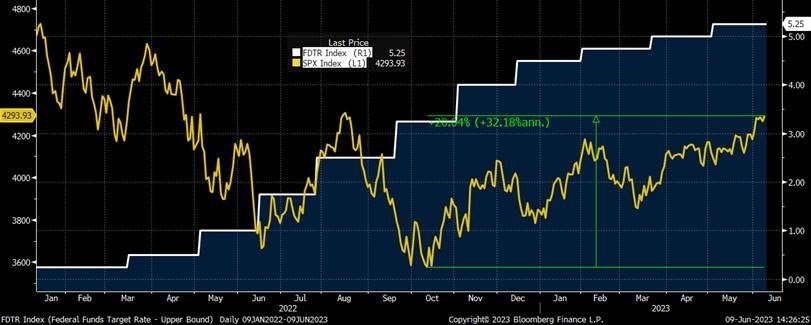
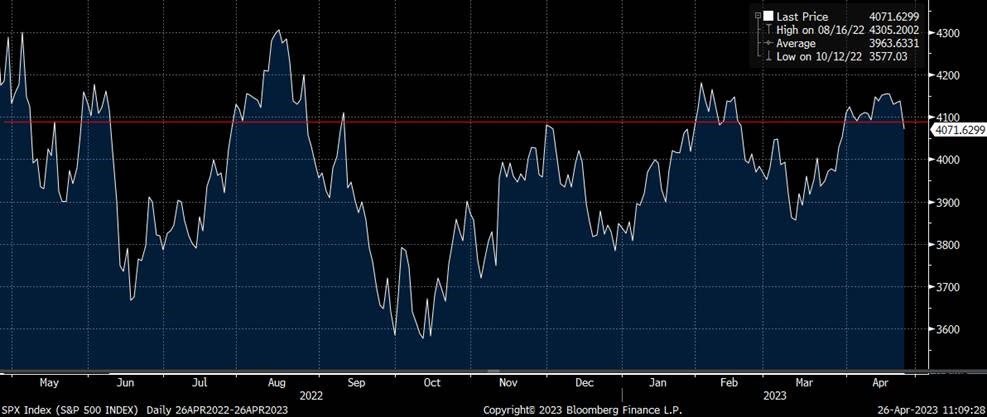
The SPX has been flat for the last 12 months (see chart above) and we may get more sideways moves in the months ahead. In such circumstances, clipping a 10%-12% p.a. coupon on a basket of large-cap stocks using income-Structured Products is still my favourite play.

For specific stock recommendations and Structured Product ideas please do not hesitate to contact me or your relationship manager.

 
Best wishes,
Manish Singh, CFA


Market expects rate cuts. The US Federal Reserve has ruled out rate cuts this year. However, failure of more smaller banks could lead to rapid emergency easing of rates by the Fed.

Summary

The US Federal Reserve has maintained a moderately hawkish tone and ruled out any interest rate cuts this year. The markets, however, have a different view and seem ready to call the Fed’s bluff. At least, the one thing that the markets and the Fed agree on – no more dramatic increases in interest rates from here.

Over, the last two weeks, the shock of Silicon Valley Bank’s (SVB) failure, delivered a massive blow to the US short-term interest rate markets. Just over three weeks ago, the two-year US Treasury yield was +5.1%, it dipped to +3.7% last week and this morning, the yield stands at +4.15%. These moves provide another example of something that’s “broken” in the aftermath of the Fed’s most aggressive tightening cycle in forty years.

The Fed is banking on generalized strength, a robust economic backdrop, as well as systemically important US banks having robust balance sheets (unlike the holes they had in 2008), in order to stay on its rate path.

However, any broadening of the turmoil in US banking sector due to the failure of more smaller banks, that cuts credit expansion and jams economic activity, could lead to rapid emergency easing by the central bank. Fed Funds futures tend to under-shoot policy rates at inflexion points. In other words, they price too few hikes during tightening cycles (we saw that this cycle too), and too few cuts during easing cycles i.e. you could see well over 100bps rate cuts this year.

For now, however, US economic activity is not collapsing, and growth is still positive. Therefore, the S&P 500 continues to stay in the range it has been in for the last six months, while the Nasdaq has also outperformed.

I continue to be risk positive and even though I expect interest rate cuts this year, a no-rate-cut outcome, wouldn’t bother me, if the economy grows well and rate cuts were delayed for that reason.

US Fed stays hawkish…markets don’t care

US Federal Reserve Chair Jerome Powell to Mr Market: “[FOMC] participants don’t see rate cuts this year. They just don’t. Rate cuts are not in our base case.”

Mr Market to Chair Powell: “Yes you are cutting rates this year.”

On March 22, the Federal Open Market Committee (FOMC) of the US Federal Reserve (Fed) approved another +0.25% increase in interest rate. This is the Fed’s ninth consecutive rate increase and brings its benchmark Federal Funds rate to a range between +4.75% and +5%, the highest level since September 2007.

The Fed changed the language regarding the outlook for future rate hikes, replacing “ongoing increases in the target range will” be appropriate, with “some additional policy firming may” be appropriate. The Fed, however, maintained a moderately hawkish tone and ruled out any rate cuts this year.

The markets, however, seem to have a different view. As the chart below shows, the markets seem ready to call the Fed’s bluff on rate cuts this year.

Current market pricing reflects a +0.75% to +1.00% interest rate cut by December. The Fed Fund Futures market is pricing in more than a full 25 bps cut, by the July meeting. This is despite Chair Powell’s and the FOMC’s repeated insistence not to expect a rate cut this year. I’ve been in the financial markets since 2004, I can’t remember a time when there was more of a disconnect between what the Fed is forecasting and what the market is expecting.

At least, the one thing that the markets and the Fed agree on – no more dramatic increases in rates from here. The Summary of Economic Projections (SEP) released by the FOMC reflected that view, with the median Fed Funds forecast for this year unchanged at +5.125% i.e. close to the current upper bound of +5%.

Implied Overnight Fed Funds policy rate and Number of Hikes/Cuts

Source: Bloomberg

Over, the last two weeks, the shock of Silicon Valley Bank’s (SVB) failure, delivered a massive blow to the short-term interest rate markets.

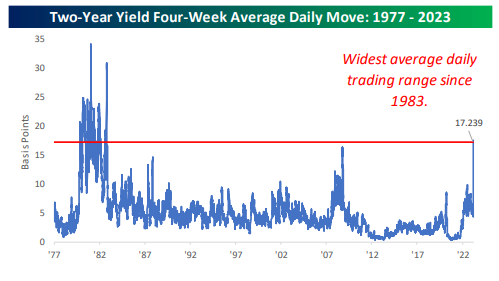
Traditionally, the 2-Year Treasury has been one of the least volatile areas of financial markets, but over the last month, the average daily move in the two-year yield, has been over +17 basis points (bps), the most volatile trading since 1983. Many days saw yields fall by over 50 bps, intraday.

Just over three weeks ago, the two-year yield was +5.1%, it dipped to +3.7% last week and this morning, the yield stands at +4.15%.

We are talking about a US Treasury bond here and not the price of Adele concert tickets!

These moves provide another example of something that’s “broken” in the aftermath of the Fed’s most aggressive tightening cycle in forty years.

Source: Bespoke Invest

The Fed is banking on generalized strength, a robust economic backdrop as well as systemically important US banks having robust balance sheets (unlike the holes they had in 2008), in order to stay on its rate path. A broadening mess in the US banking sector, due to the failure of numerous smaller banks, that cuts credit expansion and jams economic activity, could lead to rapid emergency easing.

Powell emphasized the uncertainty, saying the banking situation “could have very modest effects” on the economy, while also noting the opposite could also be true, thereby leaving the door open for rate moderation. Powell created clear grounds for changing the trajectory of policy conditional on broader pain in the banking sector hitting the real economy.

Small banks play a crucial role in the US economy and, if they fold, the big banks couldn’t fill the gap quickly enough (let alone fill it over time). Small and medium banks account for about 50% of US commercial and industrial lending, 60% of total residential lending, about 80% of total commercial real estate lending, and about 45% of total consumer lending in the US.

The easiest way the Fed can contain regional banks from folding, is by moderating rates lower over time.

The post-Covid world has already reduced the need for commercial real estate, as many employees choose to work from home. Businesses that have still kept office space, in the hope of using it in the future, will have to think hard. If rates stay high, as leases come up for renewal, they may just not be renewed, leaving a stack of non-performing loans on the books of the regional banks. This will force the Fed’s hand very quickly.

On Friday after the close, the Federal Reserve released its weekly snapshot of national bank balance sheets for the week ending March 15, capturing the failure of SVB and Signature Bank. The report shows evidence of deposits flowing away from smaller banks and towards large banks, which is a concern that could imperil regional banks more generally. Large banks saw deposits rise $67bn. Small banks lost $120bn in deposits (the most ever, and a 2.2% decline, the second-largest ever). As for loan growth, the data showed no slowdown for the week across lending categories. That may come later, but at least credit creation hasn’t yet ground to a halt.

Historically, Fed Funds futures tend to under-shoot policy rates at inflexion points. In other words, they price too few hikes during tightening cycles (we saw that this cycle too), and too few cuts during easing cycles i.e. you could see well over 100bps rate cuts this year.

Regular readers of this newsletter will know that I do not see inflation as a problem. On the contrary, disinflation will be a bigger problem, as was the case pre-Covid. Also, given the level of debt in the US economy, a Fed Funds Rate higher than +3 to +3.5%, is unsustainable over the medium to long term.

Markets and the Economy

The key event since last month’s newsletter, is the collapse of SVB, the second-biggest bank failure in US history, with total assets and deposits equalling $212 billion and $173 billion, respectively.

SVB failed because the bank’s management did not effectively manage its interest rate and liquidity risks, and the bank then suffered a devastating and unexpected run by its uninsured depositors, in less than 24 hours. Welcome to the other benefits of online banking – bank runs will happen not at the gates of bank branches, but overnight when branches are closed. Vast sums moved with a few taps on a smartphone.

SVB failed on March 10, 2023. The S&P 500 index is up + 5% since that day.

This “banking crisis” is not your 2008 crisis or Lehman 2.0, as alarmists like to call it. Back then, it was not just a liquidity but also a solvency crisis. Systemically important large US banks were undercapitalised and had too much bad debt on their books. The Fed and lawmakers were slow to realise this problem.

Bear Stearns went under on March 16, 2008, and it was almost 7-month later that the Troubled Asset Relief Program (TARP) – to help stabilize the US financial system, restart economic growth, and prevent avoidable foreclosures – was signed into law by President George W. Bush on October 3, 2008. The first allocation of TARP money was primarily used to buy preferred stock and proved ineffective in stalling the contagion.

On November 12, 2008, US Treasury Secretary Hank Paulson indicated that reviving the securitization market for consumer credit would be a new priority, in the second allotment of TARP and on December 19, 2008, Bush used his executive authority to declare that TARP funds could be spent on any program that Paulson deemed necessary, to alleviate the financial crisis. It was only then that the crisis abated. The hesitation and delay meant S&P 500 index (SPX) kept falling and between March and November 2008, the SPX was down over -40%.

This time around, the systemically important US banks are well capitalised, rules bar them from holding risky assets on their balance sheet (proprietary trading) and the Fed, the Federal Deposit Insurance Commission (FDIC) and the US Treasury, moved quickly in a coordinated fashion, to limit the contagion by guaranteeing all SVB deposits and extending additional support to all banks. Economic activity is not collapsing, and growth is still positive.

Therefore the SPX continues to stay in the range it has been in for the last six months (chart below), while the Nasdaq has also outperformed

1-year price chart: The S&P 500 Index

Source: Bloomberg

There’s another reason why the SPX has held up so well over the last six months – the market is underinvested in equities – as confirmed by the Bank of America (BofA) Fund Managers Survey (FMS) report.

The cash allocation in the report stands above +5.2% in February 2023, whilst the historical average is +4.7%. The cash allocation has remained above the historical average since December 2021.

As rates have risen, cash/deposits have become an alternative but there hasn’t been equity capitulation (chart below from Michael Hartnett of BofA Research)

Data compiled by BofA Research indicate that:

  • Since December 2019, there has been a cumulative inflow of $1.6tn into cash, $1.3tn into equities, $440bn into Investment Grade bonds, and $270bn into US Treasuries i.e. in the 2020s, cash has become an alternative
  • But there hasn’t been equity capitulation thus far. For every $100 of inflow during the last Bull market, no outflow has happened during the current bear market (vs $113 outflow during the GFC of 2008, $53 outflow during the Eurozone Debt Crisis of 2012 and $61 outflow during Covid-19)
  • As you can see, the equity line in the chart below has flatlined since last April– i.e. no net inflow/outflow for over 12 months.

The dry powder packed in deposits will start flowing into equities and other risk assets as we come to the end of the hiking cycle, risk factors abate and sentiments improve.

Yesterday, BofA reported that its client flows to US equities posted their biggest week since October, adding that they bought both single stocks and ETFs, with bigger inflows into stocks. BofA clients were net buyers of US equities for the fourth straight week. BofA is the second largest prime broker, hence their client flows offer useful insights into market sentiments.

Cumulative flows by asset class since December 2019

Meanwhile, the sentiment regarding Emerging Market equities, is already a lot better and keeps improving.

Chinese equities have recouped nearly half their recent losses and the news that Alibaba would likely split into 6 groups- brought additional cheer, with BABA up +10% on the day. The break-up of Alibaba will help unlock value.

The reorganization of one of China’s largest private companies, once valued at more than $800 billion but now worth about a third of that, comes after Chinese authorities signalled in recent months they were winding down a sweeping regulatory clampdown aimed at reining in the country’s powerful tech sector. The return of the government’s supportive stance toward China’s private enterprises is very welcome news.

After more than a decade abroad, Alibaba’s co-founder Jack Ma was spotted back in China on Monday, a co-incidence only if you don’t know how China works. It will be interesting to see if another coincidence is soon announced – Ant’s IPO. Bet on it.

Benchmark Global Equity Index Performance (2022, 2023 YTD and 6 months)

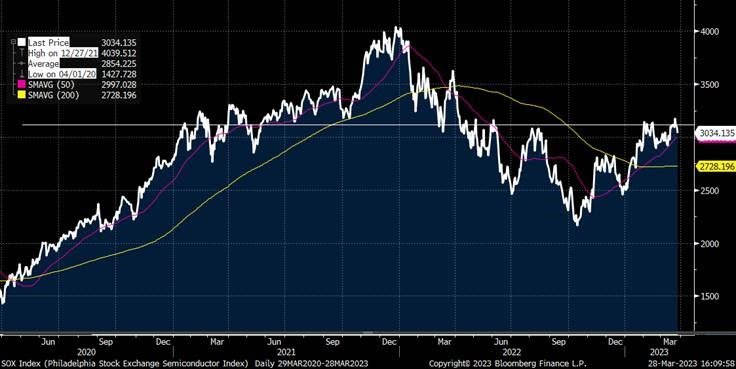
If you are in the pessimist camp, there’s a lot not to like about the market these days, but the performance of the semiconductors, has been an area of optimism.

Last week, the Philadelphia Semiconductor Index (SOX) broke out of a sideways trading range and is not far from its 52-week highs. This, with only 47% of stocks above the 50-day moving average, i.e. there’s more upside to this ETF.

Much of the strength in the semis has been attributed to NVIDIA (NVDA), which has been on fire this year, rallying more than +80% on the explosion of AI-related interest.

Semiconductor stocks, long seen as a cyclical play, may be turning into a secular growth story, particularly if the AI-driven revolution stacks up well over the next few years. One to watch.

3-Year Price chart: The Philadelphia Stock Exchange Semiconductor Index (SOX)

Source: Bloomberg

Another stock-specific news, which indicates earnings are not as weak as some anticipate.

Last week, Nike (NKE), announced a dramatic fiscal Q3 revenue beat of +8% alongside adjusted and diluted EPS +46% higher than forecast. North America and EMEA both grew more than +20% on a constant currency basis thanks to spectacular results in footwear, especially. Very few wanted NKE at $80, now everyone will want it at $120.

Warrant Buffet once said, “be fearful when others are greedy, and greedy when others are fearful.”

At Crossbridge, we chose to be greedy when others were fearful and launched the following product in November 2022 which has an attractive +15.6% coupon, with a Leveraged Put.: 5 Year 15.6% p.a. Decreasing Trigger on Nike, Disney, Pepsi, and Constellation.

The note is currently trading at 101.03, with a carry (coupon) accruing as the product progresses.

My point? You do not have to have a bullish view in order to invest. The beauty of a structured product, is you can “create a product” to suit the prevailing and forecasted outlook.

As I keep reiterating – Structured Products are a very useful means of investing in equities. They offer a degree of capital protection, while at the same time helping pick good entry points in the market, and offering means to clip coupons, in a flat to negative market.

For specific stock recommendations and Structured Product ideas, please do not hesitate to contact me or your Relationship Manager.

I continue to be risk positive and even though I expect rate cuts this year, a no-rate-cut outcome, wouldn’t bother me if the economy grows well and rate cuts were delayed for that reason.

Pessimism makes for stories and WhatsApp forwards, but unattractive for portfolio returns.

If you have a medium to long-term investment strategy and you don’t use leverage then you have little to worry about and build your portfolio with the right selection of products and structures. We are here to help. So, please do get in touch.

 
Best wishes,

Manish Singh, CFA


Inflation
Inflation in United States

Inflation peaked last June. The Fed risks killing “aggregate demand” if it doesn’t change course on rates.

Summary

The “Inflationists” won the inflation debate in November 2021, but their victory was “transitory”, as US inflation peaked seven months later in June 2022, at +9.1%. It currently sits at +6.4%, annualising at +3.2% over the last seven months. The US Federal Reserve’s effort to cool inflation, is not only working, but has worked its way through to the point where the focus should now shift from inflation to growth.

Raising interest rates further could easily sacrifice “aggregate demand” and kill the US economy’s clearest bright spot in recent years—a strong job market. A recession leading to inevitable rate cuts would undo the progress made so far by the Fed in coming out of “zero rates.” It would be better to focus on the medium-term trend in data, than to panic with one print which is above expectations.

We all should take heart that in Fed Chair, Jerome Powell we have a person who is less academic and more practical, thus well suited to ignoring the baying mob and staying focused on economic growth, just as much as inflation, and seeing through the “transitory” impact of Covid-19 on the inflation numbers.

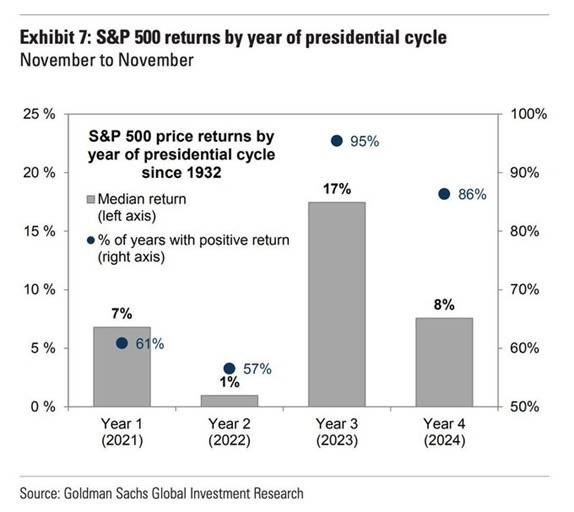
We are in the favourite part of the US Presidential cycle. The third year of a Presidential cycle tends to be the most bullish for US equity markets, with a median return of +17% with positive returns an incredible 95% of the time. It’s no surprise then that the equity markets have held up well over the last two months. Easing inflation and seasonality both doing their job to keep getting the dip buyers at every opportunity. Melt-up (with some sideways moves) is the trade, whether the equity bears like it or not.

“Inflationists” won the inflation debate in 2021, but…

Over the past 12 months, as the US Federal Funds Target Rate (FDTR) climbed to +4.75% from +0.25%, inflation sparked a furious debate that turned into an obsession within the commentariat.

Between March and November 2021, the US Consumer Price Index (CPI) rose from +2% (the US Federal Reserve’s target inflation rate), to +6.5%.

At the November 22, 2021, Federal Open Market Committee (FOMC) meeting, Fed Chair, Jerome Powell announced that the Fed would stop characterizing the high US CPI prints as “transitory.” The inflationists, led by the likes of former US Treasury Secretary Larry Summers, took a victory lap, and rightly so.

The “Inflationists” won the inflation debate, but their victory was “transitory,” as US inflation peaked seven months later in June 2022, at +9.1%. It currently sits at +6.4% (annualising at +3.2% over the last seven months – a lengthy enough timeframe to reach such a conclusion.)

The November 2021 announcement by the Fed, was largely symbolic, as the Fed’s job is to manage “expectations.” You don’t expect a central bank to be alarming in its communication. It leaves that to politicians and the talking heads on television, who love sensationalism more than rationalism, and rarely, if ever, have “skin in the game.”

We are now almost in the Spring of 2023. Inflations peaked eight months ago and since then, inflation has been coming down steadily, yet some continue to agitate for a higher Fed Funds Rate.

As recently as last week, Summers doubled down by saying, “the Federal Reserve’s efforts to cool inflation aren’t working as well as hoped.”

I would say:

  • US CPI is down from +9.1% to +6.4% (and annualising at +3.2% over the past seven months)
  • The US yield curve has inverted to an extent not seen in the last 40 years
  • The risk of a recession is rising
  • Goods prices are in disinflation
  • Housing starts have declined for nine months in a row

All the above, are signs that the Fed’s effort to cool inflation, is not only working, but has worked its way through to the point where the focus should now shift from inflation to growth.

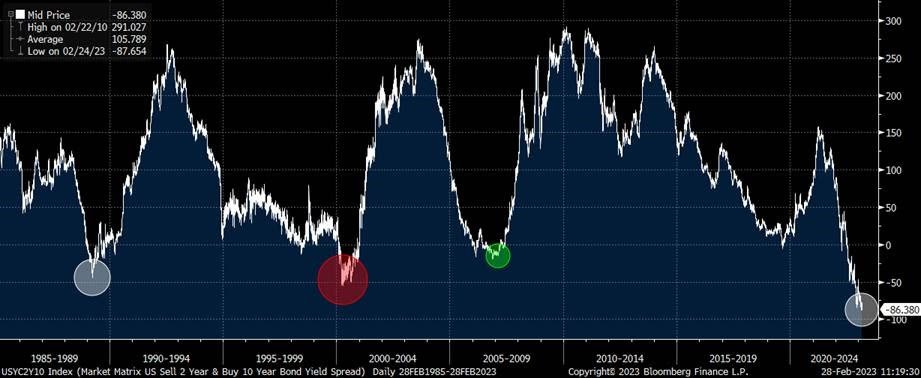
The Fed has raised short-term rates to such a high level that the spread between 2 year and 10 year Treasurys (chart below) at -86 bps, is at a worse level than the one observed in 1987 (Russian default, Asian financial crisis, Long Term Capital Management(LTCM) collapse), in 2000 (the Dotcom crisis) and in 2007-08 (the Great Financial Crisis).

US Treasury 10-year yield minus US Treasury 2-year yield

Source: Bloomberg

Besides, there’s more to the headline CPI number than meets the eye. So, let’s take a closer look at the CPI data:

  • The core goods inflation is already negative, and volatile energy prices have collapsed. The only thing keeping headline CPI high is “shelter”. Shelter makes up 34% of the US CPI basket and remains stubbornly high at over +9%. However, crucially, the shelter data lags the actual housing/rental market data by 8-12 months
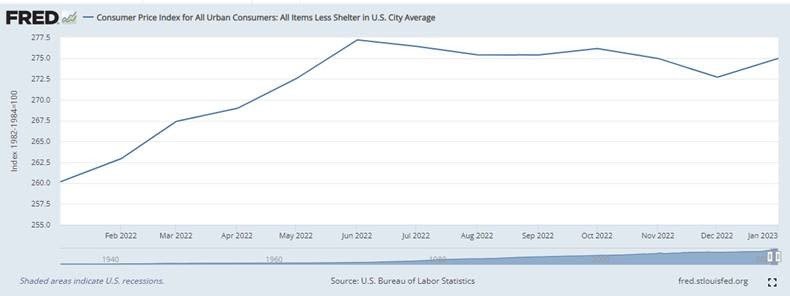
  • The CPI ex-shelter data (chart below) is already in disinflation. as of June 2022 to the current data. From June 2022 to January 2023, CPI ex-shelter, is annualising at i.e. -1.6% p.a. i.e. disinflation

US Consumer Price Index (all items, ex-shelter)

Source: US Bureau of Labour Statistics (BLS)

So, “shelter” should peak and roll over during the March -June 2023 period.

What happens to headline CPI data once its largest component normalises/ goes negative, as the current rental data indicates? Disinflation is the answer. The Fed knows “disinflation” is what it will have deal with for years to come, and it has set in already.

If this is not a sign that the Fed has done enough and the focus should stay on growth, then I don’t know what is. Thankfully, the Fed is not run by the likes of Summers, else we’d be in an economic depression now, due to policies to combat “inflation” brought on by transitionary factors.

Regular readers of this Newsletter will recall my concern that “disinflation” is where we are headed, and the short bout of inflation we have seen, is the result of Covid-19 and the accompanying fiscal spending.

Those still demanding the 1970s “Volcker shock” ought to read this newly published paper. The researchers at the Fed have concluded that Covid caused a “demand reallocation shock,” not a startling conclusion you might say. What’s more interesting is this – the reallocation shock “is able to explain a large portion—3.5 percentage points—of the increase in US inflation, post-pandemic.”

Covid-19 didn’t lead to an increase in “aggregate demand” to a new level. It shrunk “aggregate supply,” as fewer goods were made globally, due to Covid-induced disruptions. As restrictions eased, supply has caught up and inflation declined. Why then still this obsession with inflation you might wonder, even as there’s plenty of evidence that inflation has peaked. There’s a simple explanation.

Last time the world worried about inflation, was in the 1980s when the then Fed Chair Paul Volcker raised rates to +20% to curtail inflation plunging the US economy into its worst recession since the end of World War II. For much of the last four decades, inflation has taken less of macroeconomists’ and policy analysts’ time, so much so, that they are now in danger of overdoing it with their prescription to deal with a short-term burst in inflation.

However, could the inflationists force the Fed’s hands to take interest rates to +6%?

The probability of this happening is low, however, I wouldn’t bet against it, as the market did force the Fed’s hand in June last year.

Last June, as the CPI vaulted to +9.1% and the inflation-is-here-to-stay noise grew, the Fed hiked rates by 75 bps (after hiking 50 bps in May). It was the first of four 75 bps hikes last year. It’s worth noting that the CPI has been in decline ever since that June print.

What I am certain about is that if the Fed Funds Rate gets to +6%, the rate cuts that ensue will be much deeper than currently anticipated – most likely over 200 bps when the cuts start.

Data released on Friday by the US Commerce Department indicate that the Fed’s preferred inflation gauge—the Personal-Consumption Expenditures (PCE) price index—rose +5.4% in January from a year earlier. The PCE core index, which excludes food and energy and is seen as a better predictor of future inflation, rose by +4.7%.

Both readings, were on the higher side of the market’s expectations, so expect the clamour for a 50bps hike at the next Fed meeting on March 14 to grow.

Markets will continue to be in panic mode with every data that prints hotter than expectations.
Importantly, the Fed doesn’t expect inflation to slow down quickly, and they’ve already said so. The Fed’s Q4 2023 core PCE inflation forecast is +3.5% y/y which is very achievable.

The core PCE with new rent data (swapping in new rents for all rents using the Zillow and Apartment List numbers) is already at +3.4% i.e. the Fed will not be in panic mode and they have started using “disinflation” in communication and have guided for a 25bps increase.

We all should take heart that, in Powell, we have a person who is less academic and more practical, thus well suited to ignoring the baying mob and staying focused on economic growth just as much as inflation and seeing through the “transitory” impact of Covid-19 on the CPI prints.

In my opinion, the Fed will see through the noise in the January data. Besides, the Fed has only just locked in one 25bps hike given the language change in its last statements “in determining the extent of the future increase in the target range, the committee will take into account the cumulative tightening of monetary policy, the lags with which monetary policy affects economic activity and inflation and economic and financial developments.”

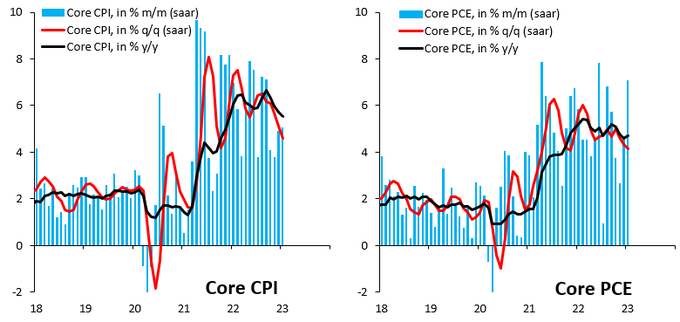
As the chart below indicates, whatever the quibbling and noise in the data, disinflation in core CPI (left hand side) and the PCE (right hand side) is happening.

Core US Consumer Price index (CPI), & core Personal Consumption Expenditure (PCE)

Source: Robin Brooks, Institute of International Finance (IIF)

Raising rates further could easily sacrifice “aggregate demand” and kill the US economy’s clearest bright spot in recent years—a strong job market that is delivering higher gains to low – and moderate-wage workers. If the “transitory” inflation of the past 20 months forces the Fed to push the economy into a recession, then it would undo the progress made so far by the Fed in coming out of “zero rates.”

Melt-up (with some sideways moves) is the trade, whether the equity bears like it or not. That’s the reason the S&P 500 has held up so well in face of better-than-expected US Jobs report, a higher headline CPI report and better than expected Retail sales number. It’s better to focus on the medium-term trend in data than to panic with one print which is above expectations.

Markets and the Economy

Did the S&P 500’s (SPX) closing low in October last year, mark the start of a new bull market (20%+ rally on a closing basis without a -20% decline in-between)?

From the Bear’s perspective, it hasn’t been a convincing rally. More than four months past the October lows, the SPX is only up +10.8%, and its maximum gain was +16.9%. Here we are 135 days removed from that October low, and the SPX still hasn’t reached the +20% threshold for a bull market. The Bears do have a point, even if it’s purely observational. To find a bull market, where it took the SPX longer to reach the +20% bull market threshold, one must go back to 1962. The ten bull markets between then and now all reached the +20% point faster.

I am reminded of what the great pragmatist and former Chinese leader Deng Xiaoping, famously said, “it doesn’t matter if a cat is black or white, so long as it catches mice.”

So, as someone who believes we are in an uptrend in SPX, it doesn’t matter if the number of days to get to +20% is 140 days or 200 days, so long as the trend continues and the market keeps ticking up with some sideways consolidation.

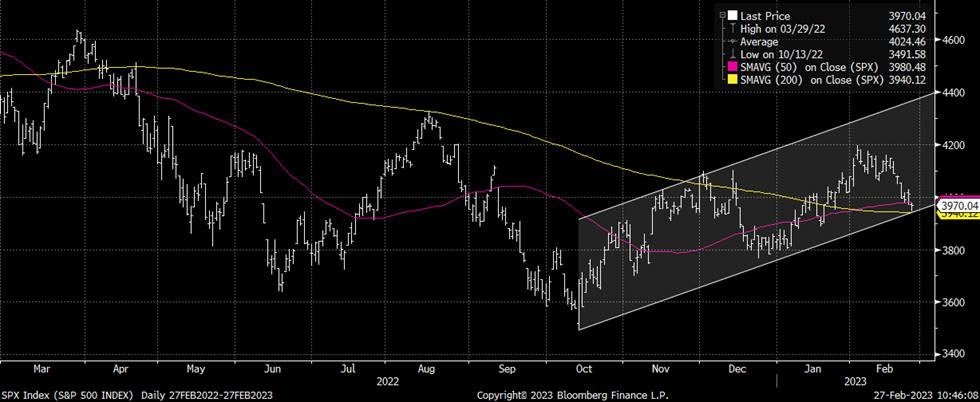
Take a look at the chart below. There’s little doubt that the downtrend in place for much of last year has been broken (a very constructive development from a technical perspective) for well over four months, and we are in a steady rally. A well-defined short-term uptrend is in place for the SPX.

The 50-day and 200-day moving averages have held up well. In technical analysis, we like to say “old resistance becomes new support” and we’ve seen a great deal of that since last October.

The economic data backdrop looks steady, as PMI data around the world has started to perk up, China’s reopening offers the hope of a further normalization of supply chains and global activity, and central banks globally seem to be nearing peak hawkishness for the cycle.

S&P 500 Index – 12-month price chart

Source: Bloomberg

You may be sick of politics and political shenanigans. You may not be interested in voting for either the Democrats or the Republicans. However, if you are holding US equities, then you can’t ignore the statistics during the third year of the US Presidential cycle.

We are in the favourite part of the Presidential cycle. As the chart below from Goldman Sachs research indicates – the third year of a Presidential cycle tends to be the most bullish for US equity markets, with a median return of +17% with positive returns positive an incredible 95% of the time. Intuitively, this makes sense, as US Presidents begin eyeing re-election in the third year of their first term, and promote growth and market-friendly policies to boost their chances of re-election.

Whatever the reason, going back to 1932, when Democrat Franklin D. Roosevelt defeated Republican Herbert Hoover in the race for the White House, the stock market performance in the third year of the Presidential cycle has been impressive. This is a statistic that mustn’t be ignored.

A key point that the table below doesn’t indicate yet is significant:

  • The first six months of the third cycle year have averaged a gain of +12.6%, with all 18 of the returns being positive. The second half of the third year has averaged a much softer return of +3.93%. So, if you are still waiting for that market drop then you’ve missed the Jan month impressive return and you might miss the whole of H1 if you don’t act fast

And if you are wondering how the third year performed, after stocks suffered in the prior year? Then the stats are even more impressive.

  • The third year of the cycle has seen a big bounce-back. In the eight years that the second year of the cycle was negative for the SPX, the third year averaged a gain of nearly +25%, with all eight returns positive. By comparison, after a positive second year in the cycle, the index averaged a gain of approximately +10% in the third year with a positive return 80% of the time.

It’s no surprise then that the equity markets have held up well over the last two months. Easing inflation and seasonality both doing their job, to keep getting the dip buyers at every opportunity.

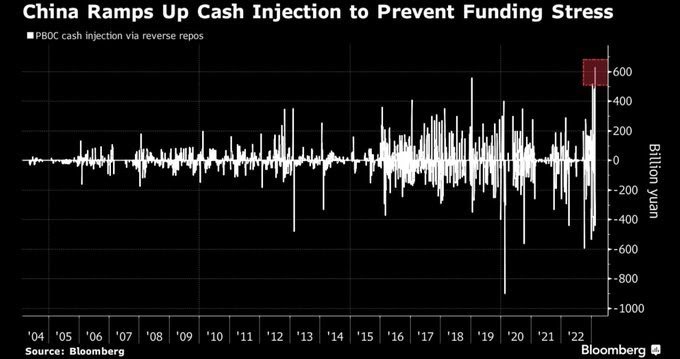
What’s even more impressive is the performance of Chinese equities, as China has fully re-opened after the Covid lockdown. China’s central bank, the People’s Bank of China (PBoC), is injecting a record amount of liquidity (chart below) into the market. On the 15th of this month, the contents of President Xi Jinping’s speech at China’s central economic work conference in December last year, were published in the party journal, Qiushi.

Titled “Several Major Issues in Current Economic Work”, the speech emphasises on expanding domestic consumption – “Prioritize the recovery and expansion of domestic consumption this year… consumer credit support should be reasonably increased .. the need to innovate consumption scenarios, and fully release consumption potential. The need to increase the consumption capacity of low and middle-income residents who have a high propensity to consume but are greatly affected by the epidemic. Rolling out policies aimed at stimulating spending on housing and unlocking consumer savings.”

Source: Bloomberg

Unlocking consumer savings is the crucial point. According to figures from the PBoC, Chinese savers had bank deposits totalling US$2.6 trillion in 2022, up a whopping +80% from 2021.
It also bodes well for Chinese equities.

Post-Covid China is a very different China and it is amped for plenty of growth and change. A growing China, with a larger consumer base bodes well for the European economy, particularly one which counts China as its major export destination.

Joe Ngai, Chairman of McKinsey & Co. Greater China put it best – “if China’s GDP grows at a conservative +2% annually for the next 10 years, the total cumulative growth will be equal to India’s GDP today. If China’s GDP grows at +5%, the total cumulative growth for the next 10 years will be equal to todays’ GDPs of India, Japan and Indonesia are put together. If you are looking for growth the answer is very simple – the next China is China.”

It’s not just China that is easing, but Japan too.

The market is failing to consider the scale of easing/liquidity injection in both China and Japan, the second and the third largest economies in the world, respectively.

After an equity market correction of -63% from February 2021 to October 2022, Chinese equities are up +53% since their October lows and the Chinese Yuan is stronger by +7%,

More economic growth lies ahead.

Benchmark Global Equity Index Performance (2022, 2023 YTD and 3 months)

Source: Bloomberg

With short-term rates pricing in Fed Funds at well over +5%, earnings yields are only slightly above 6-month US Treasury bill yields.

With so much return available risk-free at the front of the curve, equities have work to do keeping valuations high enough amidst falling earnings estimates.

This is where Structured Products become a useful means of investing in equities. They offer a degree of capital protection, while at the same time helping pick good entry points in the market, and also offer means to clips coupons in a flat to negative market.

For specific stock recommendations and Structured Product ideas please do not hesitate to contact me or your relationship manager.

 
Best wishes,

Manish Singh, CFA

“The US headline inflation at +6.5% doesn’t convey the full picture of where inflation is headed. Inflation is crashing. The new bull run may already be here”

Summary

The new Bull market is already here – Chinese equities, the EuroStoxx 50 and Emerging Market equities – have broken their downtrend and are up more than +20 to 30% from their recent lows. However, there is no Bull market for US equities yet.

The relaxation of China’s strict zero-Covid policy has boosted the economic growth prospects and the likely export prospects of the Eurozone. Add to this, the warmer weather in Europe, which has helped temper the intensity of the energy crisis feared over the last quarter, and Europe may actually avoid a recession by the looks of things and the US may experience one. How ironic would that be?

After negative returns in 2021, last year, US Treasuries, arguably, the safest asset in the world, returned -17%. Their worst returns since the State of Massachusetts ratified the United States Constitution and became the sixth US State in 1788. In their 250 years history, US Treasuries have never had three consecutive years of negative returns. So, it’s safe to conclude (and history is onside) that 2023 will be a positive year for investment in US Treasuries. The US is nearing the end of the interest rate cycle and rate cuts lie ahead.

Given how negative sentiment is towards economic growth and US equities, the biggest contrarian trade for 2023 would be: The US avoiding a recession as the Fed relents and does not raises rates to +5.25%. The S&P 500 in such a case could have a +20% year.

The US ISM index has continued to drop, the OECD leading indicators have dipped into contractionary territory, yield curves have inverted, recession talk is everywhere…and yet over the last three months, copper prices have risen +28%. Dr Copper seems to be telling us something. China’s re-opening is a big boost to the global economy and copper prices. This, in my view, is the key macro development that will have a profound effect on asset prices this year. So stay tuned!

Skate to where the puck is going to be…not where it has been

Equity markets have started the year on a positive note with European, Chinese and Emerging Market (EM) equities, continuing to build on their rally that began in Q3 last year.

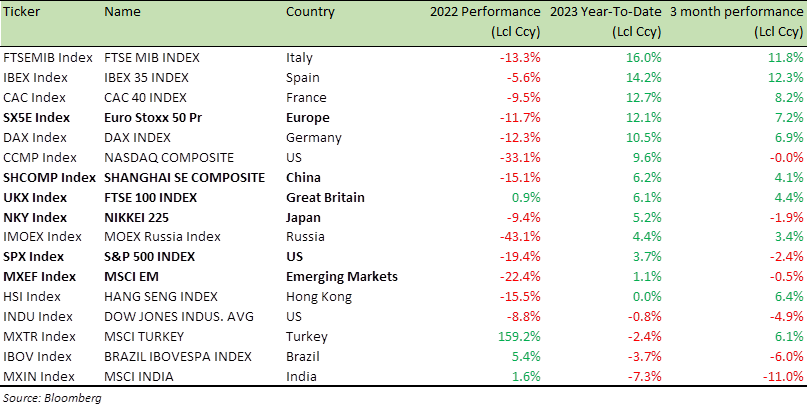
The new Bull market is already here – Chinese equities (ASHR) are up over +30% from their lows, the EuroStoxx 50 (SX5E) is +26%, and the MSCI Emerging Market Index (EEM) is +24%, as they have all broken their downtrend.

However, there is no Bull market for US equities yet. The S&P 500 (SPX) and the NASDAQ (QQQ) are up +12% and +10% respectively from their October lows. The focus in the US still seems to be on inflation and interest rate hikes by the US Federal Reserve (Fed).

If the US does experience a recession, much of the blame will rest with the Fed, which has continued to raise rates, despite all signs that inflation is not only under control, but has collapsed.

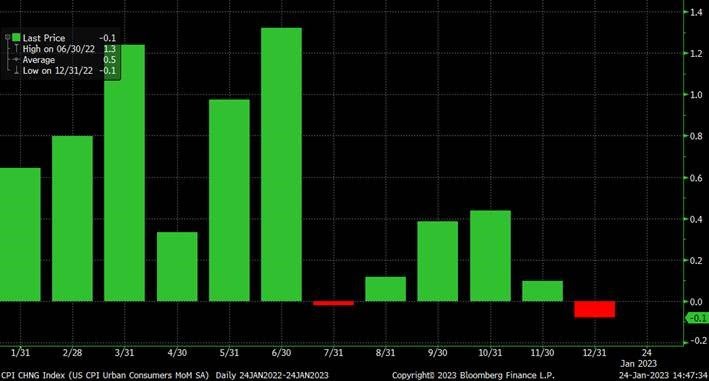
Let’s look at the data for US inflation. The chart below lays out the month-on-month change in the US Consumer Price Index (CPI) index, a measure of US inflation.

A glance at the chart will tell you that the six-month prints from July 2022 to December 2022 couldn’t be more dissimilar from the prior six-month prints.

US Consumer Price Index (CPI) month-on-month change – 1 year chart

Source: Bloomberg

The US CPI hit a 40-year high in June last year, after months of sustained price increases. However, since then, the monthly gains have slowed down sharply.

US Inflation has declined over the past three to six months, due largely to falling energy prices and prices of goods, such as used cars. There are certain signs that soaring rents and other housing costs are cooling, amid a sharp slowdown in demand, although this isn’t expected to show up in official CPI measures, until later this year, such is the quirkiness of the CPI calculation.

A simple calculation will reveal:

  • The US CPI annualised at +10.4% in the first half of 2022, and
  • The US CPI annualised at +1.8% in the second half of 2022 which is close to the average annual inflation rate of +1.7% between 2010 and 2020

Taken together, it left the headline inflation at +6.5%, which still doesn’t convey the full picture of where inflation is heading.

One should be more concerned about where inflation is heading and not where it is. As the ice hockey great Wayne Gretzky once said: “A good hockey player plays where the puck is. A great hockey player plays where the puck is going to be.”

The “inflation puck” is already below the Fed’s target rate of inflation of +2%.

The Fed has continued to sound hawkish and kept the relentless focus on the headline number, as it seeks to overcompensate for past mistakes. This has led many to stay focused on rate hikes rather than see the impending pause, followed by rate cuts, as data deteriorate.

In my opinion, there is no need for the Fed to raise rates any further. However, I don’t run the Fed and therefore, I reiterate what I wrote in the December Market Viewpoints – “The Fed will be forced into cutting interest rates in Q3 as it responds to recession.”

The more the Fed raises rates from here, the more it begets a recession and rate cuts down the line. The market knows this and as such, you have seen a steady rally in risk across asset classes.

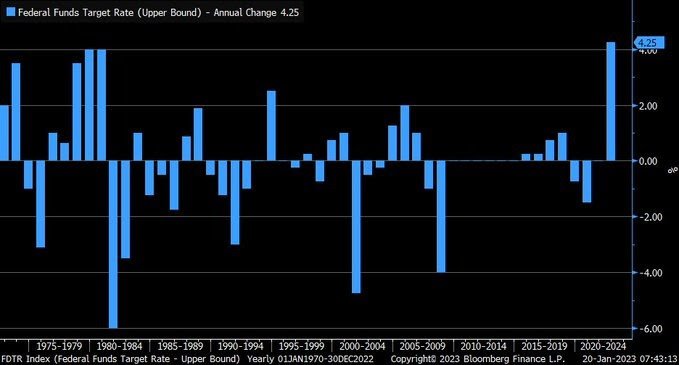
When looking at annual change (chart below), 2022 marked the most aggressive (largest) move for the Fed Funds Rate in the last 50 years.

The US Federal Funds Target Rate (upper bound) – Annual change

Source: Bloomberg

Financial conditions are very tight and the economic data isn’t getting any better.

Earlier this week, the crucial Conference Board’s Index of Leading Indicators reading (chart below) dropped -1.0% versus already weak expectations of a decline of -0.7%.

Not only that, but November’s reading was also revised down from -1.0% to a drop of -1.1%

  • On a Year-on-Year (YoY) basis, the index of Leading Indicators is now down -7.4%, the weakest YoY reading since the Covid-19 lockdowns and the level we saw during the 2008-09 recession induced by the Great Financial Crisis (GFC)
  • The chart below shows the YoY change in Leading Indicators since 1963 with the red line indicating the level as of December 2022. Since 1960, there has never been a time when the YoY reading was as low or lower than it is now and the economy wasn’t in a recession
  • There were also two other periods where the economy had a recession, and the YoY change wasn’t even as negative as it is now

December’s decline in the index of Leading Indicators was the third straight month of over -1% drops. In every prior period since 1963, where there were at least two consecutive month-on-month declines of at least -1%, the economy was already in a recession.

Source: Bespoke Invest

Are we already in a recession?

Well, the data is weak across the board. However, in the current President Joe Biden economy, two conservative quarters of negative GDP isn’t considered a recession. Additionally, the employment leg is still holding strong and consumers are still spending the savings they accumulated during the recent lockdown.

That being said, I have no doubt that the Fed must be getting worried about the recessionary indicators turning a brighter shade of red.

The Fed will very likely increase rates by +0.25% next week. That increase would bring the Fed Funds Rate to a range between +4.5% and +4.75%.

Most Fed officials projected in December that rates would rise to a peak between +5% and +5.25%. That would imply two more +0.25% increases, after the likely increase next week.

A Fed Funds Rate at +5.25% is not my base case and rates at that level will make a US recession even likelier. However, I do see a scenario in which Fed does take rates to +5.25%.

The Fed has rightly turned its focus recently toward a narrower subset of labour-intensive services, by excluding prices for food, energy, shelter and goods.

Inflation in this narrow category is running at +4.4%, up from around +2.3% on average between 2010-19. This data will reveal, if higher wage costs are passing through to consumer prices.

If services inflation is high, because pay checks are rising in lockstep with prices, then Fed officials would want to see more hiring slowdown to avoid a 1970s-style wage spiral setting in i.e. rates will have to go higher, possibly to +5.25%, unemployment will rise and wages will moderate. The US jobs market has been tight, with an unemployment rate of +3.5% in December matching multidecade lows.

In such a scenario, a US recession is even more likely than it already is, given a lot of growth data is already flashing red.

I maintain that rates will have to be cut in the second half of this year by as much as 150 bps (if not more), as a recession ensues.

Markets and the Economy

Fashionistas will tell you that Europe sets the trends. This certainly seems to be the case as far as equity markets are concerned, with the Eurostoxx 50 (SX5E) outpacing the S&P 500 (SPX) by a wide margin (see table below). It goes to show what “unloved/oversold” assets can do when they change course.

Benchmark Global Equity Index Performance (2022, 2023 YTD and 3 months)

The relaxation of China’s strict zero-Covid policy has boosted growth prospects and likely export prospects of the Eurozone. Add to this, the warmer weather in Europe, which has helped temper the intensity of the energy crisis feared over the last quarter.

On economic activity front, on Tuesday, S&P Global said its composite output index for the US, a closely watched survey of business activity, was 46.6 in January, a slightly better reading than December’s reading of 45. In Europe, however, the index rose to 50.2 from 49.3. A reading above 50 points to an expansion, while a reading below that level points to a contraction.

Europe may avoid a recession by the looks of things and the US may experience one. How ironic would that be?

One clear explanation for all this – the difference between Eurozone and US monetary policy

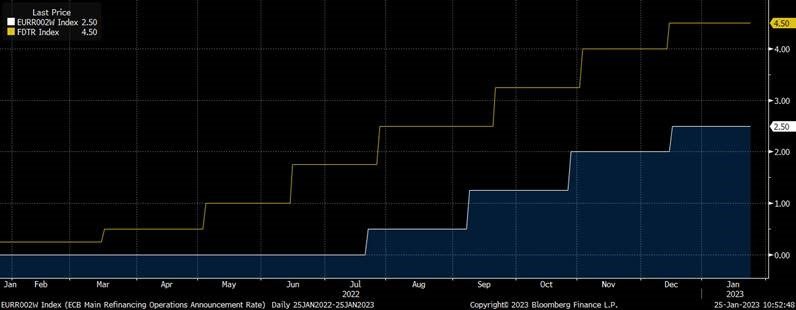
In the Eurozone, interest rates didn’t start increasing until July, and we have seen a total increase of +2.5% (see chart below).

In the US, rates started increasing in March, and we saw an increase of +4.5%. The US got to +2.5% rate when the Eurozone was still at 0% in July. If there’s one consolation – rates in Europe have further to rise, perhaps another +0.75% to +1%, while the US may be nearing the end of its rate-increase cycle.

12-month chart – ECB main refinancing rate and US Fed Funds Rate

Source: Bloomberg

As the trade-weighted US dollar (DXY) has pulled back -9.5% from its high in September, Emerging Market currencies versus the US Dollar have risen over +10%, on a total return basis. As a result, over the last three months, Emerging Markets equities (EEM) have outperformed US equities (SPX) by over +20%.

Also, if rates were to go higher in the US, then other markets will have consternation too i.e., no rapid rise in equities to a higher level.

As I wrote in my December Newsletter, I see a +10% year for US equities, and we have seen half of this already.

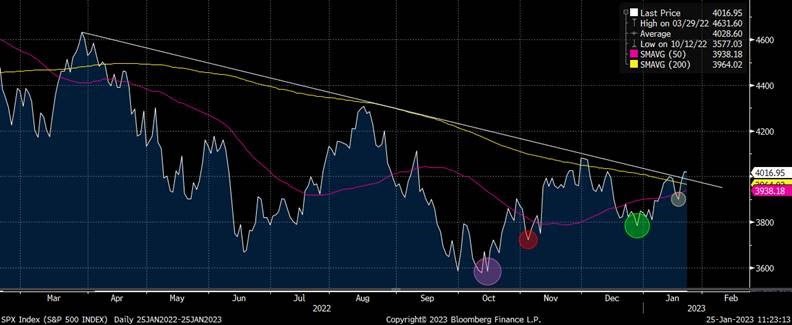
Technically, a lot is going on for the SPX (see chart below).

A clear break above the 200-day moving average (DMA) will be very positive for the SPX. Also, what we have seen recently are higher lows (filled circles in the chart below), a sign that momentum is building up.

I do not see new lows (barring an inflation spike, and a re-aggressive Fed). A rip-roaring rally can be ruled out as long as recession fears overhang. Not until the Fed indicates it is willing to cut rates, will you see a stable up-trend.

Until then clipping coupons and investing in income strategies on a basket of oversold/attractively priced equities or broad market equity indices are sensible trades to do.

1-year price chart: S&P 500 Index

Source: Bloomberg

US Treasuries’ (10 Year US Govt bond), arguably the safest asset in the world, returned -17% in 2022. This is its worse return since 1788. Yes, you read that correctly, the worse return since Massachusetts ratified the United States Constitution and became the sixth US State in 1788.

2022 was also the second year in a row of negative returns for US Treasuries. In their 250 years history, US Treasuries have never had three consecutive years of negative returns.

So, it’s safe to conclude (and history is onside) that 2023 will be a positive year for investment in US Treasuries. The US is nearing the end of the rate cycle and rate cuts lie ahead.

By the same reasoning investment in investment grade bonds – 2 to 5-year duration – seem to be a sensible trade. The Investment grade yield curve, at the shorter end, is more elevated and offers investors an attractive yield of +4% to +5%. Besides, any future rate cuts will impact shorter end 2y bonds more than the 10y bonds.

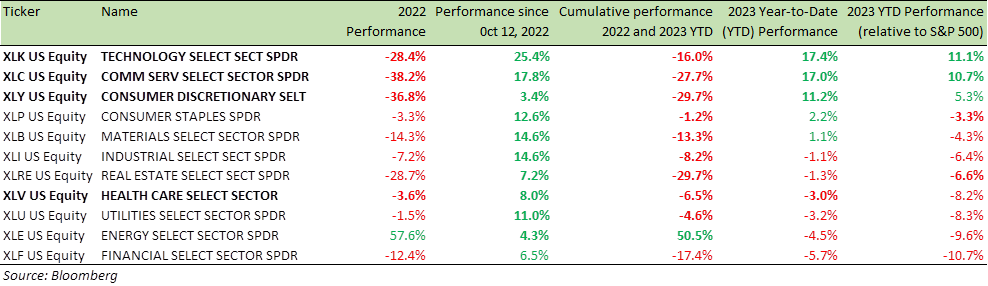
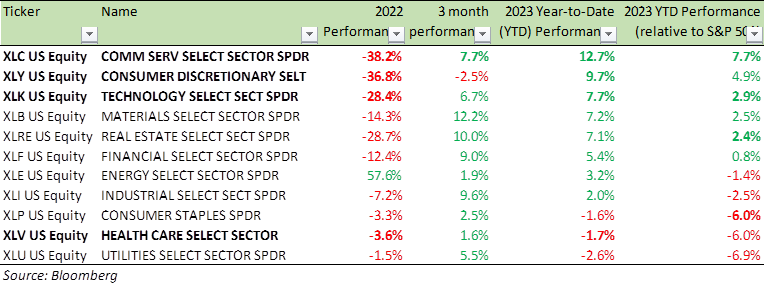
Benchmark US equity sector performance (2022, 3 month, 2023 YTD and 2023 YTD relative to the S&P 500 index)

Former UK Prime Minister Margaret Thatcher once said – “Nothing is more obstinate than a fashionable consensus.”

Given how negative sentiments are towards economic growth and US equities, the biggest contrarian trade for 2023 would be: The US avoiding a recession as the Fed relenting and not raising rates to +5.25%. The S&P 500 in such a case could have a +20% year.

Let me give you something to chew on as you, if only briefly, dwell on this constructive/bullish view.

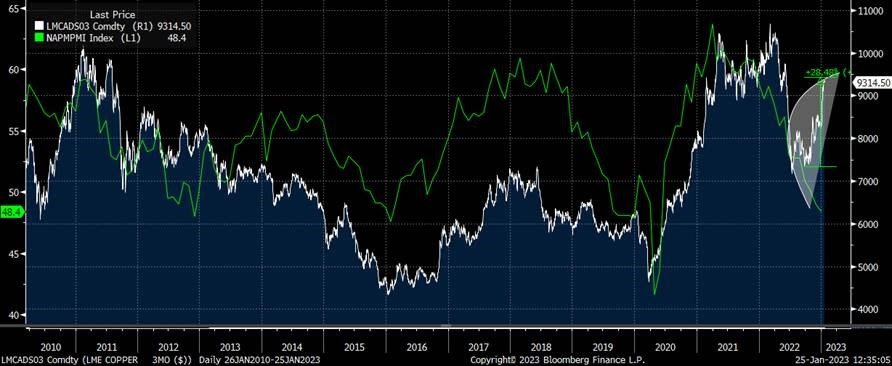
Copper is often described as “the metal with a PhD in economics” as it forecasts economic expansion and contraction. The chart below plots the price of copper alongside the US ISM Manufacturing PMI index, one of the most reliable monthly indicators of US economic activity.

The ISM index has continued to drop, the OECD leading indicators have dipped into contractionary territory, yield curves have inverted, recession talk is everywhere … and yet over the last three months, copper prices have risen +28%.

Dr Copper seems to be telling us something. China’s re-opening, as it abandoned its misguided zero-Covid policy, is a big boost to the global economy and copper prices. It is the key macro development that will have a profound effect on asset prices this year.

Chinese mortgage rates are at record lows, household cash piles are at record highs, and the Chinese government has scrapped its “three red lines” which restricted bank lending to the real estate sector. The resulting demand boost by itself, could explain the sudden rebound in copper prices and hence economic activities.

So, I would caution against too much pessimism.

Price chart: Copper and ISM Manufacturing PMI index (NAPMPI)

Source: Bloomberg

And here’s some data to mull over as you make up your mind:

  • The S&P 500 has historically posted stronger gains in February and for the remainder of the year when January has been an up month
  • Including 2023, there have been 13 years since WW2 where the SPX gained in January after posting declines in the prior year. Those years have seen a strong rest-of-year return with an average gain of +16% from the end of January through December and positive returns 10 out of 12 times.
  • In the eight prior years since WW2 where the SPX gained at least +4% in January, after posting a decline in the prior year, the index rallied at least +10% for the remainder of the year all eight times with an average gain of +21%

The SPX is currently up +4.6% month-to-date after falling -19.4% in 2022. With four trading days to go this month, let us hope this gain is maintained.

For specific stock recommendations and Structured Product ideas please do not hesitate to contact me or your relationship manager.

 
Best wishes,

Manish Singh, CFA

The Fed Funds rate is expected to get to +5%. The US economy will likely enter a recession by mid-2023 and the Fed will be forced into cutting interest rates in Q3.

Summary

Europe is not out of its energy crisis and a long spell of severe cold weather could make it worse in Q1 of 2023 as well as the winter of 2023, when storage would run low. It will take more than warm words from the politicians in charge to avert a major recession next year on the Continent.

Over in the US, the recent bout of high inflation, precipitated by two key factors – excessive money supply growth, and self-inflicted supply-side restrictions driven by lockdowns, are now in the rear-view mirror. Inflation is falling and money-supply growth is now flatlining. However, with the US Federal Reserve (Fed) still insistent on raising rates from current levels, the fate of a US recession in 2023 is sealed. The US economy will likely enter a recession by mid-2023 and the length and depth of this recession will depend on how quickly the Fed responds.

The Fed will be forced into cutting interest rates in Q3 as it responds to the recession. The Fed Funds rate -currently at +4% and expected to get to +5% – will end 2023 in the +2.75% to +3% range i.e. a 200bps rate cut over Q3-Q4 2023 levels.

A recession doesn’t have to be doom for equities and markets tend to bottom before recessions start. Market sentiment towards equities continues to be bearish. If you turn bullish when everyone else is bullish, then you are buying late in the cycle. There is an opportunity cost to it which accumulates over time. Instead, I recommend you focus on equity market internals and invest in tranches over time. In my opinion, we saw the bottom on the S&P 500 at the 3600 level in June 2022 when inflation peaked at +9.1%. My end-of-2023 target for the S&P 500 is 4,290 i.e., +10% up from current levels.

The record US Dollar rally that we have seen this year ran out of steam in October. The US Dollar will continue to weaken, as concerns about the US economy grow and inflation fears recede further in Q1 and Q2 of next year.US dollar weakness will certainly help earnings for companies that generate a large portion of their revenues outside of the US.

“Baby It’s Cold Inside”

Temperatures are plummeting across Europe and it is -3 degrees today in London, as I write this note.

The arrival of a wintery storm “Troll of Trondheim” is expected to bring snowfall to the UK over the weekend. It is getting colder by the day. Meanwhile, energy prices remain extremely high.

Thankfully, it is also the time of the year when Christmas/wintery songs take over the airwaves, so there is some cheer in the air. It’s safe to say, that if you are not living in a cave, you’ll likely hear Baby, It’s Cold Outside a few times over the rest of December.

The song won the Academy Award for best song in 1950 where it featured in the film “Neptune’s Daughter” starring Ricardo Montalban and Esther Williams. In one scene, as Esther tries to stand up, Ricardo pulls her back down by tugging her arm, points to the cold weather outside and serenades her with – baby it’s cold outside – to persuade her to stay.

High energy costs and the drive to reduce energy bills this winter in Europe, may see this now Christmas classic – baby it’s cold outside – turned on its head as Esther responds to a lovestruck Ricardo’s overtures with – baby it’s cold inside. And who would blame Ricardo if he didn’t have proper heating on?

Gas prices in Europe are still five times as great as what is considered to be normal levels.

Europe is not out of its energy crisis and a long spell of severe wintry weather could make the energy crisis worse in Q1 of 2023 as well as for the winter of 2023, when storage would run low. It will take more than warm words from the politicians in charge to avert a major recession next year on the Continent.

In the UK, the government has approved the first new coal mine for 30 years in Cumbria. I hope other governments across Europe follow the lead and deal with the energy crisis which could devastate industry, life, and livelihoods. Those focusing on 2050 and “net zero” would agree that we need to make it through 2023 first.

If there is one thing that has concerned the markets more than anything this year, it is inflation.

As we head into 2023, the big question is – What is the outlook for US inflation (CPI) and the outlook for the US Fed fund Target Rate (FDTR)?

Here is what I believe happens in 2023:

  • US inflation slides more rapidly than anticipated with US CPI getting to +4% by the end of Q1
  • The US economy enters into a recession by mid-2023
  • The US Federal Reserve (Fed) is forced into cutting rates in Q3 as it responds to the recession. The Fed Fund rate (currently at +4% and expected to get to +5%) will end 2023 in the +2.75% to +3% range i.e., a 200bps rate cut over Q3-Q4 2023 levels

Allow me to explain.

Regular readers of this newsletter will know that I believe inflation is not a problem in the medium term and that we will be back to the disinflationary period of pre-Covid years.

In the April 2021 Market Viewpoints I wrote “the last 250 years of US inflation can be summarised as – a very long period of little or no inflation, a couple of decades of high inflation in the 1970s-80 and back to more than three decades of low inflation. My gut tells me that we will see a short burst of high inflation but over the medium-term, inflation is not a significant risk.”

We have seen a bout of high inflation in terms of levels the CPI reached. I would say any Year-over-Year (YoY) CPI print of +7% and over, can be classified as “high inflation.”

  • US CPI reached +7% in December and is still above that level. However, the good news is that the data suggests US CPI peaked in June this year at +9.1% and has been coming down steadily since
  • The November US CPI report is due next week. The current estimate for November’s Month-on-Month (MoM) CPI is +0.3%
  • If CPI comes in at that +0.3% MoM for November, it will take the YoY CPI reading down to near +7% (last print +7.7%)
  • However, a decline in the MoM CPI for November, let us say -0.1% (not impossible given the sluggishness of recent macro data) will get us to +6%

We had big MoM US CPI prints in February (+0.8%) and March (+1.2%) of this year. As they drop off the annual CPI calculation and are replaced by new prints for February 2023 and March 2023, the CPI will move down quickly. I expect the CPI number down into the +4% range by next spring.

If that happens, we definitely won’t need a Fed Funds Rate at +5% for long i.e., the short burst of high inflation is over, and we are in for moderate levels going ahead.

This recent bout of high inflation was precipitated by two key factors – excessive Money supply (M2) growth, and self-inflicted supply-side restrictions driven by lockdowns. Both factors are now in the rear-view mirror. M2 is the measure for the currency in circulation that includes M1 (physical cash and checkable deposits) as well as “less liquid money”, such as savings in bank accounts. M2 growth which got to as high as +26.8% in Feb 2021 is now flatlining (more on this further down, and in the chart below).

The Western world has been out of lockdowns since February and even China has now cast off its “zero-Covid” policy. The local authorities across China are paring back some of their strictest Covid-19 control measures, even as the number of new infections remains elevated. This is good news for the supply side (as well as bringing Chinese consumption demand back online)

The chart below plots the year-on-year (YoY) growth rate of US inflation (CPI) and the growth rate of M2 supply.

As you would guess, CPI follows the increase in M2, with a lag as prices generally respond to the increase in money supply working its way through the economy impacting demand.

The M2 supply kicked into high gear around January 2020 and continued to increase as various stimulus efforts to deal with Covid-19 were implemented. The M2 growth eventually peaked a year later in February 2021 at +26.9%. At the time, the inflation was at +1.68%. Since then, the M2 growth has been coming down and inflation has been rising.

Any challenges (foreseen or unforeseen) on the supply side just make the CPI worse. This is what we saw with Covid-19. It was not just the M2 increase but the restrictions on supply that had a bearing on the CPI too.

The red circle in the chart above highlights “the inversion” – the rate of change of M2 and the rate of change of CPI crossing each other i.e., prices rising faster than money supply. This inversion is often a predictor of a recession ahead and in my opinion, we have crossed the Rubicon. With the Fed still insistent on raising rates, and as per the Fed’s projection of at least a +100bps rise ahead, the fate of a US recession in 2023 is sealed. The length and depth of the recession will depend on how quickly the Fed responds.

Here is how an increase in Money supply (M2), followed by an increase in CPI and an increase in interest rates bear on the economy to cause a recession that begets rate cuts:

  • When the M2 increases, but prices remain largely the same there’s initially an increase in the real demand for goods and services. However, the increase in M2 is only demand stimulatory until the prices of items eventually rise and reduce demand
  • Once prices rise sufficiently, the level of real demand, all else being equal, and in absence of any productivity gains, reverts to its pre-stimulatory level. As demand contracts, businesses scale back their output. Central banks and businesses realise – the money supply did not create any new wealth (How could it – it was not invested in a productive capacity as is often the case with stimulus checks)
  • A recession follows and interest rates are cut

Even as the S&P 500 (SPX) has moved down and sideways, the percentage of stocks above their 200-DMAs continues to grow and show positive breadth divergence. It is a sign of market internals getting stronger despite the prevailing bearish narrative.

Source: Bespoke Invest

A focus on the medium term will spare you the anxiety of short-term volatility. In this sell-off, the SPX bottomed at 3600 in June and here we are end of the year, with the SPX at 4,000.

Income strategies earned (accumulated) a carry of +8% if you stayed invested or invested when everyone was bearish mid-year. We saw the same in the depths of Covid-19 driven market sell-off in Q1 2020. Central banks can change the narrative without any warning. It can lead to a shallower recession (or a recession avoided)

If you turn bullish when everyone else is bullish, then you are buying late in the cycle. There is an opportunity cost to it which accumulates over time. Instead, In recommend you focus on market internals and invest in tranches over time. My end-of-2023 target for the SPX is 4,290.

Recession does not have to be doom for equities and markets tend to bottom before a recession starts. In my opinion, we have seen the bottom on the SPX at the 3600 level in June 2022, when inflation peaked at +9.1%.

Markets and the Economy

Given the year we have had, it was a solid November and Q4 year-to-date for the equity markets (see table below).

Benchmark Global Equity Index Performance (2021, 2022 YTD and QTD)

The US mid-term election year “seasonality” that I first mentioned in the August’s Market Viewpoints kicked in, in a very timely manner, and delivered solid double-digit returns over the months of October and November. Let us hope it lasts the next couple of weeks into year-end and we finish the year in a flourish with a “Santa rally” to close the year.

On a Year-to-Date (YTD) basis, we are still down -15% to -20% across the major indices and, more so, if you measure the returns in US Dollars.

The record US Dollar (USD) rally that we have seen this year, has now run out of steam, as US interest rate expectation have moderated. The recent decline in bond yields has been accompanied by a big drop in the USD as well. This is a complete reversal of the sticky trend of – higher rates, higher US dollar and lower stock prices – that we saw in Q3.

While the SPX moved back above its 200-Day Moving Average (DMA) this week after 162 trading days below it, the US Dollar Index (DXY) finally broke below its 200-DMA last week for the first time in more than 350 trading days (chart below). The streak of closes above the 200-DMA for the US dollar was easily its longest on record dating back to the 1970s. The next-longest streak ended at 231 days in March of 2019. You may recall that a “Fed pivot” followed by rate cuts started within six months of that. As I have mentioned above, I expect the Fed to start cutting rates in Q3 2023.

US inflation peaked in June and the US Dollar peaked in October when the US Dollar Index (DXY) hit a peak of 114. Since then, the DXY has been trundling down and currently sits at 105. At 105, the DXY is still 10-point higher than at the beginning of the year. I expect the USD to continue weakening, as concerns about the US economy grow and inflation fears recede further in Q1 and Q2 next year. USD weakness will certainly help earnings for companies that generate a substantial portion of their revenues outside of the US. The market has factored this in as well. Since the US dollar’s peak, stocks that generate 50%+ of their revenues outside the US have averaged a gain of +18.3%. Stocks that generate all their revenues domestically are up just +11.8% over the same period.

Source: Bespoke Invest

Market sentiment towards equities continues to be bearish. The average upside target for SPX for 2023 is +2.2% (range -5.3% to +14.4%, median +3%) as per the forecasts of the nine Global investment Banks (Goldman Sachs, JP Morgan, UBS, Citi, Morgan Stanley, Deutsche, Barclays, Bank of America, and Credit Suisse).

The American Association of Individual Investors’ (AAII)’s weekly investor sentiment survey, shows the percentage of investors who are market bullish, bearish, or neutral on stocks. The most recent survey had more bears than bulls for a record 35 weeks in a row (see chart below). It is the longest streak since 1987. It is safe to say the consensus is bearish.

“Nothing is more obstinate than a fashionable consensus” as former UK Prime Minister Margaret Thatcher once said. Consensus does not happen by magic; it must be driven and forged. Beware of a consensus driven by 24×7 doom-mongering and flashing headlines on television. Focus instead on the medium term and let’s learn from history. Being bearish and seeking the “safety of consensus” can be fashionable, but it could also lead to lost opportunities.

As the analysts at Goldman Sachs’ GIR recently put it: “in the 20th century alone, we dealt with two great wars (one of which we initially appeared to be losing); a dozen or so panics and recessions; virulent inflation that led to a 21.5% prime rate in 1980; and the Great Depression of the 1930s, when unemployment ranged between 15% and 25% for many years. America has had no shortage of challenges. without fail, however, we’ve overcome them. in the face of those obstacles — and many others — the real standard of living for Americans improved nearly seven-fold during the 1900s, while the Dow Jones Industrials rose from 66 to 11,497.”

We live in a world which is constantly evolving. Emerging market growth lies ahead of us. We have left the pandemic behind and, while the economic damage from it will take time to heal, lessons have been learnt. The damaging lockdowns of 2020-21 are unlikely to be repeated.

I have no doubt fossil fuel will be back in demand more than anyone prices in.

There is more data, and that data needs more security. Tech, SaaS, cyber-security, big-data, semi-conductor stocks etc., are not a fashionable investment, but a necessity for the long term.

Barring a nuclear war, we are not reversing the trend set over the last two decades of innovation and change. A single Google search today requires more computing power than it took to send Neil Armstrong and eleven other US astronauts to the moon.

It means that now is the time to keep building up your long equity positions before more investors turn from bearish to neutral and eventually to bullish.

Source: Bespoke Invest

A few quick comments on the bond market.

In what has been accurately described as the – worst year in history for US Treasuries – we have now seen a nice bounce over the last six weeks. The 20+ Year Treasury ETF (TLT) is now up over +18% since mid-October and is in the process of breaking above the top of its 2022 downtrend. TLT has only seen a month-over-month rally of over +15% during three other periods since its inception in 2002. Prior sharp one-month moves higher for TLT have come during periods of significant weakness for stocks that ultimately marked attractive entry points.

20+ Year Treasury ETF (TLT): 12-month price chart

Source: Bloomberg

In terms of equity sector performances

  • The Energy sector (XLE) remains up +53% YTD see table below), with less than a month to go in 2022
  • The only other sector ETF that is close to turning green is Consumer Staples (XLP). It was green at the start of the week and then slipped
  • Four sectors are underperforming the broad SPX) – Communication Services (-23%), Consumer Discretionary (-18%), Real Estate (-11%), and Technology (-9%).

Looking at sector breadth, even though Energy is up the most YTD, it currently has the lowest % of stocks above their 50-DMAs (73.9%). Five sectors have more than 90% of stocks above their 50-DMAs: Industrials, Consumer Staples, Materials, Technology, and Utilities. These sectors are showing signs of momentum building up.

Industrials has probably been the most stand-out sector recently. It has rallied the most QTD and it has the most stocks above their 50-DMAs and the second most stocks above their longer-term 200-DMAs.

Benchmark US equity sector performance (2021, 2022 YTD and QTD, 2022 YTD relative to the S&P 500 index)

With sector indices still recovering, it is time to keep building your long positions.

  • Tailwinds for equities: Strong seasonality, over bearish investors, less hawkish Fed, moderating inflation
  • Headwinds for equities: Recession risk ahead, good short-term rally so far i.e., consolidation of levels, SPX still not above 200 DMA

As I have been saying since June at least, there are plenty of high-quality stocks in the Consumer, Technology, Industrial and Healthcare sectors that are trading at -20% to -25% on a YTD basis, and present a good buying opportunity, be it directly or via Structured Products.

Structured Products in investment portfolios offer an investor the opportunity to benefit from prevailing market volatility. If you can take a 3–5-year investment view, the stocks and/or indices underlying the products do not necessarily have to rally for one to earn 10-12% in income from the products annually.

For instance, last week, we launched a 5-Year product on a basket of (Disney, Pepsi, Nike, and Constellation Brands) where the coupon was +15.6% per annum, the protection barrier was set at 60% at maturity and the losses do not accrue from 100% but from the 60% level, if the barrier is reached at maturity. In summary, therefore, Structured Products offer: Equity exposure, solid income, and good downside protection.

For specific stock recommendations and Structured Product ideas please do not hesitate to contact me or your relationship manager.

Anyway, all that is left for me to say this year, is to thank you for your time and attention.

I also wish you and your families all the best for the holiday season as well as a very Happy New Year. And if you celebrate Christmas – I hope you have a great one and stay warm.

 
Best wishes,

Manish Singh, CFA