Republicans could control both the House and Senate following upcoming Midterm elections in the US. What impact would this have on fiscal policy, on inflation and ultimately on bond and equity markets.

Summary

It’s now universally accepted that the US Federal Reserve waited too long to begin raising interest rates. The Fed cannot make up for that mistake by overcompensating and tightening rates too far. US mortgage rates topped +7% for the first time in more than two decades, extending a string of steep increases that have stymied housing demand. US mortgage demand has fallen to nearly half what it was a year ago. A housing slowdown sets a chain reaction of a slowdown in the economy. Recent earnings reports indicate that businesses are already factoring in a recession for 2023. No wonder then that the talk of a “Fed pivot” has started surfacing.

The Fed, however, can’t take anything for granted, as headline inflation is still over +8%. The Fed’s hands are tied by the loose fiscal policy thus far of the US administration. The Fed may be in luck however, and about to get some help. Polls indicate the Republican party is set to take control of both the Senate and the House of Representatives in the midterm elections in early November. A Republican-controlled Senate and House will not approve any more stimulus bills. That’s good news for inflation, as the over $4.9 trillion in stimulus over the last two years, has been a key driver of high inflation in the US.

Equity markets have seen a nice rally this month with the S&P 500 (SPX) and Dow Jones Industrial Average (DJIA) up+7.5% and +11.6% respectively. The talk of the “Fed pivot” has helped, as has the realisation that equities are oversold, and the earnings season has not been as bad as many thought it could be. Therefore, it is not time to dump equities but to build a position in them. Granted that bond yields are attractive again as well. Investors, once again, have the luxury to build both a bond and equity portfolio.

Mid-term elections and a “Fed Pivot” on the horizon

US economist and Nobel Laureate, Milton Friedman once said – “It always takes 6-12 months to quantify a move in rates impact on the underlying economy.”

The US Federal Reserve (Fed) has raised interest rates by 300 basis points (100 basis points = 1%) over the last six months i.e. the Fed has tightened significantly and the impact of this will only be fully felt over the next six months.

We are already seeing signs of it in the US housing market. As high rates crimp demand, and home prices have started to rollover sharply.

The longer-dated Case-Shiller home price index data released earlier this week for August, indicated US home prices falling by -9.81% month-over-month (annualized rate). That marks the first back-to-back monthly declines since the start of 2012. The Case-Shiller index looks across 20 different key metro regions in the US.

Furthermore, US mortgage rates have topped +7% for the first time in more than two decades, extending a string of steep increases that have stymied housing demand. US mortgage demand has now fallen to nearly half what it was a year ago, according to the Mortgage Bankers Association (MBA).

Housing numbers are a very important data to gauge the health of the US economy. The American fetish of home ownership doesn’t stop at buying a house – as “keeping up with the Joneses” often then takes over. Associated spending starts adding up, which is good for the growth figures of the economy – buying furnishings, manicuring the lawn (i.e. spending at Home Depot), upgrading the car to match the house (or better the neighbour’s car), and joining the same country club as the neighbours!

A housing slowdown, therefore, sets a chain reaction of a slowdown in the economy. High interest rates also raise rents, as house mortgage affordability, and hence house ownership, decline.

No wonder then the talk of a “Fed pivot” has started surfacing.

Last Friday, Wall Street Journal (WSJ) reporter, Nick Timiraos – widely regarded as the mouthpiece of the Fed – published an article titled “Fed set to raise rates by 0.75% and debate size of future hikes.

The key lines from the article are as follows – “Some officials have begun signalling their desire both to slow down the pace of increases soon and to stop raising rates early next year to see how their moves this year are slowing the economy. They want to reduce the risk of causing an unnecessarily sharp slowdown.”

It is now universally accepted that the Fed waited too long to begin raising interest rates. The Fed can’t make up for that mistake by overcompensating and tightening rates too far. At the same time, the Fed can’t take anything for granted, as headline inflation is still over +8%.

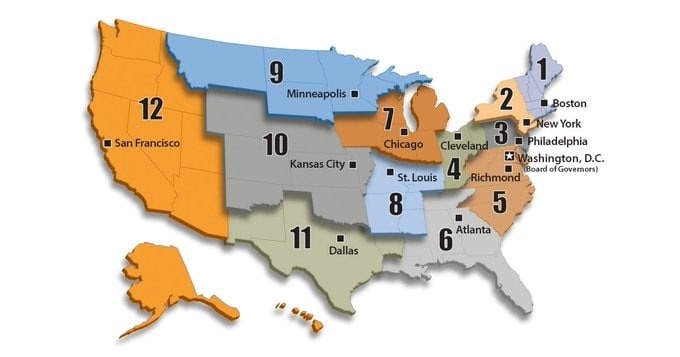
The twelve districts of the US Federal Reserve

Source: US Federal Reserve

The Fed’s hands are tied by the fiscal policy moves of the current government, which is still largely expansionary, and the impact of the Student Loan Forgiveness Initiative has not yet been factored in.

The program promises to cancel up to $20,000 of student debt for individuals who make less than $125,000 a year, or married couples who make less than $250,000 a year. The program has been challenged in the US courts by Republican-run states. If the courts allow the administration of US President Joe Biden to proceed, debt cancellation could begin almost immediately for the more than 22 million borrowers who have already signed up for the program. At a minimum, this would mean an over $400 billion boost to spending, as loan repayments are ploughed back into consumer spending.

Recent earnings reports indicate, that businesses are already factoring in a recession for 2023, which means they are adjusting forecasts, changing buying patterns and delaying big purchases. They are also not as desperate to hire as they were nine months ago, as the monthly US jobs report indicates. The US economy is a massive ship, it won’t turn on a dime, but ratcheting up interest rates has already changed the course. Raising rates much more from here, would be reckless and lead to economic damage, the extent of which we don’t know yet.

Besides, this is not the Paul Volcker Fed of the 1970s and nor can it afford to be. In the 1970s, the US debt to GDP was approximately 40%. Today, it’s well over 100%. Debt service cost adds up very fast if rates stay too high. Unlike his academic predecessors, the current Fed Chair Jerome Powell has a background in investment banking and Private Equity. Powell worked at the investment bank Dillon Reed, specialising in financing, merchant banking, and M&A from 1984-90 and at the Carlyle Group, the Private Equity and asset management giant, from 1997-2005. Nobody knows better than the Private Equity guys what debt and debt service costs can do to a business, and a nation for that matter.

The problem of inflation has been complicated as the Fed has received little help from the fiscal side. The Fed tightens while the Biden administration spends like there’s no tomorrow. The total stimulus under the Biden administration is over $5 trillion. The US Congress has raised the debt ceiling more than 45 times. There are hardly any US lawmakers willing to stop deficit spending. The current US national debt of $31 trillion can easily climb to $40 trillion by the end of the decade and all this debt needs servicing.

Until fiscal spending slows, raising rates will have very little effect on inflation. Passing the “Inflation Reduction Act” and expecting inflation to come down is akin to throwing soup at an Old Master painting and expecting the climate change issue to be solved. The Fed may be in luck however and about to get some help.

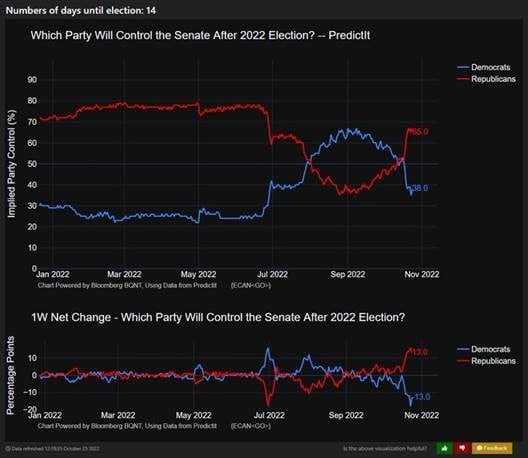
The recent Republican surge to control the US Senate may be levelling off, but the gap the Republicans have opened up on the Democrats remains substantial (see chart below).

Mid-term election betting odds: Who will control the US Senate?

Source: Predictit

Tuesday night’s debate in the key Senate seat in Pennsylvania didn’t go well for Democrat nominee John Fetterman. He opened his first answer by saying, “Hi, good night, everybody,” rather than “Hi, good evening.”

In the debate, Fetterman was asked to state his view on Natural-Gas fracking, an important economic driver in parts of Pennsylvania. In the past, Fetterman has opposed fracking. On the night he said – “I do support fracking, and I don’t, I don’t—I support fracking and I stand, and I do support fracking.” Make of that what you will. It seems it’s good night and goodbye to Fetterman in Pennsylvania after that debate, which was more like an Amtrak derailment than a car crash. The debate outcome has further boosted the Republicans with mid-term elections less than 2 weeks away.

In the House of Representatives, Republicans need to pick up just five seats to take control of the House. A Real Clear Politics (RCP) poll of polls predicts that the Republicans could pick up +12 to +47 seats with an average of +29.5 seats.

With the Republicans controlling both the House and the Senate, fiscal stimulus will be checked and more oil and gas production will be back on the agenda. The adoption or the expectation of adoption of the two policies will exert downward pressure on inflation. In a nutshell, fiscal policy is about to get restrictive in the US.

Therefore, I believe that the Fed will be well-placed to change its stance before the end of the year. However, we are not going to the low rates of the past decades anytime soon.

One thing that is often overlooked is how much globalization played a part in taming inflation in the 1980s-90s. China’s cheap labour and Saudi Arabia’s cheap oil were key to bringing down costs from the double-digit inflation rates we saw in the 1970s. China’s cheap labour is gone, and the Saudis want to keep energy prices high.

Only a concentrated effort to increase oil and gas production in the US and globally can change the energy supply balance and bring inflation down to the +2% that the Fed targets.
The world needs and will always need cheaper energy supply to preserve lives and livelihoods. Energy is the lifeblood on which the world runs and hence life is sustained. Therefore, we need more and cheaper energy supplies now, and less talk of how we are going to get to “net zero” by 2050.

Markets and the Economy

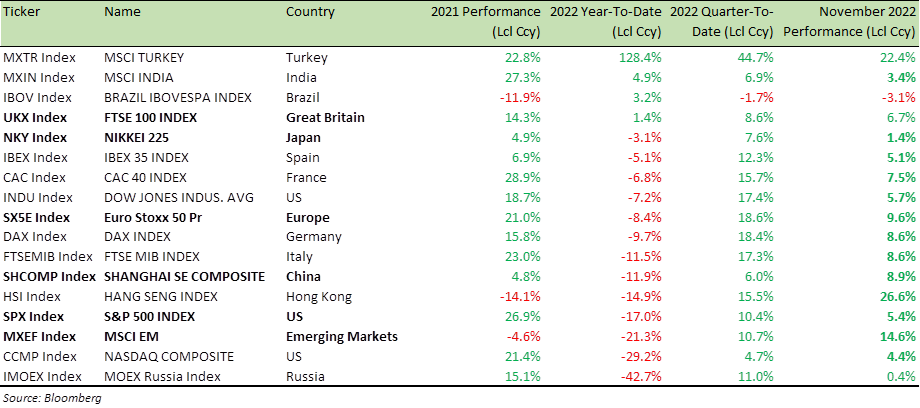
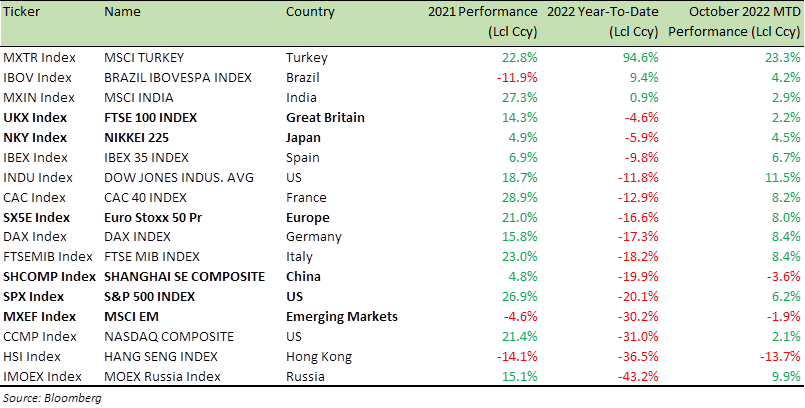
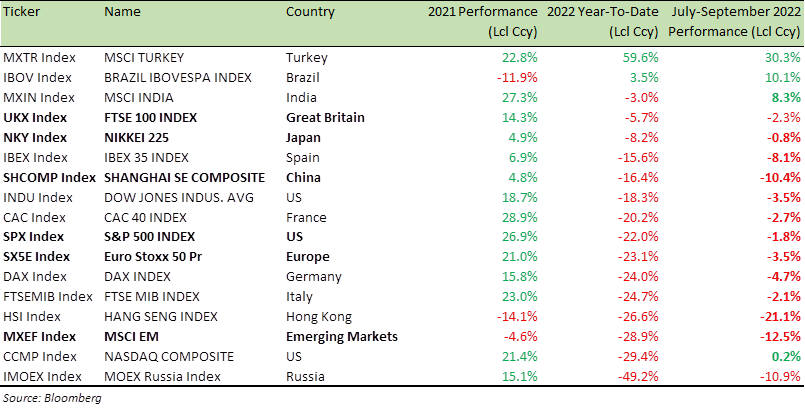
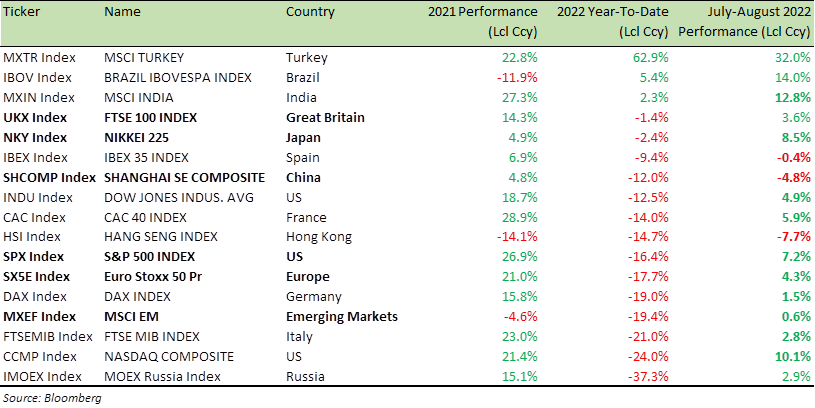
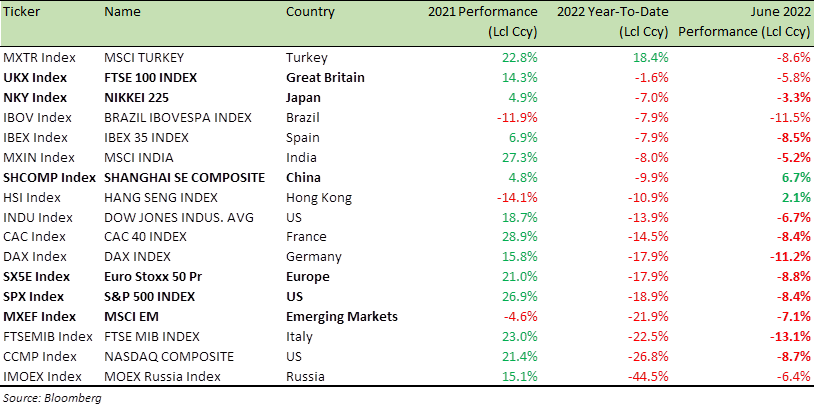
Markets have seen a solid rally this month with the S&P 500 (SPX) and Dow Jones Industrial Average (DJIA) up+7.5% and +11.6% respectively (table below)

The talk of a “Fed pivot” has helped, as has the realisation that equities are oversold and the earnings season has not been as bad as many thought it could be.

With the US likely heading into a recession (more on this below), equity bears have had a change of heart and are happy to deploy more cash and start building a long position in equities, with the main indices still down more than -20% from their highs.

A bright spot is that the 3,600 level on the SPX is holding up well and we have seen three tests of that level already since June.

We got to 3,600 in June and it’s October now. The SPX hitting the 3,600 level in June also coincided with the peak US Consumer Price Index (CPI) print of +9.1%.

The SPX index doesn’t spend much time around the 3,600 levels and bounces back very sharply. It’s back to 3800 as of now, a quick +7% rally in a week.

Benchmark Global Equity Index Performance (2021,2022 YTD and MTD)

A silver lining seems to be appearing on the horizon as far as US CPI is concerned. All the big Month-on-Month (MoM) prints in Q4 2021 will start dropping off as Q4 2022 prints start coming in. Starting with the next CPI monthly print, any headline MoM print below +0.7%, gets the YoY CPI number into the 7.5%-7.7% level. That will be cheered by the markets.

Fiscal policy is about to tighten in the US, as a Republican-controlled Senate and House will not approve any more stimulus bills. That’s good news for CPI from here on as the over $4.9 trillion in stimulus over the last two years has been a key driver of high inflation in the US.

The $1.9 trillion stimulus package in March 2021 was preceded by almost $3 trillion in stimulus the previous year. The US economy received over +20% of the Gross Domestic Product (GDP) in increased public spending. That dwarfed the early 2021’s output gap of around +4% of GDP.

With several different areas of the US bond yield curve becoming inverted this year, the probability of a US recession has been on the rise. One part of the yield curve, that has remained positively sloped, is the spread between the 10-year and 3-month US Treasury yields. That was the case until Wednesday. The 3-month/10-year yield spread — historically the most accurate predictor of recessions on the yield curve — has now inverted.

Yield curve inversion is not in itself bearish for equities. Per the table below (from True insights), US equities have realized a return close to the long-term average between Yield curve inversion and the start of the recession.

One more key point to note: the SPX performance in the year leading up to the yield curve inversion.

Historically, the SPX’s median change in the year leading up to an inverted yield curve has been a gain of +7.9%. In the current period, the SPX has declined over -18% in the year leading up to today’s inversion, which would be the weakest performance leading up to an inversion of any period in at least the last 60 years.

So, it’s not time to dump equities but to build a position in them. Granted that bond yields are attractive again too. Therefore, investors once again, have the luxury to build both a bond and equity portfolio.

If you want to see what high energy costs are doing to the world, then look no further than Europe.

The energy crisis has sowed seeds of political disharmony in the European Union (EU), caused energy-intensive businesses to downsize “permanently” and relocate operations and is set to cause a recession in Germany and Italy in 2023 as predicted by the International Monetary Fund (IMF).

From French tiremaker Michelin to German chemical giant BASF, European industry is starting to crack under the weight of record energy and raw material prices. Chemical/Industrial companies need natural gas and petrochemicals at a reasonable price and not preaching on “net zero” and “climate change.” If Europe doesn’t secure energy at reasonable prices, companies are going to relocate to regions with more secure access to energy.

This week, BASF announced plans to “permanently” downsize in Europe due to high energy costs in the region. The statement from BASF comes after it opened the first part of its new €10bn plastics engineering facility in China. Spot gas prices are five to six times higher in Europe than in the United States. BASF bemoaned a triple burden of – sluggish growth, high energy costs and over-regulation. BASF bosses have thrown their weight behind a planned expansion in China.

This week, German Chancellor Olaf Scholz put his foot down to approve a contentious deal by China’s state-run shipping giant Cosco to acquire a 35% stake in a container terminal in Hamburg, where he used to be mayor. In doing so, Scholz is brushing aside opposition from six of his ministries and 81% of Germans (as per a poll in Der Spiegel) who are opposed to the Chinese investment.

Scholz is also about to embark on a trip to China with a delegation of German business leaders, much to the annoyance of President Emmanuel Macron of France. Macron bemoaned the lack of a unified EU approach in dealing with China, saying the EU was acting as an ‘open supermarket’ to China. Scholz will become the first Western leader to visit China since the start of the Covid pandemic.

So, it seems, Germany has learnt nothing from overly relying on Russia for cheap energy. It is now putting more of its eggs in the “China basket.”

Another way to look at it is – what choice does Germany have?

China is Germany’s key market. Germany’s trade surplus has disappeared, energy costs are getting prohibitive and debt will mount up. The last thing Germany can afford to do, is make an enemy of China.

And what about Italy?

A new Prime Minister is in place, but the country faces the same old problems of debt and stagnation. Add to that mix – an energy crisis. The energy crisis is more severe for Italy, where in recent years imported natural gas has made up almost +40% of the primary energy mix. Without gas imports from Russia, it is likely that Italian energy users will have to make deep voluntary consumption cuts this winter or face forced energy rationing. Either way, it means economic activity in Italy is set to suffer.

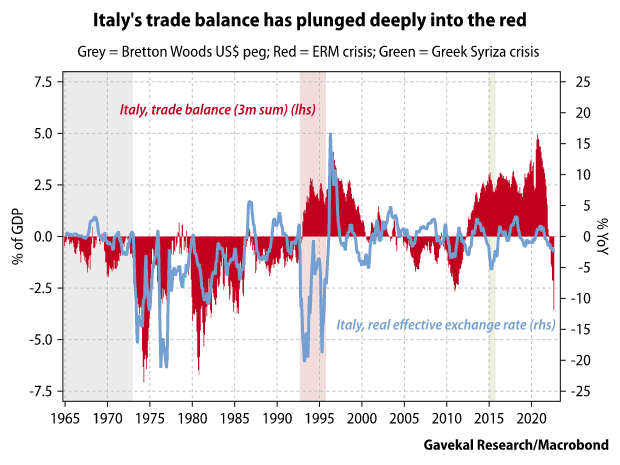
Increased energy import costs have helped to push Italy’s monthly current account balance from a surplus equivalent to +5% of GDP in April 2021 to a deficit of -4% in August this year (see chart above). The swing has been compounded by depressed demand for Italy’s exports. With around half of exports going to other European economies, which are facing similar headwinds, Italy’s non-energy trade surplus has contracted by around -2.5% of GDP over the last two years. This combination will continue to weigh on growth over the winter and possibly beyond.

A deep recession in Italy now seems a certainty.

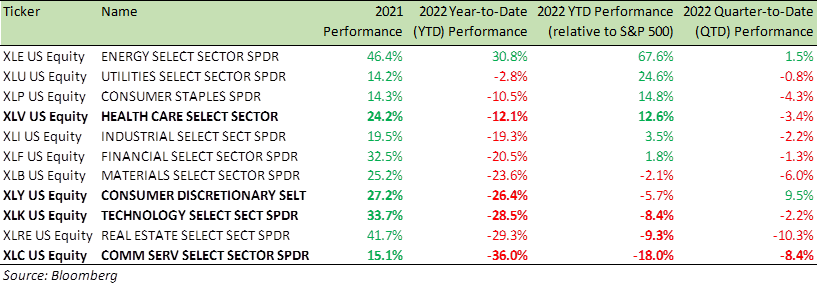
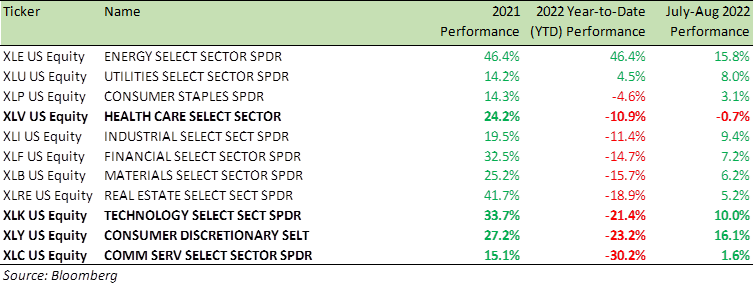
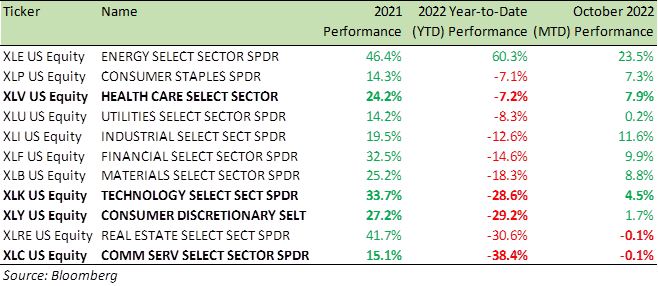
Benchmark US equity sector performance (2021, 2022 YTD and MTD)

The October seasonality I mentioned in my August Market Viewpoints seems to have kicked in already (see the MTD performance in the table above).

Historically it has led to a solid rally starting in October, that lasts until the end of the year. It might dovetail nicely with signs of dovishness from the Fed. So, please bear this in mind.

As I’ve been saying since June at least, there are plenty of high-quality stocks in the Consumer, Technology, Industrial and Healthcare sectors that are trading at -20% to -25% on a YTD basis, and present a good opportunity to invest in, be it directly or via Structured Products.

The reason I keep recommending the use of Structured Products in investment portfolios is that they offer an investor the opportunity to benefit from prevailing market volatility. The stocks and/or indices underlying the products do not necessarily have to rally for one to earn 10-12% in income from the products annually.

For instance, this week, we launched a 5-Year product on a basket of (Apple, Amazon, Google and Microsoft) where the coupon was +15.3% per annum, the protection barrier was set at 60% at maturity and the losses don’t accrue from 100% but from the 60% levels, if the barrier is reached at maturity. In summary therefore: Equity exposure, solid income and good downside protection.

For specific stock recommendations and Structured Product ideas please do not hesitate to get in touch with me or your relationship manager.

 
Best wishes,

Manish Singh, CFA

Happy New Year and Merry Christmas background with earth and peace word

“Russia’s attack on Ukraine has faltered. The looming energy crisis that could yet devastate Europe. NATO and Europe will be wise to have patience, avoid self-righteousness and assist Putin to “save face” and de-escalate”

Summary

It is evident to everyone in Russia (and around the world) that Russia’s attack on Ukraine has faltered. Russian men, long extolled for their macho culture and patriotism, ready to defend and die for Mother Russia – are seen running for the nearest border. Russia is in a bind. Russian President Vladimir Putin knows full well that he can’t win this war. The West also wants the war to end and deal with the looming energy crisis that could yet devastate Europe, if not this winter then in 2023. The ongoing referendum in the four regions of Eastern Ukraine – offers a ray of hope, even though the referendum itself is a sham.

As the four regions become part of Russia, Putin will move troops and heavy weapons into his new “Russian provinces” and an attack on them would be an attack on Russia. Ukraine President Volodymyr Zelensky’s promise to regain these territories becomes a tricky one for the North Atlantic Treaty Organization (NATO) and the West to support, as it would mean confrontation, possibly even a nuclear one with Russia. Europe and NATO will be wise to have patience, avoid self-righteousness and assist Putin to “save face” and de-escalate.

I suppose with the nuclear threat, this will be the path to peace by Christmas. Ukraine may be offered something akin to the “Marshall Plan,” to bring it to the table for a deal.

The UK is becoming the petri-dish for “structural change” that is so badly needed across the Western world – more growth, fewer taxes, lower deficits, sustainable debt, and fiscal rectitude. UK Chancellor Kwasi Kwarteng’s mini-budget and his “plan for growth” announced last week, however, have gone down like a lead balloon. The currency is trading close to parity against the US dollar and the Bank of England (BoE) has started buying UK Gilts again to rein in yields. If it’s any consolation, the economic woe isn’t just being felt in Britain. The Chinese Yuan has tumbled to its lowest level on record, as the US dollar continues to gain ground. The US Federal Reserve (Fed) has raised interest rates dramatically and more hikes are priced in.

However, US financial conditions have tightened a lot and various forward-looking indicators are orange, and ready to start flashing red. It would therefore make a lot of sense for the Fed to take a break and see how the economic situation unfolds in the coming months before hiking rates again. When the readjustment comes, you will be surprised at how quick it will happen. Bonds therefore do offer a very attractive investment opportunity at the current elevated yields.

Peace by Christmas?

Former Soviet Premier Vladimir Lenin once said: “There are decades where nothing happens, and there are weeks where decades happen.”

The retreat of the Russian armed forces from Kharkiv in Ukraine, Russian men (of fighting age) fleeing conscription, Iran’s largest anti-government protests since 2009 led by brave Iranian women, a new King and a new Prime Minister in the United Kingdom, Italy set to get its first women Prime Minister in Giorgia Meloni, Germany’s Green party accepting nuclear power is here to stay, and after 12 years of a Conservative government in the UK finally a Conservative budget but a near run on the Pound sterling … all these things happened in just the last ten days or so!

Staying with Russia, it is evident to everyone in Russia (and around the world) that Russia’s attack on Ukraine has faltered.

Advanced weaponry from the US, superior military intelligence from the UK and the bravery of the Ukrainian fighters, all have damaged irretrievably Russian President Vladimir Putin’s plan to take Ukraine. The Ukrainians have been wonderfully supported by the US, the UK and Poland – to name but a few.

After seven months of war, and not much to show by way of victory, Russia announced the mobilization of a quarter of a million men for a renewed attack on Ukraine.

Russian men (of fighting age) were mobilized and headed for airports, train stations, borders or wherever they could find flights at exorbitant prices – to get out of town. Long lines stretching for many kilometres were seen on the Russia-Georgia border.

Russian men long extolled for their macho culture, and patriotism, ready to defend and die for Mother Russia are running for the nearest border. This is probably the first instance in history of a country “where people flee not because someone invaded their country, but because they invaded another country” as was eloquently shared by exiled Russian businessman Mikhail Khodorkovsky recently on Twitter.

A much-weakened Russia is treading on thin ice here. In the past, “mobilisation” hasn’t worked out well for Russia. The first mobilization in 1914 ended the reign of Tsar Nicholas II. The second mobilisation during WWII was a success due to massive direct military aid from the US. Even before the US entered World War II in December 1941, America sent arms and equipment to the Soviet Union to help it defeat the Nazi invasion. The 1941 US Lend-Lease Act totalling $11.3 billion (or $180 billion in today’s currency), supplied needed goods to the Soviet Union from 1941 to 1945 in support of what then Soviet Leader Josef Stalin described to then US President Franklin Roosevelt as the “enormous and difficult fight against the common enemy – bloodthirsty Hitlerism.”

This third mobilisation today has Russia as an outcast of the world community, with no ally or military aid to show for it. Besides Russian supply lines to its forces in Ukraine have been mostly destroyed.

If the war continues into the winter, Russian forces will face the same dilemma as faced by German forces invading Russia in 1941, that is, do you deliver ammunition and fuel or will it be food and clothes? On present showing, the Russian Federation risks disintegration in the not-so-distant future.

Russian winter landscape

Source: Pixaby

Yet in all this doom, there seems to be a ray of hope.

Russia is in a bind. Putin knows full well that he can’t win this war. Now that the war is not going Putin’s way, he needs a face-saver and a way out.

The West also wants the war to end and deal with the looming energy crisis that could yet devastate Europe, if not this winter, then in 2023.

Germany and Europe may have an adequate supply of natural gas to tide them over this winter, but the energy crisis is not a blip. If the energy supply for industry is not sorted soon enough, Europe faces de-industrialization and crippling stagflation. Energy is not just needed for heating homes in winter. It is also needed throughout the year for industrial production. The cost of production will remain high and that will lead to a loss of production, and factory closures as demand is destroyed and exports become uncompetitive.

On Tuesday this week, we learnt that the Nord Stream 1 and Nord Stream 2 pipelines are both leaking gas into the Baltic Sea, after severe damage that will scupper any remaining hopes of Nord Stream 1 returning to service this winter. Neither Nord Stream pipeline was pumping gas to Europe at the time of the leaks. However, both pipelines were full of pressurised gas and footage showed it bubbling to the surface in the Baltic Sea, causing safety hazards for shipping and aircraft. Gas prices in Europe are still around five times higher than the historical average.

The ongoing referendum in the four regions of Eastern Ukraine – Donetsk, Luhansk, Zaporizhia and Kherson, is Putin’s attempt to not only justify the “special military operation” but also to use it as an opportunity to draw a line, offer spurious negotiations and plead for peace. The results of the referendum have started pouring in and I’m going out on a limb here in saying that when the final results are in, the percentage in favour of joining the Russian Federation will be 95%, if not more. The numbers are already in a file somewhere waiting to be published as the official result.

As Stalin said – “It’s not who votes that counts, it’s who counts the votes.” Donetsk, Luhansk, Zaporizhia and Kherson people’s republics will therefore join the Russian Federation.

Yes, the referendum is a sham, vote but a significant one. As the four regions become part of Russia, Putin will move troops and heavy weapons into his new “Russian provinces” and an attack on them would be an attack on Russia. Denouncing the referendum won’t make any difference. Ukraine President Volodymyr Zelensky’s promise to regain these territories becomes a tricky one for the North Atlantic Treaty Organization (NATO) and the West to support, as it would mean confrontation, possibly even a nuclear one with Russia.

At the time of the Cuban crisis, then US President John F. Kennedy wisely said “Keep strong, if possible. In any case, keep cool. Have unlimited patience. Never corner an opponent, and always assist him to save face. Put yourself in his shoes – so as to see things through his eyes. Avoid self-righteousness like the devil – nothing is so self-blinding.“

Europe and NATO will be wise to have patience, avoid self-righteousness and assist Putin to “save face” and de-escalate.

I suppose with the nuclear threat, this will be the path to peace by Christmas. Ukraine may be offered something akin to the “Marshall Plan,” to bring it to the table for a deal.

Let’s hope calmer heads prevail, the suffering of Ukrainians ends and a solution to Europe’s energy crisis consequently emerges.

Markets and the Economy

The United Kingdom is in the news. We have a new King; a new government and it would seem a new radical fiscal policy, that is causing somewhat of a stir – to put it mildly.

The UK is becoming the petri dish for “structural change” that is so badly needed across the Western world – more growth, fewer taxes, lower deficits, sustainable debt, and fiscal rectitude.

UK Chancellor Kwasi Kwarteng’s mini-budget (which was anything but mini) in this respect and his “plan for growth” announced last week have gone down like a lead balloon. The currency slumped close to parity against the US dollar. Kwarteng’s plan – £45 billion of tax cuts and an estimated £60 billion of spending to cap energy prices – is seen not as a plan but as an audacious political and economic gamble that challenges the Treasury “orthodoxy.” It has made many experts and commentators very unhappy.

On Wednesday, The Bank of England (BoE) stepped into the bond markets amid the market turmoil that has sent government borrowing costs soaring. The BoE said it would postpone Quantitative Tightening (QT) – the process of selling government bonds and would start buying bonds again. This brings me to a comment I often use – the Japanification of the Western world is in progress i.e. none of the major central banks in the Western world will be able to shrink their balance sheets just like the Bank of Japan (BOJ) hasn’t been able to, despite decades of trying. Every time they try, bond yields rise, sending fiscal balances into a tailspin and the central bank is forced to buy bonds again.

There is growing pressure on Kwarteng to reverse some of the measures he announced, particularly the abolition of the 45% rate of income tax on high earners which very curiously only costs £2bn out of the total of over £100bn of new spending i.e., less than a 2% impact on the budget.

If it’s any consolation, the economic woe isn’t just being felt in Britain. China’s internationally traded Yuan has tumbled to its lowest level on record as the US dollar continues to gain ground. However, such is the political charged atmosphere in the UK, that everything is being blamed on the policies of the four-week-old government of new PM Liz Truss.

Truss and Kwarteng shouldn’t buckle and draw inspiration from the experience of PM Margaret Thatcher, when she set about to change the UK economy structurally.

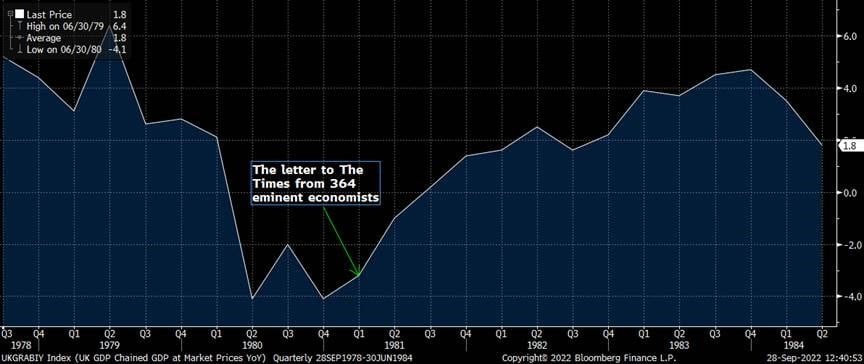
In 1981, Britain was at an economic crossroads. Policies that the Thatcher government, elected in 1979, had been implementing to deal with accelerating inflation and a spiralling national debt were not working. Thatcher and her Chancellor, Sir Geoffrey Howe, changed tack. The 1981 Budget increased taxes by £4 billion – an enormous sum in 1981 prices. Thatcher and Howe faced stiff opposition to this Budget, not just from the Labour and Liberal parties, but also from their own back benches.

In March 1981, 364 eminent British economists published a letter to Margaret Thatcher in The Times of London condemning Howe’s budget plans to hike taxes in midst of a recession saying that there was “no basis in economic theory or supporting evidence” for the policy that the Budget was seeking to implement, that it threatened Britain’s “social and political stability”, and that an alternative course must be pursued.

UK Quarterly GDP growth (1978-84)

Source: Bloomberg

It is said that Thatcher was asked in a heated debate in the House of Commons whether she could even name two economists who agreed with her. She replied that she could: Patrick Minford and Alan Walters. As the story continues, her civil servant said to her when she returned to Downing Street: “It is a good job he did not ask you to name three.”

On the face of it, the 364 economists were wrong. The economic recovery that they said would not happen began more or less as soon as the letter appeared (chart above).

A YouGov poll for The Times this week indicates that the Labour party has a 17-point lead over the Tories, the biggest since the company began polling in 2001.

Well, polls can be very misleading when a general election is almost 2 years away. In Feb 1981, Labour, with Michael Foot as its leader, had a 16-point lead. Yet, in the 1983 election, Labour lost badly as Thatcher won a stonking victory. She won the largest majority since that of the Labour Party in 1945, with a majority of 144 seats.

Will Truss and Kwarteng hold the line that they have set and see their structural change through? Only time will tell, but there is an illustrious precedent to follow.

Exciting times are ahead politically and economically in the UK. GBP/USD is likely to remain in the parity to 1.05 range for the rest of the year.

Let’s now turn our attention to the United States.

“Treasury securities are considered a safe and secure investment option” says www.treasurydirect.gov

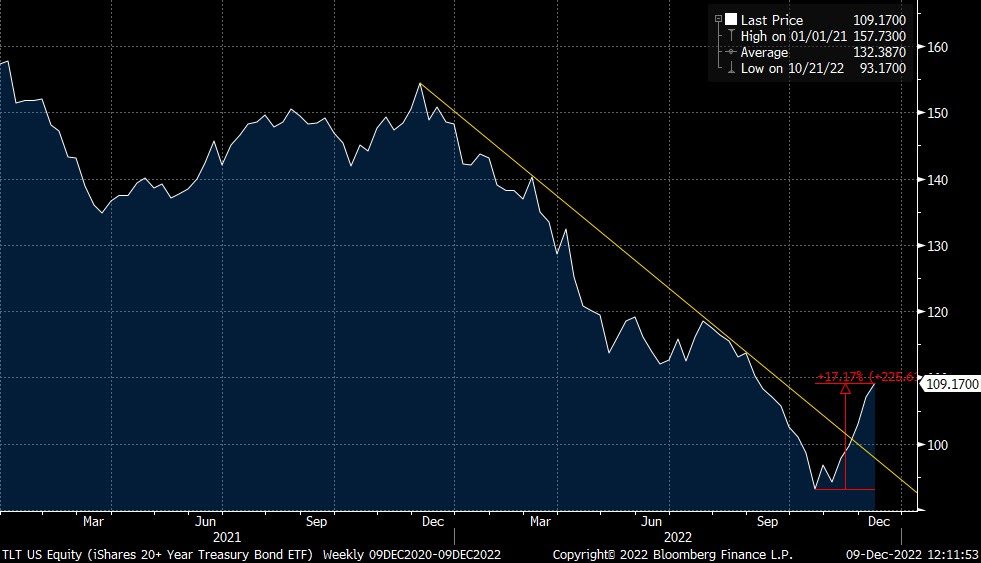
The over -20% decline in long-dated US Treasury bonds (over -30% for iShares Long term Treasury ETF (TLT)) has only happened twice before – in 1931 and 1937. We are witnessing history now.

Everyone tells you bonds are the safest investment. If you are a pensioner who put your money in a long-dated bond with the hope of clipping coupons and selling part of it as the need arose, you are now stuck with a bond you won’t sell due to capital loss.

There’s no such thing as a “safe asset.” In the financial world, it’s all relative i.e. safe with respect to what?

Having said that, I do repeat what I have said before – the inflation problem is always “man-made” and thus the redemption from it will also be “man-made.” As we now know – Covid led to the shutdown and disruption to the supply chain. Excessive (and reckless) fiscal spending followed and caused inflation.

The US Federal Reserve (Fed) has raised interest rates dramatically – a third straight +0.75% raise earlier this month, with the Fed Fund Rate (FFR) now at +3.25%. Additional a +1.25% increase is being priced in over the next three months. Not surprising then that the Fed forecasts the US unemployment rate to rise to 4.4% next year, from 3.7% today — a number that implies an additional 1.2 million people losing their jobs.

  • Deflation is already setting in for some parts of US economy – consumer electronics’ prices within CPI have tanked lately, with some (like TVs) with double-digit year/year percentage declines
  • The Richmond Fed manufacturing Index has fallen swiftly and is now in contraction
  • Say goodbye to the liquidity tide. Growth in M2 money supply (which had reached +26.8% in Feb 2021 and averages +8% typically ) is now at +4.1%, slowest since April 2019
  • The Atlanta Fed’s GDPNow model, now forecasts US GDP growth of +0.3% (q/q ann.) for the third quarter 2022. This is far cry from the over +2% growth expectation less than 12 months ago
  • Commodity pressure has intensified. The Bloomberg Commodity Spot Index is now off its peak by -21.7% (worst drawdown since April 2020)
  • US Financial conditions have tightened at a pace last seen during the Great Financial Crisis (GFC) of 2008/09, at least when looking at year/year % change
  • US Mortgage rates have hit the highest levels since 2002, as a 30y fixed rate loan costs 7% on average. Mortgage costs are soaring and as Doubline founder Jeffrey Gundlach put it – “Thanks to 40% median home price increases over the past two years and the massive increase in mortgage interest rates the monthly payment on the median priced US home is already up about 100% vs. two years ago.”
  • The S&P 500 has finished in the red on 56% of 184 US trading days YTD. It is on track to have the second-highest annual proportion of loss-producing trading days since modern inception in 1957. The “top” spot belongs to 1974 with 57.7%

Therefore, it makes a lot of sense for the Fed to take a break and see how the economic situation unfolds in the coming months, before hiking rates again.

In my opinion, interest rate rises from here on will be very damaging to the US economy and circumstances will force the Fed to stop or change the narrative to a more dovish stance.

Benchmark Global Equity Index Performance (2021 and 2022 YTD)

Rising rates will kill demand and it will kill inflation with it. Structural forces – technology and innovation and bad demographics are going to continue to reassert. When the readjustment comes, you will be surprised at how quick it will be. The cycle works like this inflation shock -> demand collapse -> new disinflation.

Therefore, bonds do offer a very attractive investment opportunity at these levels. You could pick +5% to 6% on investment-grade names in the US these days, without going out too long on duration.

The weakness in bond markets puts the weakness in equity markets in perspective. Some bond holdings are down over -20% and so are equity holdings. For most of our entire investment careers (certainly mine), when markets hit turmoil, market commentary would include something like “investors rotated into the safety and security of bonds”. This time around there is no such rotation to do and if you did, you didn’t come out well.

You were and are much better off staying in equities and accumulating positions at lower levels.
The key story of the year has been the Fed’s determination to crush inflation at home by raising interest rates and this has inflicted profound pain at home and across the world – pushing up prices, ballooning the size of interest payments on debt, increasing the risk of a deep recession.

The energy crisis in Europe continues to be a concern.

According to a report in Reuters, in Germany, one in ten mid-sized companies, which provide nearly two-thirds of German jobs, have cut or halted production, because of gas prices reducing demand.

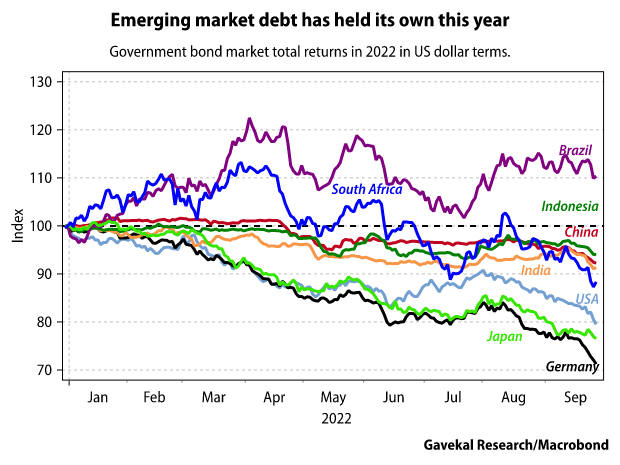
One interesting development this year has been the impressive outperformance of some of the larger Emerging Market bond markets, and even equity markets, despite the Fed’s hawkishness and the rise in the US dollar.

Historically, whenever a liquidity crisis occurred, Emerging Markets proved to be the ones that investors rushed to get out. Not this time. Singapore, India, Indonesia and Brazil are all flat or up year-to-date in local currency terms.

This points to an ongoing structural changes in the global economy. A welcome change that gives investors more avenues to invest.

How is it that we are at the lowest unemployment levels yet worried about a recession?

The US dollar is at a very strong level, the US should be having disinflation, yet the inflation in the US is at record levels. All prior models are broken as “supply side” issues have eclipsed everything else. In these circumstances, the Fed continues to hike rates. The Fed is making a mistake.

Inflation has peaked in the US and I suspect we have also seen a peak in the US Dollar too. That said, EUR/USD is unlikely to stay above parity and any relief of Fed stopping to hike will be replaced by worries about Europe’s energy crisis and the stagnation it will lead to in the Eurozone.

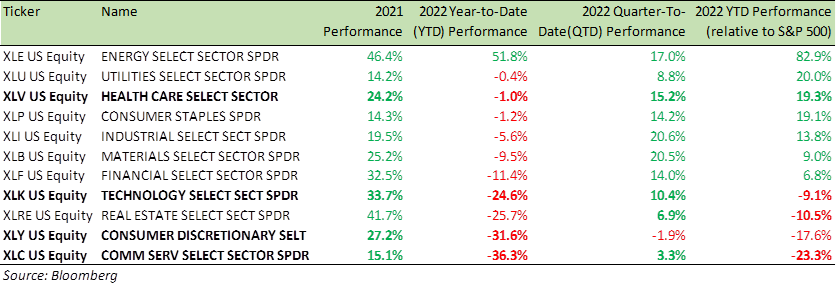
Benchmark US equity sector performance (2021, 2022 YTD)

There’s one more “redemption” to look forward to and a crucial one at that. Please mark October 16, 2022, in your calendar.

The 20th Chinese Communist Party (CCP) National Congress opens on October 16. President Xi Jinping is expected to embark on his third term as general secretary, and I suspect is the day when stringent “Covid lockdown” policies in China will start coming off. China will “re-open” and with that the global supply chain will improve very quickly.

It may still not be enough to stop the US economy from going into a recession, however, supply chain improvement will be a tremendous boost to the US and global economy.

The October seasonality I mentioned in last month’s Market Viewpoints is about to kick in soon too. Historically it has led to a nice rally starting in October that lasts until the end of the year. It might dovetail nicely with any signs of dovishness from the US Fed. So, please bear that in mind.

There are plenty of high-quality stocks in the Consumer, Technology, Industrial and Healthcare sectors that are trading at -20% to -25% on a YTD basis, and present a good opportunity to invest in, be it directly or via Structured Products.

For specific stock recommendations and Structured Product ideas please do not hesitate to get in touch.

 
Best wishes,

Manish Singh, CFA


“Germany’s policy to prioritise “trade” over everything else, has come back to bite hard, as Europe faces its winter of discontent. With EUR/USD at parity, Europe’s exports would be so much more competitive only if it had the oil & gas at reasonable price”

Summary

Not long ago, Europe (read the European Union) was concerned about the direction in which the US was going. Phrases like “terminal decline,” “too divided” and “too dysfunctional” appeared regularly in the European press and diplomatic channels. Many in Brussels openly questioned the international order led by the United States and ridiculed its then President Donald Trump. In September 2018, in a speech at the United Nations General Assembly, when Trump accused Germany of becoming ‘totally dependent’ on Russian energy, German diplomats were caught on camera laughing and German Foreign Minister Heiko Maas could be seen smirking alongside his UN colleagues. EU leaders considered America’s decline as inevitable and started to distance themselves from the US. Then Russia invaded Ukraine, and everything changed.

Germany’s policy to prioritise “trade” over everything else has come back to bite hard, as Europe faces its winter of discontent. Europe’s delusion of independence was a sand castle, as in reality, it depended on Russia for its energy, China for its trade and the US for its trade and security. With the EUR/USD exchange rate at parity, Europe’s exports would be so much more competitive only if it had the oil & gas at the reasonable price needed to run manufacturing, industries, agriculture or even its tourism industry. Everything is underpinned by energy. Energy is responsible for at least half the industrial growth in a modern economy, while representing less than one-tenth of the cost of production.

US Fed Chair Jerome Powell’s comments at the Jackson Hole summit last week, highlighted that the Fed is preparing to shift from a phase of rapid and large interest rate increases, to potentially smaller increases, focusing on slowing demand and then holding the rates instead of cutting them too soon. Unfortunately, Powell can’t take the most meaningful step to tame inflation – prevent the fiscal authorities from increasing spending by hundreds of billions of dollars in spending programs once every few months. This is also a mid-term election year in the US. Seasonality indicates that the S&P 500 (SPX) could be in for a nice rally as we head into the final quarter of the year. In a mid-term election year, the SPX bottoms by the end of Q3 and has a real flourish in the last quarter with the index up +6.0% on average, so big year-end rallies are common.

“German irrationality” is Europe’s Achilles’ heel

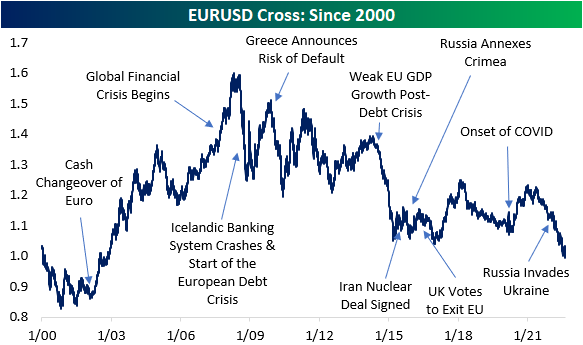
The EUR/USD exchange rate stood at 1.60 in the summer of 2008. Last week, the Euro fell below parity and there it remains. For the first time in nearly twenty years, the US dollar is more valuable than the Euro.

The last time the Euro traded at this level versus the dollar, we all printed out directions from MapQuest for our long drives, there was no such thing as social media with MySpace still six years away yet everyone was starting to chat on MSN messenger, the iPhone was still a dream in Steve Jobs’ eyes, Nokia 3310 was the bestselling phone with everyone playing Snake (the unwieldy and addictive game that came as standard with every handset), and all you could do with your phone was make calls and send SMS messages, the Baha men and everyone else was asking ‘Who Let the Dogs Out’, the first MP3 had just been launched and we were all using a website called Napster to download music and it took forever on that dial-up internet which went Screeeech . . . hisss . . . squawk (interspersed with whistles and chirps), the frustration, however, no way diminished the excitement of getting online.

The chart below summarizes the major events that have impacted the Euro since the turn of the century. It’s been a wild ride!

Source: Bespoke Research

One would expect that with such a weak currency, the Eurozone would be printing record trade surpluses and the economy would be growing at over +3%, instead, the Eurozone is moribund, inflation is running at over +10% and the region is staring at a recession. The European Central Bank (ECB) is forced to raise rates precisely when the economy is suffering and it has also morphed into a “political lender” as it helps to keep the lid on the Eurozone’s sovereign debt crisis from flaring again.

Not long ago, Europe (read the European Union) was concerned about the direction in which the US was going. Phrases like “terminal decline,” “too divided” and “too dysfunctional” appeared regularly in the European press and diplomatic channels. EU leaders considered America’s decline as inevitable and were preparing for this eventuality, by taking measures to be less dependent on the US.

Many in Brussels openly questioned the international order led by the United States and ridiculed its then President Donald Trump. In September 2018, in a speech at the United Nations General Assembly, when Trump accused Germany of becoming ‘totally dependent’ on Russian energy, the German diplomats were caught on camera laughing. German Foreign Minister Heiko Maas could be seen smirking alongside his UN colleagues.

There’s a reason why everyone in Europe is terrified of Germany. If this is the attitude when they are weak and vulnerable, then you can imagine what it would be when they are in a position of strength. Well, you don’t have to imagine it, just read about it in history. The fear of Germany has shaped Europe’s policy and all the consequences flow directly from it.

Then Russia invaded Ukraine, and everything changed. Europe’s grand thinking of building ever closer trade ties with rival global powers China and Russia are in tatters, and American strength has reasserted itself. Europe discovered it had in fact become more dependent on America and not less.

Germany has made a series of mistakes in its (and by extension the EU’s) foreign policy, yet nobody dared to stand up and criticise – barring Poland and Hungary who know their history lessons well.

History tells us that “German irrationality” is Europe’s real Achilles’ heel and it seems nothing has changed in over a century. In 1897 Europe was, collectively, the hegemon and goliath of the world in almost every sense – economic, trading and military power. Europe covers roughly 7% of the land mass of the Earth, but by 1800 it ruled 35% of the globe and by 1914 a staggering 84%. Even America was still an emerging and localised power mostly concerned with completing its conquest and colonisation of its own continent. Germany, put paid to Europe’s dominance spectacularly as German jealousy of the British Empire blew things up in Europe and led to two world wars, that devastated the continent.

Europe’s delusion of independence was a sand castle, as in reality it depended on Russia for its energy, China for its trade and America for its trade and security.

In pursuing a policy of “independence from America”, Europe found itself in the worst of all worlds and in a desperate attempt to save itself, has rushed back to clinging even more closely to Washington than ever before. The very leviathan it ridiculed and derided, is now its saviour, as an energy crisis and a belligerent Russia threatens to ravage the continent. The US has increased its military presence on the continent, and Europe has started importing American gas.

The new world order is more about security than trade, something EU-philes don’t seem to understand. The EU is an empire that can’t protect itself. It is trade-focused and that is what has led to its military weakness.

Wrong policy choices always come home to bite. In last month’s Market Viewpoints I highlighted German folly concerning its trade policy and that is pretty much the story of the continent – reliance on cheap energy to ramp up exports and no efforts to secure energy independence. Europe’s exports would be so much more competitive with a weak Euro, only if it had the oil & gas needed to run manufacturing, industries, agriculture or even its tourism industry. Everything is underpinned by energy. This is the reason China is so focused on securing its energy supply and the US is in an enviable position of being energy abundant, so much so, that they can export energy.

Energy is a foundation stone of the modern industrial economy. Energy provides an essential ingredient for almost all human activities – cooking, heating, lighting, health, food production, storage, mineral extraction, industrial production, transportation etc. Energy is the engine of economic and social development. The history of industrialisation has shown us that if a nation has to move beyond subsistence, then access to energy, for its broad section of the population, is the necessary condition.

Research has indicated that energy is responsible for at least half the industrial growth in a modern economy, while representing less than one-tenth of the cost of production.

Europe therefore has tough days and cold winter nights ahead. Humility and long-term planning will serve it well. However, for now, the Euro is likely headed lower and the international order if anything, is more dependent on the American military, economic, and financial might now than ever before.

Like any sell-off, the Euro will rebound and I see 0.84 as that rebound level. If the US Federal Reserve (Fed) pivots, then the rebound could be sooner, but the Euro will likely spend a long spell below or close to parity, given the economic and political mess that’s facing the Eurozone.

As for “dysfunctional America”, the social unrest today in the US is nothing like what it was during the 1960s when the Vietnam War and the Civil Rights movement caused social upheaval. What Europeans simply don’t understand is that America has never been “orderly” or “restrained.” Switzerland it isn’t. Americans have always been loud, divisive and more concerned with individual rights than with collective responsibility, as in Europe. But the difference between the US and the rest of the “dysfunctional/divisive” democracies (say Latin America) is that when the chips are down, Americans know how to forget any differences, save the nation and re-build to a new level of strength.

Markets and the Economy

The S&P 500 (SPX) has had quite an impressive run lately, with a +10% gain since the mid-June low. However, the index remains more than 15% below its all-time high seen on the first trading day of 2022.

A fall in headline inflation from +9.1% to +8.5% added more legs to the rally in August. This was the first negative surprise to headline inflation in over 6 months.

Gas prices in the US have moved down to $3.95/gallon (national average), $1.06 below their all-time high in mid-June and at their lowest levels in over 5 months.

Regular readers of this newsletter will know my view that the US cannot afford to have higher rates due to the high level of debt in the US economy.

I repeated this on CNBC two weeks ago – There is no way the U.S. can sustain an interest rate beyond 2.5% in the long term

We will likely see another +0.50% hike in the Federal Fund Rates (FFR) at the September 21 meeting of the US Federal Open Market Committee (FOMC) which will take the FFR to +2.75%. However, over the medium term, the state of debt, the deficit and economic growth in the US means that the FFR will stabilise in the +2.25% to +2.5% range.

Benchmark Global Equity Index Performance (2021 and 2022 YTD)

In terms of data:

  • 1. US consumer spending barely rose in July, but inflation as indicated by Personal Consumption Expenditure (PCE) – which the US Federal Reserve prefers to the CPI – eased considerably, which should give the Fed room to sound less hawkish. The PCE price index decreased by -0.1% in July, the first MoM negative print since April 2020
  • 2. On an annual basis, PCE rose +6.3% in July from a year earlier, down from +6.8% in June. The core PCE which excludes volatile food and energy prices—increased +4.6% in July from a year ago, down from +4.8% in the year through June
  • 3. World Container Index (WCI) publishes weekly indices on the cost to move containers between ports around the world on a spot basis. The latest data published by WCI indicate there has been a significant easing in the freight cost. Pre-pandemic shipping costs ran around $1600 per 40-foot box from Shanghai to Los Angeles. That number rose by nearly a factor of 10 through the peak in 2021 but it’s fallen by half since that peak. On average across a range of shipping routes, container costs have fallen by -42% from the peak. This is just the latest data confirming that supply chains have eased dramatically over the last six months.
  • 4. At the current level of 34.4, the Prices Paid component of the Dallas Fed report is now at its lowest level since October 2020, and besides the Richmond survey, every other Prices Paid component is at its lowest level since at least January 2021. This month was the second month in a row, that all five Prices Paid components of the regional Fed surveys declined on a month-over-month basis.

Last week, US President Joe Biden announced that he will cancel $10,000 in US federal student loan debt for borrowers making under $125,000 a year or for couples making less than $250,000 a year. Biden is playing Santa Claus again as the US mid-term elections are around the corner.

US taxpayers will pay for this. Thanks to Biden, now every American will become saddled with student debt.

If you worked your way through school, you received nothing, and now you will pay for others who cannot or will not pay off their student loans. If your parents saved for you to attend college, they don’t receive a refund and will now pay for the student loans of others via taxes.

The irony of Biden’s policy is there are over 11 million unfilled jobs in the US. That means there are millions of opportunities for those with student debt to earn the money to pay off their debts. Next time, Biden will be better off offering everyone a free college degree, and the US will save billions on the cost of issuing and then cancelling loans.

The reason I bring up the mid-term elections for discussion, is the seasonality of SPX returns during a mid-term election year.

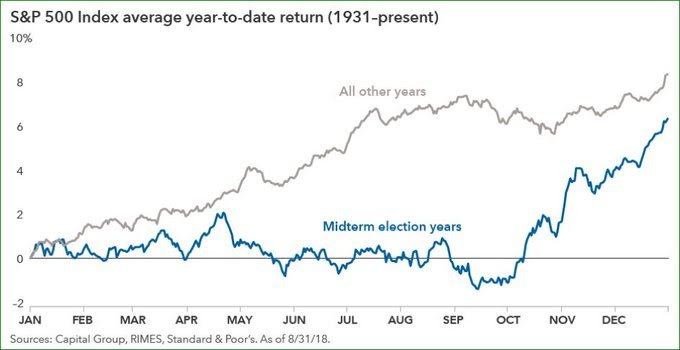
In the post-WWII period, the SPX has gained +5.03% on average in mid-term years, but it pales in comparison to the average gain of +8.95% for all years.

Further, in a mid-term election year, the SPX bottoms by the end of Q3 (see chart below from Capital Group) and has a real flourish in the last quarter with the index up +6.0% on average, so big year-end rallies are common. One to watch out for.

The adage that markets don’t like uncertainty, seems to apply here. Early in the year, there is less certainty of the election’s outcome and the subsequent effects on future policy changes therefore the markets tend to oscillate for most of the year, gaining little ground until shortly before the elections. Markets tend to rally when results are easier to predict, in the weeks leading up to the election and continue to rise after the polls finally close and the winners are declared.

S&P 500 index performance and US midterm election year seasonality

Fed Chair Jerome Powell’s address at the Kansas City Fed’s annual symposium in Jackson Hole, Wyoming was the most eagerly awaited event last week and he didn’t disappoint. He offered enough to both the hawks and the doves.

Powell said the economy “continues to show strong underlying momentum” and added “we are moving our policy stance purposefully to a level that will be sufficiently restrictive to return inflation to 2%.”

The hawkish part was – while the Fed’s current rate setting is in a “neutral” zone, such a level of rates is “not a place to stop or pause” when inflation is so high and the labour market is so tight. Bringing inflation down was likely to “require maintaining a restrictive policy stance for some time,” he said. “The historical record cautions strongly against prematurely loosening policy.”

The dovish part was – the next rate decision “will depend on the totality of the incoming data and the evolving outlook,” he said. “At some point, as the stance of monetary policy tightens further, it will likely become appropriate to slow the pace of increases.”

Powell’s comments highlighted that the Fed is preparing to shift from a phase of rapid and large rate increases, to potentially smaller increases focusing on slowing demand and then holding the rates instead of cutting them too soon.

Unfortunately, Powell can’t take the most meaningful step to tame inflation – prevent the fiscal authorities from increasing spending by hundreds of billions of dollars in spending programs once every few months.

Inflation is ultimately a political choice, even though we look to central banks to tame it. It’s easy to create inflation – just print and give away lots of money to everyone. By the same measure, it’s easy to create deflation too – raise taxes. The key to the future outlook for inflation, therefore, is not an economic model, but the political choices, desires and wants of the population.

Despite the sharp declines last week in response to Powell’s comments at Jackson Hole, most sectors remain above their 50-day moving averages (DMA) with the only two exceptions being Communications Services and Health Care.

It remains to be seen whether last week was a pause in the sharp rally off the June lows or a resumption of the bear market, but if the majority of sectors can stay above their 50-DMAs, the bulls still have hope to cling to.

Benchmark US equity sector performance (2021, 2022 YTD)

Since both the bears and bulls seem vindicated, volatility abounds, and structured products are the perfect vehicle to monetise income and retain an upside in market performance.

Seasonality indicates that the S&P 500 could be in for a nice rally as we head into September/October. So, please bear that in mind.

There are plenty of high-quality stocks in the consumer, tech, industrial and health care sectors that are trading at -15% to -20% on a YTD basis, and present a good opportunity to invest, be it directly or via structured products.

For specific stock recommendations and structured product ideas please do not hesitate to get in touch.

 
Best wishes,

Manish Singh, CFA


Europe has a tough winter ahead, but it seems the energy problem may start early. The Nord Stream pipeline gas supply not coming back on later this week, will push Germany into a very tenuous situation and a deep recession.

Summary

Germany’s political decision to distance itself from the US (and the UK for that matter) and follow Ostpolitik (German for “new eastern policy”) to build a greater Europe it thought it could shape and then benefit from – has been its greatest post-WWII miscalculation. Even more inexplicable, has been Germany’s failure to change course as the Soviet Union disintegrated at the end of the 1990s. Instead, Germany chose to rely even more on Russia and provided Russia with the leverage that it now has over energy supplies to the European continent.

Russia is constraining gas supplies right now to ensure that European countries cannot fill their storage for winter months. The Nord Stream pipeline is now shut for regular maintenance and is due to reopen on July 21. Russia may well decide to ratchet up the pressure and not reopen the Nord Stream pipeline, or at least not turn it on for a few days or weeks, thus cutting supplies to zero. Russia is suffering economically and not turning the taps back on may move Russia’s suffering level from 6 to 7 but, in Europe, the pain level could jump from 2 to 7, and that will have catastrophic outcomes economically, socially, and politically. Is Europe prepared for this?

Inflation in the US hit a new high of +9.1%, yet the bond market does not seem in any way panicked. The yield on the 10y US Treasury is now down to +2.9%. It was at +3.5% a month ago. The long end of the bond market is screaming what’s coming after the interest rate hikes – rate cuts. Commodity prices continue to weaken. Base metals (Copper and Aluminium) prices have fallen by a third or more from their highs. Oil prices have fallen by almost -20% over the last six weeks. Growth concerns and recessionary fears are growing.

In a directionless equity market such as the present, volatility abounds, and structured products are the perfect vehicle to monetise income and retain a participation in market performance.

Wandel durch Handel (“Change through trade”) has had its day

As is becoming evident with every passing month, Germany’s decision over the last two decades to shut down German nuclear plants and replace them with more Russian gas and coal is proving to be a case of economic vandalism on a continental scale. Former German Chancellor Angela Merkel has a lot to answer to, for the disaster that Germany’s industry faces if Russia were to cut-off energy supplies.

However, Germany’s decision to work closely with Russia is not Merkel’s doing alone. It goes back to the 1970s when Germany’s Chancellor was Willy Brandt. Since then, successive German Chancellors have put German business interests above all else. Ironically, that same hardnosed policy risks being Germany’s undoing.

In the post-World War II world, since at least the 1970s, Germany has aggressively pursued the policy – Wandel durch Handel or “Change through trade” which has seen it embrace autocracies (China), kleptocracies (Russia), and theocracies (Iran) in the name of doing business or as Jörg Lau in an article in the German weekly Die Zeit put it “Die deutsche Liebe zu den Diktatoren (The German love for Dictators)” . Strikingly, this approach to value “stability”, and achieve “change through trade” above all else, has remained dominant for the last 50 years and has earned Germany rich dividends. However, the present energy crisis brought on by the Russia-Ukraine war, suggests that the approach has had its day and is quite dangerous in the longer term for Germany (and by extension Europe’s) interests.

In my opinion Germans, particularly the Social Democrats, have mistakenly given this policy more credit than it deserves, for Germany’s unification and success over the last 50 years. Indeed, West Germany’s acceptance of the post-war territorial order and the renunciation of German claims for the lost lands in the East, persuaded then USSR President Mikhail Gorbachev to accept that Germany was no longer a threat to the Soviet Union, and hence West and East Germany could unite. However, without the support of the United States, Article 5 of the North Atlantic Treaty Organization (NATO) which states that – an attack on one member of NATO is an attack on all of its members – German unification would not have happened or indeed succeeded.

Germany’s political decision to distance itself from the US (and the UK for that matter) and follow Ostpolitik (German for “new eastern policy”) to build a greater Europe it thought it could shape and then benefit from – has been its greatest post-war miscalculation. Even more head scratching and inexplicable, has been Germany’s failure to change course as the Soviet Union disintegrated at the end of the 90s. Instead, Germany chose to rely even more on Russia and provided Russia with the leverage that it now has over energy supplies to the European continent.

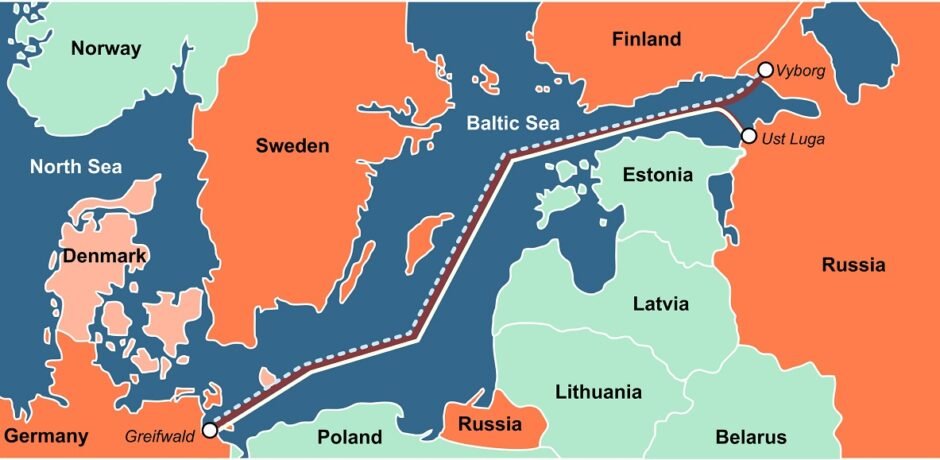
The Nord Stream pipeline runs 760 miles under the Baltic Sea from Vyborg, Russia to Lubmin, Germany

Last Monday, the Nord Stream pipeline, which supplies the bulk of Russian gas to Europe, closed down for 10 days for routine annual maintenance. The maintenance runs from July 11-21. Repairs that are routine in times of peace, would not be a subject of discussion. However, these are not peaceful times.

The EU (and the West) have made it very clear that they want to suffocate the Russian economy into submission over its transgression in Ukraine. Cast off as a pariah, Russia is only too willing to use its Natural gas supply to Europe as a weapon. Moscow has already cut gas deliveries by more than half of the Nord Stream pipeline’s capacity. Russia is constraining supplies right now to ensure that the EU countries cannot fill their storage tanks for the winter months. Russia may well decide to ratchet up the pressure and not reopen the pipeline, or at least not turn it on for a few days or weeks, thus cutting supplies to zero.

Bear in mind Russia squeezed gas supplies to Europe throughout last year leaving the continent’s gas inventories at multiyear lows as winter approached. Russia reduced flows through Ukraine to persuade Germany and the European Commission (EC) to accelerate the Nord Stream 2 signoff and they did achieve it, even though the pipeline now lies unused. Russia has already cut gas supplies to Poland, Bulgaria, the Netherlands, Denmark, and Finland over their refusal to comply with a new payment scheme of paying for Russian gas imports in the Russian currency Ruble (RUB).

Russia is suffering economically and not turning the taps back on may move Russia’s suffering level from 6 to 7 but in Europe, the pain level could jump from 2 to 7, and that will have catastrophic outcomes economically, socially and politically.

Is Europe prepared for this? The next few days and weeks will tell.

We are not even in the winter months and the pain is clear. France is nationalizing nuclear giant Electricite de France SA (EdF), and Germany is in talks to bail out one of its largest energy providers, Uniper SE, as the stand-off with Moscow chokes the finances of the company. Europe has a tough winter ahead, but it seems the energy problem may start early. Nord Stream supply not coming back on, will push Germany into a very tenuous situation and a deep recession, as industries get devastated. German industries rely entirely on gas and most German homes use gas for heating. A recession and economic destruction would have major consequences on the whole of the Eurozone economy, given Germany’s importance to the Eurozone.

The German think tank, Agora Energiewende calculates that by investing in energy efficiency and renewable energy alone, 80% of Russian gas imports could be replaced by 2027. If combined with alternative gas supplies such as LNG, it could even be 100%, the think tank suggests.

There is just a small matter of dealing with the winters between now and then…

Russia is using winter as part of their military strategy. Oh! No! Not again… wait, right, they have done this before, haven’t they?

The stringent “Climate goals” in the face of the energy crisis represent the West’s – have your cake and eat it too – dilemma.

I am all for clean energy and “net zero”. However, it must be weighed against reality. Not budging on “net zero,” as some are suggesting and not embracing fossil fuels for longer in the face of a crippling energy crisis, would be akin to New Yorkers in 1890 killing all of the horses and burning all of the buggies,10 years before the invention of the auto, in a relentless drive to replace horses and carriage, just because they had had it with the clattering sound that horse carriages made on the cobbled streets.

Losing control of the energy supply, fuelling inflation, and inviting economic misery, is sadly the likeliest path to the historical ugliness that Germany was so desperate to avoid when it chose to pursue Wandel durch Handel in engaging with Russia. Life always comes a full circle, and sometimes things that may look good in the short term, could prove to be an epic disaster in the long term.

For everyone’s sake, let’s hope before winter arrives, a resolution is in place, with all sides seeing the value of compromise, however imperfect it may be for each party.

As the damage to Europe’s economy unfolds it could force European leaders to increasingly push Ukraine to seek a peace deal – some like France, already are.

If all else fails, perhaps Frau Merkel can refer to her friendship with Russia and write a polite “Dear Vladimir” letter to President Putin asking him to delay his aggression until Germany becomes energy independent.

Markets and the Economy

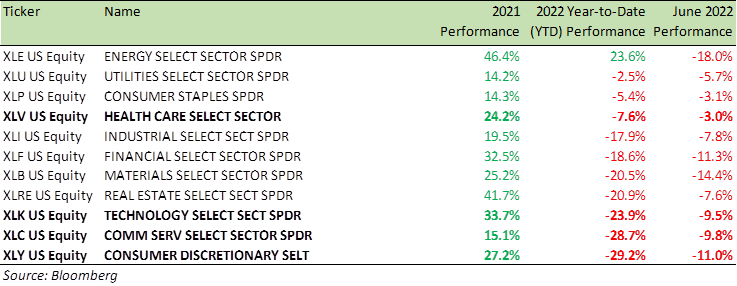
The equity market has seen a bounce in July after having a bad June (see table below) which saw the S&P 500 index (SPX) lose -8.4%. The index is down -19% for the year i.e. nearly half of the year’s decline has come in June.

Two factors have played a significant role in the swings of asset markets throughout the year – expectations for economic growth and expectations for the path of interest rates. In the first half of the year, the concerns about growth were a much smaller factor, than concerns about how high the Fed Funds Rate (FFR) could go in the US.

The expectations of the FFR hitting +4.5% by mid-June next year have moderated over the last four weeks, and the expectation now is for FFR to be at +3.5% in June next year. However, as rate rise expectations have shifted downwards, growth concerns abound,, with talk of an impending recession in the US.

Karl Otto Pöhl, President of Germany’s Bundesbank from 1980 to 1991 once said – “Inflation is like toothpaste. Once it’s out, you can hardly get it back in again.”

US Consumer Price Index (CPI) data out last week, showed that inflation reached +9.1% in June, higher than May’s +8.6% and the highest rate in nearly 40 years.

US Federal Reserve (Fed) Chairman Jerome Powell must certainly feel like he is trying to squeeze toothpaste back into the tube, as he tries to contain inflation. The percentage of items in the CPI basket whose YoY prices are increasing by over +4% is now at a new record high of over 70% i.e. inflation is very broad-based and at over +4% for the majority of items in the basket. This will concern the Fed.

Core inflation, which strips out volatile food and energy components, however, increased by +5.9% in June from a year ago. A slightly slower pace than May’s +6% increase. It indicates that the core inflation has levelled off and has started to come down ever so slowly.

Another interesting piece of recent data is US real earnings, which keep dropping. Real average hourly earnings decreased by -3.6%, seasonally adjusted, from June 2021 to June 2022. This does not bode well for consumption. Consumers are getting increasingly squeezed both in magnitude and overtime when it comes to their purchasing power, and this means the Fed’s hawkishness is working.

Benchmark Global Equity Index Performance (2021 and 2022 YTD)

Amongst all this high inflation data and the expectations of more interest rate hikes, the bond market does not seem in any way panicked.

The front-end yields (3 months to 2-year maturity) have increased as Fed hawkishness is re-priced, but long-end yields (10 years plus) fell on the day we got a record CPI print of +9.1%. The yield on 10y US Treasury is now down to +2.9%. It was at +3.5% a month ago. Bond yields move in the opposite direction to prices.

Well, the long end of the bond market is screaming what’s coming after the interest rate hikes – interest rate cuts.

Bond futures show over a 100 bps of cuts are now priced between Dec 2022 and Jun 2024. It will be the fastest cutting cycle ever immediately after the Fed finished hiking. This is what is helping long-dated bonds rally.

On Tuesday, Japanese bank Nomura Holdings became the first major bank to forecast rate cuts next year. Nomura expects the US Federal Reserve (the Fed), the Bank of England (BoE) and the European Central Bank (ECB) all to begin rate cuts as soon as the middle of next year. In my opinion, the recent set of economic data indicates that, while the near-term inflation numbers may remain high, more rate rises now, only mean more rate cuts next year.

The FFR may get to over +3.5% this rate hike cycle, as some expect. However, over the medium term, the state of debt, deficit and economic growth in the US, mean the FFR will stabilise in the +2.25% to +2.5% range.

Inflation above +9% was cue enough for some in the market to price a 100bps at the July 27 Fed meeting.

A word of caution – the Fed does have its vreputation and credibility to protect. The Fed did not look good last time when it raised rates by +0.75% at its June 14-15 meeting. The Fed’s rationale for its more aggressive tightening stance was leaked in a Wall Street Journal (WSJ) article. So, worried was the Fed about a particular set of data – the preliminary University of Michigan (UMich) Sentiment report that showed rising inflation expectations, that the Fed saw it wise to signal a +0.75% rate hike ahead of the actual hike.

During the press conference that followed the June Fed decision, Fed Chair Powell remarked, “…one of the factors in our deciding to move ahead with 75 basis points today was what we saw in inflation expectations….the preliminary Michigan reading, it’s a preliminary reading. It might be revised. Nonetheless, it was quite eye-catching, and we noticed that. We’re absolutely determined to keep them anchored at 2%.”

In an interesting twist, less than two weeks later, the uptick in inflation expectations in the UMich data, was revised away. The fact that the Fed changed the trajectory of its tightening path on a preliminary report that proved to be a ‘false alarm,’ is disconcerting and shows the chances of a monetary policy error by the central banks in the febrile economic situation that the world finds itself in. It makes the job of forecasting rates even more difficult. Therefore, please take every extreme/sensational forecast with a huge dollop of salt.

Last week, the International Monetary Fund (IMF) cut its forecast for US GDP growth down to +2.3% from +2.9%. This news is notable for two reasons.

First, it comes less than a month after the IMF downgraded its growth forecast in the US to +2.9%.

Second, given the indication from the Atlanta Fed’s GDPNow model, which is calling for a Q2 contraction of -1.2% following Q1’s decline of -1.6%, the US economy would need to grow by +3.2% in the second half to reach that goal. Based on the trend in recent data and the Fed’s tightening bias, that level of US GDP growth seems optimistic i.e. the IMF will cut its forecast again. So, we have a clear case of economic slowdown, and the Fed will not ignore this. A +9.1% inflation print, however, has sealed at least a +0.5% increase in the FFR later this month, no matter how weak the data over the next two weeks.

Even if the Fed knows inflation has peaked or is near peak, the Fed will use every opportunity to get rates as high as it can without breaking the economy to give itself the headroom it will need once growth concerns return and they already are. The Q2 US GDP print is likely going to be -1% or worse. That will confirm the US economy is in a recession.

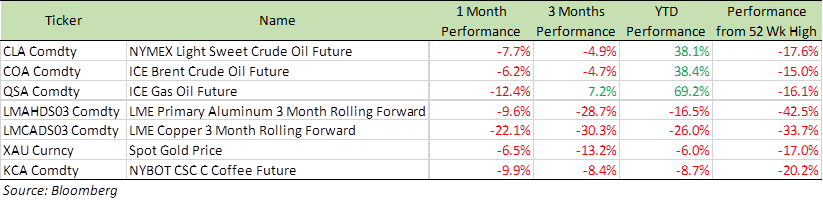
Even as prices have moved marginally up, commodity prices continue to weaken (table below). Base metals )Copper and Aluminium) prices have fallen by a third or more from their high. Oil prices have fallen by almost -20% over the last six weeks. Growth concerns and recessionary fears are growing.

Commodity performance over the last 12 months

Benchmark US equity sector performance (2021, 2022 YTD)

Investors’ nerves are still frayed as equity benchmark indexes are still down over -15% across the board and sector indexes (table above) by over -20% in many cases.

The headline US Consumer Price Index (CPI) report has rarely come in weaker than expected complicating matters for equity bulls like me to take/recommend directional trades with a high degree of conviction. In the two years through May’s report, there have only been two weaker-than-expected headline CPI reports, which is easily the lowest number over a two-year span in at least twenty years.

In such a situation it is best to invest wisely. Therefore, my insistence throughout the year for income strategies using structured products.

In a directionless market such as the present, volatility abounds, and structured products are the perfect vehicle to monetise income and retain an upside in market performance. Structured products also help an investor clip coupons, if (and it certainly looks like it) economic growth is going to disappoint, leading to the limited upside for equities.

There are plenty of high-quality stocks in the consumer, tech, industrial and health care sectors that are trading at -10% to -15% on a YTD basis, and present a good opportunity to invest using a structured product. Just last week, we structured and traded one such basket on industrial names with a coupon of +12.75%.

For specific stock recommendations and structured product ideas please do not hesitate to get in touch.

 
Best wishes,

Manish Singh, CFA

Lost in the turmoil of the 1970s, is the fact it was a decade full of breakthroughs in electronic, data-processing and medical technology. The email, the floppy disk, the first real video game, the personal computer all came in 70s. The 70s game us Microsoft, Apple, Oracle, Visa, Federal Express, Nike, Genentech, Starbucks and Home Depot.

Summary

The 1970s get a lot of bad press. It was however a decade not just about gloom, economic crises, bell-bottom trousers and thick sideburns. It was also a remarkable decade, full of breakthroughs in electronic, data-processing and medical technology, including email (ARPANET), the floppy disk (IBM), the first real video game Pong (Atari), and the personal computer (Apple). The 1970s gave us companies like Microsoft, Apple, Oracle, Visa, Federal Express, Nike, Genentech, Starbucks and Home Depot.

So, you see, lost in the turmoil of the 1970s, is the fact that the US economy was going through a painful, yet necessary, transformation. New ventures formed, that in years to come would radically change the US and the world economy. The changes and innovation of the 1970s set the stage for a new type of economy in the future – less manufacturing more services, less labour intensive and higher productivity. Anybody can brand the prevailing economic problems in the 2020s as a “crisis,” raise the flag of fear and get bearish. It takes however a mixture of intellectual boldness and gritty determination to see the ongoing innovation in the economy and hence the future.

The equity markets are in oversold territory, however, it’s the US Federal Reserve pivot on interest rates and inflation that the market is waiting for, in order for a sustainable rally to set in. For the Fed to do this, it has to see the inflation data start falling measurably. If economic data continues to worsen (and they are), inflation will slide and then one can expect Fed talk to change tack and indicate a desire to slow down or pause tightening. Until then, keep your seat belts fastened, volatility will abound.

Were the 1970s really that bad?

Of all the post-war decades, the 1970s is seen as the worst. A decade full of economic woes, sandwiched between the swinging Sixties and the go-getting Eighties.

All you ever read or hear about the ‘70s is – double-digit inflation, high unemployment, and mortgage rates as high as +20%. The decade witnessed two US economic recessions, at least two severe global energy crises, the unprecedented peacetime implementation of wage and price controls in the US, and the abandoning by the US of the global monetary system established during World War II.

The “energy crisis” played a key role in the economic woes of the 1970s. In a televised speech in 1977, then US President Jimmy Carter donned a sweater to put across his message of “energy conservation” and in doing so became the first US President to make an official appearance before the nation wearing a sweater. The fear of energy shortages, which necessitated production cuts and job cuts, was making things worse. The impact of higher prices would be felt in rising inflation and falling business confidence, which plagued the entire decade.

However, just because inflation is today at +8.3% in the US and talk of 1970s-like economic woes fills the airwaves, I am not writing this newsletter to add to the noise. In the paragraphs below, I intend to dwell on: Were the 1970s really that bad or, were there redeeming features and events that we can take comfort from?

Old Shell Petrol Station 1970s

Today, we do not have an energy shortage. We have an excess of it, if only we could ship it to where it’s needed. The shortage of energy or “peak oil,” has often been used as a bogeyman by energy producers and traders, to drive energy prices higher, which in turn drives up input costs for almost everything we produce and consume and use to get around. Energy is the lifeblood of our economy.

Daniel Yergin’s book “The Prize: the Epic Quest for Oil, Money, and Power” is a fascinating read as to how the old-fashioned “energy crisis” has travelled through time, since the oil industry came into existence in the 1890s.

In 1920, the head of the US Geological Service warned that US reserves would be depleted in exactly nine years and three months. In 1930, just as the feared date of exhaustion arrived, the industry was rocked by the discovery of the huge East Texas field. The ensuing flood of oil sent prices crashing down to 10 cents a barrel during the Depression. A similar fear of shortage after World War II led to new technological developments and the opening up of the huge oil fields of Saudi Arabia, Kuwait and elsewhere in the Middle East. Fast forward to the 21st century and we know what “shale oil” has done for the energy market and geopolitics. The US has become energy independent and its influence on global geopolitics has been enhanced. On the other hand, Russia, the largest energy exporter has seen its standing and influence slump.

In his book, Yergin reminds us that the consequences were the same as in virtually every other “energy crisis” since “Colonel” Edwin Drake struck oil in western Pennsylvania in 1859 – smaller companies slashed spending to survive, larger companies postponed new projects, people were let go, human ingenuity prevailed, new technologies were again deployed, new territories were opened up, and new supplies came through.

The reason I highlight this, is to make just one point – never underestimate human ingenuity in solving a problem to come out of a crisis. In the immortal words of US President Franklin D. Roosevelt – “The only thing we have to fear is fear itself.” Those words and the sentiment they convey have and will continue to find an echo in many a bosom for many years to come.

It was not just the US, but the UK too that had its pessimism and gloom in the 1970s. In November 1974, then UK Foreign Secretary (and later Prime Minister) James Callaghan said this to his colleagues – “Our place in the world is shrinking: our economic comparisons grow worse, long-term political influence depends on economic strength – and that is running out. If I were a young man, I should emigrate.” Yet, what followed the winter of discontent, was over a decade of glorious growth and prosperity under Prime Minister Margaret Thatcher.

Today, we do not have the unemployment problems of the 1970s. The US and the UK have more jobs than the number of people looking for employment. The unemployment rate in many a country is at historical lows and speaks of economic growth and consumption that lies ahead when we are past the headline inflation scare that abounds.

The 1970s were not just about gloom, economic crisis, bell-bottom pants and thick sideburns. They were a remarkable decade full of breakthroughs in electronic, data-processing and medical technology.

From the first mobile phone to the Rubik’s Cube to barcodes, some of the world’s greatest inventions emerged during the 1970s. The Email ( ARPANET), the floppy disk (IBM), the first real video game Pong (Atari), the personal computer (Apple), the cell phone (Motorola), the video cassette recorder (Philips), the digital camera (Cromemco), the Global Positioning System or GPS (US Navy), the portable music player or Walkman (Sony) were all innovations of the 1970s.

The floppy disk may be a largely obsolete technology now, but its legacy remains. I wrote this newsletter in Microsoft Word and each time I wanted to save the document, I clicked on the floppy disk symbol in the top left corner.

An IBM floppy disk

The 1970s gave us companies like – Microsoft, Apple, Oracle, Visa, Federal Express, Nike, Genentech, Starbucks and Home Depot, to name but a few. If you were not a doom-monger in the 1970s and looked on the bright side (as I always advocate readers of this newsletter to do), you felt as though the future was now. Storied Venture Capital firms – Kleiner, Perkins, Caufield & Byers, Sequoia Capital, Apax Partners, New Enterprise Associates and Oak Investment Partners – all were founded in the 1970s. These firms made some of the most notable investments in Tandem Computers, Genentech, Apple Inc., Electronic Arts, Compaq, Federal Express and LSI Corporation to build the technology future that we so take for granted sometimes.

So, you see lost in the turmoil of the 1970s, is the fact that the US economy was going through a painful, yet necessary, transformation. New ventures formed that in years to come would radically change the US and the world economy. The changes and innovation of the 1970s set the stage for a new type of economy in the future – less manufacturing more services, less labour intensive and higher productivity. America, which was dependent on the large manufacturing companies for a large part of the twentieth century, underwent a transformation.

The Great Depression saw the birth of some massive US corporations – General Electric, General Motors, IBM, Disney, Hewlett-Packard (HP), Morgan Stanley, Texas Instruments, United Technologies, and Polaroid Holdings. Google, eBay, Bookings Holding, and Amazon, were created during the 1998 dot.com crash.

The entrepreneurial successes of the 1970s and the great Depression convey a fundamental message – hard times are good for business innovation. They lead to what Austrian economist Joseph Schumpeter (1883–1950) called “creative destruction” as talented people are shaken free from the clutches of old institutions and old thinking and the market for ventures and innovations booms. Technology has paved the way for economic transformation and improved quality of life and it’s not going in the reverse. You will see more and not less innovation going forward. You will not make money investing in companies of the future if you get shaken out by a correction. To make lofty returns in Yahoo (YHOO) one had to endure at least five -70% corrections.

The truth is that the 1970s were better than the decades before and the following decades better than the 1970s.

Anybody can brand prevailing economic problems a “crisis,” raise the flag of fear and get bearish. However, it takes a mixture of intellectual boldness and gritty determination to see opportunity. If you see things as the “beginning of something” rather than the “end of something,” you have a very good chance of seeing the future.

Markets and the Economy

If you are invested in the equity markets, then you know already that they have been extremely volatile this year.

The chart below from Bespoke Invest outlines how volatile, compared to prior years. So far in 2022, the S&P 500 (SPX) has averaged an absolute daily move of 121 basis points (bps). Although the broader index has been incredibly weak over the last 100 trading days (down -17.1%), performance among individual sectors has diverged widely, as Energy has gained +50.7% while the Communication Services sector has declined -32.0%. The +82.7% performance spread between the two sectors is one of the highest on record.

Only July of 2009 and March of 2000 saw higher readings.

Source: Bespoke Invest

On May 16th, America’s largest retailer, Walmart (WMT) reported its first quarter results. It reported a strong +3% rise in US same-store sales for the first-quarter, spurred by higher sales of food and health and wellness products. Walmart also raised its sales forecast for the year from +3% to +4% and expects second-quarter sales to rise +5%.

However, Walmart stock declined -11.4% that day. The reason – Walmart missed its earnings expectations, due to elevated cost pressure from fuel prices, higher inventory levels, overstaffing, e-commerce fulfilment etc.

The following day, Target (TGT) reported its earnings and suffered an even bigger stock slump of over -20%. The company said comparable sales grew +3.3% in the quarter ended April 30, which was better than the +0.24% that analysts had expected, but while total revenue grew, net profit fell by more than half. Soaring fuel costs, supply-chain bottlenecks, and inventory growth of +43% were some of the reasons for the earnings miss.

Consumer staples like – Target, Walmart, Costco and Home Depot (HD) have long been touted as “defensive” shelters from the storm buffeting the growth/tech sector, but that levy seems to have been breached. The sell-off in retail stocks, in my opinion, is overdone and it caused the SPX to dip below the 4,000 level.

The most intriguing part of both the WMT and TGT earnings announcements, was the over +30% to +40% jump in inventories, which amount to tens of billions of US dollars. It’s the same story at other retailers Kohl’s and Abercrombie & Fitch. The main reason for this, is the lingering supply-chain issues that have resulted in many retailers pulling forward inventory purchases to ensure sufficient supply, whilst at the same time consumers unwilling to pay higher prices for essential (consumer staples) goods – thus leading to a pile up in inventories. Higher inventories – be they due to overstocking or fewer items sold – lead to higher operating costs, as inventories have to be stored, moved and managed with no impact to the bottom line.

This is going to serve as a key input to policymakers at the US Federal Reserve (Fed). If consumers start pulling back, a recession is a done deal. If staples see a decline, then discretionary spending – clothing, personal care and home furnishing, have little hope of holding on. How long could inflation hold up? The Fed will be mindful of not tightening into a recession.

Benchmark Global Equity Index Performance (2021 and 2022 YTD)

Last week, we saw the Richmond Fed composite manufacturing activity data for May 2022 and it was abysmal. The reading came in at -9, the first negative reading since September of 2021, and the lowest since May 2020. The shipments sub-index swung to -14 from 17, while the volume of new orders was at -16 compared to 6 in the prior month. All very dire.

The flash Purchasing Managers Index (PMI) readings also showed a sharper deceleration. While manufacturing activity fell to a 3-month low, what surprised many was an even larger deterioration in service sector activity. Weakness in manufacturing output was expected, but the weakness in services (which fell from 55.6 to 53.5, a 4-month low) came as a surprise. This is yet another confirmation that inflationary pressures are having a worse impact on the US economy and demand is weakening sharply. The Fed may have to start taking the risk of a recession more seriously.

There was no joy on the new homes sales front either, as the sales plummeted in April by the most in nearly nine years, dented by the combination of high prices and a steep climb in mortgage rates. Purchases of new single-family homes decreased by -16.6%, the weakest since April 2020.

Freddie Mac data show that the average rate on a 30-year mortgage was +5.25% last week. In January 2021, it was +2.65%.

Meanwhile, in Europe, the European Central Bank (ECB) continues to emphasize that monetary tightening needs to proceed gradually. At the recent World Economic Forum (WEF) in Davos, Switzerland, ECB chief Christine Lagarde remarked – “I don’t think that we’re in a situation of surging demand at the moment. It’s definitely an inflation that is fuelled by the supply side of the economy. In that situation, we have to move in the right direction, obviously, but we don’t have to rush and we don’t have to panic.”

Speaking at the WEF, in a timely reminder to central banks, Nobel laureate and economist Joseph Stiglitz warned that the US Fed raising interest rates won’t fix inflation and the US needs a different kind of intervention – supply-side intervention. I made a similar point in my newsletter last month. Higher interest rates can create a barrier to increasing supply and therefore the Fed has to move carefully. Fewer goods are being made globally due to Covid-induced disruptions and changes to production and supply chain, increasing the cost of capital may have the intended outcome of making supplies worse.

With Retail, Food and even Pharmaceutical stocks down for the year, it’s only Energy and Utility stocks that are in green (see table below).

Benchmark US equity sector performance (2021, 2022 YTD)

The sell-off in US consumer staples (XLP) is overdone, and these remain good defensive stocks to hold in a portfolio.

The Technology (XLK) and the Communications sectors (XLC) are bottoming out, however, several growth stocks are +20% off their lows.

The key reason Consumer Discretionary (XLY) is the worst-performing sector, is due to two stocks – Amazon (AMZN) and Tesla (TSLA). These two stocks account for nearly 40% of the index and both of them are down a whopping -40% year-to-date (YTD).

The equity market is in oversold territory, however, it’s the Fed pivot on inflation an interest rates that the market awaits for a sustainable rally to set in. For the Fed to do this, it has to see the inflation data start falling measurably. If economic data continues to worsen (and they are), inflation will slide and then one can expect Fed talk to change tack and indicate a desire to slow down or pause tightening.

Until then, volatility will abound. In such market conditions, structured products are the perfect vehicle to monetise income and retain an upside in market performance. Structured products also help an investor clip coupons, if economic growth is going to disappoint, leading to the limited upside for equities.

For specific stock recommendations and structured product ideas please do not hesitate to get in touch.

 
Best wishes,

Manish Singh, CFA