A man climbs a tall read ladder leading to higher interest rates.

The bond market sell-off is overdone. Given the drop in equities this month, the case for equities, particularly growth and technology stocks gets stronger. The pessimism on growth/tech names is overdone and cannot last.”

Summary

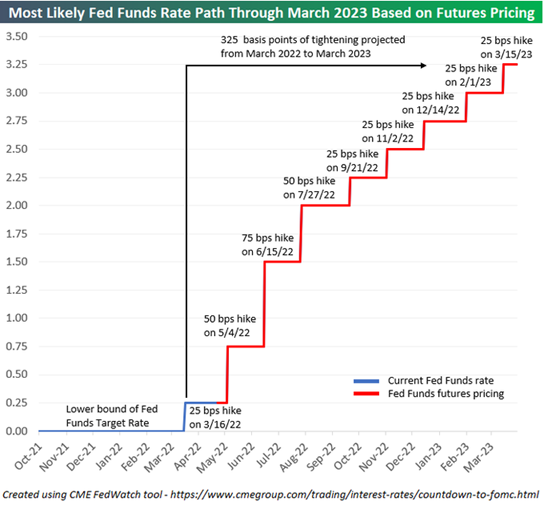
The US Fed Funds futures market is now pricing in an interest rate increase of 175 basis points over the next three Federal Open Market Committee (FOMC) meetings in May, June and July. Only 6-months ago, markets were pricing two interest rate hikes in 2022 i.e. a 50 bps increase.

If the current pricing plays out (and it often doesn’t), the year-over-year period from March 2022 to March 2023, would become the most aggressive tightening cycle conducted by the Fed since March 1988-1989 period. Also, bear in mind, that the economic impact of a +0.50% rate increase today, is equal to a +1% move in 2008, because since then, total public debt has more than doubled. If core inflation decelerates, the conversation will shift very quickly to a 25 bps tightening or even a pause in tightening later this year.

Corporate revenues and earnings growth in the US, in general, remain solid, but the market is focused on bond yields, interest rates and other macro factors. I understand market concerns around inflation and geopolitics. However, investors will also do well to remember – if inflation and supply chain issues do start to subside (and they undoubtedly will), a lower-risk course towards neutral rates could be adopted very quickly and it would substantially reduce the odds of a Fed-induced recession. The Fed is not in the business of causing recessions. Far from it and it’s not a choice the politicians (who appoint and mandate Federal Reserve members) would like the Fed to make.

In my view, the bond market sell-off is overdone and a rebound in bond prices is around the corner. Particularly the 5y mark is where bond yields will tighten the most, while the long end may still get buffeted by inflation, with more bond issuances coming down the line. Given the drop in equities this month, the case for equities, particularly growth and technology stocks, gets even stronger. The pessimism on growth and technology names is overdone and cannot last.

Is the Bond market sell-off overdone?

If you think you are nursing a loss holding technology stocks this year, and bonds would have been a safer place to be, then sample this:

A 30 year US Treasury bond bearing a coupon of +1.25%, issued on 15 May 2020, and trading at 90% as recently as December, now trades at 67%. That’s a paper loss of a third of your capital, on arguably the “safest paper” in the world.

While technology and growth stocks have been the “pain” trade, it has been even worse in the fixed income market on a risk-return adjusted basis, where long-dated Treasuries have plummeted, as interest rates expectations have spiked.

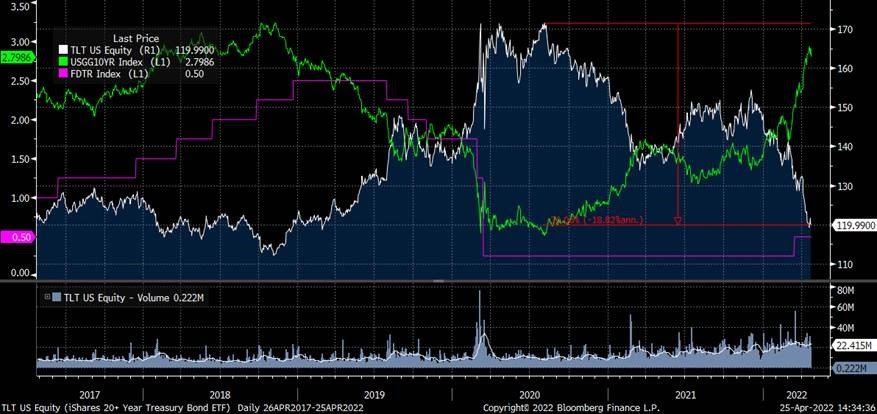
The TLT US (the Exchange-Traded Fund (ETF), which tracks a market-weighted index of debt issued by the US Treasury, with remaining maturities of 20 years or more, is down -18% since the beginning of the year and down -30% since August 2020, when bond yields hit a record low.

The tech-heavy National Association of Securities Dealers Automated Quotations (NASDAQ) 100 index in comparison is down -18% YTD and up +16% since August 2020.

The “Total Bond Market” ETF (BND) is down -9.0%, junk bonds (HYG) are down -7.6% and short-term Treasuries (SHY) are down -2.8%.

The Yield on the 10-Year US Treasury (USGG10YR Index) hit a low of +0.5% in August 2020 as Covid-19 raged. It now sits at +2.8% (see chart below), as the market has raced over the last quarter to price in aggressive interest rate rises by the US Federal Reserve (Fed). Mind you, the US Federal Funds Target Rate (FDTR) over the same period has moved from +0.25% to +0.5% i.e. a 1/10th increase compared to the increase in the yields on 10Y US Treasury bonds (see chart below)

iShares 20+ Year Treasury Bond ETF (TLT US): 5-year Price chart

Source: Bloomberg

Bond yields have increased (prices move in the opposite direction to yield) sharply this year.
The Fed Fund futures market is now pricing in (see table below), an interest rate increase of 175 basis points (1 basis point = 0.01%) over the next three Federal Open Market Committee (FOMC) meetings in May, June and July.

If current futures pricing plays out (which it often doesn’t), the year-over-year period from March 2022 to March 2023, would be the most aggressive tightening cycle conducted by the Fed since the March 1988 to March 1989 period. Also, bear in mind, that the economic impact of a +0.50% rate hike today, is equal to a +1% move in 2008, because since then, total public debt has more than doubled.

So, the question of the day is: – has the sell-off in the bond market gone too far? Is it time for bonds to rebound? The short answers are: Yes and yes.

Surveys of purchasing managers conducted over recent weeks, indicate a loss of steam in major economies such as Germany, the US and the UK in April. The IMF has downgraded the global growth outlook for the year from +4.4% to +3.6%, down from +6.1% last year. Economic growth is indeed slowing in large parts of the globe, as businesses feel the impact of Russia’s invasion of Ukraine, pandemic-prompted lockdowns in China and a sustained high level of inflation.

The Dow Jones Transportation Average (TRAN), which tracks 20 large US companies ranging from delivery giant United Parcel Service to railroad operator Union Pacific, tumbled -12% this month, whereas the 30 stock benchmark Dow Jones Industrial Average (DJIA) index was down only -3%. Changes in transportation demand, reflect changes in the demand for goods and services. For example, in periods of economic expansion, the demand for goods and services typically increases, which in turn increases the demand for transportation.

The Fed would be playing with fire, by moving as rapidly as the interest rate futures suggest.

Frankly, some of the comments I’ve heard over last few days from Fed speakers and market commentators have been ludicrous. Talks of multiple 75 bps hikes, are not just insane but frankly reckless.

In my opinion, it’s way too soon to talk about what the future holds for rates, based on two months of price action and with many of the Covid-induced supply disruptions still around.

The Fed is caught in a bind and the issue as ever is SUPPLY and DEMAND

  • The fact is, less goods are being made globally due to Covid-induced disruptions and changes to production and supply chain, yet demand has recovered and accelerated
  • Inflation is high, yes, however, will GDP growth keep up?
  • Until supply catches up to demand, we are going to see inflation. However, higher interest rates can create a barrier to increasing supply and therefore the Fed has to move carefully. That is a big reason why the Fed is talking a big game on raising rates, but falling short of delivering it. It’s the right approach.

As we often see in financial markets, the market prices in “news” much sooner and quicker than the actual turn of events.

The Fed has a tough balancing act to follow, tighten too far with supply issues still in place and the economy will be in a perilous stagflation (slow growth/recession coupled with high inflation) zone.

In my opinion, the bond market sell-off is overdone and a rebound in bond prices is around the corner. Particularly the 5y mark is where bond yields will tighten the most, while the long end may still get buffeted by inflation with more bond issuances coming down the line.

Markets and the Economy

I talked about the weakness in the Japanese Yen in last month’s Market Viewpoints. The Japanese Yen (JPY) has continued to weaken and at 130 JPY per USD, JPY is down over -13% so far this year.

A few years ago, such a move in JPY would have alarmed the market, but this time around, there seems to be an indifference of sorts.

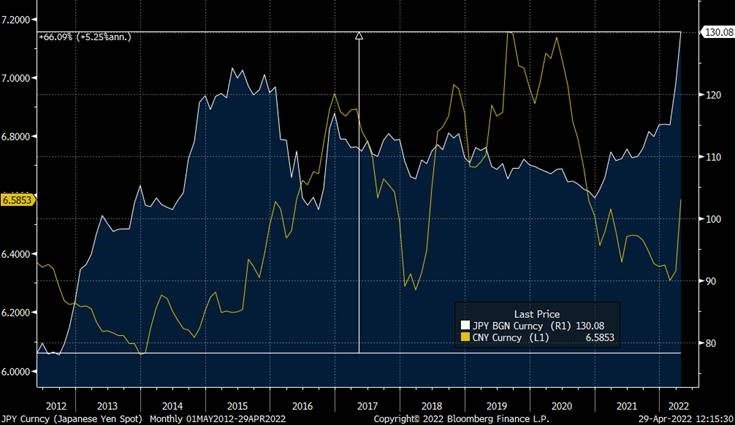
One reason for that is Japan’s relevance to the world. The rise of China has eclipsed Japan more than any other country. Corporate Japan living off old glories and riding the weak JPY wave, has failed to reward and spur innovation in Japan for over a decade if not more. JPY is -66% weaker (chart below) now than it was in 2012. The Chinese Yuan (CNY) is essentially flat over the same period.

A weaker currency is a nice thing to have, but it can soon spiral out of control and become a headache. A strong economy often leads to a strong currency, which was the case with Japan and which is the case with China today. Former Fed Chairman Paul Volcker put it best, “a nation’s exchange rate is the single most important price in its economy; it will influence the entire range of individual prices, imports and exports, and even the level of economic activity.”

Volcker’s point was that a strong economy doesn’t shy away from having a strong currency. Dealing with supply-side problems, by just tolerating currency weakness, is bound to lead to more troubles. A re-tooling of the Japanese economy and businesses, now seem inevitable, or Japan will permanently be consigned to the lower ranks of global leadership.

Today, India, Brazil and Indonesia are producing more unicorns (companies valued at over $1bn) than Japan. India is home to 54 unicorns, Brazil 12, Indonesia 7 and Japan 6. China has over 300 unicorns. Therefore, the world rightly seems to be more focused on China’s zero-Covid policy than Japan’s policy to engineer inflation in its economy. This trend is unlikely to change and JPY is likely to weaken further.

Japanese Government Bond (JGB) holders may finally realise that a +0.25% yield on 10Y JGB is not a fair compensation, given the weakness in the currency and the lack of growth prospects. Japan’s Prime Minister Fumio Kishida has a tough job at hand.

10-year price chart for Japanese Yen (JPY) and Chinese Yuan (CNY)

Source: Bloomberg

Moving on to US equity markets.

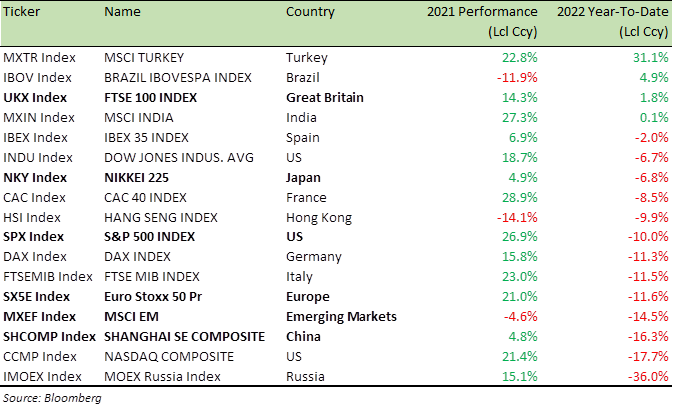
As bond yields have increased, equities have borne the brunt (table below).

The S&P 500 index (SPX) is down more than -5.4% month-to-date (MTD) and the tech and growth stock heavy NASDAQ composite is down -9.5% MTD.

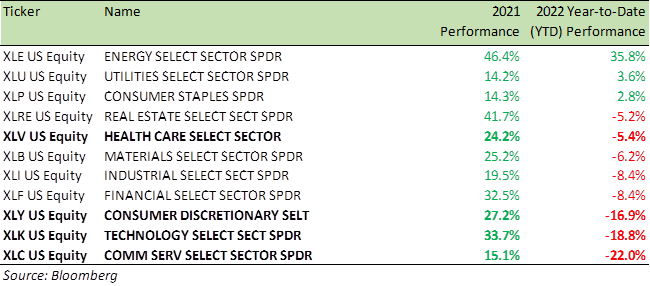
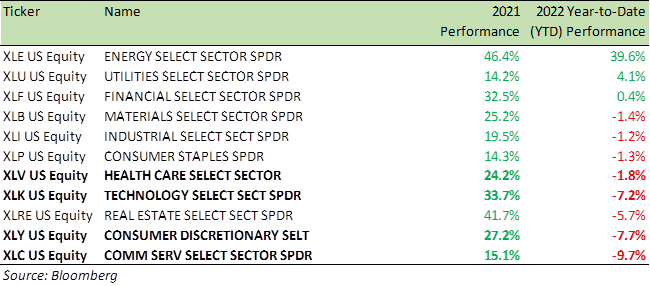
April is the third month where the SPX has been down over -5% on an intra-month basis. This just goes to show how volatile the year has been so far. Technology (XLK), Consumer Discretionary (XLY), and Communication Services (XLC) are the most severely punished sectors as the table below indicates with many stocks now trading at their 52-week lows.

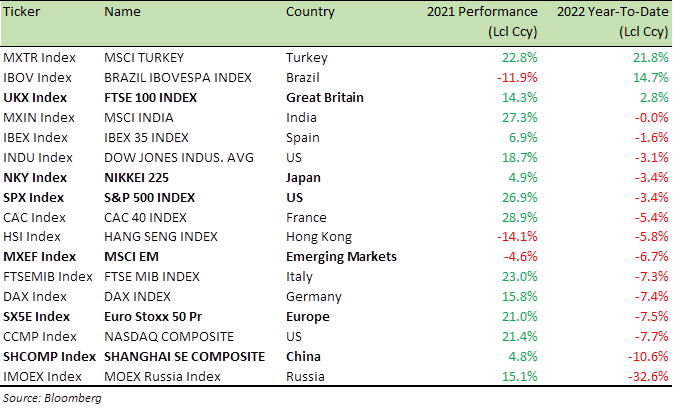
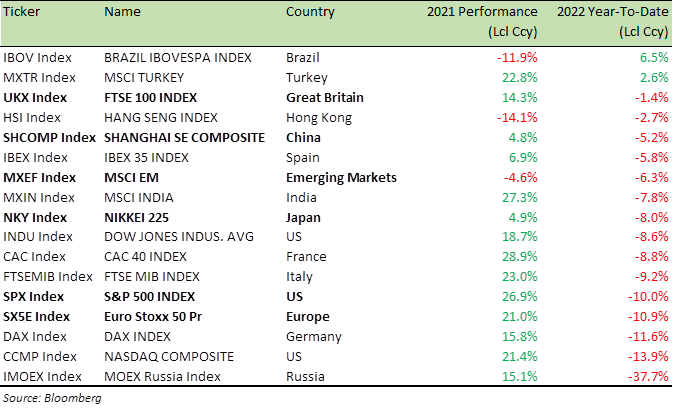
Benchmark Global Equity Index Performance (2021 and 2022 YTD)

US Corporate earnings season is in full swing and some notable earnings this week were:

  • Microsoft (MSFT) reported revenue ($49.4B vs $49.09 expected) and earnings per share ($2.22 vs $2.19 expected) that were above estimates despite an incremental $302 million revenue impact from currency and a $130 million operating income impact from halting operations in Russia. Dissecting earnings further, the personal computing, intelligent cloud, and commercial cloud segments all beat estimates. Revenues for MSFT’s cloud business Azure and the broader Commercial Cloud business exceeded $23 billion, +35% YoY growth
  • Alphabet (GOOG) Q1 revenues were in line with estimates, but the company posted an operating margin of 30.0%, which surpassed estimates by 120 bps. EPS of $24.62 missed estimates by $1.14, and the board of directors authorized a share repurchase program for up to $70 billion. Ad revenue, cloud revenue and other bets beat expectations, while services and other revenues missed and cloud posted a larger operating loss than expected.
  • Visa (V) saw payment volume increase +17% YoY, leading to a beat in processed transactions. The Q1 revenues totalled $7.2B vs expectations of $6.8 billion, while adjusted EPS was $1.79, which was 14 cents above consensus. Cross-border volume rose by +38% YoY while service revenue increased by +24%. Profit jumped by +21% due to a rebound in consumer spending.

Revenue and earnings growth, in general, remains solid, but the market is focused on bond yields, interest rates and other macro factors.

Only 6-months ago, markets were pricing two rate hikes in 2022 i.e. a 50 bps increase. Today, they are pricing an increase of 150 to 200 bps.

I understand market concerns around inflation and geopolitics. However, investors will also do well to remember – if inflation and supply chain issues do start to subside (and they will), a lower-risk course towards neutral rates could be adopted very quickly and it would substantially reduce the odds of a Fed-induced recession, that is the greatest threat to risk assets and economic growth.

The Fed is not in the business of causing recessions. Far from it and it’s not a choice the politicians (who appoint and mandate the Federal Reserve members) would like the Fed to make.

What we have now is a combination of – a strong economy, high inflation, supply chain issues, and the expectation of a much tighter monetary policy.

What the stock market needs in order to resume the rally, is a combination of – a strong economy, lower inflation, supply chain predictability and stability, and a more dovish monetary policy.

Economic surveys indicate that the US economy is showing signs of weakness and is bound to dampen inflation. Year-over-Year (YoY) inflation prints are likely to slow in the coming months given that the April 2021- July 2021 core Consumer Price Index (CPI) prints, were the fastest month-on-month readings in decades. In March, the core CPI rose +4% annualized, but that represented a big slowdown from the over +6% prints of recent months.

If the core inflation decelerates, the conversation will shift very quickly to a 25 bps tightening or even a pause in tightening later this year.

Benchmark US equity sector performance (2021, 2022 YTD)

The markets may have priced in three 50bps hikes but rising mortgage and corporate bond yields, combined with a stronger US Dollar, are bound to slow down the US economy. The Fed therefore will very unlikely not match the market’s hawkish expectations.

The lockdown in China is also set to weigh on inflation, as Chinese growth slows down and with it demand for commodities. China will eventually abandon the zero-Covid policy, but the 20th Party of Congress Chinese Communist Party (CCP) is due in September and President Xi Jinping will not risk anything. The net result is low growth in China, weakness in commodities and fall in inflation. It might be just the respite that growth stocks and bond markets are waiting for.

Given the drop in equities this month, the case for equities, particularly growth and technology stocks gets stronger. The pessimism on growth/tech names is overdone and cannot last.

In this period of elevated market volatility and geopolitical anxiety, structured products, which offer a degree of capital protection, continue to be a good way to invest. Structured products also help an investor clip coupons, if economic growth is going to disappoint, leading to limited upside for equities.

For specific stock recommendations and structured product ideas please do not hesitate to get in touch.

 
Best wishes,
Manish Singh, CFA


Yen Flying in City

“The S&P 500 has risen +10% since the US Federal Reserve raised interest rates. It’s almost surreal to see that the Japanese Yen has lost more value during March than the Russian Ruble. If the Yen were to continue weakening, China may be forced to weaken the Yuan in a repeat of what we saw in 2014-15.”

Summary

The Japanese Yen (JPY), the world’s third-largest reserve currency, is having a bad month.

At one stage, the Yen was down -7% in March and USDJPY hit 125, a near two-decade low. The last time JPY weakened to such an extent in 2014-2015, China was forced to weaken its currency (CNY) to rebalance the terms of trade. The result of this CNY weakness, was a big rally in Chinese equities. The Shanghai Composite Index (SHCOMP) doubled between February 2014 and May 2015. Given the bearish sentiment surrounding Chinese equities, a series of weak fixings for CNY could deliver a stellar rally in SHCOMP. So, watch out for more moves in JPY and CNY. In view of what’s happening in the world, it’s almost surreal to see that the Japanese Yen has lost more value during March than the Russian Ruble.

Last week, Russia announced that Moscow will now only accept Rubles (RUB) as payment for natural gas deliveries to “unfriendly” countries, which includes the European Union (EU). Russia reiterated this demand this week and is not backing down. Russia supplies around 40% of EU gas consumption. The EU’s trade deficit with Russia of €58.5 billion, is only going to get worse, as the EU has continued to import energy whilst banning any exports to Russia. The EU better be prepared for energy rationing, have enough gold to buy RUB, have aces up its sleeve or be ready to make an embarrassing about-turn. This just goes to show the importance of energy to the world. Russia’s invasion of Ukraine is a despicable and dastardly act, but the economic reality is that Russia cannot be sanctioned and treated like North Korea, without inflicting a huge economic cost to those sanctioning.

The S&P 500 index (SPX) may still be negative territory for the year, it has however surged more than +10% since mid-March. The market is yet to fully embrace the rally and turn bullish. This means there’s more upside to come, particularly when the equity market starts pricing in fewer than six interest rate hikes for the year.

Japanese Yen loses more value than Russian Ruble during March

While everyone is focused on the Ukraine-Russia war, (no Mr Putin, it’s not a special military operation!), the bigger story, in financial circles, is the weakness of the Japanese Yen (JPY).

JPY, the world’s third-largest reserve currency (the US dollar and the Euro being the top two) is on track for one of its worst monthly performance ever (please see chart below).

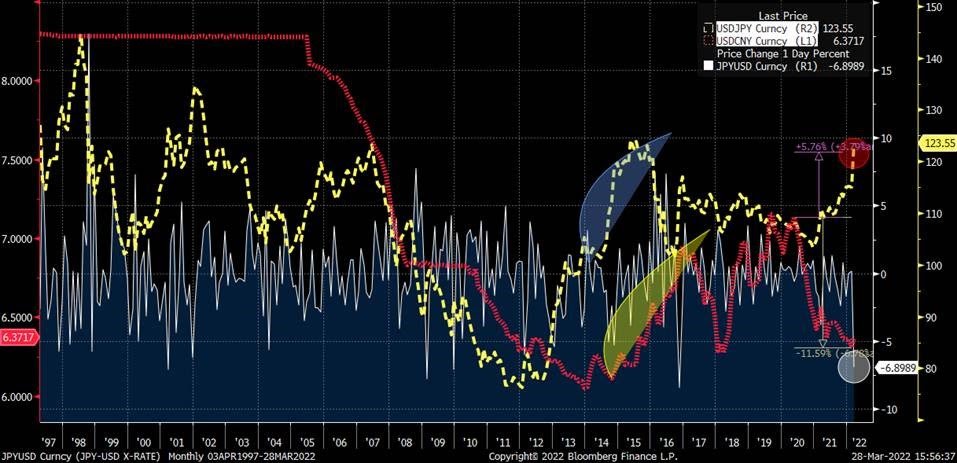
The prospects of widening US-Japan interest rate differentials have pushed the USD/JPY higher and on Monday JPY hit 125 against USD, the highest since August 2015. That’s a loss of nearly -7% for the month. The Yen has recovered since and currently trades at 122 per USD. If the Yen sell-off resumes, hitting 125.52, would be a two-decade low for the currency.

The Bank of Japan (BoJ) has pledged to keep monetary policy loose, in contrast with most other major central banks, which are in tightening mode or getting ready to tighten monetary policy. The yield on the benchmark 10-year Japanese Government Bond (JGB) hit a fresh six-year high of +0.250%, even after the BoJ stepped into the market with an offer to buy an unlimited amount of JGBs to defend the implicit +0.25% ceiling set around its yield target.

BOJ Governor Haruhiko Kuroda has repeatedly said the central bank would maintain interest rates at the current ultralow levels, given the fragile economic recovery and as inflation remains well below its +2% target.

25 year chart: Japanese Yen (USD/JPY) price, Chinese Yuan (USD/CNY) price and USD/JPY monthly price change

Source: Bloomberg

I don’t believe Japan will be particularly worried about this weakness in the Yen, as it means Japanese manufacturers will have a lower cost in dollar terms and gain an edge over other exporters.

Japan’s Vice Minister of Finance for international affairs, Masato Kanda said: “The market determines the exchange rate. We will respond appropriately while maintaining close communication with the U.S. and other monetary authorities.”

China, on the other hand, will be watching this with great interest, as the Chinese Yuan has strengthened by over +11% since June 2020 and the JPY has weakened by over -6% in the same period i.e. the terms of trade for Chinese exporters selling to the American consumer is -17% worse compared to their Japanese competitors.

One explanation for this move is that we are seeing a revival of the “carry trade” – investors borrowing in Yen at low rates, selling the Yen and buying US dollars to earn a higher rate of interest.

If President Donald Trump were still in the White House, he would have cried foul and labelled Japan a currency manipulator by now. US President Joe Biden on the other hand, will welcome a strong dollar, as it pushes the cost of imported goods down and tempers inflation – Biden White House’s biggest concern going into mid-term elections.

China on the other hand will be less charitable about the Yen weakness. The last time JPY weakened to such an extent in 2014-2015, the Chinese were forced to weaken their currency CNY to rebalance the terms of trade (see the yellow shaded region in the chart above).

The result of this weakness in CNY was a big rally in Chinese equities. The Shanghai Composite Index (SHCOMP) doubled between February 2014 and May 2015. Given the bearishness surrounding Chinese equities, a series of weak fixings for CNY, if necessitated, could deliver a stellar rally in SHCOMP.

So, watch out for more moves in JPY and CNY.

One other currency is on the move, for entirely different reasons – is the Russian Ruble (RUB). It has rallied +28% this month even as the Ukraine-Russia war rages on. It’s almost surreal to see that the Japanese Yen lost more value during March than the Russian Ruble.

The RUB, which touched 177 RUB per US dollar (USD) on March 7, is currently trading at 82 RUB per USD. This is due to targeted market interventions by Russia’s central bank and strong Oil & Gas revenues. The RUB may very soon look stronger than before the war. On February 23, the day before the Ukraine invasion RUB closed at 81.67 per USD. So what’s changed?

Russia’s demand last week that Moscow will now only accept RUB as payment for natural gas deliveries to “unfriendly” countries, which include the European Union (EU), could prove significant and force Europe – which has no access to RUB but needs Russian gas – to ease or end sanctions on Russia.

The demand is designed to make sanctioning nations reconsider their plans, support Russia’s currency and in turn support the Russian economy. This is Europe’s worst energy crunch since the 1970s and European gas prices surged over +30% after the news of Russian demands for payment in RUB.

Russia is not backing down and it reiterated on Tuesday that it will only be accepting payment for gas deliveries to the EU in RUB after G7 ministers called this arrangement “unacceptable.” Russia continues to supply around 40% of EU gas consumption.

In 2021, the total trade in goods between the EU and Russia amounted to €257.5 billion. The EU’s imports were worth €158.5 billion dominated by fuel and mining products, and exports totalled €99.0 billion i.e. a trade deficit of -€58.5 billion. This deficit will only get worse as the EU has continued to import energy while banning exports to Russia.

Also, India is set to launch a new system to allow it to make direct Rupee-Ruble payments in trading with Russia. It will allow India and Russia to bypass the US dollar in financial transactions.

This just goes to show the importance of energy to the world. Over the past month, Russia has overtaken both Iran and North Korea to become the most sanctioned country in the world. Western nations will realise that Russia is too vast and crucial for the global economy, for it to be sanctioned and treated like North Korea.

Most gas delivered to the EU is paid for in Euros, but Russia wants to change this to Rubles

Source: pixaby

If Russia doesn’t back off, how does the EU get RUB to pay for gas given the EU sanctions bar the EU nations from selling goods to Russia?

Well, it seems Russia has thought this through. The Central Bank of Russia announced that starting from March 28, the Ruble will be bound to gold – 5,000 RUB per gram of gold i.e. you want RUB to pay the gas bill, buy them with gold. This in a way completes Russia’s plans to sell oil for gold. RUB may be far away from a reserve currency status but the implications of RUB as payment currency for Russian gas is just beginning to take shape.

The EU better be prepared for energy rationing, have enough gold to buy RUB, have aces up its sleeve or be ready to make an embarrassing about-turn.

On the Ukraine-Russia war front, there is a guarded sense of relief as the Kremlin confirms the scaling back of the invasion to the ‘liberation’ of Donbas. It is the strongest indication yet that President Vladimir Putin’s aims of war are changing, after the invading Russian forces met a resolute Ukrainian resistance, denying Putin the quick victory he wanted. Over a month into the invasion, Russia has failed to capture any major city and has suffered heavy losses. Let’s hope Russian guns falls silent soon and a Ukraine-Russia compromise is worked out to alleviate the suffering of the Ukrainian people.

Markets and the Economy

The sell-off in the Bond market continues with the US 10y Treasury Yield now over +2.4%, the highest in 2 years.

The US U.S. Aggregate Bond ETF (AGG) is now down -5.8% year-to-date and over -11% since the highs of July 2020, when the US 10y was trading at a paltry yield of +0.54%.

Bond yields are the talk of the town and with the US yield curve getting flatter by the day, as the market prices in an aggressive rate-hiking plan by the US Federal Reserve (the Fed), it seems an inversion of the yield curve – the “2s10s spread” or the difference between the 10-year US Treasury yield and the 2-year US Treasury yield turning negative – is a matter of “when” not “if”.

The 2s10s spread which was as high as +0.85% at the beginning of the year has now fallen to +0.034%.

Typically, the yield curve slopes upwards. Investors expect more compensation for holding longer-dated bonds, as they expect rising inflation to lower returns over time. This means a 10-year bond typically yields more than a 2-year bond, as it has a longer duration.

A steepening yield curve also signals expectations of stronger economic activity, higher inflation, and higher interest rates. A flattening curve by contrast means the opposite – expectations of weaker economic activity and rate hikes in the near term. The current spread on 2s10s would indicate that the market has been doing the “tightening” job for the Fed.

Does a Yield curve inversion, mean a US recession is imminent?

An inversion of the yield curve is an indicator of an oncoming recession. The US yield curve has inverted before each recession since 1955, with a recession following between 6-24 months, according to a 2018 report by researchers at the Federal Reserve Bank of San Francisco. It offered a false signal just once in 1998. The last time the 2s10s inverted was in 2019. The following year, the US entered a recession – albeit one caused by the Covid-19 pandemic.

However, there’s an interesting occurrence this time around.

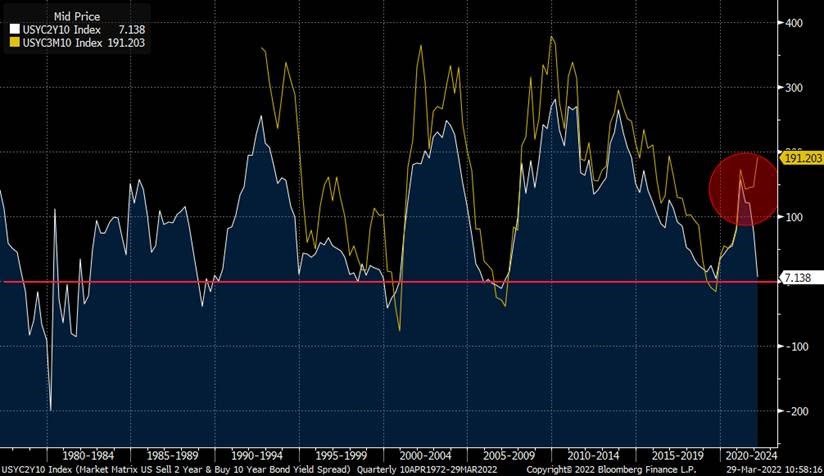
While the 2s10s is indicating slowdown, another closely monitored spread – the 10Yr/3 month spread (the difference in the yield on the 10-year Treasury notes and the 3-month Treasury bills) has been widening (the highlighted red circle in the chart below).

US Treasury Yield curve: 2-Year vs 10-Year

Source: Bloomberg

You will notice that in all previous cases of curve inversion both the 2s10s and the 10Yr/3 month spread moved in lockstep and inverted.

Has Quantitative Easing (QE) distorted the long end of the yield curve permanently due to massive bond-buying by the US Federal Reserve? Perhaps it has and therefore the 10-year yield is lower and will likely rise when the Fed starts shrinking its balance sheet, thus steepening the curve.

While it’s not easy to say whether we will see a recession in the US over the next 6-12 months, what is of little doubt is the concerns about the future economy are building up fast and rising bond yields are indicators of this.

What does this mean for the equity market? Should one be concerned about the equities keeling over?

Not so fast.

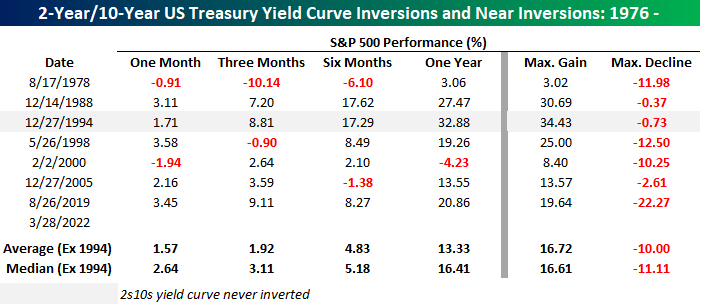
Over the last 50 years, there have been six episodes of 2s10s yield curve inversion.
The table below outlines the performance of the S&P 500 index (SPX) in the first year after inversions of the yield curve. You will notice that the performance hasn’t typically been negative.

Source: Bespoke Invest

  • In the December 1994 curve inversion, The SPX index was sharply higher over the following one, three, six, and twelve months.
  • In the five other periods where the yield curve inverted, the forward returns for SPX were also generally higher. One, three, and six months later, the SPX was higher two-thirds of the time, and a year later, it was higher five out of six times for a median gain of over +16%.
  • The only time it was lower a year later was after the inversion in February 2000 when the SPX fell by -4.23%. That was the “dotcom” bust and on that occasion, the SPX continued to show weakness and didn’t bottom until October 2002.

One other key consideration this time around to bear in mind – in all seven prior cases of 2s10s yield curve inversion, the SPX was higher in the three months leading up to the inversion. This time around, if the curve does invert shortly, it will mark the first time that the SPX declined in the three months leading up to an inversion.

The SPX is down -3.4% over the past 3 months.

The SPX may still be negative for the year (table below), it has however surged more than +10% since mid-March.

This recovery in US equity indices has continued to flummox investors who are focused on the surge in bond yields and the insistence by the Federal Open Market Committee (FOMC) that they will act aggressively to clamp down inflation.

In last month’s Market Viewpoints I wrote – “A lot of a bearishness is already priced in to equity markets and there is a likelihood that those expecting more bad news may be hit by surprises …there is room for a catch-up rally in equities. It’s time to build back equity exposure.”

If you did add to your equity position then you must be feeling cheerful. The AAII Net Bulls index (a weekly sentiment survey of AAII members, which asks if they are “Bullish,” “Bearish,” or “Neutral” on the stock market) that I refer to in the newsletter has recovered from -60 but it still sits at -43 and down from the long-term average of -23.

Benchmark Global Equity Index Performance (2021 and 2022 YTD)

The market is yet to fully embrace the rally and turn bullish. It means there’s more upside to come, particularly when the equity market starts pricing in fewer than six interest rate hikes for the year.

As I’ve written for a few months now, I do not believe the Fed can deliver on what the market is pricing in – five to six additional rate hikes this year.

On 16th March, I was on Bloomberg TV to discuss the outlook for rates and equities. Please skip to 26 mins at this Bloomberg YouTube link to see my remarks.

Chinese stocks have also seen a turnaround this month, on the back of market intervention by China’s Vice-Premier Liu He.

China’s Financial Stability Development Committee met on March 16 and the meeting was chaired by Liu He, President Xi Jinping’s closest economic adviser. He signalled a shift in policy thinking, with a call to pay more respect to investors’ interests. He further indicated that the government would take measures to “boost the economy in the first quarter”, as well as introduce “policies that are favourable to the market”. Chinese tech stocks like Alibaba (BABA), Tencent (TECHY), JD.com (JD), Baidu (BIDU) are up between +35% to +50% since the announcement.

In response to Liu He’s meeting, the regulatory body that oversees China’s securities and futures industry, the China Securities Regulatory Commission (CSRC) quickly came out with a list of things they will do – “Encourage stocks buybacks, encourage mutual fund companies put in their own capital”

When it comes to understanding China, only the words of the Chinese Communist Party (CCP) matter and they have indicated support for the market. This will draw domestic capital into the beaten-down Chinese stocks. Chinese tech stocks have further to run as most of them are still down more than -50% from the highs despite the sharp rally of the last ten days.

Benchmark US equity sector performance (2021, 2022 YTD)

Despite the over +10% rally in the SPX, Consumer Discretionary (XLY), Communications (XLC), and the Technology (XLK) sectors are still down over -7% (see table above) and present the best opportunity for stock picking. Growth and Tech stocks will particularly benefit from any re-pricing in the number of interest rate hikes.

For specific stock recommendations and structured products ideas please do not hesitate to get in touch.

 
Best wishes,

Manish Singh, CFA

President Vladimir Putin’s actions make more hard-hitting economic sanctions against Russia inevitable. If Ukraine falls, will Putin move into Eastern Europe? What do past geopolitical events tell us about the impact on equity markets?

Summary

In 1945, the Union of Soviet Socialist Republics (USSR) argued that it needed “a buffer zone” around its borders, as it had been invaded by Germany in both world wars. It claimed that having a buffer zone would protect it against any future invasions. The Soviet Union went on to establish an extensive “buffer zone” by installing communist governments friendly to the USSR in the liberated Eastern European countries. So, here we are 77 years later and the “buffer zone” concept pops up again. This time, Ukraine is the “buffer zone” that Russia wants to preserve. This time, Russia feels threatened not by Germany, but by the expanded North Atlantic Treaty Organization (NATO) alliance. We are stepping into a new period of uncertainly – a new Cold War. A new Cold War that has the potential to turn hot if Russian President Vladimir Putin feels more threatened and if China decides to join hands with him.

Putin’s actions make further and more hard-hitting US and European economic sanctions against Russia inevitable. It also raises the risk that, in a tit-for-tat, Moscow could play havoc with the energy market. Energy is the weapon that Putin can use against the West to deter them from coming to Ukraine’s help

So far, the debate for the March US Federal Open Market Committee (FOMC) meeting has revolved largely around a +0.25% or a +0.50% interest rate hike. After this week’s events in Ukraine and with still three weeks to go till the meeting, if the situation in Ukraine worsens, I am not sure we’ll see a rise in US interest rates next month.

Sector-wise, so far in 2022, it’s essentially a sea of red for most equity sectors in the S&P 500 index. The stocks in the Energy sector (XLE), with average gains of +21%, has been living in an alternate reality however driven by inflation and the conflict in Ukraine. Stocks in the Financial sector (XLF) have managed an average YTD loss of -3% this year, and every other sector’s average YTD change is negative.

A lot of a bearishness is already priced in to equity markets and there is a likelihood that those expecting more bad news may be hit by three surprises – a de-escalation in Ukraine, the US Fed staying put on rates and inflation peaking as growth and consumption tumbles. There is room for a catch-up rally in equities. It’s time to build back equity exposure.

Russia’s desire for a “buffer zone” could start a new Cold War

In 1945, the Union of Soviet Socialist Republics (USSR) – the Soviet Union – came out of World War II with an aura of prestige from having beaten Hitler’s Germany at great personal cost. The total civilian and military deaths in the war in the Soviet Union is estimated to have been 24 million, which is nearly twice as many as in Germany, Poland, France, Italy and the UK put together.

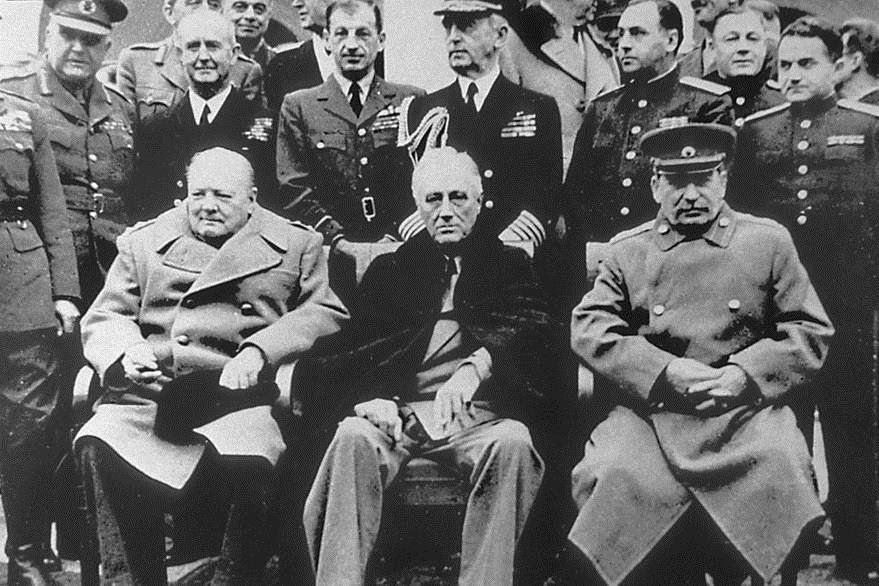
Russia argued that it needed “a buffer zone” around its borders, as it had been invaded by Germany in both world wars. It claimed that having a buffer zone would protect it against any future invasions and in February 1945, US President Franklin Roosevelt, British Prime Minister Winston Churchill, and Soviet leader Joseph Stalin met at the Yalta resort, in then-Soviet Crimea, (see photo below) to finalize a post-war settlement.

At the conference the leaders agreed “to the right of all people to choose the form of government under which they will live. The three governments [US, UK, Soviet] will jointly assist the people in any European liberated state or former Axis state in Europe…to form interim governmental authorities broadly representative of all democratic elements in the population and pledged to the earliest possible establishment through free elections of Governments responsive to the will of the people.”

At the time, US Admiral William Leahy, Chief of Staff to Roosevelt said – “This [agreement on Poland] is so elastic that the Russians can stretch it all the way from Yalta to Washington without ever technically breaking it.” To which Roosevelt replied, “I know, Bill, but it is the best I can do for Poland at this time.”

Roosevelt died soon after in April 1945 and Vice President Harry S. Truman took over as the new US President.

British Prime Minister Winston Churchill, US President Franklin Roosevelt, and Soviet leader Joseph Stalin at Yalta in February 1945

Source: US government holdings of the National Archives and Records Administration

Admiral Leahy’s concerns were proven correct, as Soviet armies took control of most of Poland and Eastern Europe and Stalin began installing Communist governments. It became clear by the Potsdam Conference in July 1945 that the Soviet Union had no intention of holding free and fair elections in the liberated Eastern European countries. By installing communist governments friendly to the USSR, the Soviet Union established an extensive “strategic depth” or “buffer zone” – the territory between a country and what it perceives to be hostile enemies – between the Soviet Union and the West.

Truman, the one-time farmer from Missouri, was rather naïve to start with and of Stalin, he observed – “I like him . . . he is straightforward.” French President Charles De Gaulle, by contrast, said Stalin was “a son of a bitch.” However, very quickly Truman became confrontational. The US had by then tested an atomic bomb and Truman knew he no longer needed Russian help in defeating Japan. The stage was set for the “Cold War” to begin, as the US and the USSR started distrusting each other. Truman’s policies came to be shrined in the “Truman Doctrine,” which positioned the US as the defender of a free world in the face of Soviet aggression. In the eyes of Stalin and successive Russian leaders the significance and need for a permanent and a wide enough “buffer zone,” were now set in stone.

So, here we are 77 years later and the “buffer zone” concept pops up again. This time, Ukraine is the buffer zone that Russia wants to preserve. This time, Russia feels threatened, not by Germany, but by the expanded North Atlantic Treaty Organization (NATO) alliance. Therefore, the present conflict is part of the continuing fallout from the disintegration of the USSR in the early 1990s and Russia’s loss of the “buffer zone,” as NATO has expanded eastwards. Russia is a regional power in decline and feels insecure. It feels it is a victim of NATO’s eastern expansion and wants a restoration of its “buffer zone” and, with it, its lost influence. The United States, on the other hand, a global power unlike Russia, is also in decline as China rises relentlessly. The US, in the face of recent setbacks in Afghanistan and the Middle East and the growing military and economic threat of China, is similarly fearful of losing its sway in the world. As Asia gets prised away slowly from American influence, Europe is the region that the US wants to keep under its influence, for economic and strategic gains.

We are stepping into a new period of uncertainly, a new Cold War that has the potential to turn hot if Russian President Vladimir Putin feels more threatened and if China decides to join hands with him.

So, earlier this week, while announcing sanctions on Russia it was good to hear US President Joseph Biden point out – “Let me be clear: These are totally defensive moves on our part. We have no intention of fighting Russia. We want to send an unmistakable message, though, that the United States, together with our allies, will defend every inch of NATO territory and abide by the commitments we made to NATO.”

In the early hours of Thursday morning, Russia launched a military offensive on Ukraine. Putin, in an angry broadcast just before 6 am Moscow time called the operation a “special military operation” aimed to “de-Nazify” Ukraine. The Russian stock market, the MOEX Russia index plunged more than -30% in early trading and trading was halted.

Putin offered a chilling warning to any Western allies who might consider coming to Ukraine’s aide: “To anyone who would consider interfering from outside: If you do, you will face consequences greater than any you have faced in history. All the relevant decisions have been taken. I hope you hear me.”

Ukraine is not a member of NATO and therefore the US is not treaty-bound to enter into a war with Russia to defend Ukraine from falling into Russia’s hands.

Putin’s actions make further and more hard-hitting US and European economic sanctions against Russia inevitable. It also raises the risk that, in a tit-for-tat, Moscow could play more havoc with the energy market. Energy is the weapon that Putin can use against the West to deter them from coming to Ukraine’s help.

Russia has already been restricting the flow of natural gas it sends to the EU, with volumes down by more than a third compared with pre-pandemic levels. The risk now is that Putin further reduces the flow and cuts back on crude oil exports. Energy shortages in the EU, and a spike in US retail gasoline prices—now at a seven and a half year high of US$3.89 a gallon—will inflict political pain in Washington.

Putin will thus force the West to accept that Ukraine will not join the NATO and stay under Russia’s influence and be its “buffer zone” with NATO.

If Ukraine falls, will Putin move into Eastern Europe?

I believe it would be foolhardy and he would be risking his demise as the economic impact of his adventurism will snowball. Few would have predicted that it would be Germany that would offer the toughest response to Putin’s invasion of Ukraine. With a decisive move to shut down the Nord Stream 2 pipeline, German Chancellor Olaf Scholz has thrust Germany into the vanguard of the West’s response to Russia. Germany is fearful of Russia on its doorsteps and it quite likes the “buffer zone” it has in Poland between itself and Russia. With Ukraine down, that buffer zone would wear thin and Germany would be wary of Russia’s move further eastwards.

No two conflicts are the same and we are in a vastly different world now with low interest rates and years of Quantitative Easing (QE) by central banks, however, it’s good to keep in mind how past geopolitical conflicts have affected equity markets. The chart below suggests that equity markets usually take conflicts in their strides – and move on.

The events that had the largest and the longest impact on the markets were – the Pearl Harbour attack and Iraq’s invasion of Kuwait – both involving the US military. The Munich Olympics attack in 1972 was also a big drag on the markets, but recall that the 1970s were also a period of continuous bad news – economic stagnation, high unemployment, an oil-shock, double-digit inflation, and the US dollar severing of links with the gold standard – weighing on overall sentiment.

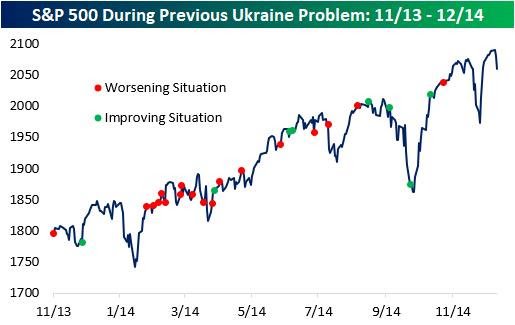
How did the US equity market react during the last Ukraine-Russia conflict? In late 2013 and for the majority of 2014, Ukraine was central in the geopolitical news cycle, as Russia moved to annex Crimea. During this period, as shown in the table below, the S&P 500 index experienced increased volatility, but investors rushed to buy the dips.

Between November of 2013 and 2014, the S&P 500 gained +13.5%. During this period, the index traded down by at least -5% from a high on two occasions. So, from the perspective of US investors, there was little concern over Ukraine.

Source: Bespoke Invest

Now the question is, the present Russian incursion is closest to which event from all the ones listed above?

I‘d say – Iraq’s invasion of Kuwait, given the Oil/commodity in focus, its impact on inflation and that an escalation of the conflict could drag US forces into the region via alliances. Having said that, the barrier to getting US forces involved in a conflict abroad with Russia is extremely high. Neither the US Congress nor the American people would support such a move given the chaotic manner (some would say ignominy) in which the US recently withdrew from Afghanistan.

As for the inflationary impact, the US is energy independent and has allies that can pump out more oil and gas. Besides, this being an election year, the Biden administration is acutely aware of “prices at the pump” and has repeated said it is going to “take robust action to make sure the pain of our [US] sanctions is targeted at the Russian economy not ours [US].”

In my opinion, interest rate increases and inflation are bigger concerns to the equity markets than the events on the Ukraine-Russia border.

Markets and the Economy

So far, the debate for the March Federal Open Market Committee (FOMC) meeting has revolved largely around a +0.25% or a +0.50% interest rate hike. After last night’s events in Ukraine and with still three weeks to go till the meeting, if the situation in Ukraine worsens, I am not sure we’ll see a rise in US interest rates.

The US economy rebounded from the Omicron wave in February, according to the latest flash Purchasing Manager Index (PMI) estimates by private data firm IHS Markit.

Both the manufacturing and service sectors recorded stronger expansions in output, with companies linking growth to substantial gains in new business, employees returning from sick leave, increased travelling and greater availability of raw materials. The composite PMI for the US rose to a two-month high of 56.0 in February from 51.1 in January. A reading above 50 indicates growth, while a level below 50 signals contraction.

European readings also showed accelerated growth driven by services providers. In the Eurozone, the PMI rose to 55.8 in February from 52.3 in January, the fastest rate of growth since September. In the U.K., the index jumped to 60.2 in February from 54.2 in January as output growth accelerated.

This week the S&P 500 (SPX) officially moved into correction territory – i.e., when a stock index falls by more than 10%. The tech-heavy NASDAQ index is down by more than -13% Year-To-Date (YTD).

Benchmark Global Equity Index Performance (2021 and 2022 YTD)

The February US inflation report, saw the inflation as measured by the Consumer Price Index (CPI) hit a 40-year high of +7.5%.

Despite this, the US yield curve continues to flatten, as the short-end 2y US Treasury yield rises faster than the long-end 10y US Treasury yield. If inflation were a major concern, for the medium to long term, one would expect long end yields to rise as well. The spread between the 2y yield and the 10y yield now stands at 0.38%. On the 10th of February (the day the inflation reading came out), this spread was at 0.55%.

This flattening of yield will not go unnoticed by the US Federal Reserve (Fed) and they will factor this into their rate decision due mid-March. This is happening at the time the Fed is still providing liquidity to the market. They’ve yet to make a final decision on monetary policy tightening.

I fail to see how the Fed could continue to raise rates, if the yield curve inverts i.e. 2y yield goes higher than 10y yield. I strongly believe that US inflation is close to peaking (more on this further down in the section) and will provide the Fed much-needed room to tone down hawkishness. As I wrote in last month’s Market Viewpoints, I do not see inflation as a concern. Disinflation in the medium to long term continues to be my base case for the US economy.

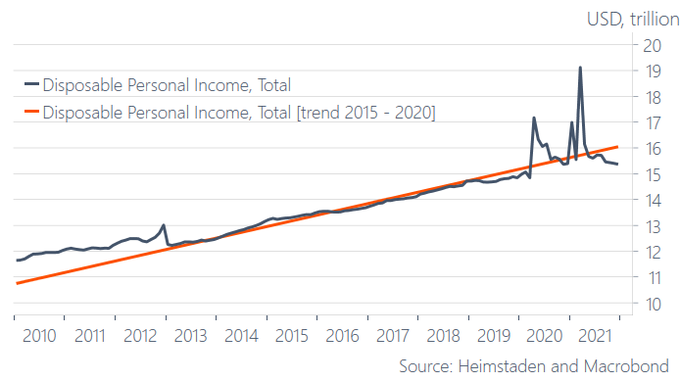
The chart below indicates that the US Disposable Personal Income (DPI) is no longer running above trend. As the growth in real disposable income declines, real personal consumption expenditure (PCE) – the Federal Reserve’s favourite measure of inflation – declines as well.

US personal disposable income (in trillion USD)

The elevated PCE that we have seen over the past three quarters is very likely a result of the pandemic shutdown, elevated growth in DPI led to savings uptick. With DPI now running below trend, the PCE will likely move back to a lower rate too i.e. we are at or near peak inflation in the US. And, if you are worried that a decline in DPI could be an indicator of a peak in GDP growth too, then let’s keep in mind that nothing ends inflation faster than an economic recession. A leg down in inflation is fast approaching.

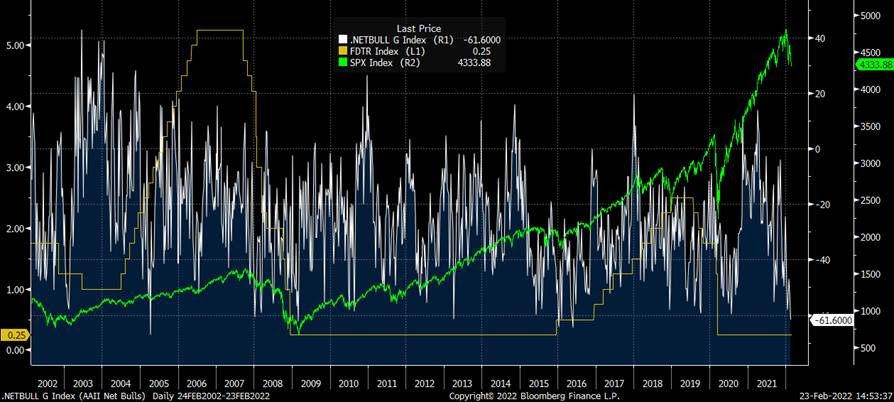
The market sentiment as indicated by the AAII Net Bulls index ( The AAII Sentiment Survey is a weekly survey of its members, which asks if they are “Bullish,” “Bearish,” or “Neutral” on the stock market) is about as bad it has been in the last 20 years and is now the low levels we saw in May 2016.

Coincidentally (as the chart below indicates), it was also the time when the Fed had just embarked on a rate hike cycle with the first increase in rates. The sentiment bottomed after the first rate hike and improved thereon.

If the same were to happen this time, one would expect the equity markets to bottom in March-April, after the first rate hike and then to stay steady and climb upwards for the rest of the year.

The AAII weekly Bull-Bear sentiment survey, the US Fed fund rate and the S&P 500 index (2002-2022)

Source: Bloomberg

Sector-wise, on YTD basis, it’s essentially a sea of red for most equity sectors in the S&P 500 index. The stocks in the Energy sector (XLE), with average gains of +21%, has been living in an alternate reality however driven by inflation and the conflict in Ukraine. Stocks in the Financial sector (XLF) have managed an average YTD loss of -3% this year, and every other sector’s average YTD change is negative.

Sectors that have been the biggest laggards include Consumer Discretionary (XLY), Communications (XLC), Technology (XLK) and Real Estate (XLRE) with an average YTD decline of over -10%. Even in a traditionally defensive sector like Utilities, the stocks have already declined an average of -8.4% YTD.

Benchmark US equity sector performance (2021, 2022 YTD)

A lot of a bearishness is already priced in and there is a likelihood that those expecting more bad news may be hit by three surprises – a de-escalation in Ukraine, the Fed staying put on rates and inflation peaking as growth and consumption tumbles.

As I mentioned above, investor sentiment is currently very negative and there is room for a catch-up rally in equities soon. It’s time to build back equity exposure. In this period of elevated market volatility and geopolitical anxiety, structured products, which offer a degree of capital protection, continue to be a good way to invest, while at the same time helping pick good entry points in the market.

For specific stock recommendations and structured products ideas please do not hesitate to get in touch.

 
Best wishes,

Manish Singh, CFA

At his press conference this week Fed Chair Jerome Powell noted that the inflation situation had gotten worse and the market is in now pricing in five interest rate increases this year. Will this happen? What will the impact be on global equity markets?

Summary

The two-day Federal Reserve Open Market Committee (FOMC) meeting that concluded on Wednesday, was one of the most anticipated ones in recent times. In the end, the committee held short-term interest rates steady at 0-0.25%, yet signalled its intentions to raise rates beginning in March. At his press conference following the meeting, Fed Chair Jerome Powell noted that the inflation situation had “gotten slightly worse,” while also saying that the differences between now and the 2015 hike cycle had “implications for our policy trajectory,” when asked about the possibility of rate hikes at consecutive meetings.

These two comments open the door to potentially four rate hikes this year and the market is in fact now pricing in five rate hikes this year. However, in my view I expect inflation to turn, and thus do not anticipate such aggressive moves by the Fed.

If a tightening of fiscal policy, easing of supply chains as COVID restrictions are loosened, and less accommodative monetary policy restrain inflation, Powell has indicated that the FOMC may not need to continue hiking – as it is not on a pre-set path. Powell categorically refused to commit to any policy path and, in my view, that’s a good thing. The Fed has never been more “data dependent” than now and market participants should take note. My call: only two interest rate increases during 2022.

The UK has cast many of the Covid restrictions aside and the UK economy is set to be the fastest-growing economy in the G7, yet, on the continent, Covid restrictions remain in place and have gotten quite severe, hitting consumer mobility and thus consumer spending on services. This means, that monetary policy in the Eurozone, unlike the US, will remain highly supportive.

Emerging Markets (EM) had a rough 2021. The EMs still face some stiff headwinds, yet there are reasons to be positive and would start building long positions in EM equities.

For 2022, we will likely see +7% to +8% return for the broad S&P 500 Index in the US, so income strategies should be prioritised. Clipping coupons in a flat to negative market, or using structured products to generate income, will be the avenues to follow this year, at least until CPI turns and we know that the Fed is not under pressure to keep raising interest rates.

Boomerang equity markets – Fed signals rate lift-off

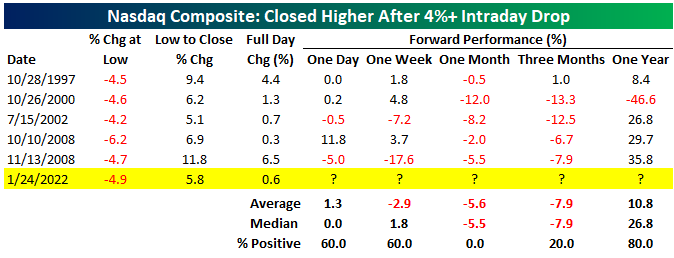
Monday saw a stunning reversal in the markets. US equities deep in the red at lunchtime during New York trading hours, staged a mammoth comeback and managed to finish positive for the day. At the lowest point of the day, the S&P 500 (SPX) index was down -3.96%, yet it finished up +0.28% by the time the market closed. The Dow Jones Industrial Average (DJIA), off over 1,000 points, also finished up +0.29% for the day. A truly boomerang market. The Tech heavy NASDAQ (NDX) composite also erased more than -4.9% decline, to finish the day higher by +0.6%.

Since 1988, when open/high/low/close data began for the NDX, there have only been five other trading days that have seen the index close higher after an intraday drop of more than -4%. Below is a table from Bespoke Invest, highlighting these five occurrences. Such extreme upside reversals, have not typically marked a short-term low for the index, although 12-month returns have been very positive on four out of the five occasions.

Source: Bespoke Invest

The one occasion that the next-year return was negative, was following the 10/26/2000 upside reversal which was marked by the “Dot-com” bust.

The key lesson to draw from 2000, is that the Nasdaq today is much more robust and made up of companies such as Apple, Microsoft, Amazon, Google, Facebook, Nvidia and Adobe – with a long history of proven revenue and earnings growth. That was not the case in 2000, when the technology boom was in its infancy. Internet hardware and software companies had the largest market cap of any stock in the NDX in March 2000.

Additionally, at the time, the NDX traded at a Price/Earnings (P/E) ratio – based on Bloomberg Best estimates of subsequent 12-month earnings – of well over 100. Today, it trades at a ratio of 25.2. The bottom line is that NDX valuations are not as stretched as they were in 2000, and the index has a very good vintage of tech stocks to invest in at both the broad index and individual stock levels.

On Tuesday and Wednesday this week, the equity markets made a similar boomerang move with the DJIA swinging by over 1,000 points in another wild session for equities. Boomerang markets may be here to stay, as interest rate rise uncertainty plays out.

The two-day Federal Reserve open Market Committee (FOMC) meeting that concluded on Wednesday, was one of the most anticipated ones in recent times. The committee held short-term interest rates steady at 0-0.25% yet signalled intentions to raise rates at the next FOMC meeting to be held in March.

US Federal Reserve Chair Jerome Powell said- “It will soon be appropriate to raise the target range for the federal-funds rate,” and added, “the economy no longer needs sustained monetary-policy support.” The committee plans to start hikes before rolling off the balance sheet, but could start reduced reinvestment of existing holdings as soon as this summer; over the long run, the FOMC anticipates it will “primarily hold Treasuries.”

At his press conference following the meeting, Fed Chair Jerome Powell noted that the inflation situation had “gotten slightly worse,” while also saying that the differences between now and the 2015 hike cycle had “implications for our policy trajectory,” when asked about the possibility of rate hikes at consecutive meetings.

These two comments open the door to potentially four rate hikes this year and the market is in fact now pricing in five rate hikes this year. However, in my view, as I expand on below, I expect inflation to turn, and thus do not anticipate such aggressive moves by the Fed.

If a tightening of fiscal policy, easing of supply chains as COVID restrictions are loosened, and less accommodative monetary policy restrain inflation, Powell has indicated that the FOMC may not need to continue hiking – as it is not on a pre-set path. Powell categorically refused to commit to any policy path and, in my view, that’s a good thing. The Fed has never been more “data dependent” than now and market participants should take note.

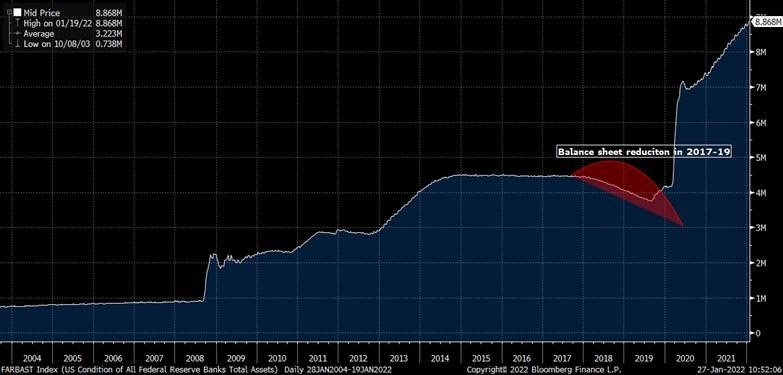
Powell also said that the Fed could allow its balance sheet holdings to shrink more quickly than it did between 2017 and 2019, when they fell to around $3.7 trillion from $4.5 trillion – in part because the balance sheet today is twice as large as it was then.

The US Federal Reserve Bank’s total assets (in trillion USD)

Source: Bloomberg

Just give this a thought – the Fed wasn’t able to reduce its balance sheet more than by $0.8 trillion in 2014 when it had $4.5 trillion on its balance sheet, and yet, we expect the Fed to do better now with a balance sheet of nearly $9 trillion?

Economists at Deutsche Bank estimate that if the Fed were to reduce its holdings by around $1.5 trillion between this summer and the end of next year, it could have the effect of an increase of around +0.75% in the Fed Funds Rate. Unwinding this mountain of debt will be far more difficult than it was accumulating it. Part of me says why bother reducing the balance sheet? Instead, label it as “special reserves,” move it off balance sheet and leave it there.

I see the Fed initiating a moderate increase in interest rates over the rest of the year, while slowly reducing the balance sheet before this reduction stalls. My call: only two interest rate increases during 2022. The risk of the Fed doing more than needed is real if inflation forces the Fed’s hand, but the turnaround will be quick if CPI turns and economic conditions deteriorate.

Additionally, with inflation currently running at +7%, the real yield on 10 year US Treasurys is around -5.17%. Real money is not going to own these bonds, unless the Fed monetizes Treasuries. If inflation proves to be sticky and systemic, there will be a sell-off in the bond market and the Fed will be back as a buyer. Bottom line: The Fed is stuck with that balance sheet whether it likes it or not. The Fed can get away with raising rates on the short end but they will not inverse the 10-2 year Treasury curve. One further observation – how far will the Fed go in an election year is anyone’s guess!

Markets and the Economy

On Monday, Markit’s Purchasing Managers’ Index (PMI) for the US, fell sharply, dropping to 50.9 from 57.6, which was the second-largest drop in history (2007) – other than the March/April 2020 COVID shock.

Also, the Chicago Fed National Activity Index (CFNAI) for December fell sharply. The big driver was the huge drop in consumer spending that showed up earlier in January in the massive miss in December retail sales. Other than the February 2021 collapse in economic activity that followed winter storms and an electrical grid collapse in Texas, this was the worst print for the consumption and housing category of the CFNAI since the pandemic began.

On Tuesday, the International Monetary Fund (IMF) downgraded its 2022 global growth forecast to +4.4% from +4.9%. In its World Economic Outlook (WEO) report, the IMF said it expects global Gross Domestic Product (GDP) to grow less than previously estimated. The revised outlook is largely due to growth markdowns in the world’s two largest economies – the United States and China. “The global economy enters 2022 in a weaker position than previously expected,” the report noted.

The US economy is expected to grow +4.0% in 2022, down from +5.2% previously forecast, as the Fed moves to withdraw its monetary stimulus and supply chain disruptions still weigh on the US economy. China, meanwhile, is predicted to grow +4.8% this year, down from an earlier estimate of +5.6%, amid disruptions caused by its zero-Covid policy, as well as “projected financial stress” among China’s property developers.

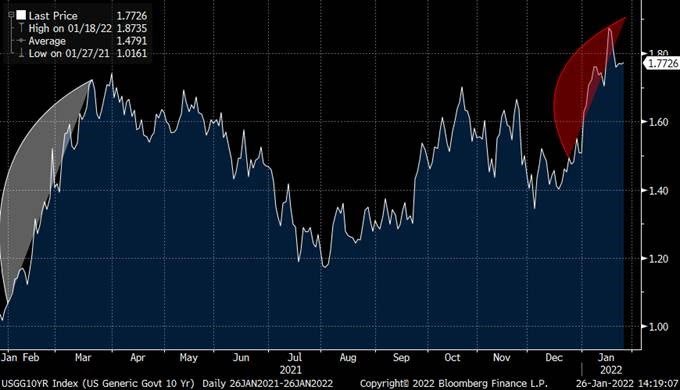
In January 2021, US bond yields charged ahead (chart below) on the expectation that vaccines would bring the pandemic to an early end. The US 10y yield almost doubled from +0.8% to +1.6% between December-March, before the Delta-variant of the coronavirus sent vast swathes of the global economy into another lockdown. The yield didn’t break to the upside and it reversed to +1.2% by July.

Will this January be a case of deja vu?

Bond yields have now surged again (see chart below) but slowdown concerns are growing. Oil is trading at $90, the Ukraine-Russia crisis is looming large, US President Joseph Biden’s Build Back Better (BBB) plan is stuck in Congress, the service sector recovery has stalled, China is cutting rates amid growth concerns and the global supply chain is still having problems.

US 10-year Treasury yield (2020 – 2022 YTD)

Source: Bloomberg, past performance is not indicative of future returns.

I believe bond yields will have a tough time breaking out above current levels.

As I wrote in the December newsletter – low bond yields are a reality that we will have to live with, given the amount of debt in both the public and private sectors. In the face of mounting debt, the conundrum that the Fed (and other central banks) face is this: Tighten and the existing debt pile becomes more expensive to service, hampering economic growth. Don’t tighten and the debt across households, companies and the government continues to grow, making it even tougher for tightening in the future. Only inflation can force the Central Bank’s hand to tighten aggressively and this will inevitably bring on a recession.

So, the key data to look out for is the Consumer Price Index (CPI). The last print for US CPI was +7%, and any sign that is retreating and the Fed will have no reason to keep raising interest rates.

Stimulus checks, beefed-up unemployment insurance and expanded child tax credits boosted US personal savings by over $2tn during the 2021, as per Congressional Budget Office (CBO), but these are not going to be annual income-booster events.

Also, low-income earners who got an income “boost,” typically spend a great proportion of any income increase on consumption. Savings will be drained soon. All or most of the excess savings could be exhausted in the next three months. The income boost and consequent “increased savings” was one of the top three reasons given by the US unemployed for not seeking a job. As savings dry up, those that dropped out of the labour market, will return to seek jobs, thus boosting the labour supply and easing wage pressures and therefore prices. We are likely heading into a period of weaker inflation ahead.

The week also saw the first major tech stock earnings of this earnings season from Microsoft (MSFT), the second-largest stock in the SPX. Microsoft surpassed analysts’ estimates on both the top and the bottom lines by +1.7% and +7% respectively. Yet, in keeping with the boomerang moves in the markets, the stock fell -5% in the extended hours before rallying back quickly to a gain of more than +1%, after the company issued its outlook for the current quarter.

For the first quarter of 2022, Microsoft expects sales of $48.5 billion to $49.3 billion, compared with analyst expectations of $48.1 billion, according to FactSet. Microsoft’s overall cloud revenue for the quarter increased +32% YoY to $22.1 billion. Its cloud-infrastructure service, called Azure, grew by +46%, down slightly from the prior quarter’s +48% growth. This bodes well for Amazon’s (AMZN) earnings, who report next Thursday. Microsoft is the second-largest player in the industry with a nearly 20% share of the global cloud-computing market after Amazon, who dominates the sector with more than a 40% share, according to Gartner Inc.

The cloud-services business is one of the fastest-growing in tech and could expand from $385 billion in 2021 to $809 billion by 2025, according to research firm International Data Corporation (IDC).

On Wednesday, in another encouraging sign, Tesla (TSLA) the fifth largest stock in the SPX, reported Q4 adjusted EPS +7.6% higher than expected on revenues +6.5% above estimates; free cash flow beat estimates by +66%, and while there were major supply chain problems, automotive gross margins were +30.6% versus +29.9% estimated. The company said factories are running “below capacity” and that is “likely to continue” through 2022; guidance was still for “50% average annual growth in vehicle deliveries”.

On Thursday, Apple (AAPL) the largest stock in the S&P 500 index, reported its largest single quarter in terms of revenue ever, $123.9 billion vs. $118.66 billion estimated, up +11% year-over-year, and Earnings per share (EPS) of $2.10 vs. $1.89 estimated, up +25% year-over-year. Margins also beat with operating margins topping forecasts by +2.24% and an impressive +33.3% pre-tax margin, the highest since 2012. These figures provide evidence that raw materials and logistics costs aren’t slowing down the company’s operations.

Heavyweight stocks beating revenue and earnings estimates should serve well in holding up the SPX.

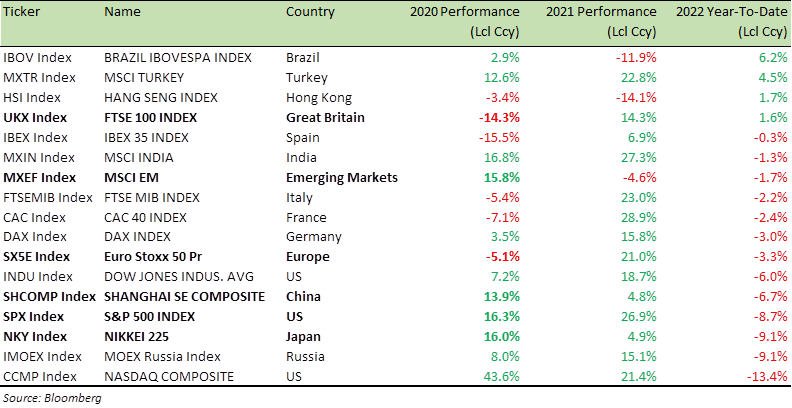
Benchmark Global Equity Index Performance (2020, 2021 and 2022 YTD)

Emerging Markets (EM) had a rough 2021. The MSCI Emerging market index (MXEF) was down –4.6% for the year. Hong Kong, Korea, Brazil, Turkey were all down in double digits with Turkey down over -30%. The EMs are still face some stiff headwinds, yet there are reasons to be positive and starting to build long positions in EM equities .

Fed hawkishness, driving the US dollar higher is always the key risk for EM. Yet, early this month when the US CPI for December hit the +7% level, the US dollar sold off against a basket of EM currencies, suggesting that the market had adequately priced in the risk of Fed’s hawkishness and its impact on the US dollar. And if the Fed doesn’t deliver fully on its hawkish intent, then the EM markets should get an additional boost.

In Europe, while the UK has cast many of the Covid restrictions aside and the UK economy is set to be the fastest-growing economy in the G7, on the continent, Covid restrictions remain in place and have gotten quite severe, hitting consumer mobility and thus consumer spending on services. This means, that unlike the US, monetary policy in the Eurozone will remain highly supportive. The fiscal policy in the Eurozone is very unlikely to return to the policies of austerity and fiscal consolidation that marked the pre-Covid decade under former German Chancellor Angela Merkel’s leadership. The political consensus in the Eurozone has firmly shifted in favour of an expansionary fiscal policy. With bond yields still at a very low levels, expect more government spending, as economies fully reopen.

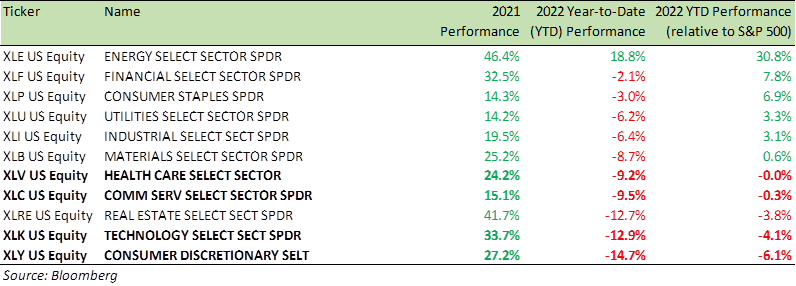
As the table below details, the massive outperformance of the Energy (XLE) sector continues unabated. After stellar returns last year, the sector is up over +30.8% versus the SPX year-to-date. It’s poetic that this performance comes less than two years after crude oil traded at -$37.63 on April 20, 2020.

Oil stocks, and the energy sector as a whole, still have upside as inflation (and the expectations of it) will likely remain elevated for the first quarter of this year. Additionally, with the risk of a Ukraine-Russia clash on the horizon, energy will remain well bid.

Benchmark US equity sector performance (2021, 2022 YTD)

For 2022, we will likely see +7% to +8% return for the broad S&P 500 Index in the US, so income strategies should be prioritised. Clipping coupons in a flat to negative market, or using structured products to generate income, will be the avenues to follow this year, at least until CPI turns and we know that the Fed is not under pressure to keep raising interest rates.

For specific stock recommendations and structured products ideas please do not hesitate to get in touch.

 
Best wishes,

Manish Singh, CFA

What’s bond yields got to do with Die Hard, Trading Places ? read in. The disinflationary impact of the two secular forces – demographics and technology – will continue to prevail, as we progress through this decade.

Summary

If you were to watch the movie Die Hard this Christmas, just remember that the plot wouldn’t likely exist (or it would be vastly different) if bond yields in the 1980s were not very high. Hans Gruber, the legendary villain in Die Hard, dreams of earning a bond yield of +20%, as he and his accomplices attempt to steal $640 million in bearer bonds. Bond yields have been trending down over the last four decades. In Q1 2000, the US 10Y Treasury yield stood at +6%. That was then. The US 10Y yield currently stands at +1.4% despite the US Federal Reserve (Fed) starting to taper its asset purchases and inflation beginning to cause some consternation. Whilst many would like to blame central banks for the low yields – and Quantitative Easing (QE) has certainly been a contributing factor over the last decade, but the downtrend in bond yields predates QE. Often, a more powerful secular force, greater than the ebb and flow of financial cycles, underpins such long term multi-decade trends. I believe the disinflation trend is not over yet and will reassert itself soon enough. I ardently believe that the disinflationary impact of the two secular forces – demographics and technology – will continue to prevail, as we progress through this decade.

The equity markets are not concerned about the Fed reducing its asset purchases and the bond market is indicating that the Fed will not be raising interest rates anytime soon. It’s also worth noting, that during the most recent tightening period (November 2016 – July 2019), the US economy didn’t enter into recession and neither did equities sell-off. Although, the Fed Funds Rate over the period went from +0.5% to +2.5%, the S&P 500 rose by over +44%. For 2022, I therefore see equities continuing to inch higher in a very benign environment, as Covid finally takes a back seat (let’s hope), and economic growth gets a leg up from a boom in the services sector.

What would Hans Gruber and Ophelia make of current bond yields?

It’s December. Another year has gone by and very soon we will find ourselves sprawled on the couch after a big Christmas lunch (or dinner), working down the list of Christmas movies. For every person who believes Frank Capra’s classic It’s a Wonderful Life is the best Christmas film, there’s another who ranks Miracle on the 34th Street as the true number one. Then there are other favourites such as Home Alone, Bad Santa, Love Actually, Trading Places, Die Hard, and the list goes on…

If you were to watch Die Hard this Christmas, just remember that the movie plot wouldn’t likely exist (or it would be vastly different) if bond yields in the 1980s were not very high. In the movie Die Hard, Hans Gruber (played by Alan Rickman), the meticulous mastermind behind the Christmas Eve Nakatomi Tower heist, is nonchalantly dreaming of earning a bond yield of +20% as he and his accomplices attempt to steal $640 million in bearer bonds of the Japanese firm Nakatomi Corporation.

To quote Gruber – “by the time they figure out what went wrong, we’d be sitting on the beach earning 20%”

Alan Rickman as the villain Hans Gruber in the movie Die Hard (1988)

DT5GFP ALAN RICKMAN DIE HARD (1988)

Source: AF archive / Alamy Stock Photo

In Trading Places, Jamie Lee Curtis’ character Ophelia reveals that she has $42,000 in the bank “in T-bills earning interest” and that she could retire in “two-three more years.”

Being invested in T-bills (a loan to the US government with a maturity of one year or less) and thinking of retiring in 2-3 years, will come as a shock to almost anyone, but particularly shocking to those under the age of 35, who have seen a near-zero yield throughout their adult life.

Yet in 1983, when Trading Places was released, the 3-month T-bill yield was around +9%. You would agree that this is somewhat higher than the measly +0.5% average of the past decade, or even today’s rate of +0.06%? To put it in context, a sum invested in 1980’s-era T-bills would double in eight years. At a yield of +0.5% and +0.06%, the same sum invested in 3-months T-bills, would double in over 130 years and over one thousand years respectively.

Bond yields have been trending down over the last four decades (as the chart below indicates). In Q1 2000, the US 10Y Treasury yield stood at +6%. A decade later, it had halved to +3% and a decade after that, it had halved again to +1.5% by Q1 2021. The yield currently stands at +1.4% despite the US Federal Reserve (Fed) starting to taper its asset purchases and inflation causing some consternation.

While many would like to blame central banks for low yields – and Quantitative Easing (QE) has certainly been a contributing factor over the last decade – the downtrend in bond yield predates QE.

Often a more powerful secular force, greater than the ebb and flow of financial cycles, underpins such long term multi-decade trends.. So, are we now at an inflexion point, as inflation chatter grows? Are bond yields going to reverse course and uptrend? These are trillion-dollar questions, with no quick and easy answers. I believe the disinflation trend is not over yet and it will reassert itself soon enough.

I am not convinced that inflation will be a problem in the medium and long term, as I ardently believe that the disinflationary impact of two secular forces – demographics and technology – will continue to prevail, as we progress through this decade. By demographics, I mean both a low birth rate and people living longer.

A very low birth rate puts downward pressure on demand and technological innovation puts downward pressure on prices. Better technology leads to better supply, as hindrances to increasing supply gets removed at a rapid pace. The post-Covid world is showing no signs of reversal in the falling birth rate and if anything, technological innovations have only accelerated in the wake of the pandemic.

Also, we have seen that people will save even at negative interest rates. Increasing life span probably necessitates it. A savings glut exerts downward pressure on interest rates, keeps the cost of capital down, fuelling further enterprise and technological innovations, which in turn exert further disinflationary pressure on the economy.

Economics is an art and not a science, and so far economists have been shockingly poor in studying the impact of technology on the economy. It’s no wonder economists have got their inflation forecasts wrong consistently over the last decade or so. Disinflation due to technology trends goes unnoticed as the debate gets combined with – “but have you seen the cost of a college education?” or “the cost of healthcare” … et al. Such news items dominate reports, become political pinata to beat the government of the day and colour the newswires. It keeps us distracted and we fail miserably to see secular trends working behind the scenes.

2021 was the year when many expected bond yields to go higher, or to be precise, real bond yields (nominal rate minus inflation) to go higher, as central banks tapered their asset purchases. This didn’t happen.

In 2013, when Fed Chairman Ben Bernanke hinted that the Fed would soon begin to taper its asset purchases, real yields on the 10-year US Treasurys promptly jumped, rising from around –1% back into positive territory. This time around, tapering has started, but the real yields continue to fall, as the chart below indicates.

The bond market is clearly indicating that it doesn’t buy the – inflation is going to be a problem – story. It is perhaps more concerned that when the temporary bout in inflation subsides, growth will be a problem again and as the disinflation trend reasserts, financial repression will resume and US Treasurys will remain bid.

That’s all good news for growth stocks, which have been battered over the last couple of months. As I wrote in the May Market Viewpoints – “Japanification” of the western world is in progress and nothing I have seen, or continue to see, tells me it’s going to stop. Low bond yields are a reality that we will have to live with. The Fed may raise interest rates a couple of times over the next two years, but I suspect the European Central Bank (ECB) will not be so lucky, and it may stay on hold until 2025, if growth doesn’t change dramatically in the Eurozone over the next 12-24 months.

What would Hans Gruber make of the low bond yields now? Would he risk his life over such a feeble yield, let alone get excited about negative real yield bonds? Maybe a discussion to be had over Christmas dinner. Perhaps a remake of Die Hard in a deflationary environment would lead to Hans Gruber fighting to return the stolen bonds to Nakatomi Corporation?

Markets and the Economy

In the markets, all the chatter is about the Omicron variant. So, let’s deal with that right away.

Earlier this week, the first study on vaccine effectiveness versus the Omicron variant was released in South Africa. The research head of a lab at South Africa’s Health Research Institute, released results that showed the impact of antibodies in blood plasma from individuals vaccinated with Pfizer (PFE) – led to a 40 times reduction in the neutralization capacity against Omicron.

This does not mean that vaccines won’t help protect against Omicron’s hit to vaccinated immune systems, and it also does not rule out Omicron leading to fewer deaths or hospitalizations relative to other variants. What it does suggest is that Omicron is very easy to spread and will do so even amongst vaccinated people.

A report in The New York Times on Monday, indicated that researchers at a major hospital complex in Pretoria have reported that their patients with coronavirus were much less sick than those they have treated before, and that other hospitals are seeing the same trends. They said that most of their infected patients were admitted for other reasons and had no Covid symptoms.

So, the early signs seem to indicate that the Omicron variant may be “manageable” and thus – we saw the relief rally in the equity markets on Tuesday.

The S&P 500 (SPX) Index may be up over +20% for the year (see table below) but it hasn’t been a smooth ride. We have seen four -4% to -5% dips during the year. The last one came only ten days ago and the most sustained one was in September, when it looked like we may see a bigger move down.

The Omicron variant was discovered only last month, and more study is clearly needed before one can judge, with any degree of confidence, its true impact.

As we know from the Delta variant, the effect of coronavirus is not always felt immediately, with hospitalizations and deaths often lagging considerably behind initial outbreaks.

Let’s hope vaccines, masks and safety measures do their job and we can put Covid behind us once and for all. Make no mistake, there will be more variants. There are more viruses than stars in the universe. An estimated 10 nonillion (10 to the 31st power) individual viruses exist on our planet—enough to assign one to every star in the universe 100 million times over, but most are not poised to hop into humans, let alone infect us. Mammals and birds alone are thought to host about 1.7 million undiscovered types of viruses.

Benchmark Global Equity Index Performance (2020, 2021 YTD and QTD)

Having discussed in the section above – why I don’t believe inflation will be a problem in the medium term, I have just read a news article in The Financial Times entitled “Yellen Says Supply-Chain Shift May Need Protectionist-Like Steps.”

In this article, US Treasury Secretary Janet Yellen says – “It’s possible that policies that people will describe as protectionist are going to be necessary in order to create the appropriate incentives to produce things at home.” Yellen adds – “I don’t think this is just about the United States making everything at home, but in some cases that may be part of the answer.”

Protectionist measures have a history of leading to higher prices and ending in tears for the consumers. So, this is one policy error I would be very wary of, if the US were to go down the path of protectionism and overdo it. This could change the inflation narrative very quickly and is one to keep a watchful eye on during 2022.

Fears of a Russian invasion of Ukraine grew last week, with US officials citing new intelligence reports about a troop build-up at the border. The expected 175,000 troops Russia is planning to assemble at the border, would be roughly twice the size of the build-up in the Spring. This is another development that could upend things in Q1.

Energy exports are the lifeblood of Russia and anything that threatens these will get a big response from them. Eastern Europe could become collateral damage (yet again). Politics will surely dominate economics again next year, as it has for quite some time now.

Last week US Fed Chair Jerome Powell announced the Fed will speed up its taper program and added “it’s time to retire the word transitory regarding inflation.”

Well played Sir! Powell stuck to “transitory” when inflation was rising through to +6%, and now decides to catapult “transitory” when it’s very likely that inflation has peaked. We shall find out when we get the next monthly inflation print in January.

The equity markets are not concerned about the Fed reducing its asset purchases and the bond market is indicating the Fed will not be raising interest rates anytime soon. I see equities continuing to inch higher in a very benign environment, as Covid finally takes a back seat (let’s hope), and economic growth gets a leg up from a boom in the services sector.

It’s also worth noting, that during the most recent tightening period (November 2016 – July 2019) the US economy didn’t enter into recession and neither did equities sell-off. The Fed Funds Rate over the period went from +0.5% to +2.5%, and the SPX rose by over +44%.

The external shock of Covid did cause a recession and a market sell-off, but that had nothing to do with Fed policy. Therefore it’s worth giving credit to the Fed for pulling off a tightening cycle without inducing a recession. Hopefully, the Federal Open Market Committee (FOMC) can do it again.

However, the unpredictability over how long the supply chain issues will last, the macro risk from a Russia-Ukraine escalation leading to higher energy price means policy error risks are more pronounced now than they were in the last cycle. Nevertheless, equities is the asset class I feel most comfortable holding.

With US inflation hitting +6.2%, a level not seen since 1990, many economists and market commentators seem baffled and some even angry, about how equities keep hitting new highs.
Well, the US 10y bond yield is remaining stable in a narrow range of +1.25% to +1.75%, despite the inflation scare. The bond market doesn’t buy the inflation story and therefore equities are a good hold.

Chinese equities are particularly undervalued and they trade at an almost -40% discount to their US counterparts. China sentiment is overly bearish. As China’s credit impulse picks up, Chinese equities will close the valuation gap to US equities. China’s recent cut to its reserve-requirement ratio is another signal that policymakers will deal with a sharp slowdown in growth directly and firmly, no matter what is said or written about the rising debt in the Chinese economy.

Sector-wise, I prefer the Consumer Staples Select (XLP) Discretionary (XLY), Technology (XLK) and Communication (XLC) sectors.

For specific stock recommendations, please do not hesitate to get in touch.

Benchmark US equity sector performance (2020, 2021 YTD)

Anyway, all that is left for me to say this year is thank you for your time and attention. I also wish you and your family all the best for this holiday season as well as a very Happy New Year. And if you celebrate Christmas – hope you have a great one – and watch Die Hard!

 
Best wishes,

Manish Singh, CFA