The AUKUS defence is a disaster for France and it has reduced the EU to the status of a paper tiger now that the UK has left the EU. The geopolitics and economic centre of the world is fast shifting eastwards. US-China relation in the Indo-Pacific will be the defining issue of the 21st century.

Summary

America’s withdrawal from Afghanistan, the Quad partnership (US, Japan, Australia, India), the Five Eyes Alliance (US, UK, Canada, Australia, New Zealand), and now the AUKUS pact (Australia, UK, US) all indicate that the defining issue of the 21st Century will be the strategic rivalry in the Indo-Pacific region – between the United States and China.

The AUKUS defence pact however, is not only a commercial disaster for France, it also deals a body blow to France’s ambitions in the Indo-Pacific region. European leaders ought to be thinking if the US and the UK can do this to France, what chance does the rest of the EU stand against the ambitions and self-interest of the Anglo-Saxon alliance? It suddenly highlights to the EU how weak they are now that the UK has left the EU. You can’t fault French President Emmanuel Macron for wanting an EU army. However, to have an EU army or not seems to be an intractable problem. Germany, the most important member of the EU, is largely a pacifist state and only too happy to piggyback off NATO for its security and, it would seem very few others in the EU, want to be led by the French. With so many differing views by the time the politicians of the 27 member states decided there was a viable military threat and mobilised an EU Army, Europe would have fallen.

No “tapering” was announced at the September meeting of the US Federal Reserve. However, I expect the Fed to announce a gradual taper in November, that wraps up by mid-June 2022. There’s a lot of talk right now about the global supply chain crisis and I am afraid we will hear more of it over the next few months. Factory shutdowns (particularly in Asia as they manage and contain outbreaks of Covid-19), port closures in China, commercial flight reductions and container ships challenges globally – are hampering supplies. Lingering growth concerns mean that monetary policy is not going to tighten much anytime soon – even as bond yields and inflation rise temporarily. “Tapering” will not imperil the Bull run in equities as the market fully expects the Fed to taper and eventually stop asset purchases. Even if asset purchases end, the Fed is a long way off from raising interest rates. Equites are still a good place to be.

The AUKUS ruckus

France is livid at Australia’s decision to cancel a $90 billion contract it signed with the French company Naval Group in 2016, for a fleet of 12 diesel-electric submarines and replace it with the AUKUS defence pact – a new three-way strategic defence alliance between Australia, the UK and US. This new alliance, will see the UK and the US jointly build eight nuclear-powered submarine for the Royal Australian Navy. Nuclear-propelled submarines are stealthier and faster than conventional diesel-powered boats, and can deploy for long periods, far from home. The US and UK will also provide Australia long-range cruise missiles and other defence technologies, including cybersecurity and artificial intelligence.

The AUKUS deal is not only a commercial disaster for France, it also deals a body blow to France’s ambitions in the Indo-Pacific region. France is a resident player in the region via its overseas territories and 93% of its Exclusive Economic Zone (EEZ) is located in the Indian and Pacific Oceans. The region is home to 1.5 million French people, as well as 8,000 French troops stationed in the region. France’s Indo-Pacific strategy announced in 2019 was, based in part on its emerging partnership with Australia. That relationship now lies in tatters. A humiliated France called the AUKUS deal a “stab in the back.”

The deal announced two weeks ago and signed in Washington last week with all three leaders – UK Prime Minister Boris Johnson, US President Joseph Biden and Australian Prime Minister Scott Morrison – present, has caused a major diplomatic ruckus and, at one point, threatened to plunge the western world into an unprecedented diplomatic crisis as France recalled its Ambassadors to the United States and to Australia. The French Ambassadors have since returned to their respective postings. It’s the first time since the American Revolutionary War (1775-1783), that France has felt the need to recall its Ambassador to the US, such is the French anger at the “betrayal.”

America’s withdrawal from Afghanistan, the Quad partnership (US, Japan, Australia, India), the Five Eyes Alliance (US, UK, Canada, Australia, New Zealand), and now the AUKUS pact (Australian, UK, US) all indicate that the US is stitching together a robust coalition to contain China’s rise and its influence in the Indo-Pacific region. The US security network also stretches into the Association of Southeast Asian Nations (ASEAN), where Singapore, Malaysia, Thailand and the Philippines, each host US troops from time to time.

It is now beyond doubt that the defining issue of the 21st Century will be the strategic rivalry in the Indo-Pacific region between the United States and China. In this respect, the US pivot to Asia-Pacific, risks deepening fractures in the North Atlantic Treaty Organization (NATO) – the bulwark of guaranteeing peace in Europe.

European Union (EU) leaders couldn’t contain their excitement when Biden was elected President of the United States. The Financial Times declared – “The Grown Ups are Back in Charge in Washington.” The AUKUS deal is an astonishing lesson in realpolitik for the French who like to describe themselves as America’s oldest ally. The AUKUS nations didn’t even see it fit to inform the French ahead of the announcement, let alone discuss it with them constructively and yet, for decades, France has been the only EU nation to provide direct military support to the US-led actions globally. The EU leaders ought to be thinking if the US and the UK can do this to France, what chance does the EU stand against the ambitions and self-interest of the Anglo-Saxon alliance? It suddenly highlights to the EU how weak they are now that the UK has left the EU.

A US Virginia-class (also known as the SSN-774 class), is a class of nuclear-powered cruise missile fast-attack submarine

Source: General Dynamics/US Navy

An incandescent French President Emmanuel Macron is now doubly determined to build a 5,000-strong EU army, with France playing a leading role in it to restore some of the lost French pride.

Is it a good idea? Will there be an EU army?

You can’t fault Macron for wanting an EU army. A nation or a bloc (as the EU is) can’t have a foreign policy without an army, just as it can’t have monetary union without political union. The EU is a half-way house and risks irrelevance if it can’t make up its mind on what sort of entity it wants to be.

Having said that, to have an EU army or not seems to be an intractable problem. At least nine of the 27 EU countries have neutrality written into their constitutions. Germany the most important member of the EU is largely a pacifist state and only too happy to piggyback off NATO for its security.

Germany is not keen to maintain a standing army, let alone create and lead the EU army. One recent report indicated that the Bundeswehr (Military of Germany) was so under-resourced that one tank unit was forced to use a broomstick painted black to simulate a missing gun on a Boxer armoured fighting vehicle. The German Luftwaffe had only four combat-ready Eurofighter jets out of 128, because of missile shortages and a problem with coolants and all six German submarines had to be put out of service for repairs.

France on the other hand is militarily capable and wants to lead the EU army. However, it would seem very few in the EU want to be led by the French. Particularly, the Eastern European members like Poland and the Baltics nations have more trust in the NATO and the Anglo-Saxon nations than France or Germany. Who can blame them given their experience of two world wars?

Over the past 2 years, UK armed forces have been deployed in Estonia, Romania and Lithuania. It is the inescapable reality that the overwhelming majority of the power of NATO is delivered by the Anglo-Saxon nations.

I am very sceptical of an EU army. The EU’s handling of the vaccine procurement programme told you all you need to know about them working together over globally important matters. In my opinion, an EU army would be doomed to failure. In the EU, decisions are made by unanimity.

How you get 27 governments to agree to attack or even defend a target in the brief time available for such decisions, is highly questionable. With so many differing views by the time the politicians of 27 member states decided there was a viable military threat and mobilised the EU Army, Europe would have fallen. However, if the EU does set up an army of 5,000, it will be the only brigade in the world with 27 Generals – one for each member nation. Whoever supplies the gold braid for them (and inevitable layers of Colonels and Major Generals) is going to make a lot of money.

Markets and the Economy

Last week, the AAII US Investor Sentiment Survey, which had been as high as 43.4 at the beginning of September, plunged to a new 12-month low of 22.4, before bouncing back slightly to 29.9 this week. The survey is a weekly measure of American Association of Individual Investors (AAII) members, which asks them if they are “Bullish,” “Bearish,” or “Neutral” on the stock market over the next six months.

The overly bearish sentiment, was largely driven by the anticipation that the US Federal Reserve (the Fed) was set to announce “tapering” (reducing) its asset purchase program at the Federal Open Market Committee (FOMC) meeting held last week. The Fed is currently purchasing $80 billion in US Treasuries and $40 billion in mortgage backed securities (MBS) every month.

In the end, no tapering was announced at the September meeting, but it’s very likely that the Fed will start to reduce, or taper, its $120 billion in monthly asset purchases as soon as its next scheduled meeting in November.

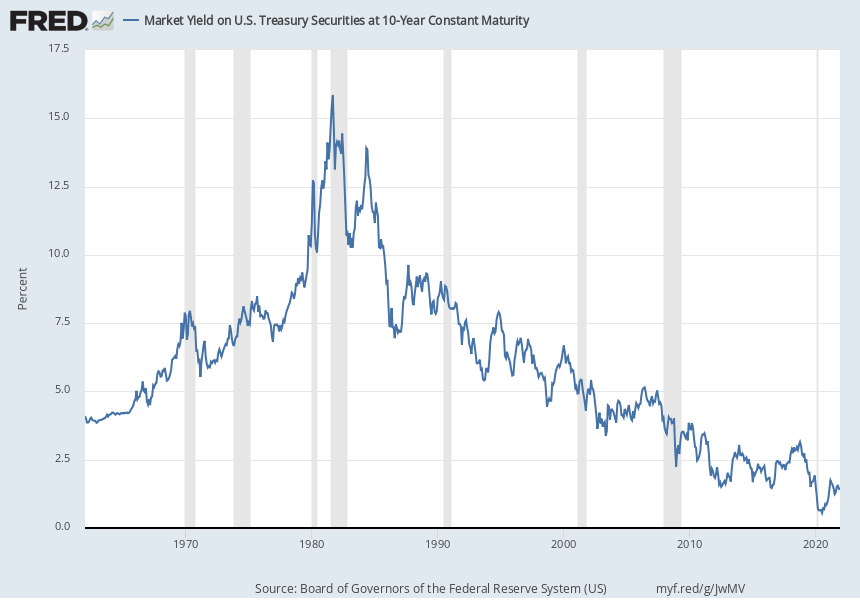
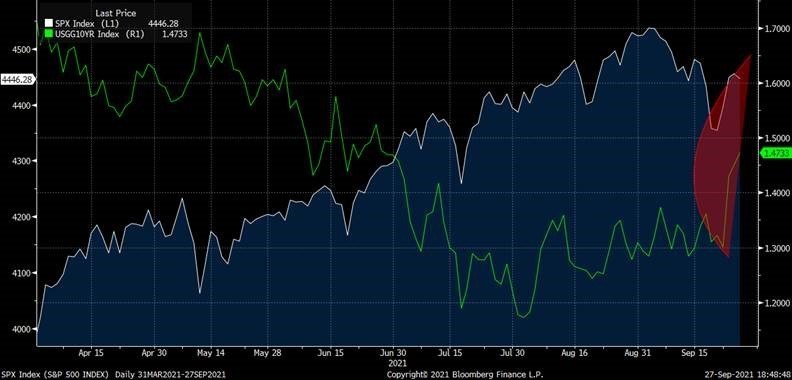
The US 10y Treasury yield has risen in anticipation rising from +1.3% to +1.5% (chart below), yet barring a couple of volatile sessions, the S&P 500 index has held up well and risen. This however, hasn’t stopped the “permabears” from calling an end to the Bull-run in equities which started in March last year.

S&P 500 Index, 10 year US Treasury yield – 6 month price chart

Source: Bloomberg

In my nearly 17 years in this profession, I have never seen a Bull market that has been viewed with such cynicism and scepticism. Every 1-2% correction is followed by a dire prognosis by the usual permabears. Red lights start flashing on CNBC and the parade of the bears ensues. Every short pull-back is met with more rash predictions of a disaster ahead.

In my opinion, Bull markets don’t end when there is still is so much scepticism. Bull markets end when there is all around euphoria and everyone is all-in at the top. The bearish sentiment remains high and it tells me that this Bull Run in equities has more room to run. Ignore the noise and instead focus on long term economic trends, secular policy or market structure changes.

As for short term pullbacks, these can happen even in healthy markets with strong economies. In fact, the S&P 500 has dealt with 32 pullbacks of -10% or more since 1950. Data crunched by Callie Cox of Ally Invest, shows that of those pullbacks, just 11 took place during economic recessions. The other 21 were quick storms, rebounding to new highs in an average of five months.

Here is another statistic tallied by investment blogger Brian Feroldi:

2011: Europe debt crisis
2012: Fiscal cliff
2013: US Government shutdown
2014: Ebola
2015: Brexit
2016: U.S. Election
2017: Harvey/Irma/Maria storms
2018: 2 US Government shutdowns
2019: US Impeachment inquiry
2020: COVID-19
2021: US Capitol Attack

During the above period 2011-2021, what was the total return of the S&P 500? Well, a staggering +375%!

The message is simple – stay invested if you believe the growth outlook over the medium to long-term remains positive. The conditions that have boosted equities – accommodative fiscal and monetary policies, very low to zero yields on cash and the low yields on bonds, growth upturn, and no inflationary concerns over the medium term – all still prevail.

Long-time readers of this newsletter will know that I do not believe in timing the market. Timing the market and getting it right is a matter of luck. In my opinion, one has to be either conceited or not understand probability and chance, to think that one can time the market.

Yes, there will be market corrections but “Time in the market” holding assets you have researched well will always beat “Timing the market”.

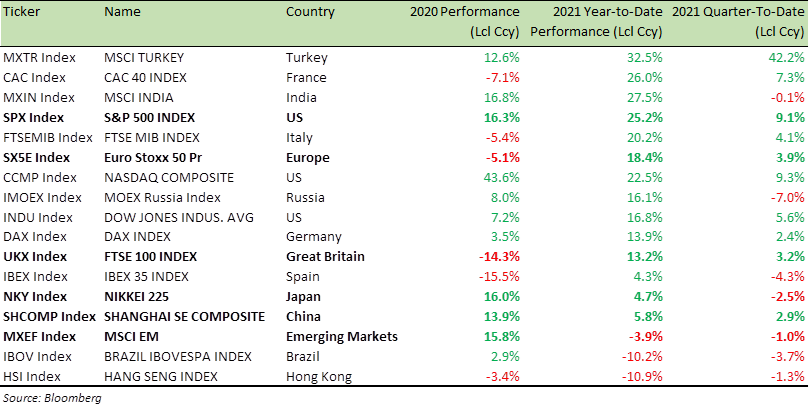
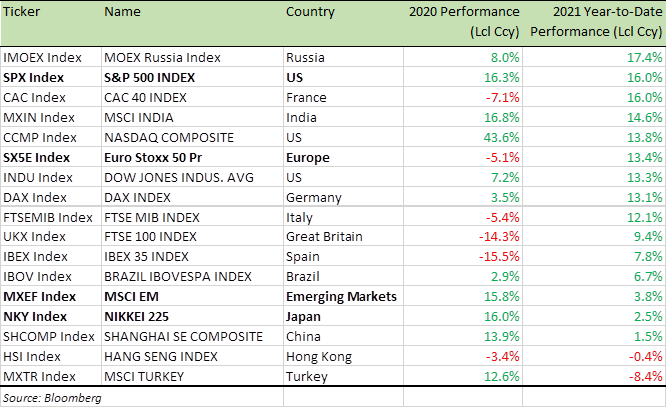
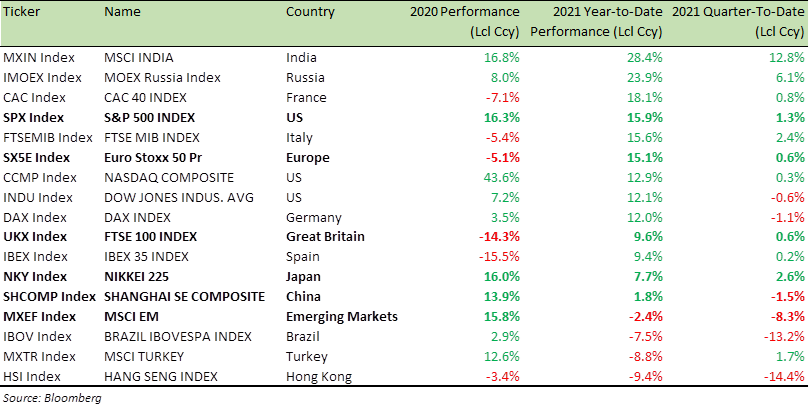
Benchmark Global Equity Index Performance (2020, 2021 YTD)

One other issue that has consumed the markets of late is – Evergrande.

No, it’s not the new size of pumpkin spice latte at Starbucks and nor is it a new lipstick line by Ariana Grande. Evergrande is the second-largest property developer in China by sales and it is in distress.

Is this China’s “Lehman moment?”

No, it isn’t.

“Lehman moments” are always a policy choice. The US Treasury made a conscious decision to let Lehman go bust. They regretted it later. Such monumental events don’t happen by chance but by choice.

China will not make that choice. China doesn’t want a systemic crisis. It doesn’t want a “Lehman moment.”

My understanding of China, its culture and psyche tells me Evergrande will “not get a bailout” but that retail investors who have bought the property from Evergrande will be protected and “made whole.” Other Chinese developers will be asked to take over Evergrande’s unfinished projects, complete them and deliver the properties to the rightful owners, who have already paid for them. China via its central bank People’s Bank of China (PBoC) will always protect the Chinese consumers. It’s a matter of existential importance for the Chinese Communist Party (CCP).

Also, bear in mind Lehman was an investment-grade credit, and the Lehman bonds were held by mom and pop investors via money market funds. Evergrande has been rated junk for a long time now. Therefore, expect an upturn in Chinese equities and Emerging Market equities as soon as the Evergrande issue is resolved or there is more clarity from the PBoC.

Over in Europe, the German elections are over. The Social Democrats (SPD) led by the current Finance Minister Olaf Scholz won 25.8% of the vote, while Chancellor Angela Merkel’s Christian Democrats (CDU) and its Bavarian sister party, the Christian Social Union (CSU), received a combined 24.1%, down from 32.9% at the last general election in 2017. The Green party came third, on 14.6%, followed by the Free Democrats (FDP) with 11.5% and the right-wing populist Alternative for Germany (AfD) with 10.4%.

Germany’s proportional electoral system makes it difficult for parties to have absolute control over parliament and hence the government. This time, with the largest party (SPD) only getting a quarter of the votes, the race is now on to form Germany’s first three-party ruling coalition since the early 1950s. The SPD and the Greens governed Germany together from 1998 to 2005. The CDU-CSU and the FDP are old allies and last ran Germany in a coalition government under Merkel from 2009 to 2013.

The SPD and the Greens would like to raise income tax on higher earners and bring back Germany’s wealth tax, which was abolished in 1997. The Greens would also like Germany to take on €500 billion of public debt for investment and give Berlin’s blessing to a permanent mechanism for the EU to borrow money in its own right.

The FDP much like the CDU-CSU promises not to raise taxes. It also pledges to reduce the burden of tax and bureaucracy on businesses. The FDP also want to reduce the total burden of business tax from 31% to 25%, create tax breaks for private investment, and take Germany back to the “Black Zero”, the stringently balanced budget it maintained before the pandemic.

I suspect we will see a Grand coalition of SPD-CDU/CSU and FDP with SPD’s Scholz as the new Chancellor.

In 2017, it took six months to form a new government. I do not expect the new coalition government to be in place this side of Christmas. A Chancellor Scholz on the margins would be fiscally loose, but in no way a game-changer for EU politics, as some expect or make it out to be.

Benchmark US equity sector performance (2020, 2021 YTD)

There’s a lot of talks right now about the global supply chain crisis and I am afraid we will hear more of it over the next few months.

Product delays, product shortages and rampant freight costs, will all weigh on growth in Q4 and possibly Q1. The supply concerns are also magnified as demand is running very high. Consumers flush with cash from personal savings and payment support from the government are not afraid to spend.

However, factory shutdowns (particularly in Asia as they manage and contain outbreaks of Covid-19), port closures in China, commercial flight reductions and container ships challenges globally -are hampering supplies.

Did you know that approximately 50% of air cargo is transported on passenger flights?

It’s a great revenue stream for passenger airlines. With travel, particularly international travel still much reduced, there is a significant reduction in air cargo capacity causing further supply issues.

All this means, the monetary policy is not going to tighten anytime soon even as bond yields and inflation rise temporarily.

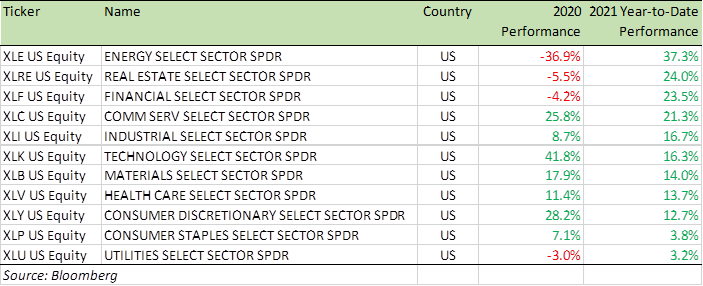
Equites are still a good place to be. I expect the Fed to announce a gradual taper in November that wraps by mid-June 2022. Tapering will not impact the equity market a great deal, as the market fully expects the Fed to taper and eventually stop asset purchases. Even if asset purchases end, the Fed is a long way off from raising interest rates.

As the table above indicates, Consumer stocks (XLY, XLP) have taken a beating and present a very good buying opportunity. Industrial (XLI) and Material (XLB) sector stocks should also benefit from the cyclical upturn when growth picks up again. Energy stocks are flying and it may be a good idea to trim them in your portfolio. There’s is no shortage of oil and gas in this world. It’s just a matter of supplying them adequately and in time to meet demand.

For specific stock recommendations, please do not hesitate to get in touch.

 
Best wishes,

Manish Singh, CFA


The US has played the role of global cop, answering 911 calls. Captain America is homeward bound. Sometimes getting out of a needless war is the best thing to do. Focusing on home, spending money domestically will serve the US interest well.

Summary

Over the last 70 years, rightly or wrongly, US allies have counted on the US – “Captain America”- to come to the rescue when needed. The US has played the role of global cop, answering 911 calls from nations near and far, sometimes at great personal cost. The US has come to the rescue of foreign nations, foreign nationals and its own citizens stuck in foreign nations and warzones. Captain America is now calling time. Captain America is homeward bound. The political will and the political capital in the White House (be it a Republican or a Democrat White House) to fight a war in a foreign land is greatly reduced and continues to wear thin. In 1975, the loss in Vietnam was seen as the final humiliation of the “spent hegemon” – the US, yet its GDP is now 12 times bigger. Sometimes getting out of a needless war is the best thing to do. In the post-Saigon era, Japan was seen as the rising economic power, and for two decades (1975-95), it was. Japan’s GDP in 1995 reached $5 trillion. Japan’s GDP today still stands at $5 trillion. Japan atrophied and the US’ economic and technological power came through. US GDP, over the same time period, nearly tripled from $7.6 trillion in 1995 to $21 trillion today. Focusing on what needs to be done at home and spending money domestically, instead of waging wars abroad, will serve the US agenda and the US economy well.

US Real personal income received a big boost over the last 12 months. It increased due to transfer receipts – benefits received by people where no current services are performed i.e. Social Security, unemployment insurance, and Covid relief payments. If you strip out these transfer receipts, it becomes quite clear that US Real personal income has actually not improved much. Transfer receipts are set to end soon and I fail to see how the consumer will continue to feel cheerful and chase products, if prices were to increase. Besides, technology has ensured that the pricing power for average or easily produced goods has shifted and continues to shift in favour of consumers and not producers. Inflation will not be a problem for a long time yet and this is good news for equities. The US Federal Reserve’s tapering of asset purchases is coming, but a rebound in bond yields will not kill the Bull Run in equities. Of course, there will be volatility, but the uptrend in equities isn’t about to end.

“Captain America” – homeward bound

“A Fish Called Wanda” is one of the funniest movies I have ever seen. If you’ve seen the movie, you will recall the scene on the tarmac as the movie comes to an end. Archie Leach (played by John Cleese – who also wrote the screenplay) – taunts former CIA agent and Anglophobe Otto West (played by Kevin Kline) about Vietnam.

Otto: You know your problem? You don’t like winners

Archie: Winners?

Otto: Yeah, winners.

Archie: Winners, like North Vietnam?

Otto: Shut up! We didn’t lose Vietnam! It was a tie!

“It [Vietnam] was a tie” shows how difficult it is for those who are used to winning, to accept defeat.

Wars rarely have a good outcome. Whether the withdrawal from Afghanistan is the United States’ Saigon or its Suez moment – will be debated for generations to come, and I will spare you my commentary in this newsletter.

Over the last 70 years, rightly or wrongly, US allies have counted on the US – “Captain America”- – to come to the rescue when needed. The US has played the role of global cop, answering 911 calls from nations near and far, sometimes at a great personal cost.

Very egregiously, some like the EU nations who now criticise the US, have for years benefited from US defence preparedness, without paying their stipulated budgetary contribution for membership of the North Atlantic Treaty Organization (NATO). Captain America has come to the rescue of foreign nations, foreign nationals and its own citizens stuck in foreign nations and warzones. Captain America is now calling time.

Captain America is homeward bound.

The truth is that successive US Presidents starting with President Barrack Obama no longer saw the Middle East region as central to US national interests. What you see in Afghanistan, I suspect, will repeat throughout the Middle East, as the US continues to pull away and concentrate on matters at home.

Except for “Dunkirk”, I fail to think of any retreat that has not embarrassed the withdrawing forces. Therefore, yes, America will be embarrassed and it will lose significant “soft power” due to its chaotic Afghan withdrawal. The consequences of it will be felt for years to come. After Dunkirk, Britain stayed in the war to finish off (with the help of the allies) Nazi Germany – otherwise the Dunkirk retreat would have been the greatest embarrassment for Britain. I frankly don’t see the US returning to Afghanistan with a large army!

In fact, the US may not return to Asia for a military conflict in the foreseeable future, and that must worry US allies there, particularly Taiwan, Korea and Japan. The political will and the political capital in the White House (be it a Republican or a Democrat White House) to fight a war in a foreign land is greatly reduced and continues to wear thin. It would also seem, that Pax Americana (Latin for “American Peace”, the US playing the cop to maintain peace) is over. A world in which the global economic leader is not prepared to act as a cop, leaves the world open to many risks that will manifest over time. The UK responded to the US decision to withdraw from Afghanistan by cobbling together an alternative coalition, but it was impossible without the vital logistical support of the US. It is abundantly clear now, that without the US there is no hope of a coalition of the West in the future.

US Marine Corps infantry force in training in Afghanistan

Source: Pixabay

Having said all that, the US withdrawal from Afghanistan is the right thing for the US to do, distasteful as it may be. As an investor in US equities and therefore someone with a vested interest in the US economy and the US dollar, the events of last week haven’t made me overly gloomy about the US economy. The withdrawal is chaotic but not a disaster. I am more concerned about US President Joe Biden’s policy with respect to the Ribbentrop-Molotov (German-Russia) Nordstream 2 pipeline treaty. I believe that will have calamitous ramifications in the future. The chaotic Afghanistan withdrawal will be quickly forgotten.

The US pulling out of expensive wars in faraway lands is good for the US economy and is US dollar positive. The UK suffered a bloody nose in the Suez crisis in 1956, yet it has prospered since. In 1975, the loss in Vietnam was seen as the final humiliation of the “spent hegemon” – the US, yet its GDP is now 12 times bigger. The US is more prosperous and much better off since the “Saigon” moment. Sometimes getting out of a needless war is the best thing to do, and it can stop the bleeding of the economy.

In the post-Saigon era, Japan was seen as the rising economic power, and for two decades (1975-95) it was. Japan’s GDP in 1995 reached $5 trillion. Japan’s GDP today still stands at $5 trillion. Japan atrophied and the US’ economic and technological power came through. The US GDP over the same time period nearly tripled from $7.6 trillion in 1995 to $21 trillion today.

The United States is still a military superpower, the US dollar still is the world’s currency and will be for the foreseeable future. Focusing on what needs to be done at home and spending domestically instead of waging wars abroad, will serve the US agenda and economy well. In 1975, the US had a major oil dependency, today the US is an energy exporter.

China is a clear beneficiary of the US’ withdrawal, but Afghanistan will not be a cakewalk even for them, as they go about extracting minerals and trading with the tribal Taliban government.

In the movie, as Archie continues to taunt Otto, Ken (played by Michael Palin) arrives on the tarmac driving a steamroller, seeking vengeance for his pet fish that Otto had eaten. Otto too busy arguing with Archie finds he has stepped on wet concrete and cannot move. He is run over, but survives. Will the US, stuck in the Afghanistan quagmire have such a lucky escape? Or will it be more damaged than Otto coming out from under the steamroller? Not even John Cleese would like to write a screenplay for it. Only time will tell.

Markets and the Economy

The S&P 500 index (SPX) has made over 50 all-time highs this year and is up +19% year-to-date. It is up over +100% since the Covid-19 pandemic induced lows of March 2020. It took less than 17 months to double, the fastest Bull market to double since WWII.

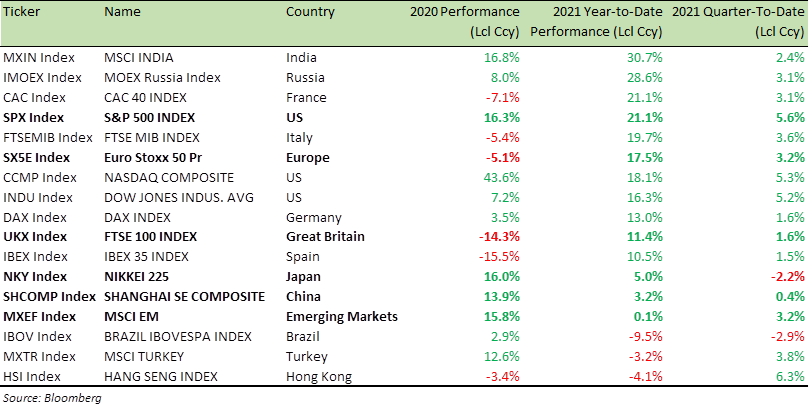
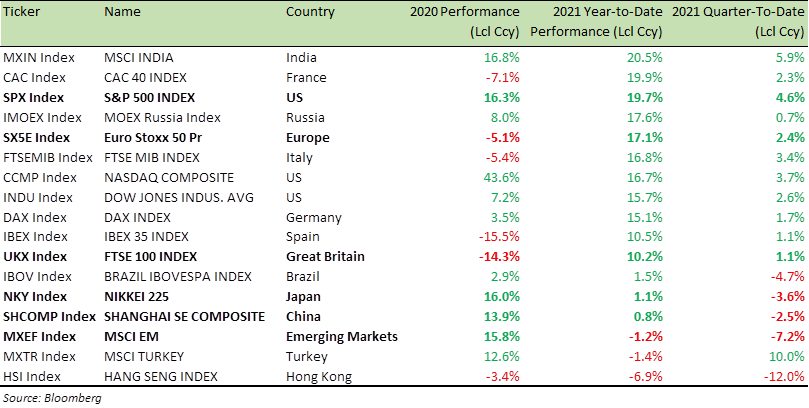
As the table below indicates, while US and European equities have thrived, Emerging Market equities, particularly China, have not just lagged, but gone into reverse.. Policy uncertainty in China is a key reason for this..

At the current levels, Chinese equities are greatly undervalued. For example, the combined market capitalisation of the four Chinese tech giants – Alibaba, Tencent, Baidu, and JD.com – is a quarter less than the market capitalisation of Amazon (AMZN), yet their combined Free Cash Flow (FCF – refers to the amount by which a business’s operating cash flow exceeds its working capital needs and expenditures on fixed assets) is nearly double that of Amazon.

“Whether a country is strong or not cannot be determined by the size of the economy alone, nor the size of the population or the size of the territory. In modern history, one of the roots of China’s fall and defeat was our backwardness in science and technology.” – wrote President Xi Jinping of China in this 2018 article. Please bear this in mind when analysing China technology and that would include internet, blockchain and digital currencies. China doesn’t want to be backwards in technology ever again i.e. China technology stocks are unlikely to remain undervalued for too long..

Benchmark Equity Index Performance (2020, 2021 YTD)

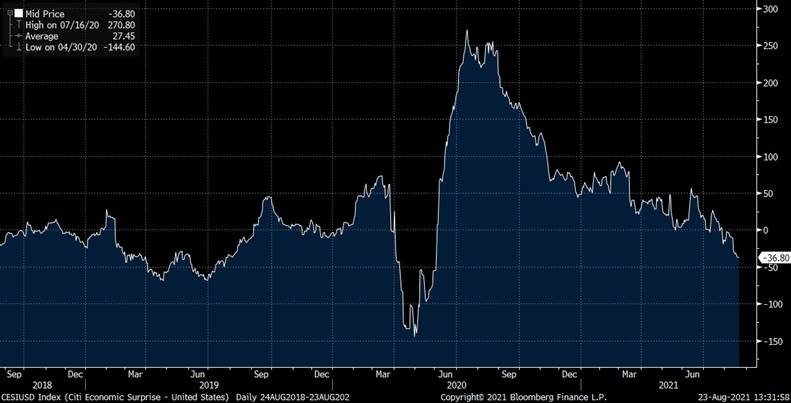
The economists who wildly underestimated the strength of the post-COVID re-opening, only to be surprised by it, may now have gone in the opposite direction. The Citi Economic Surprise Index (graph below) which measures how economic indicators are coming in relative to expectations, has recently ticked into negative territory for the first time since the early days of the pandemic in 2020. There is no doubt that eventually, economists will overshoot to the downside just like they usually overshoot to the upside.

The focus however will squarely be on the inflation, “tapering” of asset purchase by the US Federal Reserve (Fed) and their upcoming annual economic symposium in Jackson Hole, Wyoming.

The US unemployment rate fell from +5.9% in June to +5.4% in July. The jobs lost in pandemic have been recovered in no time. To put it in perspective, following the 2008 recession it took 7 years for the jobless rate to fall back to +5.4%!

Citi Economic Surprise – United States (2018-2021)

Source: Bloomberg

On inflation, as I have written in the last few newsletters, I continue to believe inflation will not be a problem in the medium term and inflationary bets will start coming off soon. With it, you are likely to see a new rally in Emerging Market equities and perhaps Chinese equities too.

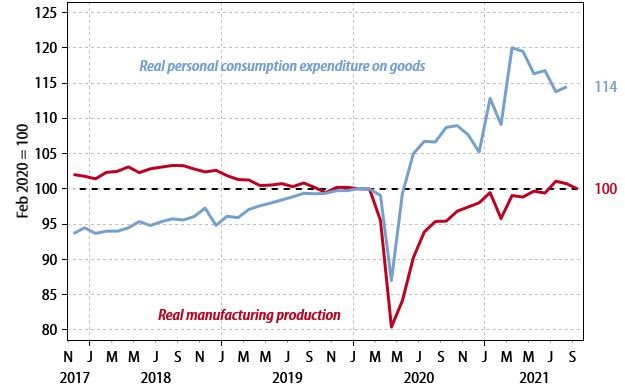
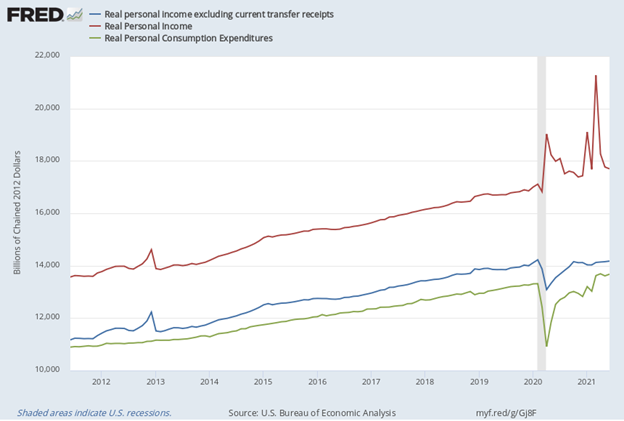
Why do I think inflation is “transitory”? Please take a look at the chart below. US Real personal income (the red line) got a big boost over the last 12 months. It was boosted by transfer receipts – benefits received by people where no current services are performed i.e. Social Security, Unemployment insurance, and Covid relief payments.

If you strip out the transfer receipts, US Real personal income excluding transfer receipts, (the blue line), you will notice that US real personal income has not actually improved much. Transfer receipts are set to stop soon and I fail to see how the consumer will continue to feel cheerful and chase products if prices were to increase.

In my opinion, inflation will not be a problem for a long time and it’s because neither President Obama nor President Donald Trump in the past or President Biden today have done or are doing anything to better the plight of the middle class American (let alone poor Americans). The real adjusted median US household income is flat over the last two decades. Over the last few decades, in the US, the giant portion of the economic benefits have continued to accrue to wealthy Americans, while 90% of Americans continue to suffer from pre-existing economic, wage and labour challenges. Record low unemployment since the 1960s make for a good statistics and political points, but on the ground, it has not done much to improve the balance sheet of the average American.

US Real personal consumer income and expenditure

Remember, inflation will be driven by demand for average daily consumer goods by average American consumer and not by the wealthy re-stocking their freezer with delicacies – like House Speaker Nancy Pelosi and her $24,000 freezer full of $12-a-pint luxury ice cream. (If you think I made this part up about Nancy Pelosi, please see the video evidence here)

Besides, technology has ensured that the pricing power for average or easily produced goods has shifted and continues to shift in favour of consumers and not producers. Price discovery using the internet is a kid’s job. Run a search for any item on Amazon and you have a plethora of suppliers. The producers are compelled to compete on price and this isn’t going to change. Global trade and supply chains, with the help of technology are so well ironed out, that demand shocks will be dealt with promptly and easily and price increases will be arbitraged away in a short time.

In Germany where national elections are due in less than a month, over the last two weeks, the Social Democrats (SPD) have not only overtaken the Greens in the opinion polls but the SPD is also polling marginally ahead of the Christian Democratic Union (CDU) – Christian Social Union (CSU) faction. If this trend continues, an SPD-led government is more likely than another CDU-led coalition. That will mean more fiscal spending within Germany and greater economic cooperation at the level of the European Union (EU) and perhaps a more lax debt and deficit targets for the EU nations. This would be positive for European equities.

The Fed’s tapering of asset purchase is coming but a rebound in bond yields will not kill the Bull Run in equities. Of course, there will be volatility, but I don’t see the uptrend in equities breaking down.

The market is primed to see the Fed reduce and eventually pause bond buying. I say pause because I fervently believe that the “Japanification” of the western world bond market is in progress. When you know – if needed – the Fed will buy bonds again – it doesn’t matter if the Fed stops now, buys later so long as the Fed indicates it is there to “help” which they always have and continue to. They have no other option.

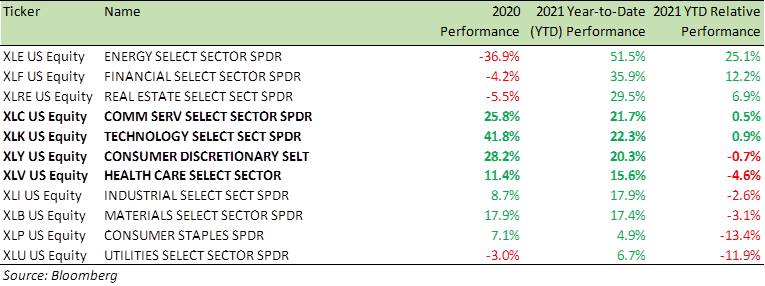
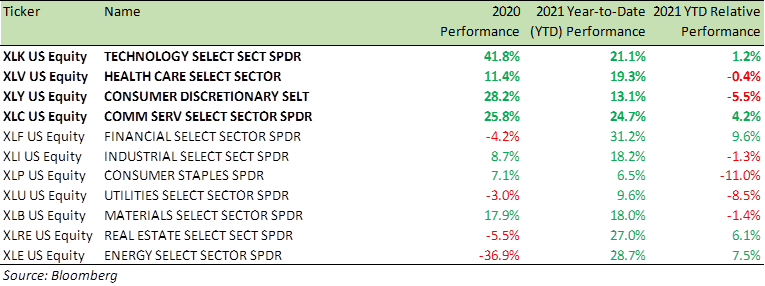
Benchmark US equity sector performance (2020, 2021 YTD)

Post “taper” we will some rates rises in 2022/23 but the Fed and other central banks buying bonds will go on for a very long time (if not forever). I continue to be bullish on growth and equities and I do not see inflation as a major medium term concern as outlined above. I see central banks pulling away support in a very steady manner and interest rate rises, when they come, will be very gradual and hit a low plateau soon.

As the table above indicates, Consumer Discretionary (XLY) and Consumer Staples (XLP) sectors have taken a hit in last few weeks, as the Delta variant has spread and the re-opening trade has paused. Once those concerns settle, and they will, consumer stocks will bounce back. Those two sector present good opportunities to stock pick.

For specific stock recommendations, please do not hesitate to get in touch.

 
Best wishes,

Manish Singh, CFA


“The difficulty lies, not in the new ideas, but in escaping from the old ones.”

John Maynard Keynes

Summary

Despite slightly hawkish central banks of late, equity markets have continued their upward trajectory and bond yields have fallen. The yield on 10 and 30-year US Treasurys, is now back at the levels seen last February. Whilst inflation may not yet be showing up or may not show up for a while, it has however already achieved an important goal– raising inflation expectations and thus taking the risk of deflation off the table for few years. The US Federal Reserve has had its foot on the gas since the COVID pandemic started and it is getting ready to take it off ever so slightly. The Fed is however not ready to put the brakes on yet, and rightly so, as the “Delta variant” of Covid-19 rages on and the vaccination rate is still very low in many parts of the world, particularly in Asia and Emerging Markets.

As per a recent report in The Wall Street Journal, the greatest wealth transfer in history has begun. The “Baby boomer” generation has started parcelling out wealth to their heirs and others, unleashing a torrent of economic activity. Older generations will hand down some $70 trillion between 2018 and 2042. A good percentage of this will be “spent” to meet living, leisure, and luxury expenses and that means GDP expansion, job creation and business growth.

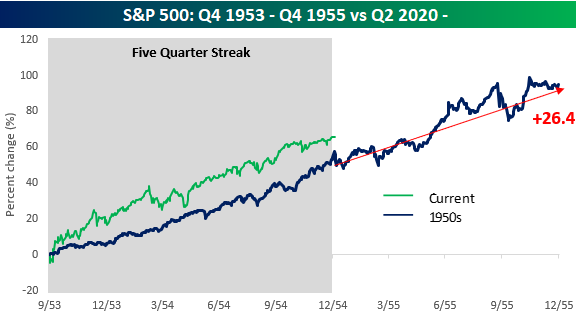
The S&P 500 index has steadily rallied in the last 15 months and each quarter has seen a rally of more than +5%. A gain of +5% in any quarter is impressive enough, but five quarters in a row is almost breath-taking. The only other period to match the current streak was in the five quarters ending in December 1954.

Approximately $580bn has been added to global equities funds in the first half of 2021. This inflow surpasses the cumulative inflow to global equity fund during all the previous 20 years. Far too many people focus on levels of the markets and miss out reading the structural changes that are happening in the economy and the markets, that have long-lasting impact. Many fall into the trap of thinking an “all-time high “ means a correction is on the way. Whilst some fret over inflation, in my view, we may be in the early stages of another Bull Run in asset prices.

The case for Inflation has weakened but be happy the risk of deflation is off the table

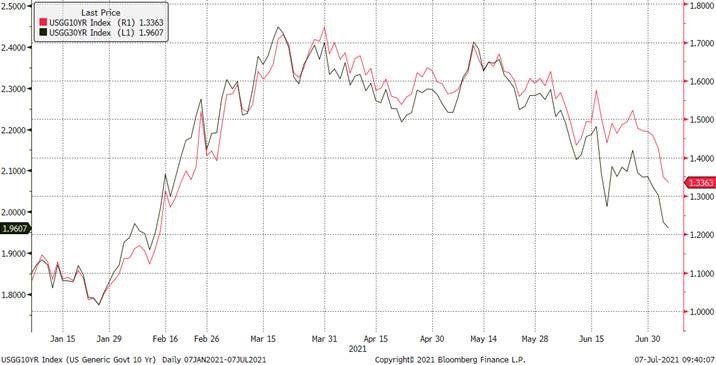
The yield on the 10 year and 30-year US Treasurys (chart below) is now back to the levels seen last February i.e. the inflation narrative priced in over the last three months has been unwound, and then some.

Cynics may say –inflation, what inflation?

Whilst inflation may not be showing up yet or may not show up for a while, it has however already achieved an important goal– raising inflation expectations and thus taking the risk of deflation off the table for few years. This must be applauded. You will recall, not so long ago, central banks were more concerned about the potential “deflation” risk. Deflation is catastrophic for asset markets, as history and the more recent experience in Japan have demonstrated.

As I wrote in May Market Viewpoints I don’t discount the risk of inflation fully. In fact, we may yet see a short burst of high inflation driven by wages (though it’s not the 1970s when the impact of labour unions on wages was considerable), or indeed because of an increase in Oil prices , however, over the medium-term, inflation is not a big risk. As outlined in the April Market Viewpoints – the last 250 years of US inflation can be summarised as – a very long period of little or no inflation, a couple of decades of high inflation in the 1970s-80 and back to more than three decades of low inflation. Inflation will be tame because of structural reasons and technology’s disinflationary impact will bear on the world for many years to come.

6 months chart: US Treasury 10Y and 30Y yield

Source: Bloomberg

It seems that US economic growth may also be peaking.

The US economy has been on a tear. It expanded at an annualized rate of +6.4% in the first quarter of 2021 and the growth in the second quarter should be even higher, as the economic re-opening has accelerated. No doubt, the bipartisan Infrastructure Bill to spend $1.2 trillion on roads and bridges will be a further boost to growth. However, more recent US economic data indicates that we may have seen the top of the US growth cycle, as the re-opening exuberance fades.

According to the current estimate of the Federal Reserve Bank of Atlanta, GDP growth in the second quarter should be +7.8%. This reading is down from +8.6% on July 1, +10% in June and +12% in May.

The marginal gain from further re-opening is likely to moderate, as most US states are now largely open and data from the Transportation Security Administration (TSA) shows that the number of Americans passing through airports actually surpassed pre-pandemic levels at some points over the July 4 long weekend. Some 2.15 million people passed through security checkpoints on Thursday and 2.2 million on Friday last week, versus 2.09 million and 2.18 on the same days in 2019. The rebound of travel follows the plummeting of coronavirus-linked cases, hospitalizations and deaths in the United States. Nearly 60% of American adults are at least partially vaccinated.

If the growth in the US has peaked, then that is good news for the equity markets. The fear of a spike in inflation will recede and the US Federal Reserve (Fed) will be under less pressure to tighten monetary policy.

The UK has the highest vaccination rate among the G20 group of economies and yet the number of confirmed cases of Covid-19 is now back up to 25,000 per day, a rate last seen in February this year. Over 90% of these cases are that of the Delta variant. The Delta variant is far more contagious and is therefore spreading rapidly. However, very encouragingly, the number of deaths is down from 600 per day in February to less than 20 per day now i.e. a reduction of -96%.

The vaccine is working and, the higher the vaccination rate, the sooner things will get back to normal. Until then, central banks will be in no rush to taper their asset purchases with anything other than a token amount. As things stand, the Fed and the European Central Bank (ECB) are still buying assets at the rate of $120 billion and €100 billion per month respectively. So, while the guidance has been adjusted at the margins by the Fed, the printing presses in the US and Europe are still whirring and increasing fiat money supply at an annual rate of $2.8 trillion.

Markets and the Economy

It is no surprise therefore that equity markets have continued to increase. Inflation fears seem to have done little to dampen the spirit of equity investors.

Approximately $580bn has been added to global equities funds in the first half of 2021. This inflow surpasses the cumulative inflow to global equity fund during all the previous 20 years, according to data provider EPFR. The S&P 500 (SPX) is up more than +15% this year, while the FTSE All-World Index has gained slightly more than +12%.

So we’ve had slightly hawkish central banks and still equity markets have been going up and bond yields have fallen. Far too many people have focused on levels of the markets and miss out on the changes going on around us. Many fall into the trap of thinking an all-time high (ATH) means a correction is ion the way.

Benchmark Equity Index Performance (2020, 2021 YTD)

After the worst quarter for US equities since the Financial Crisis of 2007/8, during the first quarter of 2020, the SPX has steadily rallied in the last 15 months and each quarter has seen a rally of more than +5%. A gain of +5% in any quarter is impressive enough, but five quarters in a row is almost breath-taking. The only other period to match the current streak was in the five quarters ending in December 1954. Besides this streak, there were three other periods when the SPX has rallied by more than +5% for four consecutive quarters (1958, Q3 1982- Q2 1983 and 1995).

So what happened to equity markets in 1955, in the quarter that followed that fifth straight quarter of gains, I hear you ask? Well, the SPX didn’t rally more than +5%, but it was up a respectable +1.7%. For the entire year that followed the five-quarter streak, the SPX added another +26.4% (chart below)

Source: Bespoke Invest

So what were the factors that contributed to the 1954-55 rally in equities? The events that led up to it have some similarities to the current period. Then, as the US struggled to finance World War II, the Fed kept interest rates low to reduce borrowing costs. The Fed did so through the purchase of Government securities, even as inflation levels surged. Naturally, when the war was over, President Harry Truman and his Treasury Secretary John Snyder argued for a continuation of the Fed’s easy policy. What politicians wouldn’t?

This time around, the pandemic has had a similar impact on Fed’s monetary policy and Chairman Powell who has already faced pressure from then President Donald Trump to cut rates and keep interest rates low, may yet find it difficult to get out of the “low rate” policy as debt and deficits continue to mount to fund President Joseph Biden’s spending plans.

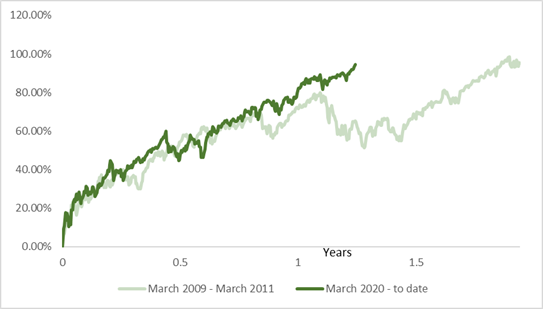
The chart below compares the current bull run in US equities, that started in March 2020 to the last bull run (March 2009- March 2011) we witnessed. The current bull run looks even better and stronger and there is no sign of a dip.

S&P 500 performance: Comparing the 2020-21 US equity Bull Run with the last one (2009-11)

Source: Crossbridge Capital, Bloomberg

It took a once in half a century pandemic to bring the last Bull Run to an end. While some fret over inflation, in reality we may be at the early stages of another Bull Run in asset prices. Ongoing fiscal and monetary accommodation, a high rate of savings coming out of the pandemic, and a buoyant jobs market, all indicate higher consumer spending which will continue to fuel the rally in equities.

Add to that these startling statistics published in The Wall Street Journal (WSJ)

  • Baby boomers and older Americans have spent decades accumulating an enormous stockpile of money. At the end of this year’s first quarter, Americans age 70 and above had a net worth of nearly $35 trillion. That amounts to a whopping 27% of all US wealth, up from 20% three decades ago. Their wealth is equal to 157% of US GDP, more than double the proportion 30 years ago
  • The greatest wealth transfer in history has begun as boomers started parcelling it out to their heirs and others, unleashing a torrent of economic activity including buying homes, starting businesses and giving to charity. Older generations will hand down some $70 trillion between 2018 and 2042, according to research and consulting firm Cerulli Associates

Of course, some of this wealth will be saved or invested, but a good percentage will be “spent” to meet living, leisure, and luxury expenses and that means GDP expansion, job creation and business growth.

It’s too easy to be bearish. Some people even have it as their base case and relish reminding everyone “I told you so” at every piece of negative news. Sadly for them, however, their much-awaited -20% correction often comes after +100% rallies.

It’s a fact that “most people would rather be in the majority, than be right” and when the media highlights doom and gloom it becomes that much easier to be a bear than a bull and find yourself in minority as I have found myself through the last bull run and this one. Yes, there will be market corrections but “Time in the market” holding assets you have researched, will always beat “Timing the market.”

Investing is as much about knowledge, forecasting as it is about psychology. If you are bearish and overindulge, you get anchored to bearish views and start seeking echo chambers full of other bears. It doesn’t take long thereafter to lose sight of reality and you completely miss the structural changes happening in the economy and the markets that has long-lasting effects. A John Maynard Keynes quote to bear in mind – “The difficulty lies, not in the new ideas, but in escaping from the old ones.”

Benchmark US equity sector performance (2020, 2021 YTD)

As you may have guessed by now, I continue to be bullish on growth and US equities and I do not see inflation as a major concern. I see central banks pulling away support in a very steady manner and interest rate rises, when they come, will be very gradual and hit a low plateau soon.

European equities still have a long way to catch up and I would caution against underestimating the changes going on in the Euro group. Italian Prime Minister Mario Draghi has established himself as the leading light, given his background and experience. As the only macroeconomic expert in the G7 leader group, he far outshone Chancellor Angela Merkel of Germany and President Emmanuel Macron of France at the recently concluded G7 meeting in Cornwall. Draghi is driving the European Union (EU) towards higher debt and higher deficit and this will be funded by more money printing by the ECB and borrowing using the EU Recovery Fund.

The first syndicated issuance by the EU recovery Fund saw a demand of €142 billion for the €20 billion inaugural issue EU’s 10-year bond offer. The EU Commission had to pay interest below 1%. By the end of 2026, the EU recovery Fund plans to raise around €800 billion. The money raised will back grants and loans to EU member states to help their economies recover from the Covid-19 crisis.

Austerity is well and truly over in the EU and spending will carry on. Of course, there will be a day of reckoning as both the EU and the Euro are structurally flawed. However, such flaws usually take a long time to unravel. The political will should never be underestimated and a flood of money can keep the market forces at bay for longer than one anticipates.

For specific stock recommendations, please do not hesitate to get in touch.

 
Best wishes,

Manish Singh, CFA

“Inflation is not all bad. After all, it has allowed every American to live in a more expensive neighbourhood without moving.”

Former US Senator Alan Cranston (June 19, 1914 – December 31, 2000)

Summary

Figures published by the US Labour Department on May 12, showed that the US Consumer Price Index (CPI) for April surged by the most in any 12-month period since 2008. This print is however being affected by what is known as the “base effect” – the effect that the choice of a basis of comparison or reference can have on the result of the comparison between data points. In this instance, the price crash for many goods and services in March and April 2020, as Covid-19 lockdowns took hold, has magnified the year-on-year change in consumer prices. If you compare the April 2021 CPI number to the print from two years ago i.e. April 2019, overall prices rose a more muted +2.2% in April, on an annualized basis, rather than the +4.2% headline number just published. The comparison over a two year period cuts out the “base effect” and gives a much more realistic reading of the change in prices. Due to generous fiscal help, the damage to demand as a result of the pandemic, has been limited and it has recovered quickly as retail sales have indicated. However, due to the reluctance of the workforce to return and some other supply-chain bottlenecks, the supply side is lagging. As soon as supply catches up, and it will, price rises will moderate. I therefore believe that we will see a short burst of high inflation, but over the medium-term, inflation is not a big risk.

The S&P 500 index has fully recovered from its two-day slump following the April CPI print and it continues to rally higher. While some fret over inflation, in reality we may be at the early stages of another Bull run in asset prices. So far, the inflation debate has mostly focused on the US. Europe, except for the UK, hasn’t featured much in the inflation debate. The UK economy, basking in the success of its vaccination program, is now expected to grow +8% this year and UK equities have rallied, although the FTSE 100 is still down by more than -10% from its all-time high. With benign inflation expectations in the Eurozone, supportive fiscal and monetary policies, export-dependent Eurozone stocks are primed for more gains as the world economy opens up. Overall, as global growth accelerates, inflation is rising but is not a concern. I therefore continue to be bullish on equities. Growth stocks will see-saw but sell-offs are an opportunity to “buy the dip” in good names.

A high inflation print in April, but will the sequels disappoint?

Any movie fan will tell you that sequels mostly disappoint, but this hasn’t stopped actors and producers from making sequels or even from hyping them. Take the case of Liam Neeson and the Taken movies. When asked about sequels, Neeson said “How many times can she be taken? I mean, that’s just bad parenting.” Yet, we got Taken, Taken 2 and Taken 3.

Figures published by the US Labour Department on May 12, showed that the US Consumer Price Index (CPI) for April surged by the most in any 12-month period since 2008. The CPI rose +4.2% from a year earlier, considerably higher than the +3.6% that had been expected and higher than +2.6% recorded for March. This has whetted the appetite of inflationistas who expect the CPI sequels to continue to print high. I am afraid, just like movie sequels, CPI sequels are also likely to disappoint.

The annual inflation print is currently being affected by what is known as the “base effect” – the effect that the choice of a basis of comparison or reference can have on the result of the comparison between data points. The price crash for many goods and services in March and April 2020, as Covid-19 lockdowns took hold and demand collapsed, has magnified the year-on-year change in consumer prices.

Furthermore, when you look at the internals of the April CPI print, you find a very steep rise in the price of car and truck rentals. Car and truck rentals surged +82% compared with April 2020 and airline fares leapt +9.6%. One reason that the used-car prices have surged so much is due to a global chip shortage that has reduced the production of new cars. According to research firm J.D. Power, that tracks car prices, the average price paid for a used car exceeded $25,000 in April for the first time in history. What is normally a depreciable asset, has been appreciating.

US CPI Urban Consumers used cars & trucks price increase (YoY%)

Source: Bloomberg

Car manufacturers have struggled, since last year, to keep up with customer demand as they recovered from Covid-19-related production stoppages and now face new supply-chain disruptions due to a chip shortage. According to car-shopping website TrueCar, US sales of used vehicles hit 3.4 million in April, up +58% from a year earlier. As the supply-chain improves, the price increase of used cars is bound to hurtle down and with it, the CPI.

Also, if you compare the April 2021 CPI print to the print from two years ago i.e. April 2019, overall prices rose a more muted +2.2% in April, on an annualized basis. The comparison over a two year period cuts out the “base effect” from April 2020 and gives a much more realistic reading of the change in prices. Due to generous fiscal help, the damage to demand has been limited and it has recovered quickly as retail sales have indicated. However, due to the reluctance of the workforce to return and some other supply-chain bottlenecks, the supply side is lagging. As soon as supply catches up, and it will, price rises will moderate.

As I highlighted in last month’s Market Viewpoints, we haven’t seen inflation concerns over the last three and half decades and each time inflation looked set to rear its head, the global economy encountered a disinflationary/deflationary event – for example: the collapse in oil prices (1986), the implosion of the Soviet Union (1989-91), the real estate and accompanying banking bust in Japan (1991), the Mexican Peso crisis (1994), the Asian financial crisis (1997-98), China’s entry into the World Trade Organization (2001), the US subprime mortgage bust (2008), the Eurozone crisis (2011-12) and the US shale revolution (2013 onwards).

Could the next disinflation/deflation event come from excessive automation? Or a China slowdown? Or other?

Visit any McDonald, KFC or Burger King and you will see fewer working staff and more automation. A recent Wall Street Journal (WSJ) report indicates that McDonald’s is designing voice-activated drive-throughs and robotic deep-fryers. Other chains are testing self-operating ovens and dishwashers, along with robots that flip burgers and perform other mechanical tasks.

While it is not clear where the next disinflation/deflationary hit will come from, making a case for inflation in the absence of a clear external shock that alters supply or demand in a meaningful way is dangerous. Covid-19 was an external shock, but the recovery from it has been fairly quick, as the chart below from The Conference Board indicates. After the start of a recession, it typically takes the US economy about 4-7 years for unemployment to return to its natural rate. This time around, the unemployment rate may return to its natural rate by 2022 i.e. approximately two years after the start of the recession. We are yet to see any meaningful alteration in supply/demand due to pandemic shock and all signs point to a reversal to the mean.

On the basis of just one month CPI print, it’s hard to categorically say what is inflation, and what is just Covid-19 related supply-side and bottleneck related price rises. However, I am inclined to believe it’s the latter and it will sort itself out over the coming weeks as supplies come online. As I wrote in April’s Market Viewpoints – my gut tells me that we will see a short burst of high inflation, but over the medium-term, inflation is not a big risk.

The silver lining is the market has seen an over +4% print in US CPI, so it is conditioned to a high number. If the next monthly print is over +4% again, the market is unlikely to panic as much. On the other hand, if the next print is sub +4%, then expect the markets to rally and a sub +3.5% print will see an even stronger rally as the “inflation is transitory” theme starts taking hold. The S&P 500 index has fully recovered from its two-day slump following the April CPI print and it continues to rally higher.

It’s remarkable how closely the current bull run in US equities, that started in March 2020 is following the last bull run (March 2009- March 2011) we witnessed as the chart below indicates.

S&P 500 performance: Comparing the 2020-21 US equity Bull Run with the last one (2009-11)

Source: Crossbridge Capital, Bloomberg

It took a once in half a century pandemic to bring the last Bull Run to an end. While some fret over inflation in reality we may be at early stages of another Bull run in asset prices. Ongoing fiscal and monetary accommodation, high rate of savings coming out of the pandemic, and a buoyant jobs market, all indicate higher consumer spending which will continue to fuel the rally in equities.

With government debt sky-high, both in the US and Europe, it’s unlikely we will see interest rates going up by much, even as tapering starts and eventually a rate rise will follow. I fully expect the “Japanification” of the US Treasury market. The need to sustain a high government debt level dominates monetary policy in Japan where the Bank of Japan now owns over 45% of the Japanese Government Bond (JGB) market. I see the US Federal Reserve (Fed) forced down this same path in the not too distant future. A cap on US bond yields will help growth stocks and equities in general.

Markets and the Economy

So far the inflation debate has mostly focused on the US. Europe, except for the UK, hasn’t featured much in the inflation debate.

The UK economy, basking in the success of its vaccination program, is now expected to grow +8% this year – the highest growth rate in the G7 group of advanced economies – fuelling the view that the Bank of England (BoE) may have to deal with inflation much sooner than either the Fed or the European Central Bank (ECB). Also, newly released data by the Office of National Statistics (ONS) of the UK, indicates that more than 5 million European (EU) nationals have chosen to stay in the UK post-Brexit, rather than the 3 million originally estimated. Recall, a portion of the economic hit to the UK was anticipated to come from departing EU workers. Therefore, this increase in EU nationals choosing to stay in the UK, is very positive news on the overall economic and consumer spending fronts.

The GBP/USD exchange rate hit 1.42 in May, as optimism rose rendering the Brexit naysayers wrong, once again. So far it seems that recovery and not inflation are the mantra, as Covid restrictions ease and push the benchmark FTSE 100 Index beyond the 7,000 level.

Despite the recent rally, the FTSE is still down by more than -10% from its all-time high set in May 2018. In comparison, both the S&P 500 index (SPX) and the EuroStoxx 50 (SX5E) indices are +24% and +5% higher than their previous cycle high in February 2020 respectively i.e. the FTSE rally has more to go. However, the upside to GBP/USD looks limited and it will likely not stay above the 1.45 level even if it were to get there.

Sticking with currencies for a moment, EUR/USD at 1.20 looks very rich and I do not expect it to have more upside despite the talk of USD weakness. At least with respect to GBP and EUR, the USD weakness has already played out for now.

In Europe – the Eurozone to be precise – although inflation and bond yields are ticking higher in the Eurozone, the levels are modest and the increases moderate. There is a broad agreement among economists and policymakers that as economies reopen, a combination of accelerating economic activity and “base effects” will push headline inflation above the ECB’s target of “below, but close to, 2%” and as with previous price rises over the last decade, inflation rise will prove short-lived.

As a result, while US stocks, particularly the technology heavy NASDAQ Index has faltered over the last two months, European stocks have prospered as the table below indicates. In fact, on a 12 months basis, Eurozone stocks returns – as measured by the CAC, SX5E, and the DAX – are now at par with NASDAQ returns, as also seen below.

Benchmark Equity Index Performance (2020, 2021 YTD, 1 year and since the March 2020 low)

With benign inflation expectations in the Eurozone, supportive fiscal and monetary policy, export-dependent Eurozone stocks are primed for more gains as the world economy opens up.

Services-sector activity in the US and Europe—which includes restaurant dining, travel and entertainment—appear poised to continue expanding at a robust pace as government restrictions ease and consumers gain confidence in response to an acceleration in vaccinations. Preliminary results of surveys of Purchasing Managers Index (PMI) published last week by Markit showed that its index of activity at US services business rose to 70.1 in May, from 64.7 in April. A reading above 50 represents an expansion in activity.

PMIs suggest that Europe’s recovery may be more rapid. Activity in France’s services sector rose to 56.6 in May from 50.3 in April, a much larger increase than the rise to 52.5 that was forecast by many economists.

However, Japan’s services sector suffered a deeper contraction in May as the government there extended restrictions on the hospitality sector in areas including Tokyo and Osaka through the end of May. As a result, the Nikkei (NKY) fell by -10% early this month from its February levels.

Also worth noting is a sharp slowdown in factory output and retail sales in China as officials warned that the recovery in the world’s second-largest economy was running into headwinds.
The official Chinese data showed that factory output rose by +9.8% in April on the year, just below forecasts but slower than the +14.1% surge reported in March. Retail sales rose by +17.7%, far weaker than both the expected +25% and the +34.2% rise in March.

Benchmark US equity sector performance (2020, 2021 YTD and since March 2020 low)

Technology and Services stocks in the US got hit by the rise in inflation and inflation expectations and there is no better measure of inflation fear than in bond yields. As inflation expectations rose, the 10Y US Treasury yield hit +1.5% in early March, reaching +1.7% by mid-march. Despite a high inflation print in May, the 10Y bond yield is not rising anymore, and has traded in a narrow range of 1.5%-1.7% as economic data have remained mixed.

Growth stocks that were sold on fear of inflation are slowly being bought back and if the next CPI print is +3.5% or below, you will see a big rally in growth names.

In summary, therefore, monetary and fiscal accommodation continues across the globe as growth accelerates. Inflation is rising but is not a concern. Supply side bottlenecks are being addressed. I continue to be bullish on equities. Growth stocks will see-saw but sell-offs are an opportunity to “buy the dip” in good names. My favourite sectors to pick stocks from – Consumer Discretionary (XLY), Healthcare (XLV), Technology (XLK) and Communications (XLC). Technology stocks continue to deliver stellar earnings, despite the rising yield curve concerns.

For specific stock recommendations, please do not hesitate to get in touch.

 
Best wishes,

Manish Singh, CFA

“In a world organized in accordance with Keynes’ specifications, there would be a constant race between the printing press and the business agents of the trade unions, with the problem of unemployment largely solved if the printing press could maintain a constant lead.”

Jacob Viner (1892 -1970) in “Mr. Keynes on the Causes of Unemployment

Summary

Looking back at the US Consumer Price Index (CPI) from 1775 to today, one realises that the obsession with inflation is quite a recent phenomenon. Inflation and what causes it, are not easy things to understand. As economist Herbert Stein, then a top adviser to US President Richard Nixon, called inflation “a hydra-headed monster” that “came in various forms—sometimes led by wages, sometimes by prices, by foods, by oil; sometimes it was domestic and sometimes imported.” However, in my view, there is one indicator that is the most useful in understanding inflation and that is: Wages. Despite the excessive money printing since the 2008, what we haven’t seen is an increase in wages. Inflation is not yet a serious headwind but it could be soon enough, as labour markets improve further. By labour market improvement, I do not mean just low unemployment rates. Instead of focusing on the unemployment rate, we should watch the rate at which workers are switching between jobs, as a precursor of increased inflation. When job-switching picks up, wages will pick up and so will inflation. My gut tells me that we will see a short burst of high inflation but over the medium-term, inflation is not a big risk.

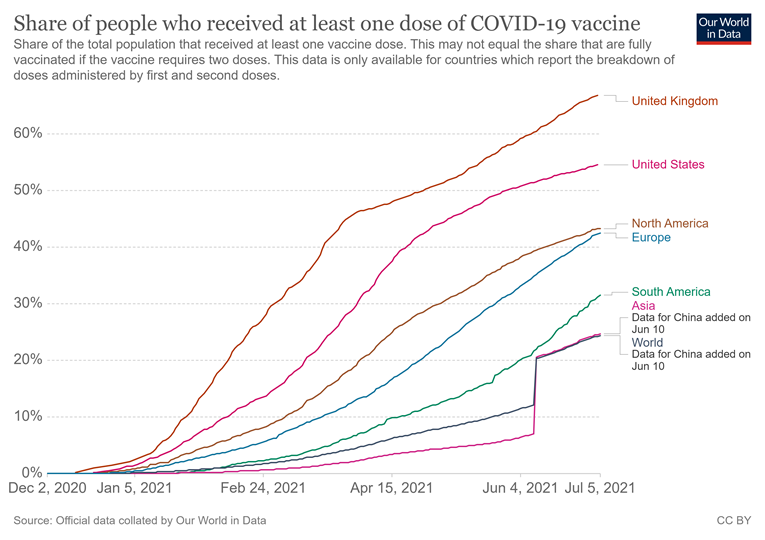
The COVID-19 pandemic is fading fast and the vaccine is working better than many would have imagined. The UK and the US have done a great job and the European Union (EU) will inevitably follow suit as they get their vaccination program in order. In the sea of good news on the COVID-19 front, the news from India is not so positive, where infections continue to mount as do fatalities. One reason is the low level of vaccination. In India, less than 2% of the country’s population have been fully vaccinated and less than 8% have received the first dose. By comparison, over 42.7% of the population in the US and over 60% of the population in the UK have received at least one dose of the vaccine. Vaccination is the only way out of this crisis. New variants are bound to rise as the virus mutates. Drug companies are already working on booster jabs to tackle this eventuality. In the US, the administration of US President Joe Biden continues to announce more spending and the governments of Germany and Italy have also signalled they are willing to run large deficits this year, in order to support their economies. As the re-opening continues, equity markets have continued to rally. The S&P 500 Index’s (SPX) return for the year is already in double digits.

Inflation will return, the question is when

As the re-opening of the US economy continues, there’s once again the talk of inflation and as bond yields rise, the talk keeps getting louder. In this world of fiat currency and money printing that we find ourselves in, inflation will inevitably return, the only question is when.

The case for inflation is not straightforward, particularly if you look at the history of inflation in the US. Looking back at the US Consumer Price Index (CPI) from 1775 to today, you realise that the obsession with inflation is just a recent phenomenon.

The chart below by US Economists Carmen Reinhart and Ken Rogoff, plots the US consumer price level from 1775 (set equal to one) until 2012.You will notice that the price level was stable to disinflationary for almost a century and a half from 1775. Inflation then built up in the 1930s and 40s and exploded in the 1970s and 80s. For the last three decades, inflation has been quite stable and falling. Recall, the US Federal Reserve (Fed), the guardian of US monetary policy, was created by an act of Congress in 1913.

  • In 1913, prices were only around +20% higher than in 1775, the year of the American Revolutionary War and -40% lower than a century prior during the War of 1812 (June 1812 – February 1815)
  • By comparison, in 2013, consumer prices were about 24 times higher than they were in 1913. An astounding increase in the price level since the creation of the Federal Reserve. This pattern, in varying orders of magnitude, repeats itself across nearly every country

Consumer price index (CPI), United States, 1775-2012 ( level 1775 =1)

Source: Bureau of Labour Statistics (BLS) and Reinhart and Rogoff (2009)

When the Federal Reserve was first established in 1913, the US Congress directed it only to “furnish an elastic currency, to afford means of rediscounting commercial paper” and “to establish a more effective supervision of banking in the United States.” In effect, the Fed’s founding purpose was to promote “financial stability” to stem banking panics. There is no mention of a “price stability” mandate in the original version of the legislation. Indeed, the word inflation does not appear at all in the document. The original Act assumed continued adherence to the gold standard regime, which tended to keep inflation under control automatically over the long run. High inflation was still largely seen by the founders of the Fed, as a relatively rare phenomenon associated with wars and their immediate aftermath.

Inflation didn’t take off until two decades after the creation of the Fed when the United States under President Franklin D. Roosevelt went off the gold standard in 1933 and then inflation exploded when the US abandoned the remnants of the “gold standard” system completely in 1973, under President Richard Nixon.

The need to control inflation in the aftermath of 1973 led to the 1977 Federal Reserve Reform Act signed into law by President Jimmy Carter. It amended the original Act by explicitly directing the Federal Reserve to “promote the goals of maximum employment, stable prices, and moderate long-term interest rates.” However, it wasn’t until 2012 that the Fed adopted a numerical definition of the mandated “stable prices” goal of 1977. The numerical definition stated that the Fed sought +2% inflation, as measured by the Commerce Department’s Personal Consumption Expenditures (PCE) price index over the medium run. US Core PCE is currently at +1.4% (see chart below). It has been below the Fed’s target of +2% for 46 of the 49 quarters since Q4 2008, rising only briefly above +2% on a few occasions

So the last 250 years of US inflation can be summarised as – a very long period of little or no inflation, a couple of decades of high inflation in the 1970s-80 and back to more than three decades of low inflation.

U.S. Core personal consumption expenditures (PCE) price YoY change (1960 – present)

Source: Bloomberg

The adoption of fiat money and money printing changed everything and thus the obsession with inflation. Money printing has become a global phenomenon even in emerging markets, particularly in Asia, getting on the bandwagon during the last decade. In the March 2020 Market Viewpoints, I wrote on how we got to a world of money-printing referring to the era of President Nixon, which saw the US abandon the gold standard completely.

The period since the Great Financial Crisis (GFC) of 2007-2008 is particularly significant, as inflation did not taken off despite record money printing, excessive debt, technological innovations, labour market changes and a downward pressure on wages – all having exerted downward pressure on inflation.

So what’s the prognosis for inflation ahead?

Inflation and what causes it, is not an easy thing to understand. As economist Herbert Stein, then a top adviser to President Nixon, called inflation “a hydra-headed monster” that “came in various forms—sometimes led by wages, sometimes by prices, by foods, by oil; sometimes it was domestic and sometimes imported.”

However, in my view, there is one indicator that is the most useful in understanding inflation and that is: Wages. Despite the excessive money printing since the GFC, what we haven’t seen is an increase in wages. Inflation no doubt is a monetary phenomenon (and we have seen plenty of money printing) but the money has to find its way through to prices. Apart from one time shocks such as high commodity prices, the sustainable way to higher prices is through an increase in wages – and we haven’t seen that over the last decade or so.

The key reason that wages haven’t increased is due to the change in market structures. Service-based economies have overtaken the largely manufacturing-driven economies. The latter historically has had more “unionised labour” and therefore an influence on wages. The former less so. As big corporations have gotten even bigger, they have started resembling “monopolies” which has made the “employer’s” position stronger vis-à-vis wages. Also, the increased use of automation and machines have made labour more dispensable.

Inflation is not yet a serious headwind but it could be soon enough, as labour markets improve further. By labour market improvement, I do not mean just low unemployment rates. Instead of focusing on just the unemployment rate, we should watch the rate at which workers are switching between jobs, as a precursor of increased inflation. When job-switching picks up, wages will pick up and so will inflation.

As Nobel Prize-winning labour economist Chris Pissarides puts it – “The biggest reason for wage rises is competition, either actual turnover or the threat of turnover. If we’re observing declining labour turnover, that should have an impact on productivity and wage increases.”

Workers can demand higher wages only if they have outside offers, regardless of the unemployment rate. Job switchers in turn also improve the bargaining position of workers who stay in their jobs, by encouraging employers to pay more to retain them. According to Giuseppe Moscarini, a labour economist at Yale University, for the average U.S. worker, 40% of wage growth over their working lifetime comes from job switching, rather than through experience or an increase in skills.

Data indicate that in the US, job-switching which used to be as high 7% per quarter in 2000, fell by more than half to as low as 3% per quarter in 2009 and only rose to 5.8% a decade later. So it’s not just the “velocity of money” but the “velocity of job-switching” that needs to change for wages to increase and feed into prices.

In this respect, the policies of the administration of President Joe Biden on tax, tackling income inequality and raising the minimum wage are going to be significant over the coming months. As a preview of it, this Tuesday, Biden signed an executive order requiring that Federal contractors pay a $15-an-hour minimum wage. The current minimum wage for workers performing work on covered Federal contracts is $10.95. The Federal minimum wage was last increased over a decade ago, in July 2009.

My gut tells me that we will see a short burst of high inflation but over the medium-term, inflation is not be a big risk.

Markets and the Economy

The COVID pandemic is fading fast and the vaccine is working better than many would have imagined. In the UK, which is a shining example to the world for its early and successful vaccination program, 40 million people now live in “COVID-free” areas, where two or fewer cases were recorded in the last week and data is indicating that the vaccine reduces hospitalisation by -98%. Deaths from the COVID-19 virus in the UK are now falling by more than -20% per week and overall mortality from all causes now is below the long-term average.

According to Sarah Walker, Professor of Medical Statistics and Epidemiology at Oxford and Chief Investigator on the Office of National Statistics’ (ONS) COVID-19 Infection Survey – “we’ve moved from a pandemic to an endemic situation.”

Across the pond in the US, 29.1% of the population has now been fully vaccinated, and 42.7% of people have received at least one dose. New York State plans to open mass-vaccination sites for walk-ins beginning this week. On Tuesday, the US Centers for Disease Control and Prevention (CDC), said people who are fully vaccinated don’t need to wear face masks when walking, hiking, biking, running alone or gathering in small groups outside. They follow mounting scientific evidence which indicates that the risk of infection is low outdoors, especially among people who are vaccinated.

In the sea of good news on the COVID-19 front, the news from India is not so positive, where a new variant has been detected. Infections continue to mount as do fatalities. In India, less than 2% of the country’s people have been fully vaccinated and less than 8% have received the first dose. Of particular concern is the rising number of cases and deaths among the younger population. Experts have long held the view that the younger population is more immune to the virus and its fatal effects. What if a new variant affects the young as much as the old? Vaccination is the only way out of this crisis. New variants are bound to rise as the virus mutates. Drug companies are already working on booster jabs to tackle this eventuality.

Benchmark Equity Index Performance (2020 and 2021 YTD)

Overall, the message on dealing with COVID-19 and therefore the boost to the economy is an upbeat one as per the latest forecasts by the International Monetary Fund (IMF). Equity markets have continued to rally. The S&P 500 Index’s (SPX) return for the year is already in double digits as the table above indicates.

  • The IMF expects the global economy to grow +6% this year, the most since 1980. That is an upgrade from a projection for +5.5% growth the IMF made in January. The pandemic cut global output by an estimated 3.3% in 2020, the worst peacetime outcome since the Great Depression
  • The US and China are the biggest drivers of this recovery. The US economy is projected to expand +6.4% this year. The IMF earlier projected +5.1% growth in 2021. China’s economy is projected to expand +8.4% this year, up from an earlier forecast of +8.1%

As more people in the US receive vaccinations, stimulus payments reached households and businesses re-opened, the US consumer confidence index has increased to 121.7 in April from a revised 109.0 in March, marking the fourth straight month of gains. US consumers also seem more upbeat regarding their income prospects due to an improving job market and the re-opening of the economy. This continued rise in confidence bodes well for consumer spending for the rest of the year.

The Federal Open Market Committee (FOMC) this week held interest rates near zero even as the recovery has picked up.Fed Chairman Jerome Powell has repeatedly stressed that he wants to see progress show up in economic data, rather than in forecasts before the Fed raises rates or scales back the bond purchases. Last week, San Francisco Fed President Mary Daly said – “We’re just in the beginning stages of seeing these good data. We’re going to need repeated months of this before we can distinguish optimism about the future from the realization of the future.”

On the fiscal front, US President Biden is set to announce a $1.8 trillion plan aimed at low and middle-income families and it will include help towards childcare, education, paid leave etc. It will include $1 trillion in new spending over 10 years and $800 billion in tax cuts, albeit not new tax cuts but extensions of some tax breaks already in place. To pay for the new programs, the administration proposes raising the income tax and capital gains tax on wealthy households making more than $1 million a year.

In the Eurozone, the European Central Bank (ECB) said last week that it would keep its key interest rate at -0.5% and continue to buy Eurozone debt under an emergency €1.85 trillion bond-buying program which will last at least until March 2022. The ECB also said it would buy those bonds at a “significantly higher pace” during the first months of this year, repeating a pledge made last month. Governments in Germany and Italy have also signalled they are willing to run large deficits this year to support their economies.

On Monday, Italy’s newly minted Prime Minister Mario Draghi unveiled a €220 bn European Union (EU)-funded recovery package for a radical restructuring of Italy’s economy as it seeks to bounce back from its deepest recession since the second world War. Hit by lockdown measures, Italy’s chronically sluggish economy shrank by -9% last year and is still mired in recession. “The destiny of the country lies in this set of projects,” Draghi told the lower house of Parliament as he presented his plan. The success of this plan is critical not only for Italy, but also to the credibility of the EU’s post-COVID-19 recovery effort. Separately, Germany’s public sector deficit reached €189.2 billion in 2020, the first deficit since 2013 and the highest budget shortfall since German reunification three decades ago, the German Statistics Office said. The spending spree is set to continue, with German Finance Minister Olaf Scholz promising to do whatever was needed to enable Germany to spend its way out of a coronavirus-induced economic slump.

Benchmark US equity sector performance (2020 and 2021 YTD)

In summary, therefore, monetary and fiscal accommodation continues across the globe as growth accelerates in the US, China and the UK.

Inflation will be a factor as outlined in the first section above but it still seems a few months away. I continue to be bullish on equities and expect European equities, which have lagged their US counterparts for much of last year, to continue to catch up as global growth accelerates. Growth stocks will see-saw but sell-offs are an opportunity to “buy the dip” in good names. My favourite sectors to pick stocks from – Consumer Discretionary (XLY), Healthcare (XLV), Technology (XLK) and Communications (XLC). Technology stocks continue to deliver stellar earnings despite the rising yield curve concerns.

For specific stock recommendations, please do not hesitate to get in touch.

 
Best wishes,

Manish Singh, CFA