Amidst geopolitical uncertainties, the unwavering demand for US equities stands out as a beacon of resilience.

Summary

In a world where the economic skies are occasionally clouded by the unpredictable winds of monetary policies, the tremors of geopolitical uncertainties, and the lightning strikes of regulatory changes—such as Apple’s recent stock stumble and China’s new tech directives—it’s the steadfast demand for US equities that shines like a beacon of resilience. Amidst this backdrop, a golden surge is powering the markets forward: The tidal wave of share buybacks.

With projections setting S&P 500 companies’ repurchases at an exhilarating $925 billion in 2024, soaring to the historic peak of over $1 trillion by 2025, this phenomenon is not just a number—it’s a testament to the robust vitality of the technology sector and the easing financial conditions as whispers of interest rate cuts by the Fed grow louder. These buybacks are the market’s vote of confidence, the tailwind that will support the continued run of equities.

Meanwhile, a seismic shift has occurred across the Pacific. After eight long years, the Bank of Japan has steered away from the shadowy depths of negative interest rates, embracing the light of positive territory at +0.1%. This bold pivot, coupled with the cessation of unconventional asset purchases, marks a new dawn for Japan’s financial landscape. As the Land of the Rising Sun embarks on this journey, the ripples could be felt across the globe, potentially luring Japanese investors back to domestic shores and influencing the ebb and flow of US mortgage rates and Treasury yields. This monumental shift underscores a dynamic interplay of global forces, hinting at a future where the allure of US assets might be recalibrated in the grand tapestry of international finance.

No Interest Rate Cuts? Equities Rally Regardless

Last week was all about global central banks and, more specifically, about the Federal Reserve (the Fed).

As the week commenced, investors braced themselves for a trio of pivotal events: Tuesday’s rate decision from the Bank of Japan (BoJ), Wednesday’s Federal Reserve (Fed) meeting and Thursday’s rate decision by the Bank of England (BoE).

Anticipation was high as the BoJ was expected to raise rates above zero for the first time in years, the BoE was expected to stay put, and the Fed was widely expected to quash any hopes of a May rate cut. (More on the BoJ’s rate decision and its implication are covered in the “Markets and the Economy” section below).

As predicted, the BoE kept rates on hold, the BoJ indeed increased rates, and although the Fed wasn’t overtly hawkish, it raised its forecast for both core inflation for this year (from +2.4% to +2.6%), and the long-term Fed Funds Rate (from a +2.50% to +2.625%).

Given the rapid rise of the equity market S&P500 (SPX) – up +27% from its low in October 2023 – leading up to these events, the market was primed for profit-taking.

So, what happened?

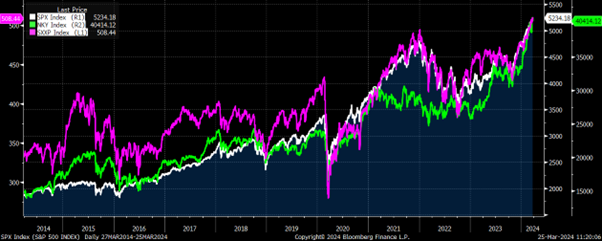
The SPX, Nikkei 225 and Stoxx 600 index all collectively reached record highs.

10-year price chart: S&P 500 Index, Nikkei 225 Index and Stoxx600 Index

Source: Bloomberg

Over the last fifty trading days, the SPX has closed at a 52-week high on 22 trading days.
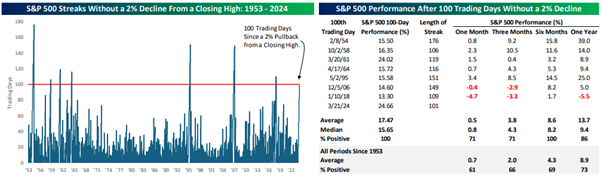
What’s particularly remarkable about the last four to five months, is the absence of even a minor pullback of -2% in the SPX (based on closing prices).

According to data compiled by our research provider, Bespoke Invest, since the inception of the five-day trading week in late 1952, there have been just seven other occasions when the SPX remained without experiencing a downturn of this magnitude for as long or longer. The most recent instance was in 2018, spanning 108 days, while the longest unbroken streak persisted for 176 trading days in 1954.

The table below outlines the SPX ‘s performance after each previous period during which it went 100 or more trading days without a -2% pullback. Given the extended duration without even a modest decline, one might expect the market to be poised for a more significant downturn.

However, this wasn’t generally the case.

Six months later, the SPX recorded gains on all seven occasions, with a median increase of +8.2%. Similarly, one year later, the median gain was +9.4%, with gains observed in six out of seven instances.

Source: Bespoke Invest

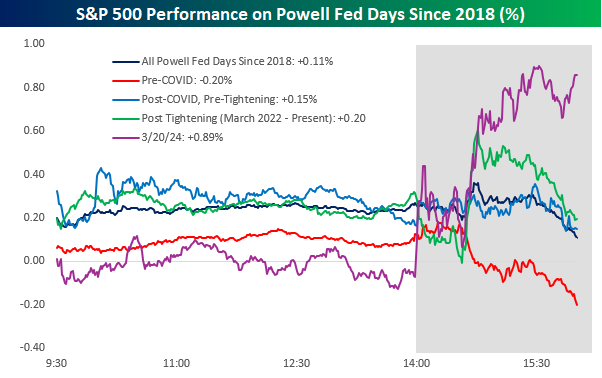
The way the market reacts to Fed Chair Jerome Powell’s comments may also be starting to shift.

Last week’s reaction to the Fed statement (purple line in graph below) also bucked the general long-term “Powell plunge,” on Fed days since he became Chair in 2018.

As shown below, whether you look at his entire tenure as Fed chair or break it up into different slices during that period, Powell has not exactly been a stock market whisperer.

With a gain of +0.89% for the SPX last Wednesday, it ranked as the 14th best single-day performance on a scheduled Fed Day, of the 48 days since Powell became Chair in March 2018.

Source: Bespoke Invest

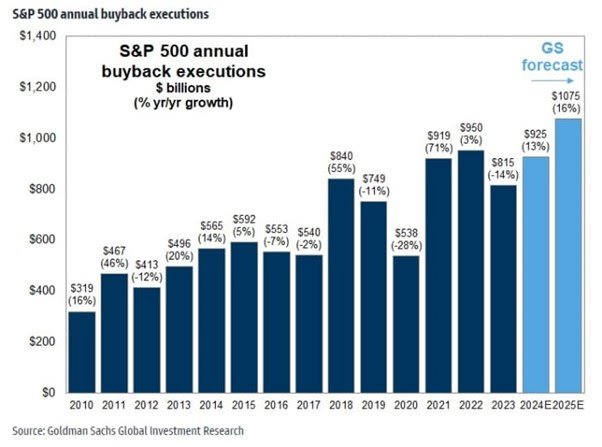
Furthermore, according to a memo from Goldman Sachs (GS), there’s a trillion-dollar impetus – share buybacks by companies – that underscore why the rally in US equities is expected to continue.

Goldman Sachs anticipates that US companies will engage in share buybacks exceeding $1 trillion for the first time in 2025, driven by robust earnings growth in the technology sector and more relaxed financial conditions, as the Fed considers reducing interest rates.

Analysts at GS forecast a +16% increase in share repurchases by SPX companies, reaching $1.08 trillion in 2025, following a +13% rise to $925 billion in 2024 (see chart below).

Companies typically repurchase shares when they feel optimistic about the future and perceive their stock price as undervalued. So, the buy-backs are a tailwind that will support the continued run of equities.

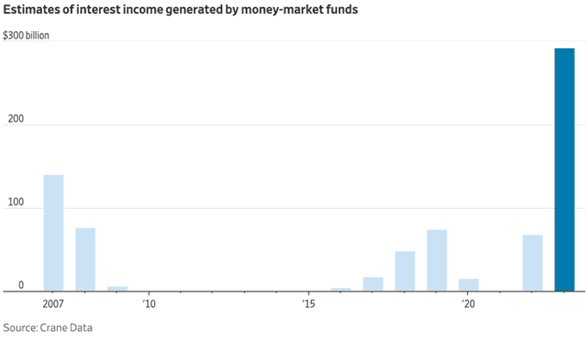
Additionally, in 2023, US households were net sellers of $57 billion in US equities, attracted by favourable cash yields, but the tide is expected to turn this year, with households poised to become net buyers, to the tune of $100 billion. While a May rate cut, at this point, is out of the question, the market is fine with that, if the ultimate direction of interest rates is still lower.

The prospect of the Fed easing alongside robust economic growth, is expected to prompt households to shift funds from the money markets into stocks. Currently, US money market assets under management owned by households stand at $3.8 trillion – the highest level on record and approximately $1.5 trillion above pre-pandemic levels.

Despite occasional turbulence stemming from monetary policy fluctuations, concerns about overvaluation, geopolitical tensions, or regulatory issues like those accompanying the recent decline in Apple’s stock price, China’s guidance to limit the use of US-made microprocessors and servers in government computers, there remains a steadfast demand for equities.

Markets and the Economy

In the latter half of 2023, as the US economy displayed resilience, and investors’ expectations for an imminent rate cut by the Fed were quickly dashed.

This disappointment coincided with the yield on the US 10-year Treasury reaching 5%, its highest level since early August 2007.

Equities suffered a substantial setback, shedding over -10% of their value during the three-month period from August to October, with the sell-off reaching its nadir on October 27, when the SPX hit the 4117 level.

The prevailing pessimism was palpable amongst many market participants and commentariat. For years, investors faced no alternative to stocks in an ultra-low interest rate environment.  With the Fed Funds rate at 5.25%, “T-Bill and Chill” – buy short term Treasury bills, earn over 5% and relax – became an investment strategy.

However, since then, a remarkable turnaround has occurred.

Despite the absence of a rate cut, the SPX has surged by +27% from its lows in October (as depicted in the table below). Huge revenue and earnings beat by Nvidia (NVDA) has led to an AI-driven boom, which is stoking demand and fostering a buoyant financial landscape.

As the market has continued its upward trajectory, sentiment on Wall Street has undergone a shift too. With numerous 2024 year-end targets being surpassed well ahead of schedule; major banks have revised their forecasts upward:

  • Société Générale (GLE) raised its year-end target to 5,500 from 4,750

  • Bank of America (BAC) recently increased its year-end forecast to 5,400, aligning with UBS, which adjusted its target to this level in February

  • In February, Goldman Sachs (GS) elevated its forecast to 5,200, marking its second upward revision since late last year. Last week, GS’s US equity strategist, David Kostin, argued for the possibility of the S&P 500 reaching 6,000 by the end of 2024, attributing this optimism to the relentless ascent of major technology companies

I must admit, when everyone gets bullish, I do start getting nervous. It’s often said that bull markets thrive on a “wall of worries” and falter amid excessive optimism.

Nevertheless, there are reasons for reassurance. The US economy continues to expand at a rate exceeding +2% annually, and the prospect of rates easing remains on the horizon

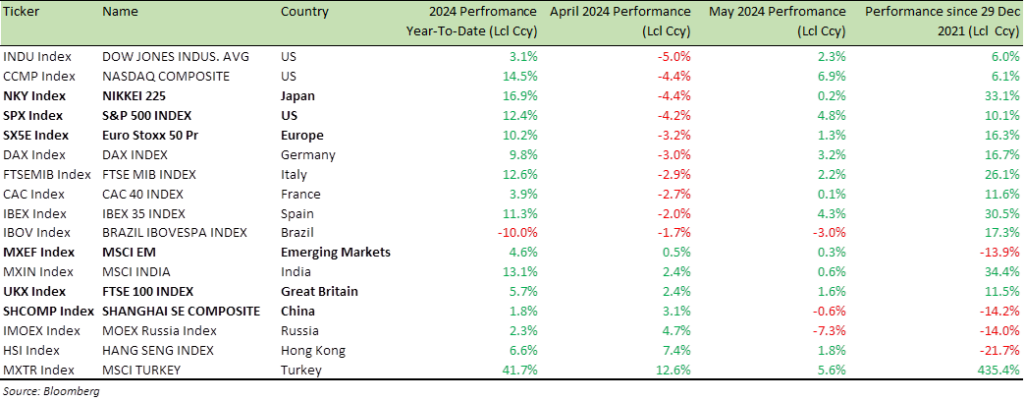
Global Equity Index Performance (2023; 2024 YTD and 27 Oct 2023-2024 YTD)

In a significant development, Japan’s unions secured an average salary increase of +5.28%, based on the initial results of Japan’s annual spring wage negotiations, as reported by the Japanese Trade Union Confederation last week. This marks a notable departure from the trend of the past decade, where the final annual increase never surpassed +2.4%.

In response to these shifts and amid signs of a potentially new era of stable inflation in Japan, the Bank of Japan (BoJ) made substantial changes to its monetary policies. After eight years, the BoJ ceased negative interest rates and began unwinding most of its unorthodox monetary easing measures. The main policy rate was raised to +0.1%, and explicit targets for the yield on 10-year Japanese government bonds were discontinued. Furthermore, the BoJ announced plans to halt the purchase of stocks and real estate investment trusts, indicating a reduction in commercial paper and corporate bond acquisitions.

For close to a decade, the BoJ has been renowned as the most accommodative central bank globally. Yet, the dynamics influenced by the pandemic, coupled with the BoJ’s unwavering dedication to lose monetary policies, have catalysed a surge in inflation within Japan. This inflationary trajectory has the potential to become self-perpetuating, particularly as labour force participation rates reach their peak, bolstering the bargaining power of labour and resulting in significant wage hikes.

However, despite these adjustments, the BoJ’s cautious approach remains evident. Monthly purchases of ¥6 trillion in Japanese government bonds will continue, emphasizing the central bank’s commitment to maintaining accommodative financial conditions “for the time being.” i.e. much likely won’t change in the short term.

Over the long term, the implications of positive interest rates in Japan could have far-reaching effects, influencing various aspects such as US mortgage rates and US Treasury yields.

  • Japanese individuals and companies have long been substantial investors abroad, actively seeking higher yields. As of the end of last year, Japan’s foreign portfolio investments amounted to approximately $4.2 trillion. A significant portion of this investment originates from Japanese pension funds and insurers, who may reassess their investment strategies if Japanese interest rates rise, finding domestic options more appealing
  • For example, Japanese investors currently hold approximately $1.1 trillion of Treasury bonds, positioning them as the largest foreign holders of US Treasuries. If Japanese interest rates become more favourable, these investors may opt to redirect more capital toward domestic investments, rather than maintaining their current allocations abroad

If US growth undergoes structural decline, leading to a narrowing of the yield advantage of many US assets, the impact of any rate rise in Japan will be significant.

The BoJ will probably pace its rate increases slowly: The past couple of years have, if anything, reaffirmed its reputation for moving slowly and deliberately. Moreover, while inflation is still high by Japanese standards,+2.2% in January, it has already cooled from the peaks of last year.

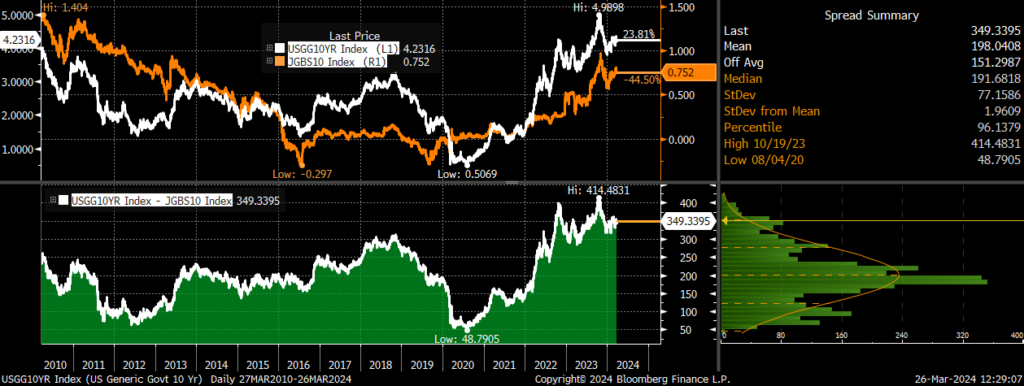
Japanese bond yields have picked up, but they are still substantially lower than in the U.S. The rate differential between 10-year government bonds in the U.S. and Japan stands at 3.5 percentage points (see chart below). This is significantly lower than the 4.2-percentage-point gap of a few months ago, but still way higher than the 1.5 percentage points of three years ago.

USGG10, JGB10 spread analysis

Source: Bloomberg

And what about the Japanese Yen?

At the press conference last week, BoJ Governor Kazuo Ueda reiterated the importance of maintaining accommodative conditions. Ueda emphasized that there is still a considerable gap for price expectations (inflation)  to reach the targeted +2%. While the move out of negative rates was hawkish at the margin, BoJ officials maintained their plans to keep policy easy. As a result of the actions and comments, the Japanese yen sold off on the news, and has continued to sell off.

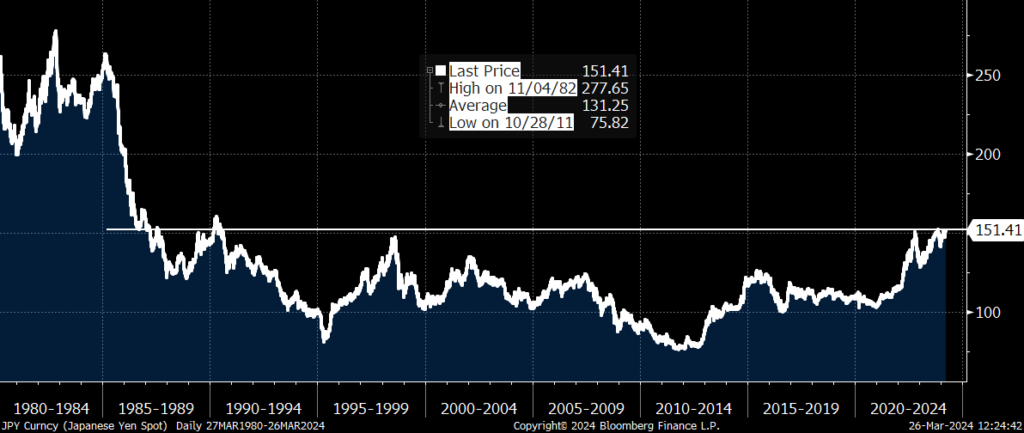
Taking a very long-term look at the yen, the roughly 152 resistance level has been in place for decades.  The yen also weakened (rising price in the below chart) towards those levels back in the late 1990s and late 1980s, before rallying.

If the yen does manage to take out that 152 resistance level in the weeks/months ahead, there would be very little resistance between here and 200, and that would likely have some pretty major macro ramifications for capital flows in Japan and around the world.

Japanese Yen spot rate: 1980 – 2024

Source: Bloomberg

Meanwhile, last week, China’s Shanghai Composite closed above its 200-day moving average, for the first time in more than six months.

This resurgence beyond the 200-DMA marks a notable shift in sentiment for the once beleaguered Chinese stock market. Despite this rally, the index continues to trade approximately 20% below its all-time high recorded in February 2021. One to watch.

As outlined in the January Market Viewpoints:

  • The current bull market began in October 2022. To surpass the duration of the next shortest bull market (March 2020 – Jan 2022), this one would need to persist until at least the end of July 2024

  • Looking to the Median: Post-WWII, the median bull market experienced a surge of +83.1% over 1,418 days. If we apply these medians to the current bull run, we could anticipate an SPX target of approximately 6,700 by late May 2026

Bull markets are periods of above average market returns. Something will knock the bull off course, but for now it remains on track.

A shift in interest rate projections, without a downturn in economy is likely to trigger a “catch-up” scenario for the majority of S&P 500 stocks, which have been held back by concerns about sustained high interest rates and consequently haven’t experienced as significant a rally as the mega-cap tech giants.

A further increase of over +10% in the SPX from its current level appears very feasible under these circumstances.

For specific stock recommendations and insights related to structured products, please don’t hesitate to reach out to me or your dedicated relationship manager.

 
Best wishes,

Manish Singh, CFA


“AI isn’t just about technological advancement; it’s a revolution in productivity and economic prosperity. Nvidia is at the heart of it.”

Summary

Nvidia (NVDA) is on the brink of becoming a colossus in the stock market, potentially eclipsing Microsoft with its staggering growth trajectory. In a whirlwind of financial success, Nvidia’s market cap recently skyrocketed to $2 trillion, a huge leap from its $1 trillion milestone just months ago in June. This surge is fuelled by back-to-back quarters of stellar revenue and earnings growth, that have the potential to double, treble or more from here.

At the heart of Nvidia’s meteoric rise is the transformative power of Artificial Intelligence (AI). AI isn’t just a buzzword; it’s the backbone of a new era, poised to reshape our future and redefine success for those ready to harness its potential. The next generation will grow up in a world built on AI, benefiting from the unprecedented democratization of data through large language models (LLMs). This isn’t just about technological advancement; it’s a revolution in productivity and economic prosperity.

While some draw parallels between the Crypto frenzy and Nvidia’s ascent, the comparison falls short. Crypto is based on nothing, but Nvidia stands on solid ground with $22 billion in quarterly revenues —a figure that’s only expected to soar.

On the macroeconomic front, the US Federal Reserve (the Fed) finds itself navigating the complexities of the AI-driven boom. This surge in AI investment is stoking demand and fostering a buoyant financial landscape, making it unlikely for the Fed to cut interest rates soon. Yet, the stock market doesn’t need to pin its hopes on rate cuts to climb. With US GDP growing at a robust +3% per annum and inflation in check, the stage is set for earnings growth to propel the S&P 500 beyond its current level.

Nvidia: The “Taylor Swift” of the stock market

In terms of popularity over the past year, only Nvidia (NVDA) and its Chief Executive Jensen Huang, can rival Taylor Swift. Just like Ms. Swift, NVDA keeps dropping banger after banger.

In just over a year, Nvidia has gone from being a company that got most of its business from chips designed for high-end videogaming, to an Artificial Intelligence (AI) powerhouse, valued at more than US$2 trillion.

In March of last year, while Taylor Swift embarked on her “The Eras Tour,” NVDA was embarking on its own journey – a rapid surge in sales of its semiconductor chips. NVDA’s stock began trading at $228 at the start of March; today, it sits at nearly $800.

Huang had a better year than Swift (if that’s possible!) While Swift reportedly earned around $1 billion, Huang, with his 3.5% stake in NVDA, raked in at least 40 times that amount.

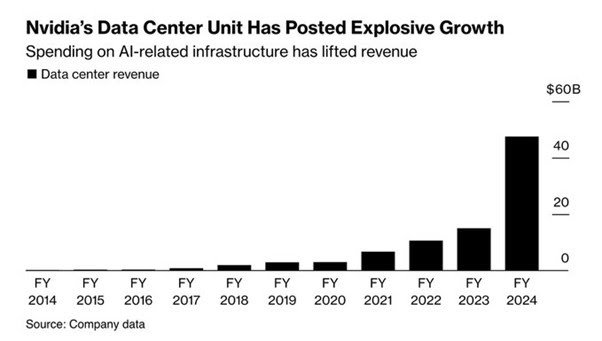
Nvidia’s quarterly revenue in Q1 2024 stood at $7.2 billion, a figure that soared to $22 billion in Q4 2024. Analysts are forecasting Nvidia’s annual revenue to jump to $110 billion by 2026, up from $59 billion in the fiscal year that just ended.

Not just the revenue, Nvidia’s profitability rates are outstanding too. At 50% for the year as a whole and nearly 58% on a quarterly basis, it’s a substantial leap from a 10% rate in 2022. For comparison, even in its prosperous years, Intel (INTC) typically achieved a profitability rate of around 30%.

Last week, Nvidia’s market capitalisation soared to $2 trillion, driven by yet another exceptional quarter of revenue and earnings growth. This achievement comes on the heels of Nvidia surpassing the $1 trillion valuation mark just last June.

Analysts are playing catch up, as they keep updating their 12-month target price on the stock of NVDA, every time it delivers stellar sales and earnings growth.

Back in 1993, at Denny’s Diner in San Jose, California, Huang, along with his co-founders Chris Malachowsky and Curtis Priem, laid out the plan for Nvidia. When Jensen told his mother he was making graphics cards for videogames, she asked him to get a real job. Fortunately, Jensen persisted in the hardware business, focusing on building Graphics Processing Units (GPUs), a decision that wasn’t without its challenges.

As a major player in AI chip technology, Nvidia stands as one of the largest stocks globally, benefitting from an unprecedented surge in demand for its graphics processing units (GPUs), crucial for training Artificial Intelligence (AI) models. The company’s fourth-quarter results underscored the ongoing robust spending on AI systems, as Nvidia races to keep pace with demand.

During the recent earnings call, Huang also mentioned that NVIDIA’s latest products will continue to be in high demand for the remainder of the year. He noted that despite the increasing supply, the demand has not shown any signs of slowing down. “Generative AI has initiated a new investment cycle and continued.” “The scale of future data centre infrastructure will double in five years, representing a market opportunity of hundreds of billions of dollars annually.”

We are still in the early days in AI.

Below is a comparison of Google search interest (the number of times people search for specific words or terms) for ChatGPT, AI, and Bitcoin. As shown in the chart, search interest for AI is still making new highs, so there’s no slowdown yet, but it hasn’t quite hit the fever pitch that Bitcoin hit around November 2017.

Source: Bespoke Invest

In my view, AI represents the next major trend in hardware, with the potential to generate substantial demand for years to come. Most software companies currently do not manufacture their own hardware, relying instead on large-scale hardware vendors like Nvidia to spearhead this revolution.

The advancements in AI-generated videos AI Generated Videos Just Changed Forever exemplified on platforms like YouTube, showcase the immense potential of AI. Nvidia benefits from both the AI used to create the videos and the image processing required to generate them.

Also, those comparing the Crypto craze to Nvidia, ought to bear this in mind – Crypto is based on nothing.  Nvidia is based on $22 billion/quarterly revenues that have the potential to double, treble or more from here. While stock prices may outpace earnings, Nvidia’s products will continue to evolve and expand.

Huang is definitely one of the true geniuses of his generation. Jensen’s mastery in monetizing software for Nvidia’s GPUs has propelled the company way ahead of competition, perhaps beyond the comprehension of most investors. Therefore, NVIDIA’s constant focus on maintaining strong chip and software performance to further solidify its position in the market. Jensen likes to say – “You’re always on the way to going out of business. If you don’t internalize that sensibility, you will go out of business.” Nvidia’s continued success rests on its visionary leader who no doubt applies the advice of Intel’s former boss Andy Grove – “Only the paranoid survive.”

NVDA has the potential to be the largest stock overtaking Microsoft and I suspect we will be talking about a $3 trillion market cap by mid-2025 (if not before).

Even savvy investors can become side tracked by fixating too heavily on Nvidia’s ban from selling chips to China.

Nvidia’s potential and runway in ex-China market, particularly in the realm of enterprise AI and related services is immense and dominant. Eventually the Chinese will get into high end chip production and will do to chip prices what they did to steel prices and solar panel – significant reduction in prices. Nevertheless, the demand for high performance chips is only set to accelerate.

Personally, I’m eagerly awaiting the advent of a personal AI robot outfitted with Nvidia chips. I envision being able to input a variety of data and receive answers to complex questions such as:

“It’s Sunday, I’ve got the children ready, is it safe to order Uber now? Or will my wife take another 30 minutes to get ready for lunch?”

“What do the children want for dinner tonight, considering they’ve already had spaghetti twice this week and declined pizza or chicken nuggets at lunchtime?” (It’s often challenging to get clear responses from them beyond “I don’t know” or “I’m not sure, Daddy.”)

I am hoping Nvidia will be able to help.

Markets and the Economy

After a record six straight better than expected reports, US Retail Sales for January, came up short relative to consensus forecasts. While economists were already expecting a modest decline in the headline report, the actual reading showed a decline of -0.8% relative to December.

Stripping out Autos and Gas, the results weren’t quite as weak, but they were still down. In terms of revisions, December’s headline reading was taken down to +0.4% from +0.6%, but there was no change to the ex-Autos and ex-Gas readings.

Although the January report was weaker than expected and a broad disappointment, heading into the report, the last six reports were all better than expected, which is a record, dating back to 1992.

Additionally, there have been some big swings in the January readings in the post-COVID period. The data shows that the consumer took a breather in January, but seasonal adjustments could have also exaggerated the weakness.

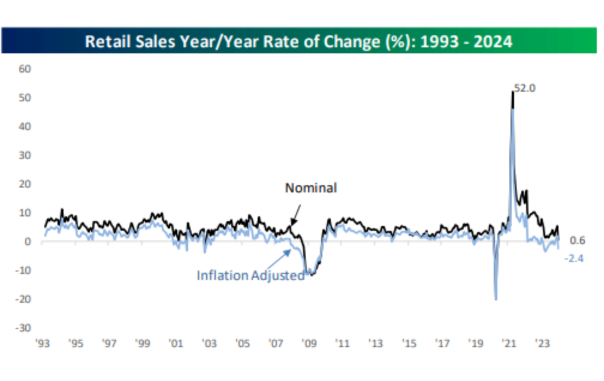
One notable trend, impacting the headline figures of Retail Sales in the post-Covid era, is inflation.

Illustrated in the chart below is the year-on-year change in Retail Sales, presented in both nominal and inflation-adjusted terms since 1993.

  • Following the peak of the COVID pandemic, both nominal and inflation-adjusted sales have experienced a decline, with the latter showing a more pronounced drop, even entering negative territory at one point in early 2023

  • After reaching a low point of -3.5% last April, inflation-adjusted sales saw a significant rebound to +1.9% in December. However, the January report reversed this momentum, indicating a decline of -2.4%

Source: Bespoke Invest

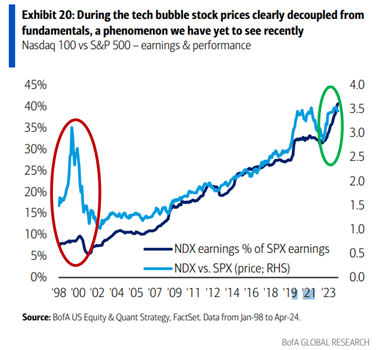
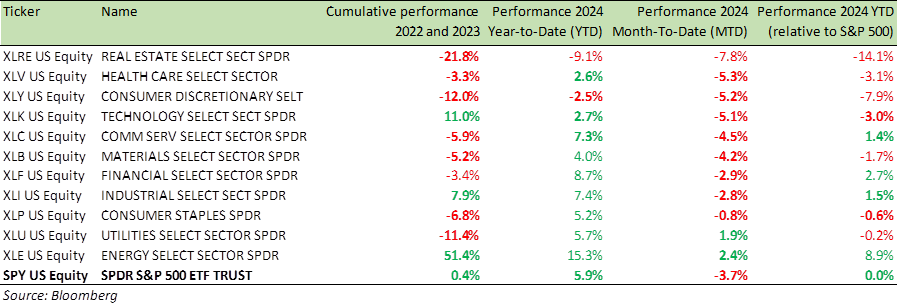
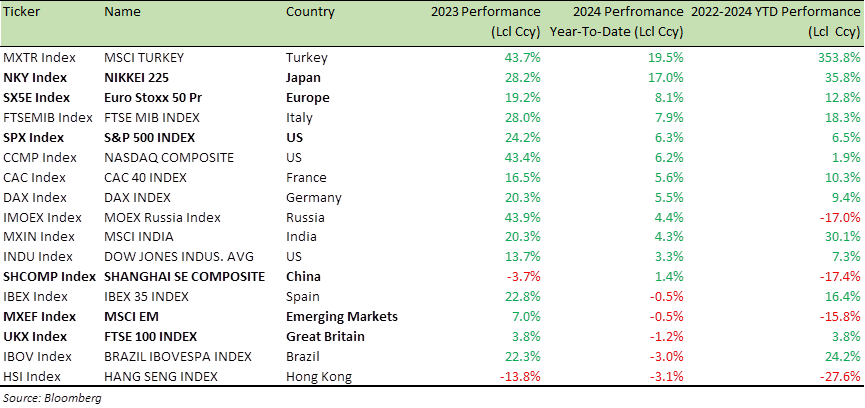
The Tech heavy NASDAQ index has continued where it finished last year. After a stellar +44% performance in 2023 (see table below), the index continues to move higher.

Last Thursday, the Nasdaq 100 gained more than +3% and closed at an all-time high. That hasn’t happened since March 22, 2000. Similarly, the S&P 500 (SPX) gained just over +2% and also closed at an all-time high. That hasn’t happened since March 21, 2000.

Benchmark Global Equity Index Performance (2023; 2024 YTD and 2022-2024 YTD)

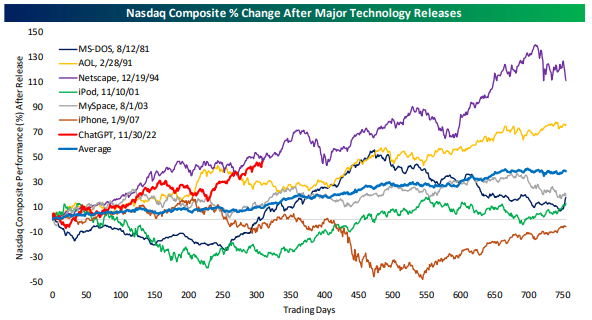
Given the significant and expanding popularity of AI and the performance of AI stocks overall, since the release of ChatGPT in late 2022, it’s natural to seek historical comparisons.

One emerging question among analysts, is whether the current trend resembles the early to mid-90s, during the infancy of the Internet boom, or the late 1990s, nearing the peak of the Dot-Com bubble. The chart below from Bespoke Invest, our research provider, examines the performance of the NASDAQ in the years following several major technological releases in modern history.

These include:

  • The debut of the first MS-DOS operating system for PCs in August 1981

  • The launch of America Online (AOL) in February 1991

  • The introduction of the Netscape web browser in December 1994

  • The unveiling of the iPod in November 2001

  • The emergence of MySpace in August 2003, and

  • The iPhone in January 2007

These milestones represented key advancements in personal computing, the internet, web browsing, digital media/smartphones, and social media.

Interestingly, the NASDAQ rally since the release of ChatGPT in November 2022, closely resembles the surge observed after the introduction of Netscape in December 1994.

As of now, we are 309 trading days after the release of ChatGPT, and the Nasdaq has risen by +46.07% during this period. Comparatively, in the 309 trading days following the launch of Netscape, the Nasdaq experienced a similar gain of +45.9%. The resemblance is strikingly similar.

Furthermore, the NASDAQ ‘s performance in the first 309 days after the release of AOL in 1991, also bears resemblance to the current trend since ChatGPT’s release.

In hindsight, the rally in the NASDAQ continued to gain momentum after the launch of AOL and Netscape, fuelling speculation that we might still be in the early stages of the AI boom. Time will tell.

Source: Bespoke Invest

In the earnings call last week, Nvidia Chief Executive Huang described AI as hitting “the tipping point” and indicated demand for the computing power that underlies AI remained astronomical. “Demand is surging worldwide across companies, industries and nations,” he said.

In my view, the current AI growth differs from the internet bubble era. With the abundance of data since the internet’s inception, we are witnessing the democratization of data and information through large language models (LLM), leading to improvements in productivity and economic growth.

AI is a very powerful technology, which will change the fortunes of those who set themselves up to benefit from it. AI will be what the next generation is raised on.

While AI will replace many jobs, humans will still be necessary for numerous tasks, ultimately leading to increased productivity and GDP.

AI has the potential to remove barriers to learning programming, potentially leading to a surge in productivity. Instead of mastering programming languages or relying on costly programmers, individuals can simply input text instructions and data into AI systems, which will then provide answers in plain English and develop software and applications tailored to specific industry need.

Meanwhile, the US Federal Reserve’s Federal Open Market Committee (FOMC) faces a significant and immediate macroeconomic challenge posed by AI –  The speculative investment and AI boom are driving aggregate demand and creating highly accommodative financial conditions.

Consequently, the Federal Reserve (the Fed) is unlikely to further ease conditions by cutting interest rates soon.

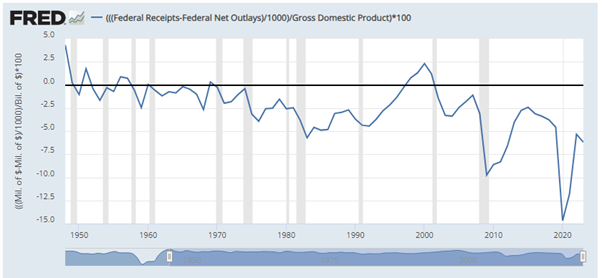
The US Federal budget balance as a fraction of GDP (1948-present)

Source: OMB; St. Louis Fed

Furthermore, with the economy currently experiencing robust growth (GDP growth of over +3%) and inflation remaining at +3%, the Fed could opt to delay a rate cut to the second half of the year.

It’s important to highlight that the US Government is currently in a phase of increased spending, which is contributing to economic growth. However, running a budget deficit of over 6.5% of GDP during peacetime (as indicated in the chart above) is a significant concern, albeit one to address later.

Below is the 18-month price chart for the S&P 500 (SPX), which traces back to the beginning of the current bull market in October 2022.

Whether you adhere to the principle of “the trend is your friend” or “don’t fight the tape” in trading, they essentially convey the same message. Presently, the directional trend in SPX continues to point upwards (see chart below).

18-month price chart: S&P 500 Index

Source: Bloomberg

It’s been a while since we discussed Crypto, so let’s take a look at how things are shaping up.

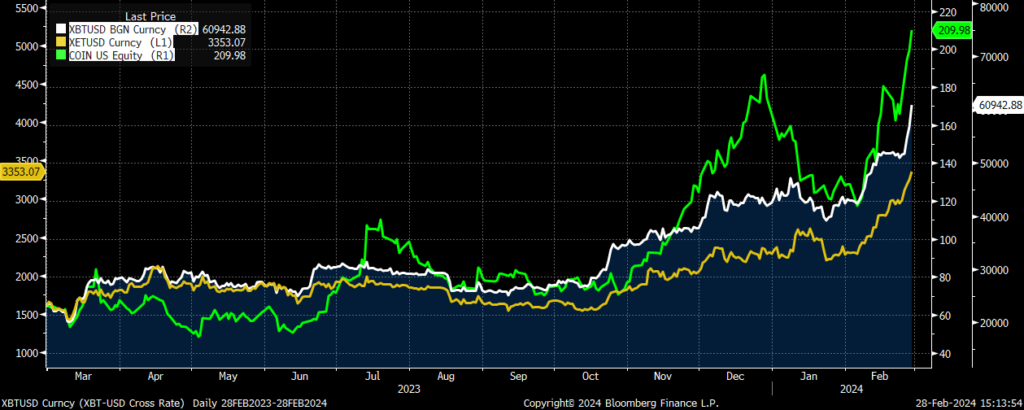
When the Bitcoin ETFs were initially launched on January 11 earlier this year, prices immediately dropped by more than -20%, resembling another sell-the-news event surrounding a Bitcoin milestone. However, in the past month alone, the largest cryptocurrency has surged by more than +40% (and +55% from the January sell-off lows, as shown in the chart below).

Bitcoin (XBT) is now just a little over 10% away from its previous all-time high. Could 2024 be the year for a new high in Bitcoin?

Even more remarkable than Bitcoin’s recent rally is Ethereum’s (XET) ascent. In the last month alone, the second-largest crypto has surged by +47%, surpassing even Nvidia Despite this impressive surge, Ethereum remains -30% below its November 2021 high of $4,800.

In a “gold rush,” selling “shovels” can be a profitable venture. Coinbase, an exchange for buying and selling cryptocurrencies, serves as a “shovel” in the Crypto “gold rush” and has experienced an impressive +55% rally over the last four weeks.

1-Year price chart: Bitcoin (XBT), Ethereum (XET) and Coinbase (COIN)

Source: Bloomberg

When considering the broader market, it’s essential to bear in mind the historical context referenced in last month’s Market Viewpoints, which I’m reiterating below.

“Looking to the Median: Post-WWII, the median bull market experienced a surge of +83.1% over 1,418 days. If we apply these medians to the current bull run, we could anticipate an SPX target of approximately 6,700 by late May 2026.”

Market volatility is a regular feature and should be expected. Short-term predictions for market movements can be notably challenging. Therefore, I emphasize the value of equity structured products as a highly effective way to invest in equities, serving to navigate and potentially benefit from heightened market volatility.

These products provide a certain level of capital protection, all the while aiding in the identification of favourable entry points in the market and offering opportunities to generate returns, even in a flat or negative market environment.

For specific stock recommendations and insights related to structured products, please don’t hesitate to reach out to me or your dedicated relationship manager.

 
Best wishes,

Manish Singh, CFA


Halloween season Inflation concept as Autumn pumpkin symbol with an upward leaning financial chart arrow representing rising Fall seasonal prices and the rising costs of taxes and expenses or higher credit debt as a funny jack o lantern.

“Inflation in the US is now back to the Fed’s target, Europe now boasts its own “magnificent five” – SAP, ASML, Siemens, LVMH, Total Energies”

Summary

US consumers were expected to roll over, but they have remained resilient and continue to spend. A year ago, consensus estimates strongly predicted a recession in 2023, forecasting meager +0.2% growth for the year. However, the actual outcome defied these projections, with the US economy expanding at +3.1% in 2023, more than four times faster than the +0.7% growth observed the previous year.

Supply expansion leading to price increases is more permanent than when it is driven by demand contraction because demand can rebound, and if supply doesn’t improve, prices can rise again. This is unlike what occurred in 1976, as the current situation sees supply increasing and prices falling. Inflation in the US is now back to the Fed’s target, and Fed Chair Jerome Powell and his team deserve credit for achieving this. The stage is set for the Federal Reserve to proceed with a 25-basis points rate cut at its March 20 meeting.

For an extended period, the European economy and equities have trailed their counterparts in the US. However, there are signs of a potential shift. Over the last five months, the Euro Stoxx 50 index has displayed significant momentum, with both the S&P 500 and Euro Stoxx 50 posting comparable gains.

The Euro Stoxx 50 is no longer weighed down by underperforming telecom and financial stocks; instead, growth sectors like technology and luxury now make up 20% of the index. Europe now boasts its own “magnificent five” – SAP, ASML, Siemens, LVMH, Total Energies – and these stocks have strong tailwinds due to their leadership positions in their respective sectors.

Returning to target inflation, and “Good news” is once again good news!

Contrary to expectations, the highly anticipated recession in the United States failed to materialize in 2023, and instead, the US economy exhibited robust growth, achieving a remarkable +3.1% expansion over the span of 12 months. A year prior, consensus estimates had strongly indicated an impending recession, projecting a meagre +0.2% growth for the year. However, the actual outcome defied these predictions, with the US economy surging at a pace more than four times faster than the +0.7% growth observed in 2022.

In the final quarter of 2023, the US Gross Domestic Product (GDP) exhibited an impressive +3.3% annual growth rate, surpassing the expected +2.0% rate and the +2.4% forecast by the Atlanta Fed’s GDPNow tracker, widely regarded as the gold standard for real-time GDP tracking. Instead of seeing a downturn in consumer spending, US consumers remained steadfast and continued to spend.

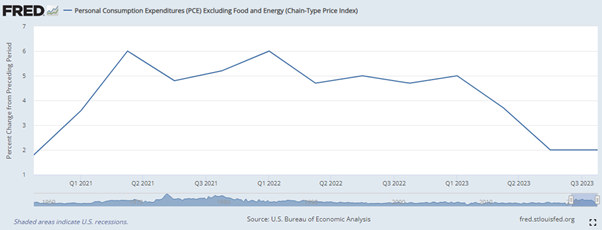
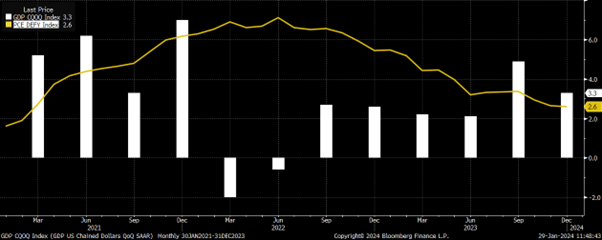
Arguably, one of the most noteworthy highlights from the recent quarterly National Income and Product Accounts (NIPA) data release is the core Personal Consumption Expenditure (PCE) prices, which saw a consecutive +2.0% quarter-over-quarter seasonally adjusted annual rate (QoQ SAAR) increase for the second time. Essentially, the quarterly GDP data, subject to potential revisions, demonstrates an almost precision-like return to target inflation, as illustrated in the chart below.

While US GDP maintains its growth trajectory, core inflation in the United States, as measured by the Personal Consumption Expenditure (PCE) index, is achieving the desired +2% growth rate.

US Core PCE back to +2% target.. for two straight quarters

A year ago, these numbers looked scary. Core PCE increased by +5.0% in Q1 and +3.7% in Q2.

Using the month-on-month data,

on a 3-month basis, core PCE is +1.52% p.a.

on a 6-month basis, core PCE is +1.86% p.a.

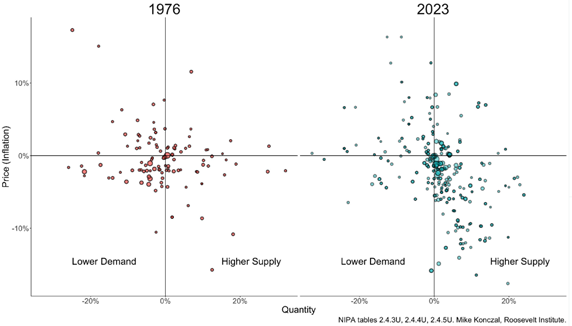
While some still fret about the potential resurgence of inflation, the chart below from the New York-based Roosevelt Institute, provides a compelling and optimistic perspective.

At a fundamental level, there are typically two primary explanations for the potential decline in price levels, which is synonymous with a decrease in inflation. The first involves expanding “supply,” while the second entails reducing “demand.”

In the scenario where demand is dwindling while supply is on the rise, it inherently sets the stage for a hastened decline in prices, potentially initiating a sequence starting with disinflation and ultimately progressing towards deflation.

  • In 2023, 71 percent of the weighted deceleration in prices was observed in categories where the quantity expanded, indicating a supply expansion
  • In contrast, back in 1976, 68 percent of the deceleration in prices occurred in categories where quantities were declining, signifying a decrease in demand
  • Supply expansion that leads to declaration in prices is more permanent than the one that is led by demand contraction as demand can come back again and if supply hasn’t improved, prices can start rising again. This is what happened in 1976 and isn’t happening now.

This time around it’s – supply is increasing, and prices are falling.

Price Indices for Personal Consumption Expenditures (PCE) by supply and demand of product

Source: Mike Konczal, Roosevelt Institute, New York

The noteworthy driver of disinflation is the substantial increase in supply, a phenomenon that is particularly pronounced in the core goods sector (with 87% of it attributed to supply expansion, according to research conducted by the Roosevelt Institute). This trend aligns with expectations, considering the growing accessibility of crucial raw materials, the opening of supply chains, and the expansion of semiconductor production.

Furthermore, when we examine recent GDP figures and reflect on historical data, as illustrated in the chart below, it becomes evident that inflation reached its peak during periods of negative GDP growth in Q1-Q2 2022. However, in the last two quarters, inflation has returned to its target levels, coinciding with a surge in economic growth.

The divergence between output growth and the price level, characterized by falling prices and rising growth, serves as a classic indicator of dynamic supply curves. It also provides a promising outlook for future price levels.

US GDP growth and Personal Consumption Expenditure (PCE)

Source: Bloomberg

Over the past week, we have observed a series of positive data points: robust GDP growth in Q4 2023, a US Manufacturing PMI at an 18-month high, an impressive 8% surge in new home sales in December, a seven-month high for US services PMI, an eighteen-month high for US consumer sentiment, and the S&P 500 (SPX) setting a record for the fifth consecutive day.

Historically, a flurry of positive developments in data often triggered concerns about potential monetary policy tightening, leading to market selloffs. However, it seems that this trend has shifted, and “good news” is once again being perceived as just that—good news. Let us hope that this trend continues.

The fabled “soft landing” is still on, as I wrote in the September Market Viewpoints, is still on track.

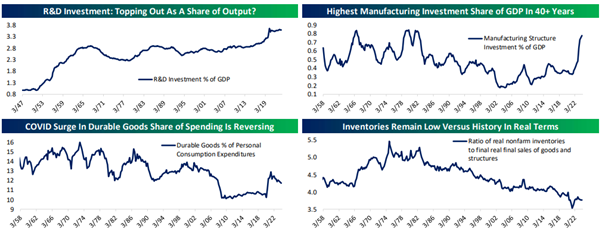
Few other data worth highlighting from the NIPA release.

  • Firstly, there has been a recent deceleration in research and development (R&D) investment. After experiencing significant growth in 2019 and 2020, R&D has stabilized, accounting for approximately 3.5% of the Gross Domestic Product (GDP)
  • Secondly, while investment in fundamental research has decelerated, the private sector is actively increasing its investment in the construction of manufacturing facilities. The investment in structures for the manufacturing industry is at its highest share of output in over four decades and continues to rise
  • On the consumption front, Americans are gradually reversing the pandemic-induced trend of heightened spending on durable goods. The surge in this spending category during the COVID shock, driven by limitations on service purchases, is gradually diminishing. This should have an easing effect on inflation as prices of durable goods are likely to fall further
  • Lastly, it is noteworthy that inventories remain considerably low in comparison to sales on a real basis. This indicates that there is potential for inventory restocking to act as a positive force for GDP growth in the next few quarters

Source: Bespoke Invest

In 2023, we witnessed a remarkable shift towards disinflation following a period of temporary inflation. Throughout this period, economic growth maintained its vigour, labour markets remained robust, and inflation regressed to its targeted levels.

However, it’s essential to note that despite the tightening measures and the deceleration in inflation implemented by the US Federal Reserve (Fed), the bedrock of strong economic growth has endured. In all fairness, the United States has effectively returned inflation to the Fed’s intended target, a commendable achievement attributed to Fed Chair Jerome Powell and his dedicated team.

Now, you might wonder why the Fed has not embarked on a path of interest rate reduction. In my analysis, their approach is rooted in pragmatism, stemming from the fact that the economy continues to exhibit resilience.

In 2021, the Federal Reserve chose to overlook significant price hikes in goods markets, and this approach has persisted into the latter half of 2023, even as they are now disregarding notable price declines, especially in the goods sector. Instead, their attention is focused on the services sector, where concerns regarding sustained inflation persist.

Fortunately, there have been discernible shifts in supply dynamics within the services industry as well. As highlighted in the earlier mentioned Roosevelt Institute report, a substantial 66 percent of the reduction in services inflation can be attributed to increased quantities. This development, in my perspective, brings encouraging news and lays the foundation for the Federal Reserve to consider a 25-basis point interest rate cut at its upcoming meeting on March 20.

Markets and the Economy

The past year has been marked by a whirlwind of activities, ranging from challenges in the banking sector and adaptive monetary policies to breakthroughs in AI, widespread labour strikes, and geopolitical tensions.

In the final two months of 2023, we witnessed a remarkable shift in risk assets as the “higher for longer” perspective gave way, and interest rate cuts were factored in.

Commencing at 3824, the SPX experienced a mid-year slump but rebounded with vigour, concluding the year at 4769, marking an impressive annual increase of +24%.

For the SPX, nearly 60% of the annual return in 2023 came during the last two months of the year. Other indices followed a similar pattern (see the table below).

Benchmark Global Equity Index Performance (2023; 2024 YTD and November-December 2023)

Following the US Presidential elections in November, the president-elect takes office on January 20 of the subsequent year.

Currently, we are in an election year, and the 2024 Presidential Election is rapidly approaching. At this juncture, it appears to be a rematch of the 2020 contest, with President Joe Biden now the incumbent.

While there is speculation about whether Biden will be the candidate, let’s set that aside for now and focus on what an election year typically means for the markets.

Below is a summary of the performance of the SPX during Presidential election years since World War II:

Throughout these years, the SPX has generally traded somewhat flat in the first quarter, followed by a rally until the end of the summer. This rally tends to decelerate in the immediate lead-up to the election in November. However, the consolidation is often compensated for in the final months of the year, resulting in the index finishing with an average gain of +6.8% for the year.

Source: Bespoke Invest

When breaking down market performance based on the incumbent President’s party, periods when a Democrat is in charge, like the current one, have tended towards stronger results, with an average gain of +10.1% by the end of the year.

In contrast, years with a Republican incumbent administration have shown an average gain of +3.9 However, there is an important caveat here.

There was a significant -38.5% decline during George W. Bush’s second term when the SPX fell amidst the Global Financial Crisis (GFC) in 2008. An outlier data point in statistics speak.
When excluding this outlier data from Bush II’s second term, the Republican average full-year gain of +8.66% narrows the gap significantly with the previously mentioned Democrat average of +10.1%.

In other words, election years end up with good returns. Let’s see what 2024 will bring!
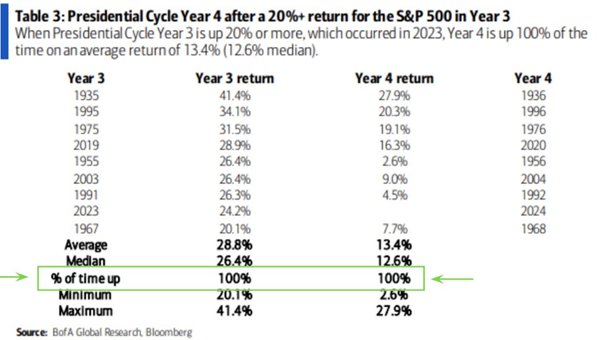
And if you need more convincing then consider this stat – the SPX has never been negative in the fourth year of the Presidential cycle following a +20% gain in a pre-election year. Notably, we had a +24.3% gain last year (see table below).

Moving on to Europe.

It’s no secret that the European economy and equities have lagged their counterparts in the US, and the data supports this observation.

Over the past decade:

  • US GDP has expanded by a robust +60%, whereas the Euro area has seen a more modest growth of +15%
  • On a price return basis during the same period, the SPX has surged by +175%, while the Euro area’s flagship index, Euro Stoxx 50 (SX5E), has experienced a more modest increase of +54%

However, there are signs of a potential shift. In the last five months, the Euro Stoxx 50 index has shown significant momentum, with both indices posting comparable gains.
In the recent week, the Euro Stoxx 50 index recorded an impressive +4.2% surge, achieving its highest closing since February 2001, although it remains -15% below its peak in March 2000.

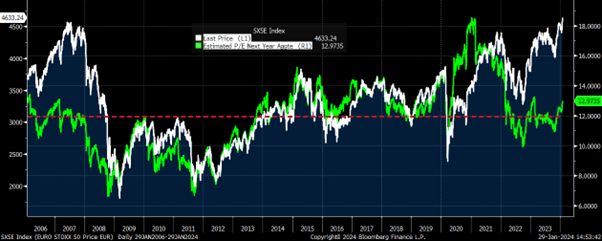
  • In April 2021, the 12-month forward price-to-earnings (P/E) ratio was at 18.4x. Subsequently, the P/E multiples have decreased to 13x, while the price level has risen by +20%. This suggests that the recent rally has been propelled by robust earnings growth, signalling potential continued strength in the future
  • With a forward P/E of 13x, the Euro Stoxx 50 remains relatively inexpensive, trading at a -33% discount to the SPX

Also, it is worth noting the transformation in the composition of the index that is driving the rally.

In 2000, before the dotcom bubble burst, the top 3 stocks were Deutsche Telecom (10.8%), Nokia (9.8%), and France Telecom (7.2%), accounting for 28% of the index.

Over the past decade and beyond, the dominance of telecom and banks as top constituents by weight has impeded the performance of the Euro Stoxx 50. However, today, the top 3 stocks are ASML (10%), LVMH (6%), and SAP (5%), reflecting a dramatic shift with dominance of growth sectors – technology and luxury, now constituting over 20% of the index. This shift strategically positions the index to continue to capitalize on growth opportunities in sectors anticipated to demonstrate resilience, sustained growth, and more favourable valuations.

ASML, the global leader in lithography machine needed to manufacture semiconductor chips and LVMH, the world’s biggest luxury group and owner of brands including Louis Vuitton, Christian Dior, Tiffany etc. alone have contributed almost a third of the index’s overall return since post financial crisis bottom of March 2009 (with ASML entering the index only in 2012). Over this period, ASML’s market capitalization has surged from €6 billion to €320 billion, and LVMH’s has risen from €40 billion to €778 billion This underscores the significant impact and growth of these key players in shaping the performance of the Euro area index.

Since the bottom in March 2009, over half the gains in the index can be attributed to just five key names: ASML, LVMH, SAP, Siemens, and Total Energies.

Europe now has its own “magnificent five” – SAP, ASML, Siemens, LVMH, Total Energies and these stocks have great tailwinds thanks to their leadership positions in their respective sectors.

Euro Stoxx 50 (SX5E Index) price chart and forward price/earnings (P/E)

Source: Bloomberg

The European Central Bank (ECB) is expected to make its next move by implementing a rate cut, with April being the more likely timeframe, as inflation is showing improvement. With impending rate cuts on the horizon and a well-balanced index featuring the “magnificent five” on the rise, the SX5E holds promising potential for further upward movement. It is positioned to continue its ascent and potentially reach its all-time high level of 5464, achieved on March 6, 2000.

Current trends suggest that investors are anticipating a significant easing of Fed policies, with six to seven rate cuts expected, aiming for a mid-3% Fed Funds Rate by year-end. This outlook is more dovish compared to the Fed’s own projection of three rate cuts. Investors seem to be anticipating a milder approach.

Historical data sheds light on how aggressive recent tightening measures have been, with the Real Fed Funds Rate currently at +2.4%, significantly above the historical average of +0.89%. The Fed’s mission to curb inflation to +2% is closely linked to stabilizing the labour market, and this strategy is showing signs of effectiveness. US job openings, as measured by JOLTS data, have decreased by over +25% from their peak, indicating a shift towards the Fed’s objectives.

If the SPX continues to align with historical election cycle patterns, we are likely to witness the continuation of a bull market that is still in its growth phase, without any signs of a mid-life crisis.

  • Historical Context: Comparatively, in the post-WWII era, only a few bull markets have been shorter than our current run, which is not yet ready for historical benchmarks. The current bull market began in October 2022. To surpass the duration of the next shortest bull market (March 2020 – Jan 2022), this one would need to persist until at least the end of July 2024.
  • Growth Comparison: Despite only rising by +36% up to January 2024, this bull market’s growth is considered modest. Nevertheless, if it endures, it could outperform those that were both shorter and less robust.
  • Looking to the Median: Post-WWII, the median bull market experienced a surge of +83.1% over 1,418 days. If we apply these medians to the current bull run, we could anticipate an SPX target of approximately 6,700 by late May 2026.

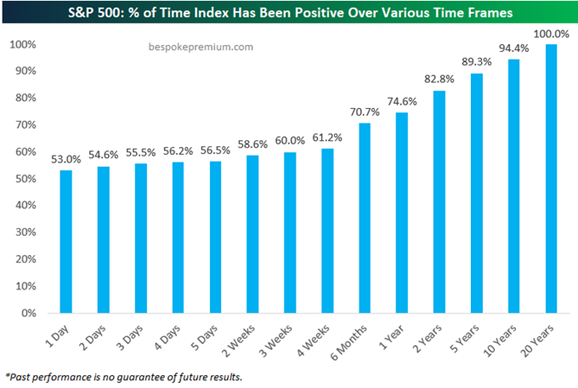
Market volatility is a regular feature and should be expected. Short-term predictions for market movements can be notably challenging. However, over the long term, markets often follow predictable patterns. This is due to the fact that a more extended holding period increases the likelihood of capturing the full market cycle.

The chart below emphasizes this point, demonstrating that the longer your holding period, the more advantageous your position becomes. A long-term investment horizon proves to be the most effective strategy for navigating and enduring market volatility.

Source: Bespoke Invest

The cycle of rising interest rates appears to have concluded, and the prospect of rate cuts soon, is on the horizon. This transition may introduce a period of increased volatility as market participants begin to factor in the potential for a recession.

Therefore, I emphasize the value of equity structured products as a highly effective way to invest in equities, serving to navigate and potentially benefit from heightened market volatility. These products provide a certain level of capital protection, all the while aiding in the identification of favourable entry points in the market and offering opportunities to generate returns, even in a flat or negative market environment.

For specific stock recommendations and insights related to structured products, please don’t hesitate to reach out to me or your dedicated relationship manager.

 
Best wishes,

Manish Singh, CFA

The S&P 500 advanced +8.92% during November, putting in its best monthly showing in 18 months. The rally also extended to bonds, as yields continued to fall. What next?

Summary

November has been a great month for risk. For over 5 weeks now, the US stock market, along with most other asset classes, has been on a rally. The S&P 500 advanced +8.92% during November, putting in its best monthly showing in 18 months. The rally also extended to bonds, as yields continued to fall. It seems, nobody is taking seriously Federal Reserve Chair Jerome Powell’s warning that it’s “premature” to start talking about interest rate cuts.

The S&P 500 is now -5% from its all time high of January 3, 2022, and its total return index (which takes into account dividends) is merely -1.1% away from its previous all-time high.

Meanwhile in Europe, the EuroStoxx 50 has hit a 52-week high, and is inching close to its all-time high of July 2007.

Looking ahead to 2024, one theme that stands out to me is the influence of Chinese Apps on US and European consumers as well as the price dynamics.

Chinese companies that have thrived and beaten competition in a market of 1.4 billion people, often find it comparatively easier to outpace competitors in European markets with considerably smaller populations of 30- 50 million. While cultural disparities exist, the universal truth remains: Low price combined with high quality, equals an increased market share. This dynamic is already evident in the automotive manufacturing industry where Chinese cars are competing strongly on both pricing and quality.

At this point last year, as I peered into the upcoming year and put down my end of year target for the S&P 500, I had anticipated a +12% increase for the index in 2023. However, we’re currently on a trajectory for a +20% increase for the year. Glancing forward to next year, even if there is to be a recession in the US (which I believe will be a mild one), I forecast the S&P 500 surpassing 5,000 by the close of 2024, indicating a +10% rise.

An early Santa Claus rally; disinflation in 2024 (and beyond)

The holiday season is almost upon us and it’s good to see a consistent sea of green on Bloomberg screens over the last few weeks.

Very soon, it will be high season for holiday shopping. My rule for holiday shopping is – wait until January. Sadly, it never works.

My two kids have kicked off the festive season by penning letters to Santa and crafting lists of their desired gifts. I can handle that much. What gets me a bit flustered, though, is the recent tradition of “elf on the shelf.”

If your kids have outgrown this tradition or aren’t interested in the whole “elf on the shelf” affair, count yourself lucky and feel free to skip ahead to the equity market discussion below.

For the uninitiated, the elf on the shelf is a toy elf that keeps a watchful eye on children’s behaviour, reporting back to Santa every night from its perch on the shelf. Each morning, it magically relocates to a new spot in the house, and the kids eagerly search for its new position.

One nerve-wracking incident this week had me jolt awake at 4 am—I had forgotten to move the elf before calling it a night.

Already guilty of a similar slip-up, I had already used the “bad weather hindered the elf’s journey back to the North Pole” excuse. I can’t use that one again! Well, the great British weather might excuse it, but I’d rather not raise any doubts, if you catch my drift.

Those that have promoted this practise seem to believe it’s good way to keep kids in line during the holiday season. I say to them – I too had something like this watching my behaviour and keeping me in line when I was a kid. I called him Dad.

Anyway, back to the markets!

The yield on the benchmark 10-year US Treasury bond is now at +4.1% (chart below), down from +5% – its highest yield since 2007 – only one month ago.

US Yield curve from 1 month to 30 years: Current and 2 months ago

Source: Bloomberg

The sharp rally in the bond market is fuelled by the growing anticipation of forthcoming US interest rate reductions in 2024. Currently, US interest-rate futures are indicating an approximate 125 basis points (where 100 basis points equal 1%) decrease in fed fund rates for the upcoming year.

The 2-year yield, which typically mirrors shorter-term interest rate projections most closely, continued its decline, hitting +4.5% earlier this week, down from its peak of +5.25%, six weeks ago. Despite the US Federal Reserve (Fed) having increased its federal funds rate by 525 bps since March 2022, it has abstained from raising rates in three out of its past four meetings.

There is no expectation for a rate hike at its meeting scheduled for December 13 next week.

On November 28, Fed Governor Christopher Waller said that if inflation continues to decline in the coming months, the Fed will likely start cutting rates. “There is no reason to say we will keep it really high,” Waller said during an event at the American Enterprise Institute.

November has been a great month for risk. For over 5 weeks now, the stock market, along with most other asset classes, has been on a rally.

The S&P 500 (SPX) advanced +8.92% during November, putting in its best monthly showing in 18 months. The only other stronger months since the COVID pandemic, were April 2020 and November 2020. The rally also extended to bonds, as yields continued to fall. It seems, nobody is taking seriously Fed Chair Jerome Powell’s warning that it’s “premature” to start talking about rate cuts.

The SPX is now -5% from its all time high of January 3, 2022. However, if you take into account dividends, the SPX total return index, is almost at the brink of setting new record highs. The total return index is merely -1.1% away from its previous all-time high.

Moreover, the SPX pattern closely resembles a cup and handle (see chart below), a configuration that technical analysts view as a bullish indicator.

New highs in 2024? Well, wouldn’t that be welcome after a gap of 2 years!

S&P 500 Total Return Index (SPXT): 5-Year price chart

Source: Bloomberg

Looking ahead to 2024, one theme that stands out to me is the influence of Chinese Apps on US and European consumers, as well as the price dynamics.

If you’ve followed the development of the Chinese economy over the last three decades, then you’ll know that what happens in China doesn’t always stay in China. China has a long history of upending trends.

A prime example is when China unilaterally devalued its currency from 5.8 RMB/USD to 8.7 RMB/USD. This decision largely flew under the radar for many investors due to China’s limited global economic influence at the time. Currency devaluations don’t swiftly affect economies; it takes time for supply chains to adjust, and corporations typically hedge their foreign exchange exposure for several years. The impact of China’s devaluation in late 1994, took three years to impact its trade rivals. Subsequently, in 1997, the Thai Baht was forced to devalue, setting off a series of events that led to the Asian financial crisis, leaving a lasting impact on those who witnessed it firsthand.

Last week, I was on CNBC to discuss PDD Holding’s (PDD – principally agriculture focused commerce platform in China and the now uber-popular e-commerce platform Temu in North America) earnings, and China consumer stocks. Here’s a short clip from that interview

Notably, Chinese e-commerce entities have gained substantial traction in China (Covid-19 accelerated the e-commerce trend in China) and they are now expanding vigorously in the US and Europe.

It’s a great time for Chinese apps, as both Western and Chinese consumers share a common desire for seeking attractive “bargains” when making purchase. While the Western consumers grapple with the ongoing “cost of living” crisis, Chinese consumers face a decline in “property wealth,” due to China’s economic shift away from property-driven growth.

Chinese companies that have thrived and beaten competition in a market of 1.4 billion people, often find it comparatively easier to outpace competitors in European markets with considerably smaller populations of 30- 50 million. While cultural disparities exist, the universal truth remains: Low price combined with high quality equals an increased market share.

This dynamic is already evident in the automotive manufacturing industry where Chinese cars, competing strongly on both pricing and quality, are challenging and surpassing esteemed German manufacturers, leaving them struggling to keep up.

Chinese manufacturers who have been selling on platforms such as Tmall, Shein, or Pinduoduo (PDD) have a significant background in producing goods for foreign brands. These sellers are now venturing into establishing their own brands. This transformation is motivated by a desire for autonomy and the promise of higher profitability.

Back in 1994, China’s GDP was one-third the size of the US. However, today, China’s economy has grown to be as substantial as, if not larger than, that of the US, especially on a purchasing power parity (PPP) basis. Consequently, China’s influence on the rest of the world has become more rapid and significant.

Temu, PDD’s overseas initiative launched in the US in September 2022 and is now available in 48 countries, including across Europe and the Middle East, as well as South East Asia and Australia.

Much like during China’s rise to manufacturing dominance over two decades ago, China’s prowess in the App-driven economy, leveraging its vast internet user base for testing preferences and optimizing AI models, is poised to disrupt daily consumer goods markets globally. They’re also getting smarter and learning from challenges faced by Chinese companies in the West. Both Shein and Temu have sought to avoid the kind of scrutiny TikTok has come under by attempting to mark a distance from their Chinese roots. In 2021, Shein changed its parent company from a Hong Kong-registered firm to a Singapore-incorporated entity. Temu is based in Boston and runs its U.S. business through a Delaware-based company.

In a nutshell – more choice, and lower prices for consumers in US and Europe.

China’s hard working culture that values math and science, is far outpacing the western world and helping China develop better apps. Meanwhile, the West is busy glorifying wealth through celebrities, and kids aspiring to become “social influencers,” entertainers, or sports stars, evident in the exorbitant salaries paid in these fields. Even an assistant football coach at a US university can command a multi-million dollar salary. The diligence and dedication to quality education that propelled the US and the West to their peak, have lost momentum. This drive has shifted towards nations – China and India in particular, that still champion hard work, scientific education, and perseverance.

The transformation initiated by Chinese manufacturers selling on Amazon post the 2008 financial crisis has evolved, bringing Chinese companies directly into Western households through their Amazon-like platforms. The evolving landscape of Chinese consumer apps demands close attention for potential impacts on the Western market in the years ahead.

Markets and the Economy

With inflation back on target in the short term, economic data looking unimpressive, and very weak foreign conditions in China and Europe, the Fed Funds Rate is looking increasingly tight, relative to what the US economy needs.

Chair Powell’s exhortation this week that “it is premature….to speculate on when policy might ease,” seems to have fallen on deaf ears as the market is correctly betting on interest rates have gone from easy to too tight.

As a result, over recent weeks, we have seen a robust rally in equities across the globe (see chart below).

The SPX is on track for a +20% year.

While most equity markets have performed well this year, there have been exceptions, particularly in China and the Emerging Market index, where China holds significant weight.

Benchmark Global Equity Index Performance (2022; 2023 YTD and November 2023)

In 2024, closely monitoring the US labour market will be crucial, given that a key hallmark of a recession, involves a decline in overall payrolls and an increase in the unemployment rate.

Throughout 2023, US payrolls continued to expand, although at a slower pace compared to 2022.

In 2022, job growth stood at a robust 410,000 per month. During the initial half of this year, job growth averaged 250,000 per month, while over the latter six months, the rate dropped to 180,000 per month i.e. a slowing trend.

Furthermore, we are seeing the first signs of a growing slowdown in the jobs market. The US job openings as measured by US Job Openings and Labor Turnover Survey (JOLTS), fell to their lowest level in more than two-and-a-half years in October. Business advertisements for job vacancies dropped from 9.6 million in September to 8.7 million in October, below the consensus forecast of 9.3 million. Job openings serve as a reliable gauge of labour demand.

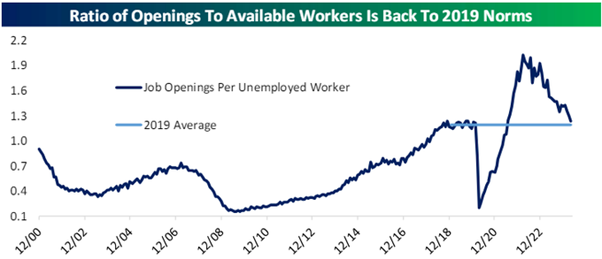
Chairman Powell often references the ratio of job openings to unemployed workers, as a favoured metric for assessing labour market tightness. This ratio had previously reached as high as 2.0 (two openings per unemployed person) but has now retreated to 1.34, nearing the pre-pandemic range of 1.2 to 1.25, and declining rapidly.

Interestingly, the JOLTS data appears to be closely linked to movements in the SPX. Where JOLTS trends, the SPX tends to follow (see chart below). However, a rate cut could potentially alter this trajectory entirely.

US Job Openings and Labor Turnover Survey (JOLTS) and S&P 500 – 20 Year Price chart

Source: Bloomberg

Meanwhile in Europe, the EuroStoxx 50 (SX5E) has hit a 52-week high and is inching close to its all-time high of July 2007. Despite a rapid rise in short-term interest rates by 450 basis points in 14 months, from -0.5% in June 2022 to +4.0% in September this year, both the SX5E and the German equity benchmark DAX have shown substantial gains.

The DAX has soared +12.6% in last 6 weeks alone.

In 2023, Europe experienced a mixed bag – averting an energy crisis over the winter, but facing disappointing GDP growth since the spring. Consequently, private consumption remained subdued, while investment continued relatively strong.

November saw a decline in inflation in the Eurozone to +2.4%, down from 2.9% the previous month, edging closer to the ECB’s 2% inflation target, and all but confirming that the ECB’s rate hiking cycle is over. Among the EU bloc’s largest economies, annual inflation fell in Germany to +2.3%, France to +3.8%, Italy to +0.7% and Spain to +3.2%, according to EU-harmonized data. A rate cut in the Eurozone looms.

With wage growth in the Eurozone now outpacing prices, consumers’ purchasing power is set to be enhanced. The combination of increased consumer spending power and a potential rate cut, could provide further upward momentum for the SX5E.

If you ever saw a “cup and handle” bullish chart then this has to be it. A rather deep cup you may say, which has been 18 years in the making.

EuroStoxx 50: 20-year price chart

Source: Bloomberg

Over the past six weeks, prices of high yield bonds have surged, driven by a combination of declining rates and reduced spreads. The US high yield index has risen by +6% during this period (see chart below)

While yields for European high yield bonds, still exceed the levels observed at the height of the bull market, they have trended downwards in 2023. September saw yields around +7%, a notable decline of about +3% from the elevated levels at the close of 2022.

Further boosting confidence among investors in high yield assets was a recent adjustment in US GDP data, revealing slower inflation than initially estimated for the third quarter. The revision downward by -0.1% in the Personal Consumption Expenditure (PCE) price index, which the Fed favours as its inflation gauge, now stands at +2.8%.

With inflation in check, the Fed has more flexibility to react to growing risks in GDP growth, potentially allowing for rate cuts without concerns of fuelling inflation. The focus has now shifted to the timing and scale of these cuts rather than debating their possibility, let alone the risk of hikes. This positive outlook bodes well for high yield bonds.

While the US and European high yield markets have experienced optimism, the Asia-Pacific region hasn’t mirrored this positivity. The ongoing crisis in the Chinese real estate sector, historically a key driver of high yield activity in the region, has significantly impacted high yield issuance across the Asia-Pacific.

The Bloomberg US Corporate High Yield Bond Index: 1 Year price chart

Source: Bloomberg

In last December’s Market Viewpoints, as I looked forward to 2023, I emphasized the importance of focusing on the medium term to navigate through short-term volatility

I wrote:

“A focus on the medium term will spare you the anxiety of short-term volatility. In this sell-off, the SPX bottomed at 3600 in June [2022] and here we are end of the year, with the SPX at 4,000. Central banks can change the narrative without any warning. It can lead to a shallower recession (or a recession avoided). If you turn bullish when everyone else is bullish, then you are buying late in the cycle. There is an opportunity cost to it which accumulates over time. Instead, I recommend you focus on market internals and invest in tranches over time. My end-of-2023 target for the SPX is 4,290.”

I was expecting 2023 to be a +12% year for the SPX. Instead, we are on track to have a +20% year, with the SPX currently at 4565.

So, what’s my target for the SPX for next year, you ask ?

Looking ahead to next year, even in the scenario of a US recession, I anticipate the SPX to reach over 5,000 by the end of 2024, marking a +10% year.

As this year comes to a close, I’d like to express my gratitude for your time and attention.

Wishing you and your loved ones a joyous holiday season and a Happy New Year. For those celebrating Christmas, I hope it’s a fantastic one filled with warmth and happiness.

 
Best wishes,

Manish Singh, CFA


Halloween season Inflation concept as Autumn pumpkin symbol with an upward leaning financial chart arrow representing rising Fall seasonal prices and the rising costs of taxes and expenses or higher credit debt as a funny jack o lantern.

There’s nothing spooky about the recent equity market sell-off, we are peak rates, inflation is coming down fast.

Summary

US GDP grew at the annualised rate +4.9% in Q3 2023, a notable improvement from the +2.1% in Q2. Arguably, one of the most noteworthy highlights from the GDP data, was the significant decline in core PCE (Personal Consumption Expenditure) inflation. The Core PCE increased by +5.0% in Q1, +3.7% in Q2, but then markedly slowed to +2.4% in Q3. This brings it much closer to the +2% target set by the US Federal Reserve. This combination of diminishing price hikes and a resilient economy, augurs well for the prospect of a soft-landing scenario in the US, whereby inflation recedes without triggering a recession.

The S&P 500 is down -10% from its July high. Many stocks are not overvalued, and a significant portion of them have experienced no growth over the past 12-24 months, due to the notable rise in interest rates. In fact, at present, there are only two sectors – communication services and technology – that have outperformed the S&P 500 in the last twelve months.

As per the American Association of Individual Investors (AAII) survey, bearish sentiment has surged by 8.6 percentage points in just one week, marking the most substantial weekly increase since February. The bearish sentiment now surpasses the bullish sentiment by a margin of 13.9 percentage points, which is the widest gap seen since May.

We are now at peak interest rates this cycle and rates are headed down from here. This seems to align favourably for a Q4 rally in equities, consistent with historical seasonality trends. There’s nothing spooky about the recent equity market sell-off. It should not unnerve investors who maintain a thoughtful, medium to long-term investment approach.

“Spooky” equity markets?

Ah, Halloween!

In the 1970s, an experiment sought to determine whether Halloween trick-or-treaters would indulge in taking more candy than allowed, from an unattended bowl.

Predictably, the findings indicated that indeed they did. However, when researchers positioned a mirror next to the candy bowl, children were less inclined to overindulge. Evidently, catching a reflection of themselves heightened their self-awareness, subsequently promoting a greater sense of responsibility and honesty.

So, consider incorporating a mirror into your Halloween decor this year, if you plan to leave an unattended candy bowl at your doorstep.

There’s a valuable message for elders as well: Occasionally, take a moment to reflect on yourself. It will foster greater honesty and responsibility and a reduced inclination to blame others.

Moving on to markets…

With the NASDAQ down -11% and the S&P 500 (SPX) down -9% over the last 12 weeks (see table below), you could say that stocks are already spooked leading into Halloween.

What’s next – trick or treat?

Let’s look at the individual investor sentiments first.

One of the most dependable indicators, is the American Association of Individual Investors (AAII) survey, which currently reveals a bullish sentiment of 29.3% and a bearish sentiment of 43.2%. This represents the highest reading since the first week of May. Notably, bearish sentiment has surged by 8.6 percentage points in just one week, marking the most substantial weekly increase since February. The bearish sentiment now surpasses the bullish sentiment by a margin of 13.9 percentage points, which is the widest gap seen since May.

Taking a closer look at individual stocks, when comparing the Earnings Yield (the inverse of the Price/Earnings ratio) to their respective 10-year averages, 44 companies within the S&P 100, the largest-cap index, are currently trading with a trailing earnings yield at least 1% higher than their decade-long average.

The energy and automotive sectors top this list, boasting attractive earnings yields, due to either robust recent earnings (in the case of energy) or concerns about future earnings (in the case of autos). Other industries that feature prominently on this list include industrials, telecoms, banks, insurance companies, retailers, and payment firms.

Benchmark Global Equity Index Performance (2022; 2023 YTD and 2023 August-October MTD)

Source: Bloomberg

Regarding the overall US economy, Q3 GDP surged at an annualized rate of +4.9%, surpassing the estimated +4.5%, and representing a notable improvement from the +2.1% in Q2.

Here are some key points to consider:

  • Housing and government spending, both essential components of domestic demand, have undergone a remarkable transformation, from being significant headwinds in 2021 and 2022, to becoming substantial tailwinds. Housing activity is on the rise, and government spending on goods and services remains robust. However, the ascent of mortgage rates to nearly +8%, the highest since mid-2000, could potentially dampen housing demand
  • The buildup in inventories significantly contributed to the economic expansion in the third quarter, contributing more than 1 percentage point to growth.
  • Real income, which accounts for after-tax and inflation-adjusted income for Americans, declined at an annualized rate of -1% in Q3. This is the most substantial quarter-over-quarter drop in real household income growth since Q2 of 2022

The deceleration in real income among Americans may raise some concerns, but on a more optimistic note, the slowing of nominal earnings, while GDP continues to grow, suggests a rapid reversal of inflationary trends.

US GDP data is one set of data points that the US Bureau of Economic Analysis (BEA) produces as part of its quarterly National Income and Product Accounts (NIPA) data release.

Arguably, one of the most noteworthy highlights from last week’s quarterly NIPA release, was the significant decline in core PCE (Personal Consumption Expenditure) inflation.

While the US GDP price index (distinct from the US Consumer Price Index, although both gauge inflation) surged at an annualized rate of +3.5%, compared to +1.7% in Q2 and an expected +2.7%, the US core inflation, as measured by the Personal Consumption Expenditure (PCE) index, is experiencing a sharp downturn in 2023.

The Core PCE increased by +5.0% in Q1, +3.7% in Q2, but then markedly slowed to +2.4% in Q3. This brings it much closer to the +2% target set by the US Federal Reserve (Fed).

Consequently, not only is the Fed likely to keep interest rates steady at its upcoming meeting, but it may also embark on an extended period of unchanged rates. This combination of diminishing price hikes and a resilient economy augurs well for the prospect of a soft-landing scenario, where inflation recedes without triggering a recession, as previously discussed in last month’s Market Viewpoints.

Taking a closer look at specific sectors, despite the SPX’s impressive +8% gain over the past year, most sectors have failed to match the broad market’s performance.

In fact, at present, there are only two sectors (as depicted in the chart below) that have outperformed the SPX in the last twelve months: Communication Services, boasting a remarkable +32% gain, and the Technology sector, which has seen an impressive +29% increase over the past 12 months.

Examining the relative strength lines of each sector below, it becomes evident that these two groups have consistently outshone the broader market since October of the previous year. There exists a substantial gap between their relative performance and that of other sectors.

Source: Bespoke Invest

Technology (XLK) and Communication Services (XLC) have significantly bolstered the SPX, while most other stocks have struggled amid rising interest rates. However, in the past 12 weeks, both XLK and XLC have experienced -10% to -12% decline, which has, in turn, weighed down the SPX. This sell-off is primarily driven by the downturn in the Technology and Communication Services sectors, even though they have consistently been the top performers.

Now, we find ourselves at the peak of interest rates, which offers ample cause for optimism, given that rates are headed lower from here.

More than a decade ago, Marc Andreessen, the co-founder of the venture capital firm Andreessen Horowitz, famously declared that “software is eating the world.” This assertion holds truer today than ever before.

Below is data from a report by the Philadelphia Federal Reserve which lists out capital expenditure plans for this year, and compares it to the change from last year.

Software continues to experience an upswing in capital expenditure allocation within corporate
budgets, overshadowing investment in almost every other sector. Not even the category of Energy-Savings Investments, which had recently captured the attention of most C-suite executives aiming to enhance their ESG (Environmental, Social, Governance) credentials, has been exempt from this trend.

Tech and software stocks still hold great promise.

So, overall, there’s nothing spooky about the recent sell-off. It should not unnerve investors who maintain a thoughtful, medium to long-term investment approach. However, traders who engage in short-term trading and utilize leverage should remain attentive to market volatility, particularly if concerns about a recession intensify.

Think of this sell-off as a momentary startle, akin to a “one-day ‘Boo!’” or “a bump in the night.” Embrace it as an opportunity to initiate long trades and, if feasible, structure these trades to generate returns through structured equity strategies, a view I consistently emphasize each month in these pages.

Rest assured, there will be no Halloween-themed puns in the following section.

Markets and the Economy

The seven technology stocks – Apple, Google, Facebook, Microsoft, Amazon, Tesla, and NVIDIA, have been responsible for all the year-to-date (YTD) gains in the MSCI’s All-Country World Index (ACWI), which encompasses nearly 3,000 large and mid-sized companies. The seven stocks have been dubbed the “Magnificent Seven.”

Those of a certain vintage (and Western film fanatics) will remember the classic 1960 film The Magnificent Seven. This cinematic masterpiece, features an ensemble cast of acting icons, including Yul Brynner, Steve McQueen, Charles Bronson, and James Coburn, among other distinguished stars.

In the movie, “The Seven” gunslingers lead by Brynner (as Chris Adams) come to the rescue of a besieged village under assault from bandits. The “Magnificent Seven” tech stocks have come to rescue the stock market. Without the contributions of these seven stocks, the ACWI index would have experienced a decline YTD. Together, they have added a cumulative 40 points to the index, which has seen an overall increase of 37 points.

The SPX is currently trading at approximately18 times projected earnings for the next 12 months, in contrast to the MSCI All-Country (excluding US) stocks, which are trading at about 12 times earnings.

It’s worth noting that US stocks are not overvalued; it’s the stocks from the rest of the world that are attractively priced. Geopolitical uncertainties bear down on the valuation of non-US stocks. Historically, geopolitical concerns have had a more pronounced impact on markets outside the US.

It’s important to highlight that the “Magnificent Seven” experienced a -48% decline (as depicted in the chart below) during the 2021-22 tech sell-off, coinciding with the onset of interest rate hikes. However, it is a testament to their resilience that these stocks have not only recouped all their losses in just under 18 months but have done so during a period of rising interest rates.

The Bloomberg “Magnificent Seven” Total Return Index – 5-year price chart

Source: Bloomberg

Five of the “Magnificent seven” stocks – Amazon, Microsoft, Meta, Alphabet, and Tesla – have already reported their third-quarter earnings. Apple is scheduled to release its report on Thursday, and Nvidia’s earnings are expected on November 21.

Robust recovery in online advertising expenditures, sustained expansion in the cloud-computing sector, effective cost management, and controlled hiring practices have collectively contributed to an impressive earnings performance for these leading tech giants.

However, the big tech stocks are down approximately -15% from their recent peaks, with Tesla experiencing a substantial -30% decrease. Notably, the Q3 earnings reports from major tech companies have consistently underscored substantial investments in Artificial Intelligence (AI), a trend that could favourably impact Nvidia.

Moving on to Europe

In another indication that we have reached the peak in interest rates, the European Central Bank (ECB) opted to keep rates unchanged during its recent meeting.

The ECB presented a rather unremarkable policy statement, stating that “incoming information broadly confirmed the previous assessment” of the economy and inflation.

The ECB Governing Council emphasized the need to maintain the current rate level “for a sufficiently long period.” It pointed out that rate increases have been “increasingly dampening demand,” and most underlying inflation measures have continued to trend downward.

ECB President Christine Lagarde noted that the European economy “remains weak” with “some signs of labour market weakening.” Although the economy is expected to strengthen in the coming years, she mentioned that “credit dynamics have weakened further.” ECB’s stance is to remain steady and hold the current rates. Rate cuts were not discussed. In general, they believe that “now is not the time for forward guidance.”

While the ECB, much like the Fed, cannot explicitly declare that it has reached its terminal rate, it appears highly unlikely that further rate hikes will be implemented, as the delayed impacts of tightening policies are expected to unfold “through Q4 2023 and Q1 2024.”

Here’s an intriguing data point to consider: the correlation between stocks and bonds.

After an extended period during which stock and bond prices moved in opposite directions, we are now witnessing a notable uptick in the correlation between these two asset classes.

Source: Bespoke Invest

In the chart above, provided by our research partner, Bespoke Invest, we observe the historical correlation between daily fluctuations in the NASDAQ 100 and 10-year Treasury prices. The data reveals that this correlation steadily declined from the 1980s through the 2010s but has recently seen a resurgence.

In essence, around 35 years ago, stocks and bonds typically moved in tandem. However, this pattern reversed over the course of the 2010s, when they consistently exhibited opposing movements. In the past few years, this trend has reverted once more, with bond and stock prices now exhibiting a synchronized movement, marking a complete turnaround from the behaviour observed over the past two decades.

What adds an intriguing dimension to this observation is that this same pattern of stock-bond correlations diminishing and subsequently reversing, can also be applied to interest rates. In other words, in a high-rate environment (bond yields as proxy), stocks and bonds exhibit a positive correlation, whereas in a low-rate environment, this correlation tends to dissipate.

One possible explanation for this phenomenon could be inflation.

Low interest rates (good for stocks) typically coincide with periods of low inflation. However, when inflation starts to climb, it necessitates central banks to respond not only to economic growth and employment, but also to inflation itself. This dynamic creates the potential for periods of sluggish economic growth and the implementation of restrictive monetary policies (bad both for stocks and bonds), which are less feasible during low inflation periods. This upswing in rates may explain the growing correlation between bond and stock prices.

They also seem to reflect the reality that central banks are as much of a risk to economic activity and risk assets, as they are a support when inflation concerns were not a prominent issue.

A trade in small-cap stocks is becoming increasingly attractive, especially as interest rates begin to trend lower.

Throughout this year, the gap in performance between small-cap stocks and large-cap stocks has continued to widen. The small-cap Russell 2000 index is currently down over -33% from its post-Covid highs. In contrast, large-cap stocks have displayed more resilience, with the SPX declining by less than -14% from its post-Covid high. Consequently, this divergence has resulted in the large-cap SPX outperforming the small-cap S&P 600 by more than 15 percentage points in 2023.

The performance gap between the two indices is notable across most sectors, as illustrated in the chart below. It provides a year-to-date comparison of the performance of large-cap (SPX) and small-cap (S&P 600) sectors, thus far this year.

Source: Bespoke Invest

As previously mentioned, there is no need for undue apprehension and stock valuations are not excessively high, nor is market sentiment overly bullish.

Taking a broader perspective, many stocks are not overvalued, and a significant portion of them have experienced no growth over the past 12-24 months, due to the notable rise in interest rates.

All these factors seem to align favourably for a potential Q4 rally, consistent with historical seasonality trends, as discussed in our September Market Viewpoints

Benchmark US equity sector performance (2022, 2023 YTD and 2023 YTD relative to the S&P 500 Index)

In the table above, you can observe the sector-level performance of the SPX. On a 24-month basis (the first column), with the exception of the energy sector, all other sectors are displaying negative returns.

The cycle of rising interest rates appears to have concluded, and the prospect of rate cuts in the near future, is on the horizon. This transition may introduce a period of increased volatility as market participants begin to factor in the potential for a recession.

Therefore, I emphasize the value of equity structured products as a highly effective way to invest in equities, serving as a means to navigate and potentially benefit from heightened market volatility. These products provide a certain level of capital protection, all the while aiding in the identification of favourable entry points in the market and offering opportunities to generate returns, even in a flat or negative market environment.

For specific stock recommendations and insights related to structured products, please don’t hesitate to reach out to me or your dedicated relationship manager.

 
Best wishes,

Manish Singh, CFA